Wolf hunt limits set for 2014-2015; landowners may kill up to 100 threatening wolves per year

Private land | Owners can kill wolves they believe are a threat without it counting toward hunting season

MISSOULA — Private landowners may kill up to 100 wolves a year they believe are threatening livestock, dogs or people under a new state law that doesn’t count toward Montana’s wolf-hunting season.

But Fish, Wildlife and Parks commissioners opted to monitor those landowner killings in blocks of 25 instead of an earlier plan to allow 50 kills before review. The decision came during the commission’s meeting in Missoula on Thursday.

The landowner quota is separate from the state’s annual wolf hunt. Hunters must have a wolf license and operate during an annual season, while landowners or their agents can kill wolves “that are a potential threat to human safety, livestock or domestic dogs” at any time of year. That option comes from Senate Bill 200, passed in the last Legislature.

Landowners may also kill wolves in the act of attacking livestock without affecting the 100-animal quota.

But they can only use that privilege on private land — not on public-land grazing allotments. And while landowners may allow private hunters to kill threatening wolves on their property under the quota, the landowner (not the hunter) would be responsible for any illegal wolf kill.

So, for example, if a rancher told elk hunters on his land they had his permission to shoot wolves near his cattle, they could do so under the landowner quota without using their hunting licenses. But if a hunter killed a wolf after the quota was exceeded or somewhere that the wolf posed no believable threat, the landowner could be liable for the violation.

On Thursday, the commissioners also set rules for the 2014-15 wolf hunting season, which remained generally the same as last year. The coming rifle season will run from Sept. 15 to March 15, with a bag limit of five wolves per hunter. Two hunting districts near Yellowstone National Park have quotas of three wolves, to protect packs popular with wildlife watchers in the park.

Hunters have no quota on wolves except in those areas close to Yellowstone and Glacier National parks. Last year, hunters killed 128 wolves while trappers took another 97.

Landowners have killed far fewer wolves under previous shoot-on-sight rules for livestock protection. FWP wildlife manager Quentin Kujula said the past several years averaged less than 10.

“Landowners want the opportunity to deal with the situation themselves,” FWP director Jeff Hagener said after the unanimous approval of the quota. “They don’t want to wait for compensation for wolf depredation or for (federal) Wildlife Services to arrive. This way, they don’t have additional costs, and we the taxpayers don’t have additional costs.”

That prompted commissioners Matthew Tourtlotte and Gary Wolfe to amend the landowner rule. The original version required commission review after the first 50 wolves were killed. Tourtlotte and Wolfe proposed making checks in 25-kill blocks.

“I’m really concerned about a perception there’s open season on wolves on private land in Montana,” Wolfe said. “This is to give landowners the ability to address legitimate perceived threats, not to create an open season on private land. It’s easier to become more liberal than try and back off in the future.”

Commission chairman Dan Vermillion said estimates of the state’s wolf population show it has been able to absorb the impact of no-quota hunting seasons. Montana has around 600 wolves.
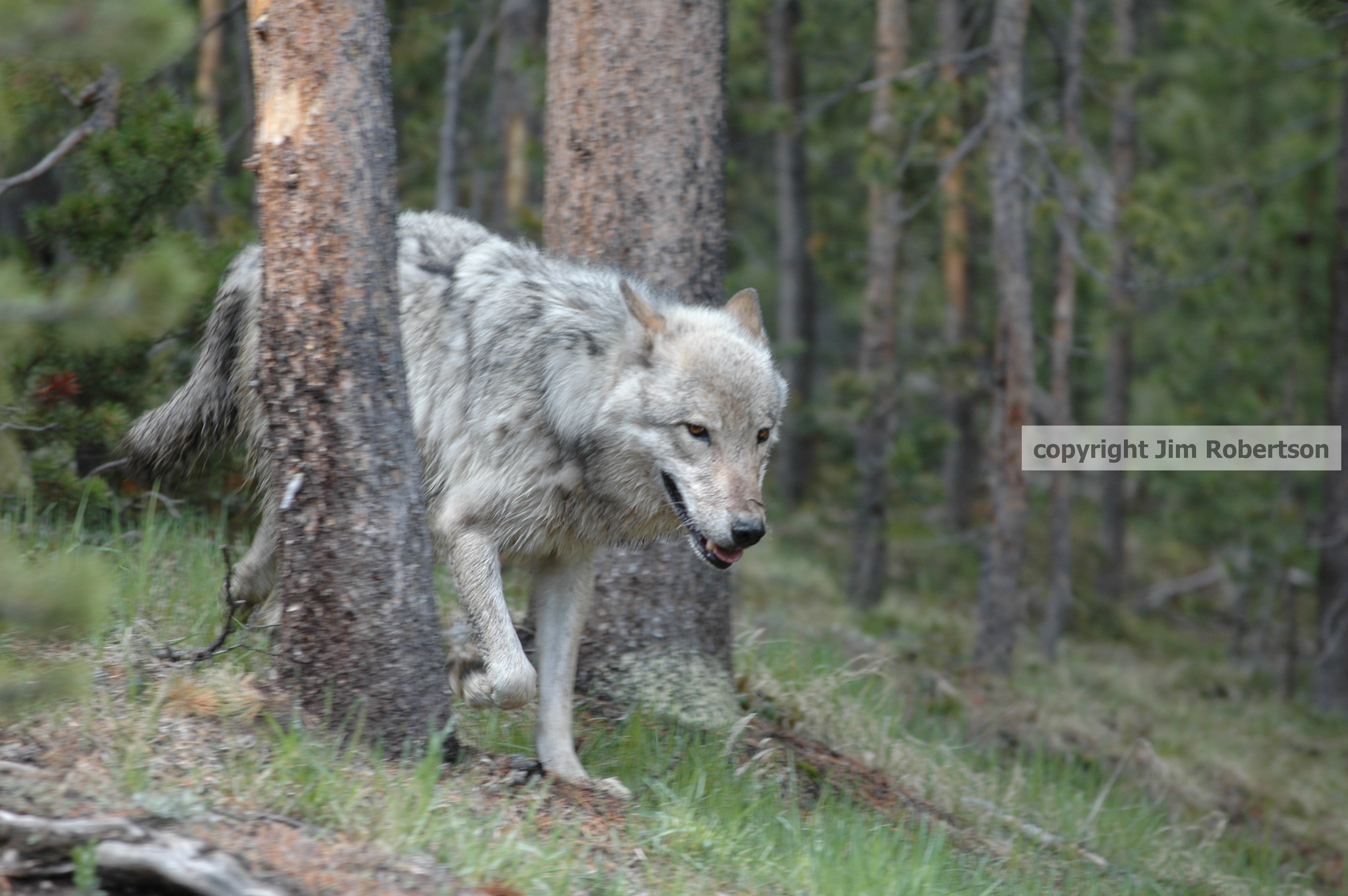
copyrighted Hayden wolf in lodgepoles

“I think this is the kind of program that helps foster more tolerance for wolves on the landscape,” Vermillion said.

When wolves were protected under the federal Endangered Species Act, Montanans felt powerless to deal with the predators’ impact, and that fostered intolerance for their presence, he argued.


Appeals Court Rules That Hounders Are Able To “Train” Their Dogs Against Wolves…….The Fix Is In

rali74's avatarOur Wisconsin, Our Wildlife

This is "sport" and "heritage" in Wisconsin. This is “sport” and “heritage” in Wisconsin.

**UPDATED 7/10/2014 4:45 PM**

According to a wildlife advocate that spoke with Wisconsin DNR Carnivore Biologist Dave McFarland, today’s court ruling means that there are ZERO rules for “training” with dogs against wolves and that hounders can now use their dogs against them 365 days a year. You read that right. Hounders as of now can pit their dogs against wolves with ZERO restrictions year round. Don’t we live in a lovely state? 

Just when you thought that it couldn’t get any worse for wildlife in the Blood Sport Capital of the United States, Wisconsin, it does. A lawsuit filed in 2012 by a coalition of humane societies and wildlife advocates attempted to stop the barbaric use of dogs against wolves during the yearly kill season. The use of dogs was written into the disgusting 2012 Wisconsin Bear Hunter Association authored bill that…

View original post 1,273 more words

Good News: Unsporting Bill Shot Down

Michael Markarian: Animals & Politics


The Senate today shot down a motion to move forward on S. 2363, the dangerous if innocuous sounding “Sportsmen’s Act,” which has been portrayed as feel-good legislation but could have serious and far-reaching consequences for wildlife, public spaces, and human health and safety. The bill needed 60 votes to advance, but only received 41 in favor, and 56 opposed—a result of some Democrats opposing the bill because of its extreme provisions and Republicans uniting in opposition because they could not offer amendments on gun rights and other topics.

BALDEAGLEMYSTICLAKES

A bald eagle at Mystic Lake in Massachusetts. Photo by John Harrison
Sportsmen, of course, are already allowed to pursue their activities on the vast majority of federal public lands, including national forests, BLM lands, and most national wildlife refuges, with only national parks and some national monuments generally closed to hunting. That’s not to mention the millions of acres of state and private lands also available. But as things now stand, resource managers have the flexibility to look at the big picture and determine when it makes sense to allow hunting and fur trapping—and when it doesn’t. They consider local concerns such as whether endangered or threatened species are present, and balance the interests of hunters and trappers with other public land users and recreationalists.
S. 2363 would flip the burden and turn the current process on its head. Public lands would be “open unless closed” to hunting and fur trapping, regardless of whether they’re compatible with other land uses or threatened or endangered species, and closing lands would require a burdensome bureaucratic process. On top of that, the bill would force land managers to prioritize hunting and trapping above other outdoor activities, effectively excluding a large proportion of the American public from enjoying our national spaces, including in designated “wilderness areas.” Rather than local control, it would be a federal fiat from Washington that the default is to allow sport hunting and the use of painful and indiscriminate steel-jawed leghold traps.
The harmful legislation would also stop scientists at the EPA from restricting the use of lead ammunition, which is a known toxin that kills millions of wild animals from more than 130 species each year, including bald eagles, California condors, and other threatened and endangered species. These bullets keep on killing long after they’ve left the chamber, with animals poisoned by eating the lead fragments directly, preying on contaminated animals, or feeding on gut piles left behind by hunters.
President George H.W. Bush’s administration banned the use of lead for all waterfowl hunting in 1991, and non-lead ammunition such as copper, steel, and bismuth are readily available and affordable. That sensible policy has prevented the poisoning deaths of millions of birds, and it’s been part of the march of progress toward getting toxic lead out of the environment. There’s no compelling reason for Congress to thumb its nose at science and innovation, and forbid EPA or any other responsible agency, with appropriate authority and expertise, from even examining this issue.
POLAR_BEAR

a polar bear in the wild
Finally, this bill is a sweetheart deal for millionaire big-game hunters. Far from benefiting our nation’s rank-and-file sportsmen, this is a special order delivery for only 41 wealthy big game hunters who dropped up to $50,000 each for guided polar bear hunts in the Arctic. These trophy hunters, who compete to see their names in the Safari Club record books for killing the rarest species around the world, have been lobbying Congress to allow them to bring the heads and hides of threatened polar bears into this country from Canada in defiance of current law.
This would be the latest in a series of import allowances that Congress has approved—each time making the argument that it’s only a few animals and the polar bears are already dead and have no conservation value—but the cumulative impacts of these waivers time and time again lead to more reckless trophy killing. Do we want Congress to set this kind of precedent, encouraging trophy hunters to kill rare animals as they are about to be listed as endangered or threatened species and then to get relief from Congress to make a special dispensation for them?
Thank you to all the animal advocates who contacted your Senators and asked them to oppose this extreme and reckless “Sportsmen’s Act.” Those calls made a difference—a game-changing difference for millions of animals. Wild animals and the environment have dodged a bullet now that this terrible package of anti-conservation policies has stalled in the Senate.

Mills Canyon Fire burns at least 7,000 acres; new evacuations ordered

A Red Flag Wind warning is in affect from 1 p.m. to 10 p.m. Wednesday near the Columbia Basin of Eastern Washington. A Red Flag warning means critical weather conditions for fires such as high winds, low humidity and warm temperatures contribute to extreme fire behavior and the spread of fire.

Read more: http://q13fox.com/2014/07/09/dangerous-day-for-firefighters-as-red-flag-warning-issued-fires-little-contained/#ixzz3753p1Q3S

Why whale poo could be the secret to reversing the effects of climate change

http://www.theguardian.com/commentisfree/2014/jul/08/whale-poo-reverse-climate-change

I have been at the wrong end of a defecating sperm whale: it smells, it’s nutrient rich, and could just save the world
A whale seen under a whalewatching boat in Peninsula Valdez, Argentina.

A whale seen under a whalewatching boat in Peninsula Valdez, Argentina. Photograph: Justin Hofman / Barcroft Media

The first success of the environmental movements of the 1960s was to save the whale. Now, with deep irony, whales may be about to save us with their poo. A new scientific report from the University of Vermont, which gathers together several decades of research, shows that the great whales which nearly became extinct in the 20th century – and are now recovering in number due to the 1983 ban on whaling – may be the enablers of massive carbon sinks via their prodigious production of faeces.

Not only do the nutrients in whale poo feed other organisms, from phytoplankton upwards – and thereby absorb the carbon we humans are pumping into the atmosphere – even in death the sinking bodies of these massive animals create new resources on the sea bed, where entire species exist solely to graze on rotting whale. There’s an additional and direct benefit for humans, too. Contrary to the suspicions of fishermen that whales take their catch, cetacean recovery could “lead to higher rates of productivity in locations where whales aggregate to feed and give birth”. Their fertilizing faeces here, too, would encourage phytoplankton which in turn would encourage healthier fisheries.

Such propositions speak to our own species’ arrogance. As demonstrated in the fantastical geoengineering projects dreamed up to address climate change, the human race’s belief that the world revolves around it knows no bounds. What if whales were nature’s ultimate geoengineers? The new report only underlines what has been suspected for some time: that cetaceans, both living and dead, are ecosystems in their own right. But it also raises a hitherto unexplored prospect, that climate change may have been accelerated by the terrible whale culls of the 20th century, which removed hundreds of thousands of these ultimate facilitators of CO2 absorption. As Greg Gatenby, the acclaimed Canadian writer on whales told me in response to the Vermont report, “about 300,000 blue whales were taken in the 20th century. If you average each whale at 100 tons, that makes for the removal from the ocean of approximately 30m tons of biomass. And that’s just for one species”.

A defecating sperm whale off the coast of Sri Lanka. A defecating sperm whale off the coast of Sri Lanka. Photograph: Andrew Sutton There’s another irony here, too. American whaling, as celebrated in Herman Melville’s Moby-Dick (1851), declined in part because of the discovery of mineral oil wells in the second half of the 19th century. One unsustainable resource – the whale oil which lit and lubricated the industrial revolution – was replaced by another. By killing so many whales, then turning to carbon-emitting mineral oil, humans created a double-whammy for climate change. (Conversely, and perhaps perversely, some US commentators have claimed that capitalism saved the whales rather than environmentalists. They contend that our use of mineral oil actually alleviated the pressure on whale populations – proof, they say, that human ingenuity has the ultimate power to solve the planet’s problems).

The 10 scientists who jointly contributed to the new paper note the benefits of “an ocean repopulated by the great whales”. Working on a whalewatching boat off Cape Cod last month, I witnessed astonishing numbers of fin whales, humpbacks and minkes feeding on vast schools of sand eels. I watched dozens of whales at a time, co-operatively hoovering up the bait – and producing plentiful clouds of poo in the process. (Having been at the receiving end of a defecating sperm whale, I can testify to its richly odiferous qualities.)

Observers in the Azores have reported similarly remarkable concentrations of cetaceans this summer. And with a 10% increase in humpback calves returning to Australian waters each year, and blue whales being seen in the Irish Sea, a burgeoning global population of cetaceans might not just be good for the whalewatching industry, they may play a significant role in the planet’s rearguard action against climate change.

It would certainly be a generous return on their part, given what we’ve inflicted on them. Indeed, as Melville imagined in his prophetic chapter in Moby-Dick, Does the Whale’s Magnitude Diminish?, the whale might yet have the last laugh, regaining its reign in a flooded world of the future to “spout his frothed defiance to the skies”.

Leaked Document: Scientists Ordered to Scrap Plan to Protect Wolverines

http://www.biologicaldiversity.org/news/press_releases/2014/wolverine-07-07-2014.html

Despite Extinction Threat From Global Warming, Obama Administration Caves to
Pressure From States, Overrules Federal Scientists

WASHINGTON— According to a leaked memo obtained by the Center for Biological Diversity, scientists with the U.S. Fish and Wildlife Service have been ordered to reverse their own conclusions and withdraw last year’s proposal to protect American wolverines under the Endangered Species Act.

Wolverine
Photo by Steve Kroschel, USFWS. Photos are available for media use.

Fewer than 300 wolverines remain in the lower 48 states, and global warming over the next 75 years is predicted to wipe out 63 percent of the snowy habitat they need to survive, government scientists have said. In fact changes due to climate warming are “threatening the species with extinction,” the Fish and Wildlife Service said in last year’s announcement of its protection proposal.

Now the memo — signed by Noreen Walsh, director of the Rocky Mountain Region of the Fish and Wildlife Service — tells federal scientists to set aside those conclusions, even though there has been no new science casting doubt on those findings.

“The Obama administration’s own scientists have said for years that global warming is pushing wolverines toward extinction, and now those conclusions are being cast aside for political convenience,” said Noah Greenwald, endangered species director at the Center. “This is a bizarre and disturbing turn, especially for an administration that’s vowed to let science rule the day when it comes to decisions about the survival of our most endangered wildlife.”

Fish and Wildlife Service scientists proposed Endangered Species Act protection for the wolverine in February 2013. Subsequently state officials in Montana, Idaho and Wyoming raised questions about the degree to which wolverines are dependent on persistent snow and about the degree to which warming will impact their habitat. In response Fish and Wildlife convened a panel of scientists to review the science behind the proposal, resulting in a report in which “nine out of nine panelists expressed pessimism for the long-term (roughly end-of-century) future of wolverines in the contiguous U.S. because of the effects of climate change on habitat.”

Based on the conclusions of the panel, scientists from the Montana field office of the Fish and Wildlife Service recommended that protection be finalized, but, as shown in the leaked memo, were overruled by agency bureaucrats.

“The decision to overrule agency scientists and deny protection to the wolverine is deeply disappointing and shows that political interference in what should be a scientific decision continues to be a problem under the Obama administration, just as it was under George W. Bush,” said Greenwald. “Wolverines and the winter habitats they depend on are severely threatened by our warming world. Only serious action to reduce fossil fuels can save the wolverine, tens of thousands of other species, and our very way of life.”

Background
On Feb. 4, 2013, the Fish and Wildlife Service found that wolverines warrant protection as a threatened species, concluding based on the “best scientific and commercial information available” that “the contiguous United States wolverine DPS presently meets the definition of a threatened species due to the likelihood of habitat loss caused by climate change resulting in population decline leading to breakdown of metapopulation dynamics.” This conclusion was based on the fact that “(w)olverines require habitats with near-arctic conditions wherever they occur,” that they “exist as small and semi-isolated subpopulations in a larger metapopulation that requires regular dispersal of wolverines between habitat patches to maintain itself” and that “(c)limate changes are predicted to reduce wolverine habitat and range by 31 percent over the next 30 years and 63 percent over the next 75 years, rendering remaining wolverine habitat significantly smaller and more fragmented.”

In response to the proposed rule, the states of Montana, Idaho and Wyoming all submitted comments opposing protection of wolverines, questioning the science behind the conclusion that they were threatened by climate change. To address these concerns, the Fish and Wildlife Service delayed final protection for six months and convened an expert scientific panel to evaluate the science. The panel issued a report in April 2014 concluding that “there are three primary climate related factors that are correlated with wolverines: persistent deep snow, contiguous snow, and temperature,” a finding that led to the panel’s unanimous statement of concern for the long-term survival  of wolverines in the contiguous United States. These conclusions support the conclusion of the proposed rule that the wolverine is threatened with extinction.

On May 17, 2014, the assistant regional director of ecological services at the Fish and Wildlife Service sent a memo to the regional director in Denver transmitting the recommendation of the Montana field office that “the wolverine listing be finalized as threatened.” The memo further concludes that, “In our review we have been unable to obtain or evaluate any other peer reviewed literature or other bodies of evidence that would lead us to a different conclusion.”

In contrast, the recently leaked memo overrules and ignores the substantial evidence and conclusions of the proposed rule, the independent science panel report, and the strong conclusions of the Montana field office, which is staffed with the agency scientists who have the greatest knowledge of wolverines.

The Center for Biological Diversity is a national, nonprofit conservation organization with more than 775,000 members and online activists dedicated to the protection of endangered species and wild places.

DNR’s 2013-2014 Wisconsin Wolf Season Report

dvoight09's avatarWisconsin Wildlife Ethic-Vote Our Wildlife

This year’s wolf slaughter report has been made available by the DNR at:

http://dnr.wi.gov/topic/WildlifeHabitat/documents/reports/graywolfharv.pdf 

The report is brief. DNR “examination” of bodies for trauma from dog bites was inconclusive….very few “samples” and very little information (by design).

View original post

Patricia Randolph’s Madravenspeak: Human denial causing great dying on Earth

dvoight09's avatarWisconsin Wildlife Ethic-Vote Our Wildlife

lion_53b98b222b9a3.preview-300MADRAVENSPEAK

Unsustainable Human Activities: Loss of ecosystem services and the web of life that supports us

“I do not think we in any way should feel complacent that we are not on the list of possible extinctions.” ~ Richard Leakey, paleontologist

Every day that passes the world is in worse shape.

Humans are in the process of destroying more species on earth in this 100 years than have gone extinct in the past 65 million years. We hear overwhelming statistics and we dissociate. Earth is in human-caused crisis on almost every level – overpopulation of humans doing the wrong things in energy and mining extraction, poisoned and genetically altered food supplies, accelerating climate change, and destroying biodiversity to a tipping point of collapse.

Politics operates within the framework that humans are the lords of creation, and all life and the natural world are just a commodity for our abuse and…

View original post 787 more words