Exposing the Big Game

Forget Hunters' Feeble Rationalizations and Trust Your Gut Feelings: Making Sport of Killing Is Not Healthy Human Behavior

Exposing the Big Game

Vatican tells UN “population bomb” is not the cause of poverty

https://cruxnow.com/vatican/2017/04/06/vatican-tells-un-population-bomb-not-cause-poverty/

Vatican tells UN “population bomb” is not the cause of poverty

Archbishop Bernardito Auza, the Vatican’s permanent observer to the United Nations. (Credit: Gregory A. Shemitz/CNS.)

The Vatican’s representative to the United Nations said “corruption, protracted conflicts and other man-made disasters” are the cause of entrenched poverty in the developing world, not a “healthy, growing population.” He also called on the world body to “respect life” when it comes to giving international aid.

ROME – Talk of an “impending population bomb,” the Vatican’s representative to the United Nations said on Wednesday, has led to sometimes “draconian” policies, which ignore the complex nature of population growth.

Filipino Archbishop Bernardito Auza, speaking to the UN’s Commission on Population and Development, said “differing regional and even country specific situations” need to be taken into account when speaking about demographic changes.

Auza noted that populations are growing in some countries, while stabilizing in others, but pointed out some countries are experiencing a “spiraling demographic decline.”

Auza’s reference to a “population bomb” is a reference to the 1968 book of the same title written by Stanford professor Paul R. Ehrlich, who predicted that by the 1980s mass starvation and other consequences of food shortages caused by overpopulation would lead to social upheavals across the world.

Despite the inaccuracy of his forecasts, Ehrlich still supports the central thesis of his work: Massive government population control measures, including artificial birth control and abortion, are needed to protect the planet’s future.

Ehrlich was controversially invited to a conference earlier this year on Pope Francis’s ecological document Laudato Si’, sponsored by the Pontifical Academies of Science and Social Sciences.

Auza said the idea of a “population bomb” has led certain governments to adopt policies that encourage population control measures as the easiest response to the fear of resource scarcity and underdevelopment, adding that some of these policies are “draconian.”

The most obvious example of such a policy would be in China, where a “one child” policy has led to forced abortions, and the limiting of civil rights for anyone who has more children than the government allows.

The archbishop, while not naming Ehrlich in his address, countered his arguments by saying “demographic growth is fully compatible with shared prosperity.”

Auza said while “responsible parenthood and sexual behavior are always moral imperatives,” the use of “coercive regulation of fertility” undermines freedom and responsibility.

“Respect for life from the moment of conception to natural death, even in the face of the great challenge of birth, must always inform policies, especially when it comes to international aid, which should be made available according to the real priorities of the receiving nation, and not by an imposed will of the donor,” he said.

Auza also pointed out the trend to lower birth rates in the developed world began “before it had access to modern methods of contraception.

“It occurred with economic and technological advancement, as well as investments in education, infrastructure and institutions,” – Auza said – “It is well known that economic growth corresponds with lower fertility rates and, when accompanied by investment in education and health, increases productivity and the well-being of societies.”

The Vatican diplomat also said it was not a “healthy, growing population” which is causing entrenched poverty, but “corruption, protracted conflicts and other man-made disasters.”

Auza’s statement came just a month after Ehrlich’s appearance at the February 27 – March 1 Vatican conference titled “Biological extinction: How to save the natural world on which we depend.”

Despite his participation, the “final declaration” of the meeting stated increasing threats against biodiversity, unsustainable use of the earth’s resources, and accelerated extinction rates “are driven more by over-consumption and unjust wealth distribution than by the number of people on the planet.”

Moratorium on cownose ray fishing contests passed by Maryland General Assembly

ANNAPOLIS, Md. – (AP) – A moratorium on fishing for cownose rays has been passed by the Maryland General Assembly.

The legislature voted Wednesday to send the bill to Gov. Larry Hogan.

It creates a moratorium on contests that involve killing the rays until July 1, 2019. It also requires the Department of Natural Resources to prepare a fisheries management plan by Dec. 31, 2018.

The Humane Society of the United States has condemned the contests. The organization is calling the bill a major step in protecting Chesapeake Bay wildlife.

Legislation initially called for a ban. The moratorium was part of a compromise. Opponents of a permanent ban say the rays have been identified as damaging to bay oyster populations, but supporters say science has shown the rays are not responsible for oyster declines.

Why I’m An Animal Rights Activist When There Is So Much Human Suffering In The World

Exposing the Big Game's avatarExposing the Big Game

10615414_311553309030149_2346944286901096966_n

https://www.thedodo.com/why-im-an-animal-lover-1207140226.html?xrs=RebelMouse_fb#

by Tracey Narayani Glover

Before I was an animal rights activist, I was a budding human rights activist. While in law school, I helped victims of domestic violence obtain personal protection orders. I studied human rights and refugee law, participated in an asylum clinic, spent all my summer legal internships working with refugee organizations and focused primarily on helping women who were victims of gender-based persecution and violence such as honor crimes, forced genital mutilation, sex-trafficking, and rape.

My first client let me touch the shrapnel that was embedded under the skin in her knee after the Taliban had bombed her village in Afghanistan and killed most of her family. I also represented men when they were in need, like the gentle Congolese man who had been tortured, and had the marks on his body to prove it, because of dubious ties to the wrong political party.

Refugees and…

View original post 2,546 more words

All of us with compassion

No automatic alt text available.

“For as long as i can breath i will fight for the animals…
The day i stop breathing, on my final breath i will feel sadness, that i can fight no more.
Yet elated that i am freed from this living hell that all of us with compassion have to witness on a daily basis, created by fellow humans that i am ashamed to be connected with.~ X”

Girl found living with monkeys in Indian forest

https://www.bostonglobe.com/news/world/2017/04/06/girl-found-living-with-monkeys-indian-forest/WV7RDGKOmRloWH7t7faI1K/story.html

LUCKNOW, India — Indian police are reviewing reports of missing children to try to identify a girl who was found living in a forest with a group of monkeys.

The girl, believed to be 10 to 12 years old, was unable to speak, was wearing no clothes and was emaciated when she was discovered in January and taken to a hospital in Bahraich, a town in Uttar Pradesh state in northern India.

She behaved like an animal, running on her arms and legs and eating food off the floor with her mouth, said D.K. Singh, chief medical superintendent of the government-run hospital.

After treatment, she has begun walking normally and eating with her hands.

Flu pandemic likelihood increasing as new strains emerge, UNSW researchers warn

by Harriet Alexander

A gathering number of new influenza strains in the past five years has escalated the likelihood of a major influenza pandemic on the scale of the deadly Spanish flu, researchers say.

UNSW researchers in the school of public health are calling for better collaboration between countries and first responder agencies in the event of a flu pandemic.

Their study published in the Archives of Public Health identified 19 separate influenza strains that have emerged in humans during the past century, including seven in the past five years alone.

Raina MacIntyre, director of the UNSW’s Integrated Systems for Epidemic Response, said the unprecedented rise in new strains appeared to be a true increase and not just a matter of more cases being detected.

“The question is, why?” Professor MacIntyre said.

“Some of the reasons involve things like climate change and its impact on pathogens, changes like urbanisation, but none of these things have increased at the rate the virus is increasing so there’s something else going on.”

Advertisement

The Spanish flu, which killed 50 million people in 1918-19, was followed by a 40-year hiatus during which no new flu strains emerged, and then a 10-year gap from the one after that to the next.

But the emergence of strains has gathered pace in the past 15 years.

Professor MacIntyre said a repeat of the Spanish flu was “very possible” and countries and sectors such as health, agriculture, defence and emergency services needed to collaborate better on how to respond in such an event.

“We are somewhat prepared, but when pandemics occur there are almost always unanticipated scenarios,” she said.

“When health systems become stressed and unable to cope with the sick, that is when we are truly tested.”

Influenza strains that have developed in recent years have been transmissible only from birds to humans and not between people, and fatalities have been rare.

But study co-author Chau Bui said the large number of viruses circulating among birds in recent years increased the likelihood that one would mutate and become transmissible between humans.

The risks could be mitigated by banning the sale of live birds in wet markets in Asia, thereby reducing the spread of viruses between birds, and controlling the purchase of live or freshly slaughtered poultry in wet markets to stop the public coming into contact with the bodily fluids of infected poultry, she said.

Special Interest Group for Influenza chair Alan Hampson, who was not part of the study, said there needed to be more research into the genetics of influenza viruses because if they were able to bind to human receptors, or survive in the air, then person-to-person transmission would become more likely.

“These viruses are reinventing themselves all the time,” Dr Hampson said.

“Most people think it’s highly probable that we will have influenza pandemics in the future and it may come from a source that’s being looked at under the World Health Organisation surveillance program or it may be like the one in 2009 that came out of left field and took us all by surprise.”

Meanwhile, a study by the US Centre for Disease Prevention and Control has found that flu vaccinations significantly reduce a child’s chances of dying from influenza.

Using data from 2010 to 2014, the researchers found only one in four children who died had been vaccinated.

Arctic Sea Ice Volume Continues to Crater

robertscribbler's avatarrobertscribbler

“Facts are stubborn things; and whatever may be our wishes, our inclinations, or the dictates of our passions, they cannot alter the state of facts and evidence.”John Adams

*****

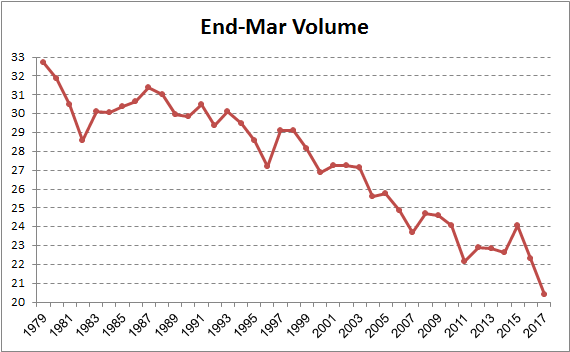
(March sea ice volume hit a new record low in the PIOMAS measure during 2017. Image source: Oren and the Arctic Sea Ice Blog.)

This week, measurements from PIOMAS indicate that Arctic sea ice volume for the month of March hit new, all-time record lows during 2017. March 2017 volume, according to the Polar Science Center, dropped about 1,800 cubic kilometers from the previous record low set during the same month in 2011. In total, more than a third of March sea ice volume has been lost since 1979.

The Polar Science Center notes:

Arctic sea ice volume through March 2017 continued substantially below prior years. March 2017 sea ice  volume was 19,600 km3 , …

View original post 520 more words

The Animals’ Vegan Manifesto

 By Sue Coe
From All-Creatures.org Book, CD and Video Review Guide

The intent of this book and video review guide is to help us to live according to Kingdom standards which bring Heaven to earth.

Author: Sue Coe, GraphicWitness.org
Reviewed by: Heidi Stephenson

Sue Coe

The Animals’ Vegan Manifesto By Sue Coe
Available from OR Books

Review:

“We are the Nazis, there is no escaping it. Nazi is a condition of humanity.”

Animal exploitation, killing and abuse is at an all-time high and the suffering we humans inflict so sickening, so shocking, so painful to bear witness so that the majority turn away from the activist photographs which shine a light on this darkness, in horror begging: “Don’t tell me. Don’t tell me, I don’t want to know.” But Sue Coe’s clever political art gets right in, under the radar. She unlocks hearts like no other and forces the wilfully blind to see. Doing what art does when it’s at its best, inspired, courageous and just about bearable, she shatters our complacency with her vivid, evocative empathy, her highly memorable compassion. Sue Coe tells it as it is, from the animals’ point of view, in sharp, black and white woodcuts. She emblazons the need for change on our reluctant, human consciousness. She dreams the dream of a humane, vegan world, Martin Luther King-style.

This is a book in two parts. The reality of our man-made Death cult in which a slaughterman can pitch-fork a living baby piglet, a human fist can hover menacingly over a newborn male chick, ready to smash him into non-existence and a baby lamb can so casually be turned into so much minced meat, is presented with an uncompromising commitment to the terrible truth. God-given lives are Satanically alchemized into meaningless bags of money, by a gang of greedy men. Lobsters are boiled alive by indifferent chefs. We witness the terror of a cow being forced into the abattoir while her desperate calf tries to cling to her. We see (and our imaginations hear) the hysterical weeping, leaping and screaming, the terrible grief of some sows as they watch helplessly as one of their youngsters is stunned in preparation for his imminent murder. Organic, free range, crate free “Happy Meat” is shown to be anything but. While we eat, drink and continue to be merry, the animals die. A couple sit, wine in  hand, over yet another roast dinner – surrounded by the spirits of all the animals whose lives they have directly taken (over 11,000 per person, per lifetime, according to VIVA! figures).

Animal suffering – emotional as well as physical – is given full vent. We witness the abject misery, the highly conscious teardrops of a trapped, ‘battery’ hen, of a grief-stricken cow in the presence of her murdered calf; the depression, profound pain (and grave sense of injustice) of an innocent pig locked inside the dark hell of his ‘prison cell.’ Lions weep in their cages; elephants are literally brought to their knees in heavy ‘circus’ chains. In a bleak landscape, filled only with dark, ominous tower blocks and dead tree stumps, a lone wolf is trapped in agony, his front leg gripped by a deathly leg-hold trap. A crying angel comforts a bleeding goose whose feathers have been excruciatingly ripped out through live plucking. A ewe hugs her lamb-child with such tenderness against the terrifying backdrop of a missile attack: a bleak reminder that human bombs rain down on animals too. Genetic mutations, vivisection, the gassing of unwanted animals, Sue Coe does not leave a single tombstone unturned.

The Animals’ Vegan Manifesto also shows us the madness of it all: the two-faced, Janus heads of Man who with one arm affectionately strokes his dog, while with the other he stabs a baby lamb in the throat with a knife. Men devour platefuls of meat, while a Third World child starves to death. An autocratic father force-feeds his baby with a young piglet, creating the seeds of his own child’s premature demise. Another man devours two, huge turkey legs – and with them pus, salmonella, e-coli, and an early grave.

In part two, the tide finally, mercifully turns and we are shown what could be – what will ultimately be. Sue Coe has a Martin Luther King-scale Dream. There is love in the skies, in the heavens; animal angels are shown to be the guiding stars of their animal brethren. There is hope. And there is liberation. On pages 57 and 58 a cow cuts through the barbed wire of some hell-hole of a farm under a bright moon. Her act is deliberate and conscious, and we know that it will ultimately be effective. On page 63 a goat does the same. On pages 74 and 75 two brave pigs follow suit. Chains are broken, and the animals, literally, see the Light.

There are human cries too, vegan cries for “Freedom! Peace! Justice! Stop Violence!” The vegans become far greater in number, unwilling to participate any longer in the meat industry’s blood money scam. A thin, but determined donkey walks through the night towards a new Vegan World which is only 155 miles away. Other animals find the path too and begin to pursue it hopefully; they carry a V banner above them.

An Isaian world begins to manifest: a mule embraces a dog, a cow and a pig write a new law: “Eat veg, not us,” another cow scours The Vegan News for inspiration, and the animals unite in a common mission for love and unity. They help each other – and they find their freedom again. They share a vegan meal together, and they sleep soundly in the protective care of each other. A bat heralds rebirth and more Good News. The bears enjoy their tree tops again; bucks and fawns leap for joy, fish dance in ponds.

Shooting stars break out in the night skies as a choir of wolves sing to the new world; butterfly and grasshopper exchange flowers, a sunflowers bursts into fullest bloom. A woman holds a calf in her arms, expressing her deepest, motherly/sisterly love, clearly mourning all the terror, pain and violent death which man has inflicted on the animals for so long. There is great rejoicing as the world finally becomes vegan. Miraculously, a hardened scientist breaks out of his own man-made cage – and stretches out to embrace the animals, while a cockerel heralds a new vegan dawn.

Sue Coe grew up next to a slaughterhouse in Liverpool. In The Animals’ Vegan Manifesto she conveys the most important message of our times, about the last, most terrible, most prolonged, mass slavery and life-engulfing genocide the world has ever known. There is great love in these pages and her vision is Biblical in its moving magnificence. She has done what a thousand words from a thousand writers have failed to do.  She is a true prophet of our times – and her book is essential reading. If you buy just one book this year, let it be this one.

animals’ vegan manifesto
to 2 leggeds

1 close all slaughterhouses
2 the seas are salty with our tears,
leave us alone
3 turn all farmprisons into sanctuaries
4 we want to fly away
5 stop stealing our eggs
6 don’t take our lambs, or coats

from all of us, of fur, fin and feather
eat plants, not us, thankyou.

About the Author:

Sue Coe is a keen observer, a ‘graphic witness’ to realities more often overlooked or avoided. She is a journalist who uses printed images in preference to words. For a quarter century she has explored factory farming, meat packing, aparteid, sweat shops, prisons, AIDS, and most recently, war. Her commentary on political events and social injustice is published in newspapers, magazines and books. The results of her investigations are hung in museum and gallery exhibitions and form an essential part of personal fine print collections by artists and activists alike. Coe paintings and prints are auctioned as fund raisers for a variety of progressive causes, and since 1998, she has sold prints here to benefit animal rights.

http://www.all-creatures.org/book/r-animals-vegan-manifesto.html

International Respect for Chickens Day One Month from Today – May 4, 2017!

Chickens Ruby and Ivy.
For merchandise, posters and brochures, please visit our online store.

Please join us at the White House for UPC’s International Respect for Chickens Day/Month of May Public Outreach Event! We provide brochures, posters & banners – all we need is YOU!

When: Sunday May 7 Noon – 3:00pm
Where: Lafayette Park across from the White House at Pennsylvania Avenue
Why: Stick Up For Chickens!

For more information visit:
International Respect for Chickens Day

Karen and Liqin holding a 'International Respect for Chickens Month' banner by the White House.

MAY 7, 2017

Leafleting at the White House for International Respect for Chickens Day

Hosted by United Poultry Concerns


Thank you for taking action!

How Nutritious Is Human Flesh?

By Charles Choi | April 5, 2017
Ancient cannibalism may not have been as nutritious as previously thought, a new calorie-counting study finds, which means ancient cannibalism may have been more complex than often thought.

Nowadays cannibalism is associated with fictional serial killer Hannibal Lecter or by desperate souls as a last resort, such as the Donner Party or the survivors of the Andes flight disaster. But studies suggest cannibalism was practiced since prehistory, and even performed by extinct human lineages. For instance, at Neanderthal sites, researchers discovered unmistakable signs of butchery on human bones and found scraps of human remains in fossilized excrement.

Archaeologist James Cole at the University of Brighton in England investigated cannibalism to learn how extinct human lineages might have behaved or thought. He found prior research that suggested occurrences of Stone Age cannibalism were frequently interpreted as “nutritional” in nature, but they didn’t indicate just how nourishing man-eating actually was. As such, he sought to elucidate the nutritional value of cannibalism.

“Having some time to reflect on it, it was quite a weird thing to think about how calorific I am as a person,” Cole admitted.

Part by Part

Cole calculated calorie values of the fat and protein in each human body part, based on data on four adult human males collected by four different past studies.

“Those studies were interested in the construction of the human body, in what elements we were made up of,” he said.

Based on these past data, Cole estimated that there were roughly 1,300 calories per kilogram of modern human muscle. Although Cole would ideally have included data from women and juveniles, he could not find any published scientific reports on their chemical compositions, and collecting such data himself “was outside the ethical (and legal) scope of this study,” he wrote online Thursday in the journal Scientific Reports.

Cole noted these calorie estimates might not pertain to extinct human lineages—Neanderthals, for example, were beefier than modern humans. As such, Cole stressed that his estimates should be taken as minimum values. He also cautioned that he only had data from a few people, and “given the nature of this study, it was not possible to conduct analyses on cooked human flesh.”

Given these caveats, all in all, when compared to animal species whose remains were also unearthed at sites of Stone Age cannibalism, the nutritional value of human flesh is broadly similar to beasts of a similar weight and size, such as an ibex. However, snacking on humans pales in comparison to meals comprised of larger animals. For instance, mammoths are estimated to have supplied about 2,000 calories per kilogram of muscle; woolly rhinos, 1,750; the extinct oxen known as aurochs, 2,040; bears, 4,000; and boars, 4,000.

Cannibalism: It’s Complicated

“I went in with the preconception that we humans would’ve been very nutritionally viable animals, but compared with other animals humans ate, we aren’t terribly nutritious at all,” Cole said. “That makes me think that if, say, six of us are not as nutritious as a single horse or bison, it doesn’t really make sense to cannibalize people simply for their nutritional value.”

This suggests that the motivations for cannibalism in ancient human lineages “may have been as complex as they potentially are for our own,” Cole said. In addition to nutritional value or psychosis, modern humans have historically engaged in cannibalism during warfare, and for rituals such as “eating a recently deceased member of your family to carry them as part of you as you continue your life,” Cole said.

“We can’t limit our understanding of ancient cannibalism to just that one interpretation of nutrition, since it implies a lack of complexity on the part of those groups,” Cole said. “We should embrace complexity.”