Exposing the Big Game

Forget Hunters' Feeble Rationalizations and Trust Your Gut Feelings: Making Sport of Killing Is Not Healthy Human Behavior

Exposing the Big Game

Data reveals more than 300 B.C. grizzlies killed by hunters yearly

http://www.theglobeandmail.com/news/british-columbia/more-than-300-bc-grizzly-bears-killed-by-hunters-yearly-david-suzuki-data/article34550355/

VANCOUVER — The Globe and Mail

Nearly 14,000 grizzly bears have been killed in B.C. since the government started tracking mortality records for the species in 1975, the vast majority by hunters, according to provincial data compiled by the David Suzuki Foundation.

Of those bears – an estimated 329 each year – 87 per cent have been killed by licensed hunters, with other kills attributed to causes including the shooting of problem bears by conservation officers, illegal poaching and collisions with cars and trains.

A total of 13,804 grizzly bears have been killed by humans from 1975 to 2016, the group says.

 The Suzuki foundation provided the data to The Globe and Mail ahead of the opening on Saturday of the province’s controversial trophy grizzly-bear hunt. The governing Liberal party has defended the hunt and resisted calls to shut it down. With the Opposition NDP opposed to the hunt, the issue will likely arise during the spring election campaign.

The figures, compiled from the B.C. Compulsory Inspection Database, show a relatively consistent number of grizzly bears killed each year over the past four decades, with the exception of a dip in 2001, when there was a moratorium on the grizzly-bear hunt.

(The database consists of information submitted by hunters through required inspections for certain species, including grizzly bears.)

The figures also indicate that, on average, 34 per cent of grizzly bears killed each year are female – a percentage that worries some conservationists and is one element in a public debate over whether the hunt should be banned.

“Despite being a large, dominant animal, grizzlies are among the most threatened large species on the continent,” Faisal Moola, director-general of the Suzuki foundation, said on Friday.

Because female grizzly bears reproduce later in life and have a small number of cubs that survive, the species is vulnerable to decline if too many female bears are taken out of the population, he said.

“The ability of a population to rebound, or bounce back, from a period of hunting, is wholly dependent on the success of those female bears to continue to reproduce and replenish the population,” Dr. Moola said.

The province estimates the grizzly population in B.C. at 15,000 – about one-quarter of the population in North America. Of 56 bear “population units” in B.C. – geographic areas based on habitat and natural boundaries – nine are classified as threatened.

But conservation groups say that figure overestimates the health of the grizzly population.

The Liberal government maintains that the grizzly-bear hunt is sustainable, based on sound science, and tightly regulated.

If hunters take more than 30 per cent of female bears, “hunting opportunities are reduced or that unit is closed to hunting,” the Ministry of Forests, Lands and Natural Resource Operations said on Friday in a statement.

There is significant opposition to the hunt, including from First Nations that see greater economic opportunity in bear-viewing.

There is also debate over whether sanctioned hunts could put further pressure on population units deemed to be threatened.

The province refused to provide spatial data on individual grizzly kills unless the Suzuki foundation agreed to sign a confidentiality agreement, which it declined to do, Dr. Moola said.

Without that information, the group was unable to determine whether grizzly bears are being killed in parks or protected areas or in local populations where over-hunting has occurred in the past, he said in an e-mail.

Kill locations of grizzly bears are “considered sensitive information and not released publicly,” the ministry said. “The province fully supports ensuring the long-term sustainability of Grizzly bear populations, and the protection of seasonally-critical habitats is a significant part of conservation efforts,” the ministry added.

Grizzly-bear hunting is not allowed in areas where conservation is a concern. Last September, the B.C. Auditor-General’s office included grizzly-bear management in its list of planned projects to determine “whether government is meeting its objective of ensuring healthy grizzly bear populations throughout B.C.”
Alaska’s national refuges are not private game reserves

The Times Editorial Board

March 18, 2017 5 am

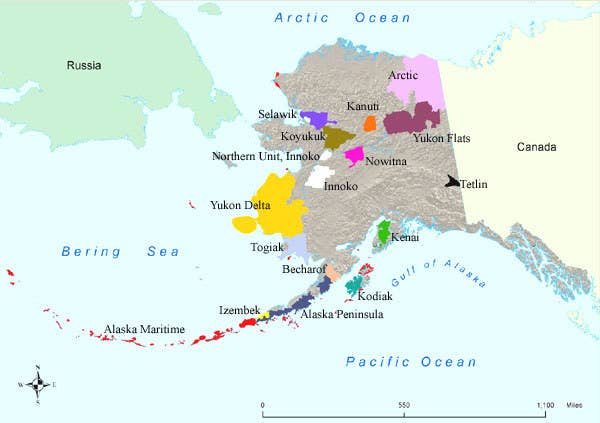
The 16 national wildlife refuges in Alaska span the state from the remote Arctic on the northern edge to the volcanic Aleutian islands southwest of Anchorage. Across the refuges’ nearly 77 million acres, animal diversity abounds — ice worms and seabirds, black bears and grizzly bears, wolves, moose, caribou, predators and prey. There is one guiding principle behind the U.S. Fish and Wildlife Service’s management of all the species on these refuges: Conserve the natural diversity of wildlife as it is. In essence, let them be, and let humans enjoy the spectacle of nature on these refuges.

But at these particular enclaves, that also means letting humans hunt — within limits. It’s difficult to believe that any wildlife refuge isn’t truly a refuge from hunters. That’s the way the national system of refuges started, but over the last quarter century, many have been opened up to regulated hunting.

 And herein lies the problem. The state of Alaska shares the responsibility for managing the refuges’ wildlife, and it has its own goal: Making sure there are plenty of animals to hunt. In an effort to maximize the number of moose, caribou and deer, the state authorized in some areas more efficient but brutal methods to kill the wolves and bears that prey upon those popular hunting targets.

Concerned that the state’s predator control campaign could become widespread enough to disrupt the refuges’ ecosystems, the U.S. Fish and Wildlife Service issued a rule that bars hunters and trappers in the refuges from killing wolves and their pups in their dens, killing bear cubs or sows with cubs, baiting brown bears, shooting bears from aircraft, or capturing bears with traps and snares. The rule took effect in September.

Alarmingly, Alaska’s congressional delegation is pushing hard to get rid of these ecologically sound and humane restrictions, and Republican lawmakers are responding. A joint resolution revoking the rule has passed the House and is expected to come up for a vote in the Senate the week of March 20. It is misguided and should be hunted down and killed.

Let’s be clear on a few things. The federal rule prohibits only these gruesome methods of hunting on national wildlife refuges. It does not apply to hunting in state-owned wilderness or to rural Alaskan residents who hunt for subsistence. And it’s doubtful that killing huge numbers of wolves and bears would automatically drive up the number of moose and caribou. “The best available science indicates that widespread elimination of bears, coyotes and wolves will quite unlikely make ungulate herds magically reappear,” wrote 31 biologists and other scientists to then-Secretary of the Interior Sally Jewell last year when the rule was still being studied.

In other words, the Alaskan government sought to allow types of hunting that probably would not accomplish what it wants to accomplish, but would end up killing brown bears who’d been lured with bait, slaughtering helpless cubs and wolf pups, and allowing bears to languish in excruciating pain for unknown hours in steel-jawed traps. This is unconscionable.

And this is not a case of states’ rights being usurped by the federal government. If anything, the congressional measures would subvert the federal government’s decades-long statutory authority over federal lands in Alaska. The national refuges are not Alaska’s private game reserve. That wilderness belongs to all of us. The Senate should stop this bill from going any further.

Man charged with selling bear paws, gall bladders in Cache Creek area

November 15, 2016 – 8:00 PM

KAMLOOPS – Nine charges have been laid against a man who is accused of trafficking parts of a dead bear in B.C.’s Interior and Cariboo regions.

Hong Hui Xie, who’s in his 40s, faces charges including trafficking in bear gall bladders, trafficking in bear paws and unlawful possession of dead wildlife.

“Nine counts have… been laid against a 100 Mile House resident for alleged offences that occurred in 100 Mile House and Cache Creek between October 2015 and September 2016,” the B.C. Conservation Officer Service says on its Facebook page.

Court documents show from Oct. 27, 2015 to Jan. 21, 2016, Xie allegedly trafficked in a bear gall bladder, trafficked in bear paws separate from the carcass and trafficked in deer meat while in the 100 Mile House area.

On Sept. 7, 2016, Xie allegedly trafficked in bear paws and gall bladders while in the Cache Creek area.

Xie is not being held in custody and his first court appearance is expected to be in Kamloops Provincial Court later this month.


http://infotel.ca/newsitem/man-charged-with-selling-bear-paws-gall-bladders-in-cache-creek-area/it36788#.WOJfPMUSHbE.facebook

Trump Just Lifted A Ban On Shooting Bears And Wolves From Airplanes In Alaska

https://www.buzzfeed.com/salvadorhernandez/trump-just-lifted-a-ban-on-shooting-bears-and-wolves-from?utm_term=.dtVExXm7AZ#.hjE5KB39XE

An Obama-era rule prohibited the hunting of predator animals like bears and wolves in Alaska’s national wildlife refuges.

Posted on April 3, 2017, at 7:57 p.m.

So Far, 2017 is in the Running to be the 4th Consecutive Hottest Year on Record

robertscribbler's avatarrobertscribbler

We haven’t quite gotten to the global ‘year without a winter’ yet. But it sure looks like we’re heading in that direction –fast.

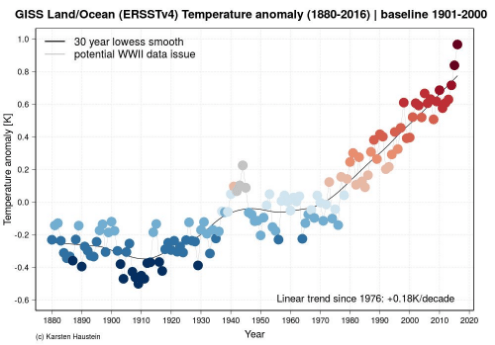
Due to the highest volume of heat-trapping gasses hitting the Earth’s atmosphere in all of the past 4-15 million years combining with a warming of Pacific Ocean surface waters, the period of 2014 through 2016 saw an unprecedented three consecutive record hot years. With Pacific Ocean waters cooling during late 2016, it appeared that 2017 would become ‘just’ the 2nd to 5th hottest year ever recorded. But that was before the waters off South America’s west coast began to blaze with unexpected heat during early 2017 even as temperatures at the poles climbed to surprisingly warm levels.

(Due to the combined effects of extremely high levels of heat trapping gasses in the Earth’s atmosphere and a switch to the warmer phase of natural variability, the global…

View original post 401 more words

For Colombia, The Rain Bombs of Climate Change Fell in the Dark of Night

robertscribbler's avatarrobertscribbler

As the lower atmosphere becomes warmer, evaporation rates will increase, resulting in an increase in the amount of moisture circulating throughout the troposphere (lower atmosphere). An observed consequence of higher water vapor concentrations is the increased frequency of intense precipitation events… — NASA’s Earth Observatory

******

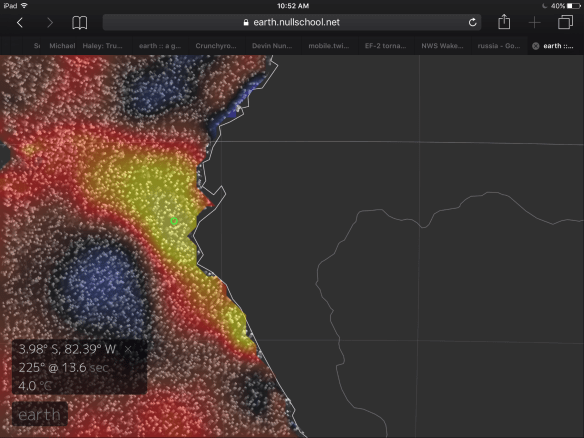
Just off the coasts of Colombia, Ecuador and Peru, the Pacific Ocean has been abnormally warm of-late. For the past month, sea surface temperatures have ranged between 3 and 5 degrees Celsius above average. This excess heating of the ocean surface, facilitated by human-forced climate change, has pumped a prodigious volume of moisture into the atmosphere of this coastal region. Southerly winds running along the western edge of South America have drawn this moisture north and eastward — feeding into the prevailing storms that originate on the Atlantic side of South America and track eastwards.

(Sea surface temperature anomaly map from Earth…

View original post 559 more words

Wolves have purpose

http://www.spokesman.com/stories/2017/apr/03/leave-wolves-roam-intended/

Letters to the Editor

MONDAY, APRIL 3, 2017

Contrary to Stevens County Commissioner Don Dashiell’s claim that the numbers of wolves today are at levels never seen in Washington state’s history (March 18 article), the facts are available online. The Fish and Wildlife Department site states that historically wolves were common throughout the state until the influx of settlers between 1850 and 1900. Hunting, trapping and poisoning decimated a species that had called Washington (and most of the Lower 48) home for millennia.

Wolves have their part to play in the web of life on this planet. People need to think twice before deciding they know better than the one who created all this and stop destroying what is not to their liking. I don’t think God looks favorably on those who have such disrespect for this perfect blueprint. Wolves and all predators have a predetermined purpose, as does everything that inhabits Earth. Let’s stop interfering with the design and work with it, instead of trying to dismantle and redraft it.

by Jeannie Shank

Colville

Another rude awakening for cormorants

http://www.dailyastorian.com/Local_News/20170403/another-rude-awakening-for-cormorants?utm_source=Daily+Astorian+Updates&utm_campaign=e4006b0b68-TEMPLATE_Daily_Astorian_Newsletter_Update&utm_medium=email&utm_term=0_e787c9ed3c-e4006b0b68-109860249&ct=t(TEMPLATE_Daily_Astorian_Newsletter_Updat6_21_2016)

By Katie Frankowicz

For The Daily Astorian

Published on April 3, 2017 9:03AM

The state will resume hazing cormorants on the Oregon Coast to protect salmon.

DAILY ASTORIAN/FILE PHOTO

The state will resume hazing cormorants on the Oregon Coast to protect salmon.

Buy this photo

Cormorants facing possible death by shotgun blast at their colony near the mouth of the Columbia River don’t seem to have started house-hunting in less dangerous neighborhoods farther down the coast.

But as the Oregon Department of Fish and Wildlife once again prepares to coordinate nonlethal hazing projects at various Oregon estuaries this spring, biologists will watch for changes in cormorant colonies south of the river.

The U.S. Army Corps of Engineers, which manages the massive double-crested cormorant colony on East Sand Island, began a culling program in 2015 in an effort to manage the growing colony and reduce the number of young salmon the birds were estimated to consume annually. That year, the Army Corps’ contractors killed a total of 2,346 adult birds and oiled eggs — a process that prevents the eggs from hatching — in 5,089 nests. In 2016, the Corps reported a total of 2,982 adult birds killed.
Cormorant populations
So far there haven’t been any changes in populations elsewhere that state biologists can directly attribute to management activities on East Sand Island. Drawing a straight line from the Columbia River estuary to changing cormorant populations farther down the coast is difficult to do anyway.

“If we do see increases at the Oregon Coast colonies, we would be curious to know how this might be related to activities on the Columbia River,” said state biologist and avian predation coordinator James Lawonn. But, he added, “cormorant colonies naturally fluctuate quite a bit.”

The Department of Fish and Wildlife already monitors double-crested cormorant populations on the coast extensively. In addition to regular nonlethal hazing activities, when some monitoring can occur, there are regular aerial surveys and estuary surveys. On these excursions, biologists focus on a variety of bird species but also take note of the double-crested cormorants.

The state has not increased any of its monitoring activities in response to the Corps’ lethal management plan on East Sand Island. This is mostly because the Department of Fish and Wildlife’s own monitoring efforts along the coast and in the estuaries are already “pretty robust,” Lawonn said. “We feel that we’ve got our bases covered.”
Nonlethal hazing
Oregon plans to begin its nonlethal hazing activities in May, focusing on the Nehalem, Nestucca and Coquille river estuaries and Tillamook and Alsea bays before moving up to the Lower Columbia River area.

The cormorants are native to Oregon and are particularly prevalent on the state’s estuaries from April through October, according to a news release from the Department of Fish and Wildlife — overlapping with when wild-spawned and hatchery salmon juveniles are migrating from their origin streams to the ocean.

The hazing activities by the state are an effort to protect, in particular, spring migrants that are considered threatened under the Endangered Species Act. Though some small pyrotechnics might be used, most often the state’s hazing techniques take the form of people driving around in boats, chasing cormorants away from areas where vulnerable — and valuable — juvenile salmon are concentrated.

The Department of Fish and Wildlife has coordinated this cormorant hazing project for the last eight years, and such nonlethal hazing in one form or another has occurred at some Oregon estuaries since the late 1980s.

WPatricia Randolph’s Madravenspeak: Vote April 10 on a crane hunt, factory farming, frac-sand mining, pipeline expansion and more

dvoight09's avatarWisconsin Wildlife Ethic-Vote Our Wildlife

IMG_0064

Pixnio Free Images

“The least I can do is speak out for those who cannot speak for themselves.” ~ Jane Goodall

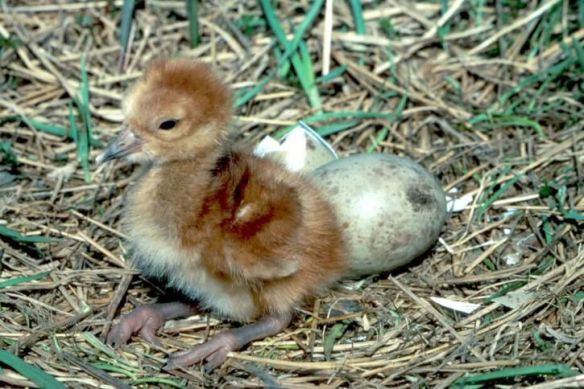
Monday evening, 6:30 p.m., April 10, the 83rd statewide county elections of delegates will be held to elect representatives to voice our will in governing our public lands, waters and wildlife. Find this year’s policy proposal questionnaire and your county location here on the DNR website. There you can learn how to propose change (make a resolution), and how to run for one of the two open delegate positions in your county, with candidates announcing their candidacy only the night of the election.

There are a wide variety of issues that should attract most citizens to attend and vote, since they directly impact most of our lives. Madravenspeak will provide a second column, April 9, explaining more about this election and the aggressive agenda up for public input.

View original post 736 more words

Extinct creature sightings are piling up in Australia

[No thanks to Man.]

By Mike Wehner

http://www.foxnews.com/tech/2017/04/03/extinct-creature-sightings-are-piling-up-in-australia.html

File photo - Don Colgan, Head of the Evolutionary Biology Unit at the Australian Museum, speaks under a model of a Tasmanian Tiger at a media conference in Sydney as seen in this May 4, 2000 file photo regarding the quality DNA extracted from the heart, liver, muscle and bone marrow tissue samples of a 134 year-old Tiger specimen (R) preserved in alcohol. The last known Tasmanian Tiger died in 1936 after it was hunted down and wiped out in only 100 years of human settlement. (Reuters)

File photo – Don Colgan, Head of the Evolutionary Biology Unit at the Australian Museum, speaks under a model of a Tasmanian Tiger at a media conference in Sydney as seen in this May 4, 2000 file photo regarding the quality DNA extracted from the heart, liver, muscle and bone marrow tissue samples of a 134 year-old Tiger specimen (R) preserved in alcohol. The last known Tasmanian Tiger died in 1936 after it was hunted down and wiped out in only 100 years of human settlement. (Reuters)

Multiple reports of Tasmanian Tiger sightings are starting to flow in from everyday citizens in Australia. Several people have recently claimed they’ve spotted the animal, which isn’t a tiger at all — and, despite looking very much like a species of dog, isn’t of canine lineage either — but a carnivorous marsupial. Spotting an interesting creature in Australia isn’t exactly a rare occurrence, but there’s one problem with these reports in particular: the Tasmanian Tiger is supposed to be extinct.

The last known Tasmanian Tiger was captured in its native Australia in 1933 and lived for a few years in a zoo before dying, and its death has long been thought to be the final nail in the species’ coffin. Australians have occasionally claimed to have spotted the dog-like animals over the years, but the sightings were typically rare and attributed to nothing more than misidentification. That’s all changed now, as several “plausible sightings” are beginning to give life to the theory that the animal never actually went extinct at all.

Now, scientists in Queensland, Australia, are taking action in the hopes of actually finding evidence that the Tiger is still around. If confirmed, it would be an absolutely monumental discovery, considering the animal’s history. The team plans to set up cameras in areas where reported sightings have taken place in the hopes of confirming the claims.

In the late 1800s there were actually bounties on Tasmanian Tigers in Australia, and the creatures were hunted to the brink of extinction before any action was taken. By that point, the species was thought to be doomed, and when the last captive animal died it was assumed that was the end of the road. Now, it appears that might not be the case after all.