Exposing the Big Game

Forget Hunters' Feeble Rationalizations and Trust Your Gut Feelings: Making Sport of Killing Is Not Healthy Human Behavior

Exposing the Big Game

87% of B.C. Grizzly Deaths Due to Trophy Hunting

https://www.desmog.ca/2017/04/12/87-b-c-grizzly-deaths-due-trophy-hunting-records-reveal?utm_source=Newsletter&utm_medium=DSCWeekly&utm_campaign=April_13_2017

Grizzly bear trophy hunt

Eighty-seven per cent of known, human-caused grizzly bear deaths in B.C. are attributable to trophy hunters, who have killed 12,026 grizzly bears since the government began keeping records in 1975, according to data obtained by David Suzuki Foundation.*

In 2016, 274 grizzlies were killed by humans — the vast majority of which (235) were killed by trophy hunters.

B.C. currently sanctions a legal trophy hunt by both resident and foreign hunters. Non-resident hunters killed almost 30 per cent of the grizzlies in the 2016 hunt.

The trophy hunt has become a hot election issue with the NDP and Green Party vowing to end the hunt if elected. An Insights West survey conducted in the fall of 2016 found 91 percent of British Columbians are opposed to trophy hunting.

Meantime, Tweet: The @BCLiberals are the party of choice for international #trophyhunters http://bit.ly/2p7i3c2 #bcpoli #bcelxn17 #grizzlyhunt #BanBigMoneythe B.C. Liberals are the party of choice for international trophy hunters — who donated $60,000 to the Guide Outfitters Association of B.C. to help prevent an NDP win.

The Canadian chapter of Safari Club International posted to Facebook: “NDP have vowed to end the Grizzly hunt in BC if elected. SCI chapters from CANADA and the USA banded together donating $60000.00 [sic].”

The Guide Outfitters lobby to continue trophy hunting, which attracts wealthy customers from around the world who pay as much as $20,000 for a hunt. The annual spring bear hunt began April 1.

Source: David Suzuki Foundation

B.C. Premier Christy Clark is a vocal supporter of the trophy hunting industry and a past winner of the Guide Outfitter association’s President’s Award.

B.C. has some of the weakest political donations rules in Canada, which allows anyone (including foreign corporations) to donate unlimited amounts of cash.

The New York Times recently called B.C. the ‘wild west’ of political cash and a Globe and Mail investigation revealed that lobbyists are routinely making political donations under their own names while being reimbursed by corporations — something that is illegal.

The B.C. NDP and B.C. Green Party have vowed to ban corporate and union donations if elected while the B.C. Liberals have promised to appoint a panel to review campaign finance rules if re-elected.

* Article updated to clarify data is based on known, human-caused grizzly bear deaths and does not include natural mortality (most of which is unknown).

USDA halts use of M-44 ‘cyanide bombs’ in Idaho following death of family pet

http://www.foxnews.com/us/2017/04/11/usda-halts-use-m-44-cyanide-bombs-in-idaho-following-death-family-pet.html

This photo shows the M-44 that killed the Mansfield family's 3-year-old dog in Pocatello, Idaho.

This photo shows the M-44 that killed the Mansfield family’s 3-year-old dog in Pocatello, Idaho.

The federal government has agreed to halt the use of M-44 cyanide “bombs” to control predatory animals in Idaho after a 14-year-boy was injured and his dog killed by the controversial device.

Canyon Mansfield, 14, was knocked to the ground last month when an M-44 predator control device spewed cyanide gas into his face and killed his dog. The family had no knowledge the device — set by the U.S. government some 350 yards from the Mansfields’ doorstep — was there.

Four conservation and animal-welfare groups also filed suit last week against the government over the M-44s after a gray wolf — a protected species — was accidentally killed by the device in Oregon.

In a letter Tuesday to conservation groups, the USDA’s Wildlife Services program – which kills thousands of predators across the country annually – said it was halting the use of M-44s on all private, state, and federal lands in Idaho.

“We take seriously the incident in Idaho,” the letter read.

“Currently, WS has ceased all use of M-44 devices on all land ownerships in the state of Idaho,” it said. “WS has also removed all M-44s currently deployed on all land ownerships in Idaho.”

It remains unknown whether Wildlife Services will decide to permanently halt the use of M44s. At least 19 conservation groups have filed a petition calling for the devices to be banned permanently.

In its letter, Wildlife Services informed the groups that “WS will notify you 30 days prior to placing any new M-44s in Idaho.”

The M-44s, also known as “coyote-getters,” are designed to lure animals with a smelly bait. When an animal tugs on the device, a spring-loaded metal cylinder fires sodium cyanide powder into its mouth. The devices are placed on land by Wildlife Services — a little-known branch of the USDA tasked with destroying animals seen as threats to people, agriculture and the environment.

Over the years, thousands of non-target animals — wild and domestic — have been mistakenly killed by the lethal devices.

Canyon Mansfield stumbled upon the unmarked device March 16 while running up a hill behind his parents’ Pocatello, Idaho home with his 3-year-old golden Labrador, Casey.

When the M-44 detonated, the boy watched as his dog lay dying, suffocating from the orange-colored cyanide sprayed by the device. Since the incident, Canyon has experienced headaches, nausea and numbness and has visited a neurologist for testing, his mother, Theresa Mansfield, told Fox News.

The Mansfield dog’s death follows a string of other recent incidents in which family pets and endangered species were accidentally killed by M-44s.

The government, meanwhile, has called the accidental death of family pets from M-44s a “rare occurrence,” and said Wildlife Services posts signs and issues other warnings to alert pet owners when traps are placed near their homes.

On Tuesday, various conservation groups praised the decision to temorarily ban use of the devices in Idaho.

“This could well be the tipping point that leads to a nationwide ban of these extraordinarily dangerous devices via the legislation introduced in Congress last month,” said Brooks Fahy, executive director of the national wildlife advocacy group, Predator Defense.

“As the recent cases in Idaho, Wyoming and Oregon amply demonstrate, M-44s endanger non-target wildlife, pets and children, no matter how they are used.”

Andrea Santarsiere, a senior attorney with the Center for Biological Diversity, said, “We’re glad to see these indiscriminate killing devices being pulled from Idaho – that’s an important step toward protecting wildlife, people and pets from these cyanide bombs.”

The groups petitioning for the M-44 ban included Western Watersheds Project, Predator Defense, WildEarth Guardians, the Center for Biological Diversity, Friends of the Clearwater, Western Wildlife Conservancy and Nevada Wildlife Alliance.

TV hunting personality Chris David guilty of breaking Sask. wildlife laws

http://www.cbc.ca/news/canada/saskatoon/chris-david-wild-tv-hunting-alberta-saskatchewan-1.4065846

Jason David, also known as Chris David, had his unlawful kill aired on Wild TV

CBC News Posted: Apr 11, 2017 11:39 AM CT Last Updated: Apr 11, 2017 11:39 AM CT

Former hunting television personality Jason David, also known as Chris David, was recently fined after being found guilty of breaking Saskatchewan wildlife laws.

Former hunting television personality Jason David, also known as Chris David, was recently fined after being found guilty of breaking Saskatchewan wildlife laws. (Facebook)

A television celebrity from Alberta has been fined and suspended for unlawful hunting after a trip to Saskatchewan that aired as an episode on Wild TV.

Jason David, 43, also known as Chris David on shows like The Hunting Chronicles and No Limits TV, came to the Grenfell, Sask., area to shoot white-tailed deer in 2011.

But the visit ended up playing out in the courts after an investigation by wildlife officials.

They found that the deer had been shot in the wrong wildlife management zone and was then unlawfully taken back to Alberta.

David was recently fined $5,600 after a Broadview, Sask., provincial court judge found him guilty on several charges under the Saskatchewan Wildlife Act.

He also received a one-year hunting suspension.

The TV shows also pulled the plug on David’s appearances.

Chris David kill

David, shown here after a successful hunt in northern Alberta in 2010, has been banned from hunting for one year. (Facebook )

BC Liberals promise to eliminate grizzly trophy hunting in the Great Bear Rainforest

In a stunning reversal of policy, the BC Liberals are promising to eliminate grizzly bear hunting in the province’s Great Bear Rainforest.

Premier Christy’s Clark’s Liberals made the promise as they unveiled a new platform for the May 9 provincial election that promised to protect healthy and sustainable wildlife populations.

“We must operate on the principle of conservation first in order to pass on B.C.’s natural splendour so future generations can enjoy it,” said the Liberal platform. “That’s why our wildlife management practices are determined by the best available science.”

The BC Liberals previously defended grizzly bear hunting in British Columbia, despite opinion polls showing nearly 90 per cent of B.C. residents opposed to the trophy hunting of grizzlies. But the new platform promised to phase it out.

“Today’s BC Liberals will work with the Coastal First Nations towards the elimination of the grizzly bear hunt in the Great Bear Rainforest, continuing with the science based approach to the bear hunt elsewhere in the province,” the platform said.

“We know that many First Nations have a deep connection to the land, and also use wildlife for food, social and ceremonial uses. Our hunting, trapping and angling regulations are designed to ensure species conservation and to maintain healthy wildlife populations for use.”

Green Party and NDP also opposed hunt

Green Party Leader Andrew Weaver proposed legislation, in March 2015, to stop the hunt.

The latest move by the Liberals also follows a similar commitment by the BC NDP which also pledged, last November, to end the controversial trophy hunt.

One of the provincial NDP candidates, Bryce Casavant, is a former conservation officer who was fired for refusing to kill two orphaned black bear cubs in 2015.

Chris Genovali, executive director of Raincoast Conservation Foundation, has actively campaigned against the trophy hunting of grizzly bears in B.C. over the years. He said the foundation welcomed seeing major political parties support calls to end the hunt.

“The evidence is overwhelming. Every argument that’s been put out there to justify the grizzly hunt has been blown out of the water, whether it’s economic, ecological or ethical,” Genovali said. “Studies have shown that bear viewing generates more revenue than bear hunting.

“I think finally the political parities recognized that [grizzly hunting] is not a winning party platform, at least with regard to the Great Bear Rainforest.”

Editor’s note: This article was updated at 8:50 p.m. PT with additional background information.

Correction 9:56 p.m.: An earlier version of this article stated that Bryce Casavant refused to kill two grizzly cubs. This has been corrected to black bear cubs.

Fossey Fund trackers save young gorilla from snare

https://gorillafund.org/fossey-fund-trackers-save-young-gorilla-snare/?utm_source=Gorilla+List&utm_campaign=55d6ab2251-FashaUpdate_2017_04_10&utm_medium=email&utm_term=0_335decb1af-55d6ab2251-72515689&mc_cid=55d6ab2251&mc_eid=40a04b9ac4

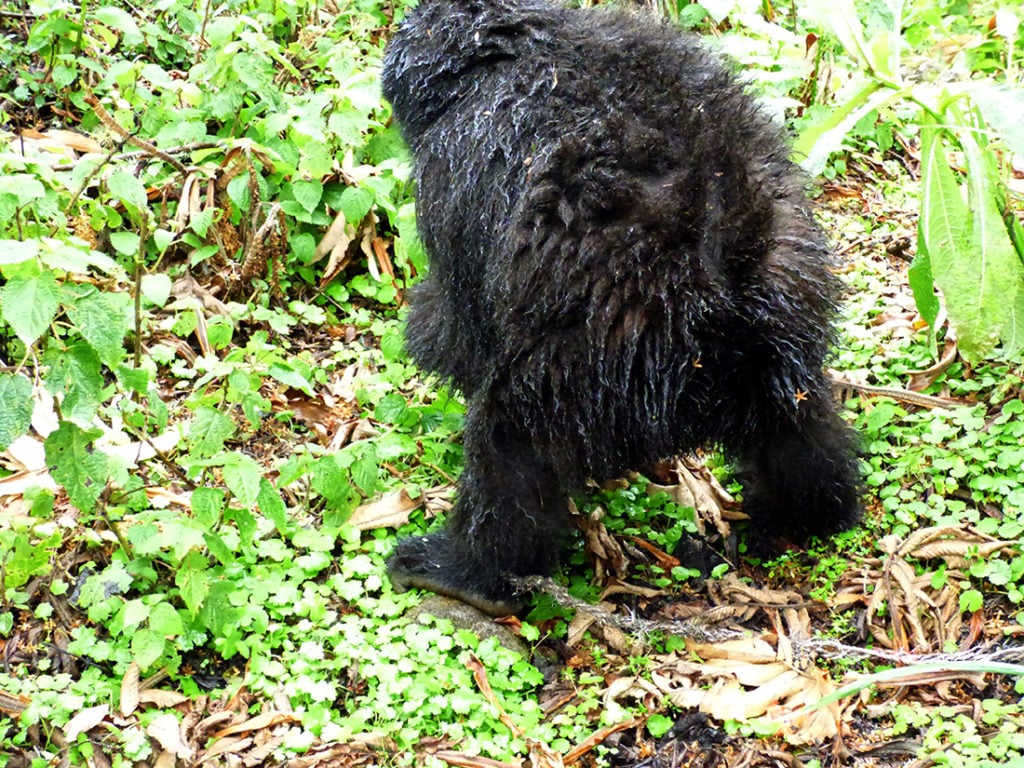
It’s been a very stressful time for one of the mountain gorilla groups we monitor every day in Rwanda’s Volcanoes mountains. Isabukuru’s group faced the death of its leader late last month, and yesterday our trackers found one of the youngsters from this group caught in a snare.

Although no gorillas in the groups we protect had been caught in snares since November 2015, Fossey Fund staff have concerned about recent increases in the numbers of snares seen, many of which have been close to the gorilla groups. When our trackers arrived in Isabukuru’s group yesterday and noticed immediately that 3-year-old Fasha was not in the group, they began a search for him and found a deactivated snare nearby.

Soon they located Fasha by himself, with a long piece of rope around his ankle, attached to a bamboo branch. They were able to detach the branch, but the rope was wound tightly around his foot. This meant that a veterinary intervention would be necessary to have the rope removed, which requires sedation, and plans were made for this to happen today. Our trackers then waited in the forest for the rest of the day, until Fasha was able to move back to his group, since he was extremely stressed out and initially seemed to be going in the wrong direction.

Fasha with the rope from the snare on his left foot
Fasha with the rope from the snare on his left ankle

https://player.vimeo.com/video/212283403?color=ffffff&title=0&byline=0&portrait=0
Successful intervention

Today the intervention was conducted with Gorilla Doctors veterinarians, and included nine staff from the Fossey Fund, as well as Rwanda park authorities (RDB). Initially, Fasha was located close to silverback Kubaha, who has taken over the group since former leader Isabukuru died on March 26. Fasha was one of three youngsters who were receiving special protection from Isabukuru, since they all had mothers who had transferred out of the group. Luckily, Kubaha has so far taken over this protective role.

As our trackers arrived in the group, they found Fasha and others still in their night nests. When Fasha fell asleep after being sedated with a dart, our trackers were able to chase the other gorillas and keep them away during the intervention. The rope had become very tight on Fasha’s now-swollen left ankle, showing that he or other gorillas had tried to remove it, and he’d also lost a few teeth, probably while trying to bite the snare off. But the rope was successfully removed, the wound cleaned and antibiotics given, all within about 30 minutes. After resting for a short while, Fasha started moving with the group and all were feeding calmly.

Trackers play critical role

The Fossey Fund’s gorilla trackers and researchers play a critical role in this kind of situation, since it is our daily following of every gorilla in each group we protect that allows us to notice when something is wrong and to make experienced decisions in handling the situation. If our trackers had not noticed Fasha was missing, had not been able to locate him, and had not made sure he returned to his group, it is likely the outcome would have much more serious.

Thanks to support from all of our donors, we are able to provide this kind of daily, intensive protection for all of the gorillas we monitor. Help us continue this work by donating here.

Unprecedented Harm to Great Barrier Reef From Back-to-Back Bleaching Confirmed

robertscribbler's avatarrobertscribbler

It’s becoming more and more clear that the Great Barrier Reef has been pushed onto the ropes by human-caused climate change. That its very future is now in serious jeopardy. That only swift action by a responsible populace will now be able to save it.

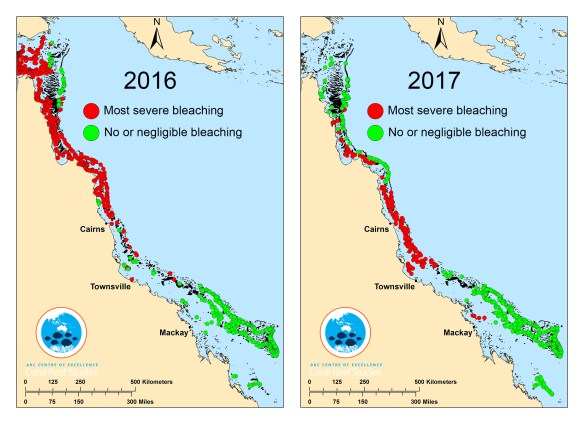
During 2016 to 2017, the Great Barrier Reef experienced an unprecedented back-to-back bleaching event. In 2016, more than 60 percent of the corals of the reef’s northern section experienced bleaching. Ultimately, roughly 2/3 of the shallow water corals along this section of the reef perished.

In 2017, warmer than normal waters shifted south. As a result, the central section of the Great Barrier Reef is presently experiencing 60 percent or higher bleaching rates. Now, mass mortality in regions unaffected or minimally affected by last year’s record bleaching is expected.

(New composite bleaching maps show the extent of the 2016-2017 coral mortality event which now…

View original post 656 more words

Great Barrier Reef at ‘terminal stage’: scientists despair at latest coral bleaching data

https://www.theguardian.com/environment/2017/apr/10/great-barrier-reef-terminal-stage-australia-scientists-despair-latest-coral-bleaching-data?
Last year was bad enough, this is a disaster,’ says one expert as Australia Research Council finds fresh damage across 8,000km

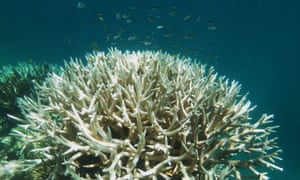
Back-to-back severe bleaching events have affected two-thirds of Australia’s Great Barrier Reef, new aerial surveys have found.

The findings have caused alarm among scientists, who say the proximity of the 2016 and 2017 bleaching events is unprecedented for the reef, and will give damaged coral little chance to recover.

Scientists with the Australian Research Council’s Centre of Excellence for CoralReef Studies last week completed aerial surveys of the world’s largest living structure, scoring bleaching at 800 individual coral reefs across 8,000km.

The results show the two consecutive mass bleaching events have affected a 1,500km stretch, leaving only the reef’s southern third unscathed.

Where last year’s bleaching was concentrated in the reef’s northern third, the 2017 event spread further south, and was most intense in the middle section of the Great Barrier Reef. This year’s mass bleaching, second in severity only to 2016, has occurred even in the absence of an El Niño event.

https://interactive.guim.co.uk/embed/aus/2017/apr/gbr-bleaching/bleach-16-17/

Mass bleaching – a phenomenon caused by global warming-induced rises to sea surface temperatures – has occurred on the reef four times in recorded history.

Prof Terry Hughes, who led the surveys, said the length of time coral needed to recover – about 10 years for fast-growing types – raised serious concerns about the increasing frequency of mass bleaching events.

“The significance of bleaching this year is that it’s back to back, so there’s been zero time for recovery,” Hughes told the Guardian. “It’s too early yet to tell what the full death toll will be from this year’s bleaching, but clearly it will extend 500km south of last year’s bleaching.”

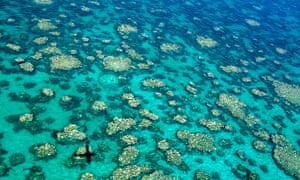
A reef from the air
Pinterest
Aerial surveys of the world’s largest living structure, scoring bleaching at 800 individual coral reefs across 8,000km. Photograph: Ed Roberts/ARC

Last year, in the worst-affected areas to the reef’s north, roughly two-thirds of shallow-water corals were lost.

Hughes has warned Australia now faces a closing window to save the reef by taking decisive action on climate change.

The 2017 bleaching is likely to be compounded by other stresses on the reef, including the destructive crown-of-thorns starfish and poor water quality. The category-four tropical cyclone Debbie came too late and too far south for its cooling effect to alleviate bleaching.

https://interactive.guim.co.uk/embed/aus/2017/apr/gbr-bleaching/gbr-coverage

But Hughes said its slow movement across the reef was likely to have caused destruction to coral along a path up to 100km wide. “It added to the woes of the bleaching. It came too late to stop the bleaching, and it came to the wrong place,” he said.

The University of Technology Sydney’s lead reef researcher, marine biologist David Suggett, said that to properly recover, affected reefs needed to be connected to those left untouched by bleaching.

He said Hughes’ survey results showed such connectivity was in jeopardy. “It’s that connection ultimately that will drive the rate and extent of recovery,” Suggett said. “So if bleaching events are moving around the [Great Barrier Reef] system on an annual basis, it does really undermine any potential resilience through connectivity between neighbouring reefs.”

Some reef scientists are now becoming despondent. Water quality expert, Jon Brodie, told the Guardian the reef was now in a “terminal stage”. Brodie has devoted much of his life to improving water quality on the reef, one of a suite of measures used to stop bleaching.

The reef from the air
Pinterest
ARC conducted an aerial and underwater survey of the reef which concluded that two-thirds of it has been hit by mass coral bleaching for second time in 12 months. Photograph: Ed Roberts/ARC

He said measures to improve water quality, which were a central tenet of the Australian government’s rescue effort, were failing.

“We’ve given up. It’s been my life managing water quality, we’ve failed,” Brodie said. “Even though we’ve spent a lot of money, we’ve had no success.”

Brodie used strong language to describe the threats to the reef in 2017. He said the compounding effect of back-to-back bleaching, Cyclone Debbie, and run-off from nearby catchments should not be understated.

“Last year was bad enough, this year is a disaster year,” Brodie said. “The federal government is doing nothing really, and the current programs, the water quality management is having very limited success. It’s unsuccessful.”

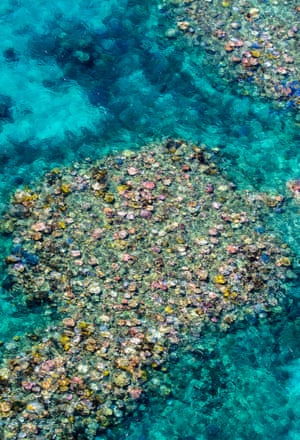
Bleached coral at Mission Beach Reefs
Pinterest
Bleached coral at Mission Beach Reefs. Photograph: Bette Willis/ARC Centre of Excellence for Coral Reef Studies

Others remain optimistic, out of necessity. Jon Day was a director of the Great Barrier Reef Marine Park Authority for 16 years until retiring in 2014.

Day, whose expertise lies in protected area planning and management, said the federal government’s approach to protecting the reef was sorely lacking. He said it was taking too relaxed an approach to fishing, run-off and pollution from farming, and the dumping of maintenance dredge spoil.

The government was far short of the $8.2bn investment needed to meet water quality targets, he said, and Australia was on track to fail its short-term 2018 water quality targets, let alone achieve more ambitious long-term goals.

“You’ve got to be optimistic, I think we have to be,” Day said. “But every moment we waste, and every dollar we waste, isn’t helping the issue. We’ve been denying it for so long, and now we’re starting to accept it. But we’re spending insufficient amounts addressing the problem.”

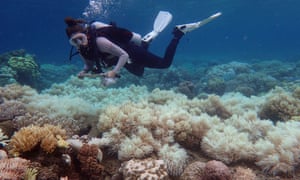
A diver over bleached coral at Orpheus Island
Pinterest
A diver over bleached coral at Orpheus Island. Photograph: Greg Torda/ARC Centre of Excellence for Coral Reef Studies

The Queensland tourism industry raised questions about the reliability of the survey, saying scientists had previously made exaggerated claims about mortality rates and bleaching.

https://interactive.guim.co.uk/charts/embed/apr/2017-04-09T01:14:30/embed.html

“There is no doubt that we have had a significant bleaching event off Cairns this time around,” said Col McKenzie, of the Association of Marine Park Tourism Operators.

“The far north probably did a little bit better, Port Douglas to Townsille has seen some significant bleaching,” he said. “Fortunately we haven’t seen much mortality at this time, and fortunately the temperatures have fallen.”

McKenzie said more money needed to be invested in water quality measures, and criticised what he saw as a piecemeal and uncoordinated approach to water quality projects up and down the coast.

Parasite Reminds Hunters Bear Meat Must Be Thoroughly Cooked

http://www.adfg.alaska.gov/index.cfm?adfg=wildlifenews.view_article&articles_id=682

By Riley Woodford

 caption follows

A brown colored black bear. Bears and other carnivores and scavengers in Alaska commonly carry the trichinella roundworm parasite, which can be transmitted to people who eat undercooked meat. Richard Housineaux photo.

Aparty of successful out-of-state hunters left Alaska earlier this year with bear meat – and a load of parasites.

The incident is a good reminder that the trichinellosis roundworm is widespread in bears and meat needs to be thoroughly cooked, said Dr. Louisa Castrodale, an epidemiologist and veterinarian with the Alaska Department of Health. She said the group of friends became sick after they returned home.

“They all came up to hunt, from four different states, and after they got home they started emailing back and forth, ‘Are you sick? I’m sick.’ They figured it out,” Castrodale said. “One person from Washington had some meat and had the Washington Health Department test it, and it was positive.”

She said the hunters cooked hunks of meat over their campfire. “Like any meat, you want to get it up over a certain temperature and thoroughly cook the whole thing,” she said. “Over a fire it’s hard to say if it’s evenly cooked.”

According to the Centers for Disease Control and Prevention, wild game meat like bear should reach an internal temperature of 160 degrees and rest at that temperature for three minutes. Curing, salting, drying, smoking, or microwaving does not consistently kill the worms, and homemade jerky and sausage were the cause of many cases of trichinellosis reported to CDC in recent years.

That’s true in Alaska. Dr. Kimberlee Beckmen, the veterinarian for the Alaska Department of Fish and Game, said curing methods that don’t kill the parasites, such as drying or smoking, and inadequate cooking, like slow cooking in a crock pot, cause most of the cases she knows of in Alaska.

caption follows

Drying is not an appropriate method for curing bear meat, as it doesn’t kill the parasites.

“People should always assume bear meat is infected,” she said. “It must be cooked, 100 percent of the time. You can’t see the larvae, they’re microscopic.”

Trichinellosis, also called trichinosis, is the disease caused by a nematode, a tiny worm with an adult and larval form. Trichinella is the genus, and spiralis is the species most adapted to domestic pigs. T. nativa is the species found in Alaska’s bears. It’s a much tougher bug. Freezing will kill spiralis, freezing doesn’t kill the northern variety, nativa.

Beckmen cited a study where infected polar bear meat was frozen at minus 18 degrees centigrade for six years and the parasites were still viable; and another where fox meat frozen for four years was still laden with living larvae, ready to infect a new host. “It’s arctic adapted to freezing,” she said. “For Trichinella to spread, it has to be consumed by another carnivore. It can survive for a very long time in a carcass that is frozen. It wants to be consumed by another potential host later. It’s biding its time.”

Trichinella nativa is found in carnivores such as wolves, foxes, lynx and coyotes, and walrus and seals as well. So how do carnivores live with this parasite?

caption follows

While the trichinella species most commonly found in pork can be killed by freezing and by heating the meat to 140 degrees, the Alaska trichinella parasite found in bears is more hardy. Meat must be cooked thoroughly to an internal temperature of 160 degrees, and then hold or “rest” at that temperature for at least three minutes.

“It’s a parasite that evolved along with the hosts, carnivores and scavengers, so bears and lynx are adapted to living with it,” Beckmen said. “It affects us more severely because we’re not typically exposed to it. Some animals may develop muscle edema and pain, and I’m sure some animals suffer more problems than others depending on the number of larvae they consume.”

Parasites in general don’t cause severe symptoms in the species they’re evolved for, she said. Parasites and their hosts evolve together, and it rarely benefits the parasite to kill its host. “Wildlife having parasites is a normal state, and doesn’t usually cause problems unless the animal is sick from some other reason or stressed.”

But that’s not the case when the parasite jumps to a different species. In part because the parasite can’t complete its usual life cycle, it gets confused and ends up in the wrong part of the body, like the eyes instead of the gut.

“It’s not meant to be in us, we react severely,” Beckmen said. “Like the roundworm of dogs, which causes blindness and brain inflation in children. In people it may migrate throughout the body, it goes to the brain or the eyes, in a dog, it goes to intestine and lives there on the contents.”

Trichinellosis rarely kills people, but it can cause severe pain, swelling and inflammation. Castrodale said initial symptoms result from the adult parasites in the intestinal tract and include diarrhea. She added that the initial symptoms can be mild and may not even really register. Over the course of the next few weeks the larvae migrate to muscles and establish themselves, which results in fever, muscle pain, weakness, and sometimes swelling around the skin of the eyes. “That’s when people realize something is up, they’re sick,” she said.

photo

The CDC reports that trichinellosis is rare, and about 20 cases a year are reported. Rare, but Castrodale said this isn’t the first time a situation like this has occurred. “People will call from out of state and describe their symptoms and we’ll ask, ‘Did you eat bear meat?’ If you have those muscle pains and walk into clinic in Lower 48 they won’t necessarily think to ask about it.”

Prompt treatment with deworming drugs will kill the adults, but once larvae are established in muscle tissue, usually three or four weeks after infection, they’re much less vulnerable to the drug. The CDC reports that the host immune response leads to expulsion of the adult worms after several weeks; the larvae, once in muscle, can persist for months or years, although symptoms typically wane after several months.

“Treatment might include a steroid to calm the immune response and address the inflammation,” Castrodale said. “Eventually people get over it, it runs its course. You still have them, but they stop migrating, they’re walled off and encysted.”

caption follows

Caribou meat can carry a parasitic disease, toxoplasmosis, and should be cooked.

How prevalent is this parasite in Alaska’s wild carnivores?

Beckmen looked at tissue samples from bears and wolves killed in the state predator control program. She’s also sampled bears killed in Defense of Life and Property (DLP) and sampled coyotes, lynx and walrus. She said the tongue and diaphragm will have most larvae. Lynx, coyotes, foxes and wolves have a very high rate of infection, but since people don’t generally eat those animals that’s not well known.

“The prevalence rate in black bears is higher the further north you go, and polar bears are 100 percent infected,” she said.

She added that another parasitic disease, toxoplasmosis, is also prevalent in wild game in northern Alaska and she cautions people against eating raw meat from caribou or marine mammals.

Pregnant women should especially abstain, as toxoplasmosis can be damaging or fatal to a developing fetus. Small children are also at risk.

“It’s better to cook the meat,” she said.

More on wildlife diseases that hunters might encounter

A handy one-page color PDF on trichinosis and other common wildlife parasites

By Riley Woodford

Ethiopia park tries to relocate settlers to protect wolves

 https://www.washingtonpost.com/world/africa/ethiopia-park-tries-to-relocate-settlers-to-protect-wolves/2017/04/09/5641f5aa-1d30-11e7-bb59-a74ccaf1d02f_story.html?utm_term=.9e5dbb9f9cfc
April 9
SIMIEN MOUNTAINS NATIONAL PARK, Ethiopia — Thousands of Ethiopian wolves once roamed much of this country’s mountainous north but their number has fallen dramatically as farmers encroach on their habitat and introduce domestic dogs that carry rabies.

Only 120 wolves are estimated to remain in this national park and they are elusive, usually seen shortly after sunrise or just before sunset.

“They are almost at the brink of extinction. So my vision is to increase their number significantly,” said Getachew Assefam, coordinator of the Ethiopian Wolf Conservation Program.

The movement of people move in search of fertile land in the highlands has put pressure on the park. Across the country less than 500 Ethiopian wolves remain in a few mountain enclaves, the Britain-based Born Free Foundation says.

Efforts are underway to move most of the settlers out of this national park in the hope of saving the remaining wolves. The local community currently uses more than two-thirds of the park’s area for grazing, agriculture and settlement, according to the Ethiopian Wildlife Conservation Authority.

The wildlife authority said 38 villages with a total of 3,000 people are living within the park’s boundaries.

Gichi village in the heart of the park had more than 418 households before the resettlement program began three years ago. Now there are none. Now the government is focusing on settlers in other areas.

The relocated settlers “are all now living in a better condition,” said the park’s chief warden, Maru Biadgelegn.

But some farmers said the compensation they received for the move is not enough.

Requests by The Associated Press to gain access to the resettlement area were denied. In a recent meeting, residents rejected the government’s compensation offer to resettle the remaining farmers.

“I believe we can come to an agreement on this in the future,” said one park resident, Zezo Adugna.

Copyright 2017 The Associated Press