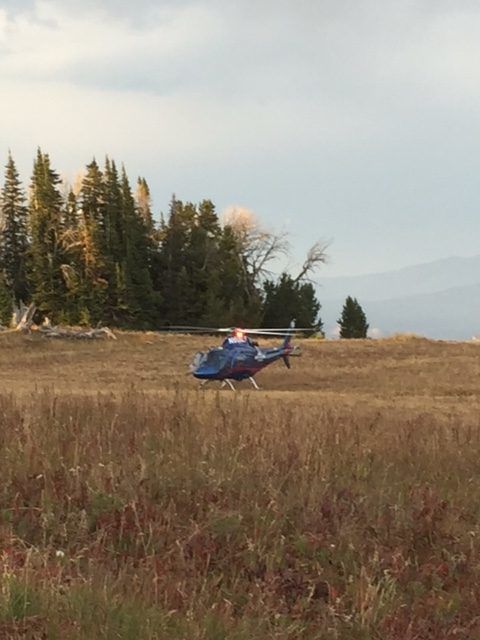
A Life Flight Network helicopter responds to transport an injured bow hunter from the Big Sky area to Bozeman Health Deaconess Hospital on Thursday.
Photo courtesy of the Gallatin County Sheriff’s Office
A bow hunter was impaled in the leg by an arrow in an accident south of Big Sky on Thursday afternoon.
According to the Gallatin County Sheriff’s Office, at about 4 p.m. Thursday, dispatch received a report of an injured bow hunter on Buck Ridge.
The 61-year-old Indiana man had fallen down a steep hill while hunting. During the fall, one of his arrows came loose from his quiver, impaling him in the upper right thigh.
The arrow was removed and one of his hunting partners applied a compression bandage.
Gallatin County Sheriff’s deputies and volunteers from search and rescue in Big Sky responded to the area, which was on the Buck Ridge trail…
By Heather Moore People for the Ethical Treatment of Animals
It’s been almost a decade since swine flu first dominated the national news, causing people to panic after a pandemic that started in Mexico spread to the U.S. in 2009 and resulted in more than 274,300 hospitalizations and 12,400 deaths. (The global death toll may have been as high as 575,400.)
But just because swine flu hasn’t been making headlines as often as it once did —now only popping up when there’s a regional outbreak or when kids get sick after visiting a petting zoo —that doesn’t mean the disease has gone away or is any less of a threat.
Case in point: Swine flu recently sickened around 120 people from at least 25 states who attended a national letter carriers’ convention in Grand Rapids, Mich. Health officials say it was the same H1N1 strain that emerged in 2009…
A controversial statewide coyote killing contestsaw a dramatic increase in animal deaths over the previous year — an outcome disappointing to critics of the contest.
The Georgia Coyote Challenge conducted by the state’s Department of Natural Resources encourages people to kill the animals from March to August for a chance to win a lifetime hunting license or similarly valued prize. This year, 215 hunters killed 431 coyotes.
During the 2017 challenge period, 83 hunters turned in a total of 195 coyotes. That’s a 121 percent increase.
Tina Johannsen, a DNR wildlife biologist, said the increase was “a function of the entry system.” Last year, submissions were made by presenting a carcass at a field office; this year, people could apply much more accessibly by using a photo and online entry form.
Cows are milked at a dairy farm at the University of California, Davis, where researchers are studying whether adding small amounts of seaweed to cattle feed can help reduce their emissions of methane. Terry CheaAP
As tomato harvest hits full capacity and the almond harvest begins to ramp up, global leaders will gather in San Francisco this month to promote continued action on climate change.
While Silicon Valley seeks the spotlight, it is the more humble Central Valley that solidifies California’s leadership as one of the world’s most climate-smart economies.
Our Mediterranean climate allows us to produce and export $20 billion of the world’s most nutritious and high-quality foods. Partnerships between the state government, farmers and ranchers are ensuring that this bounty has the lowest greenhouse gas and environmental footprint in the…
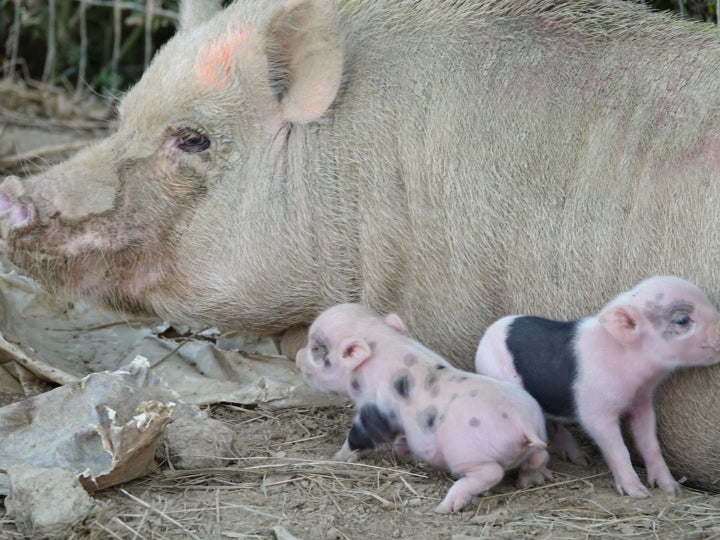
Rescue workers are scrambling to find homes for more than 400 pot-bellied pigs who were rescued from a Kentucky farm in late August, plus numerous piglets born since then.
About 458 pigs were found malnourished on the farm in Falmouth, Kentucky, and potentially face euthanasia, according to the Pig Advocates League, a nonprofit dedicated to creating cruel-free lives for pigs. The animals were seized in a “hoarding” case after complaints of free-roaming pigs were reported to the Kentucky Department of Fish and Wildlife.
A woman in Falmouth began with a few pigs years ago and ended up with hundreds of pigs after out-of-control breeding, PAL said in a Facebook post on Aug. 24. Kentucky Fish and Wildlife told HuffPost in a statement that pigs can reproduce at astonishing rates and if they’re not in a controlled environment can revert to a feral state within generations.
A spokeswoman for PAL told HuffPost this is “the largest miniature pig seizure we have seen in this country.” The nonprofit is working with volunteers, animal sanctuaries and veterinarians to spay, neuter and microchip the animals, as they need a clean bill of health before they can be re-homed.
“The most [urgent] needs now are transports and donations,” the nonprofit told HuffPost in an email. “Many piglets have been born since the initial seizure and the total number of pigs is now north of 500. The cost to spay, neuter, vet, and transport to a new home will well exceed $100,000.”
Although pot-bellied pigs are often referred to as “miniature pigs,” one of the rescuers, Josh Carpenter Costner, told the Louisville Courier Journal they range from 80 to 150 pounds as adults.
COURTESY OF PIG ADVOCATES LEAGUE
The Kentucky Department of Fish and Wildlife originally gave the volunteers a Sept. 14 deadline before it would begin to euthanize the animals, PAL had originally said. But since then, it told HuffPost, the department has agreed to extend its deadline so long as volunteers show “continual progress” on moving the pigs.
“Since Monday, we have received over 1200 adoption applications,” the nonprofit said in an email. “Each application is being thoroughly screened to ensure these animals will not be going from a bad spot to worse.”
Each application to adopt the pet pigs will be vetted to ensure the animals do not get into the hands of breeders or owners who raise pigs for slaughter. One of the animal sanctuaries working to care for the pigs, the Cotton Branch Farm Animal Sanctuary, said the adoption applications were carefully crafted to ensure the animal’s safety.
Tesla Model 3 is driving a massive surge in U.S. electric vehicles sales. According to Inside EVs, Tesla Model 3 sales hit 17,800 during August in the U.S. Meanwhile total U.S. EV sales likely hit near 35,000.
An overview of present tropical cyclone activity over the U.S. and in the North Atlantic to include Gordon, Francis, and a tropical disturbance emerging from Africa. Both National Hurricane Center reports and larger climate change related factors are discussed.
This picture of a Sierra Nevada red fox was the first confirmed detection in Yosemite in nearly a century
PHOTO BY NATIONAL PARK SERVICE
“(T)hese bills go right at the key decision junctures in the act that protect species.” ~ Kieran Suckling, executive director of the Center for Biological Diversity
The Trump administration, of course, values money and political power above the intrinsic value of the dwindling natural world. This is not a new concept, but this regime is the most extreme ever. Since inception, the U.S. Fish and Wildlife Service and state agencies that manage our public lands, waters, and wildlife have been funded primarily on fees collected for killing wildlife and weapon and ammunition taxes.
Now the Trump administration has ordered our federal agencies to consider economic concerns over protecting endangered species.
Republican legislator Don Young and the Congressional Western Caucus (representing hunter, trapper and rancher abuse of public…
by Robert I. Field, Ph.D., J.D., M.P.H.,Posted: September 4, 2018
AP FILE/CHARLIE NEIBERGALL
EMAIL
The most important trade war to come may have nothing to do with cars, steel or soybeans. It may involve a virus.
The vast agricultural enterprise in southern China is the source of most new flu strains. Under rules established by the World Health Organization in 2011, China has routinely shared samples of them with researchers in the United States and other countries where vaccines are developed. But recent trade tensions may be leading it to change course.
Influenza is a serious disease. The seasonal variety kills thousands of people worldwide each year. But its impact pales in comparison with pandemic flu. That is the kind that emerges every few years and spreads like wildfire around the globe, sometimes killing millions – as it did in 1918.
Originally posted to the Exposing the Big Game blog on
Satire, by Jim Robertson (with a nod to the late Cleveland Amory, author of Mankind?: Our Incredible War on Wildlife and founder of the Hunt the Hunters Hunt Club):
In a comment on one of the many tragic hunting accidents I’ve blogged about lately, a gentle reader mentioned there should be a hunt the hunters hunting season, to which another compassionate soul replied, “I’d contribute to that.”
We’ve all heard (ad nauseam) hunters boast that their license fees pay for wildlife programs, implying that it entitles them to kill the subjects of their alleged generosity—of course hunters don’t contribute out of the kindness of their hearts or their profound love for living animals. This got me to thinking we need a non-hunter license and tag system that emulates hunter tags, to finally put to rest this notion that hunters…






 Exposing the Big Game