CONTACT: Lt. Adam Cheney CO Cole LeTourneau 603-271-3361 September 15, 2021
Pelham, NH– On September 14, 2021, at 11:38 a.m., New Hampshire Fish and Game Conservation Officers responded to Pelham for a hunter who reported that he had fallen and sustained a leg injury.
Johnathan Briand, 33, of Nashua, NH, was able to get his correct location to Conservation Officers, who located him shortly after 12:00 p.m. Briand claimed he was out hunting in the Peabody Forest in Pelham and stepped on a log causing him to lose his footing. Briand sustained serious non-life-threatening injuries. A Conservation Officer was able to assist Briand out of the woods approximately 200 yards to his vehicle. He then transported himself to a Parkland Medical Center in Derry.
Briand was properly equipped for the activity he was involved in. For additional information, NH Fish and Game Conservation Officers recommend visiting
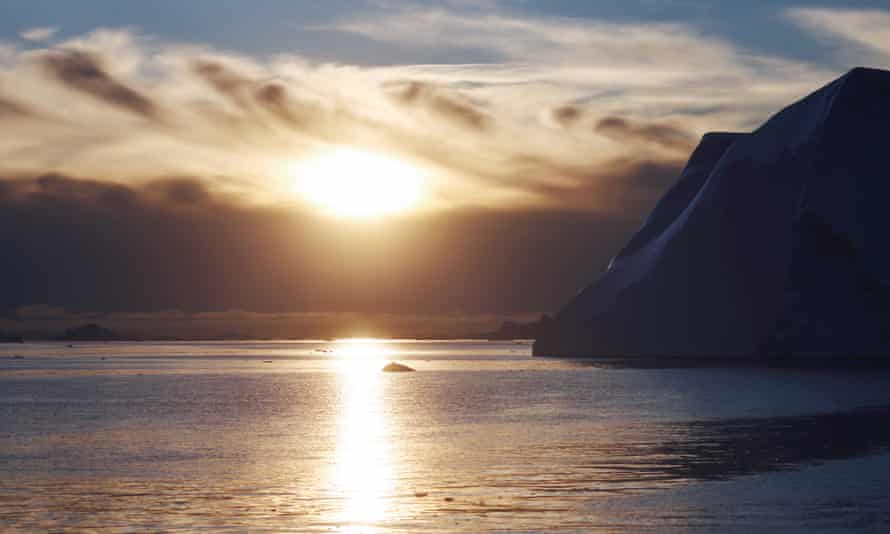
The hole in the ozone layer that develops annually is “rather larger than usual” and is currently bigger than Antartica, say the scientists responsible for monitoring it.
Researchers from the Copernicus Atmosphere Monitoring Service say that this year’s hole is growing quickly and is larger than 75% of ozone holes at this stage in the season since 1979.
Ozone exists about seven to 25 miles (11-40km) above the Earth’s surface, in the stratosphere, and acts like a sunscreen for the planet, shielding it from ultraviolet radiation. Every year, a hole forms during the late winter of thesouthern hemisphere as the sun causes ozone-depleting reactions, which involve chemically active forms of…
(CNN)President Joe Biden on Wednesday unveiled a new effort to help Australia acquire nuclear-powered submarines, a major step toward countering China as he worksto build international backingfor hisapproach to Beijing.The announcement came as part of a new trilateral partnership among the United States, Australia and the United Kingdom that the three countries’ leaders jointly revealed Wednesday afternoon.”The United States, Australia and the United Kingdom have long been faithful and capable partners and we’re even closer today,” the President said. “Today, we’re taking another historic step to deepen and formalize cooperation among all three of our nations, because we all recognize the imperative of ensuring peace and stability in the Indo-Pacific over the long term.”
The partnership kicks off what is expected to be a flurry of diplomatic engagements for…
PUBLISHED THU, SEP 16 20217:30 AM EDTUPDATED 6 HOURS AGOSalvador Rodriguez@SAL19SHAREShare Article via FacebookShare Article via TwitterShare Article via LinkedInShare Article via EmailKEY POINTS
For those who are already feeling the direct impact of global warming and can afford to relocate, climate change migration has begun.
Nearly half of Americans who plan to move in the next year say natural disasters and extreme temperatures factored into their decision to relocate, according to a survey conducted by Redfin.
One in 5 Americans believe climate change is already negatively impacting home values in their areas, and 35% of homeowners have already spent $5,000 or more protecting their homes against climate risk, according to Redfin.
WATCH NOWVIDEO45:19Living on the front lines of climate change — victims of fire and flood
Christy Gentry and her husband have been dealing with California’s wildfires for the past four years.
In 2017, the couple evacuated their Santa Rosa home for three weeks. In 2019, they were forced to cut a trip to Hawaii shortand get their animals and stuff out of their house as a fire approached.
“It was just one thing after another. It was smoke, it was the fire danger, the potential of fire danger, the potential of being evacuated,” Gentry said. “It changed the way we viewed our property.”
After so many fires, Gentry and her husband rented a home in Bend, Oregon, in August 2020 so they would have somewhere to go during the California fire season.
Fires finally hit their property in September 2020. Although they didn’t lose their home, one of their barns burned down and they couldn’t get back to their property until mid-November. So Gentry and her husband bought a home in Bend in January 2021 and now split time between there and Santa Rosa.
“It comes down to feeling safe,” Gentry said. “Everybody has a little PTSD — I won’t even light candles in my house.”
Christy Gentry is among a growing number of homeowners citing climate change as a primary reason for moving.Courtesy of Christy Gentry
‘Wealthier people can adapt’
Gentry is among a growing number of homeowners citing climate change as a primary reason for moving.
Nearly half of Americans who plan to move in the next year say natural disasters and extreme temperatures factored into their decision to relocate, according to an April survey conducted by real estate brokerage firm Redfin.
Last month, the United Nations’ climate panel delivered a dire report calling for immediate action. The agency warned that limiting global warming to close to 1.5 degrees Celsius or even 2 degrees Celsius above pre-industrial levels “will be beyond reach” in the next two decades without rapid and large-scale reductions in greenhouse gas emissions. The report said that at 2 degrees Celsius, heat extremes would often reach critical tolerance thresholds for agriculture and health.
One in 5 Americans believe climate change is already negatively impacting home values in their areas, and 35% of homeowners have already spent $5,000 or more protecting their homes against climate risk, according to Redfin. Meanwhile, 79% of Americans said they would be hesitant to buy a home in areas with increasing frequency or intensity of natural disasters, 75% said they’d be hesitant to buy in an area with extreme temperatures and 76% said they would be hesitant to purchase in regions with rising sea levels, Redfin’s survey found.
“We know from these surveys that homebuyers, homeowners, homesellers — they’re recognizing the threat of climate change and it is impacting their home’s values and will impact their home’s values,” said Daryl Fairweather, Redfin’s chief economist.
At the same time, there’s no shortage of buyers for the properties that concerned homeowners are abandoning — in fact, Redfin found that more people are actually moving into areas facing high risk from climate change than out of them, according to an August survey.
Affordability is a major factor. According to Redfin, counties where many homes face high heat risk are less expensive on average.
“Climate change will definitely impact poorer people more than wealthier people,” Fairweather said. “Wealthier people can adapt. They can modify their homes to be more resilient … and they can also just pick up and move. You can sell your home and buy another home somewhere else pretty easily.”
After living in San Jose, California, for 39 years, Kathryn Kelly moved back to her hometown of Natick, Massachusetts, with her family to escape California’s wildfires.Courtesy of Kathryn Kelly
Fleeing fires and rising seas in California
Kathryn Kelly moved back to her hometown of Natick, Massachusetts, in August after more than 30 years living in San Jose, California, in the heart of Silicon Valley.
Kelly and her husband had grown concerned about the increasing frequency of wildfires surrounding the San Francisco Bay Area and the impact their smoke could have on the long-term health of their 13-year-old daughter.
“We want to make sure she doesn’t end up with lung cancer when she’s 20 from breathing that kind of air,” Kelly said.
Last summer, the family escaped the Bay Area fires by heading to their second home in Huntington Beach, in Southern California. Although they were able to get away, they also worry about the potential impact of rising sea levels on their second home. This summer, the family ended up getting caught near one of the California fires as they drove back to San Jose in June.
“The whole mountainside on the freeway was on fire, and it was super scary,” Kelly said.
These experiences prompted the family to move, and they settled on Kelly’s hometown of Natick. The family is no longer worrying about fires and is excited about how green and lush their new area is. Despite Massachusetts getting its own smoke from wildfires in July, Kelly said these concerns are exponentially higher in California considering its year-round drought conditions.
“We can’t escape the effects of climate change completely by moving to Massachusetts, but we lessen the impact on our health greatly with less smoke and smog year round,” she said.
The Covid-19 pandemic helped ease the way. Although Kelly had already been working from home for several years, her husband had not. But when the pandemic forced corporate workers out of the office and into remote work, his job gave them the flexibility to make a move as long as he remained in proximity to one of their offices.
“Even though Covid has been such a disaster, it was a pivotal time for us to say ‘This is it. This is our chance to do it,’” Kelly said.
Kim Romano decided to sell her Key West, Florida, property after being told that raising the home to avoid future floods would cost her $250,000 or more.Courtesy of Kim Romano
Giving up the flooding fight in Key West
The pandemic also played a role in Kim Romano’s climate change migration.
In July 2020, Romano left her home in Key West, Florida, for Seattle to be near her son during the pandemic.In 2019, Romano had received an estimate that raising her Key West home of 12 yearsby 7 feet to avoid future floods would cost her $250,000 or more. After arriving in Seattle and falling in love with the city, Romano decided she was going to relocate rather than paying to harden her Florida home.
“I decided that I just need to leave,” Romano said. “The mitigation costs for climate change are already starting, and it’s just going to be way too expensive. I don’t want to spend my money in that way, I’d rather be here in Seattle.”
Following that decision, Romano’s son bought her a home in Seattle in May 2021, and she is now in the process of selling her Key West home.
There are plenty of potential buyers. Consistent with Redfin’s findings that more people are moving into high-risk areas, Romano said that the market is hotter than ever. After buying the house for approximately $650,000 12 years ago, she and her realtor are going to list it for $1.2 million.
“Basically, it’s a great time to sell,” she said.
For Romano, who is retired, climate change is the last thing she wants to worry about as she enjoys her golden years. She’d rather just get ahead of it.
“I feel like this is the last quarter of my last quarter, and I’m going to make good use of it,” Romano said.
The capture of wild animals for domestic consumption not only poses a threat to protected migratory species but also significantly increases the risk of zoonotic diseases like COVID-19, according to aUnited Nations reportreleased Wednesday.
Hunting such animals for consumption within national borders istaking a toll on most terrestrial speciesprotected under the U.N.’s Convention on the Conservation of Migratory Species of Wild Animals (CMS), a news release accompanying the study said.
The report, published by CMS and the U.N. Environment Program, also found strong evidence linking “wild meat taking and consumption” to zoonotic diseases like the coronavirus that are transmitted from animals to humans.
“They’re kept in horrible cages where they’re stressed and suffering from trauma, and so their immune systems are suppressed — you almost couldn’t design a better way of encouraging pathogens, viruses, bacteria, parasites, to jump species,”…
A conservative radio talk show host and preacher in Denver who spoke out againstCOVID-19 vaccineshas died after contracting the coronavirus, one of his co-hosts announced.
Bob Enyart, who reportedly pushedunfoundedclaims about vaccines on his radio program and website, earlier this yearurged his followersto boycott the vaccinein an attempt”to further increase social tension and put pressure on the child killers.”
Fred Williams, one ofEnyart’s co-hosts,announcedhis death on Facebook on Monday.
“It comes with an extremely heavy heart that my close friend and co-host of Real Science Radio has lost his battle with Covid,” Williams wrote.
“Bob Enyart was one of the smartest, and without question the wisest person I’ve known,” Williams added. “All the while being exceedingly kind and humble, and always, always willing to listen and discuss anything you wanted.”
The Jefferson County, Colo., coronerconfirmedto The Washington Post…
Co-founders of Colossal, Ben Lamm (L), CEO and George Church (R)
A flashy new biotech startuplaunchedyesterday called Colossal is on a mission to make an elephant-woolly mammoth mashup — with the ultimate goal of promoting biodiversity and combating climate change, it says. The effort has gotten a lot of hype and big-name backers, but scientists who work in conservation are still pretty skeptical.THE SCIENCE BEHIND COLOSSAL IS IN VERY EARLY STAGES AND IS MIRED IN ETHICAL QUANDARIES
The science behind Colossal is in very early stages and is mired in ethical quandaries. The company won’t actually bring back a woolly mammoth, which hasn’t roamed the Earth in about 10,000 years. Instead, Colossal’s de-extinction effort…
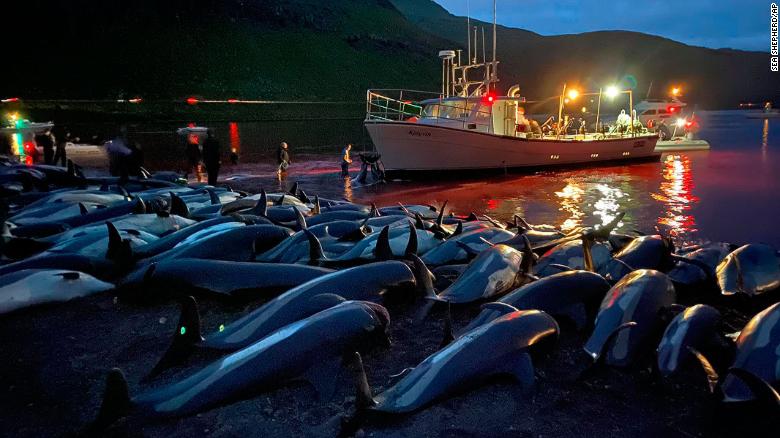
In this image released by Sea Shepherd Conservation Society, the carcasses of dead white-sided dolphins lay on a beach Sunday after being pulled from the water on the island of Eysturoy, which is part of the Faeroe Islands.Sea Shepherd via AP
COPENHAGEN, Denmark — The slaughter of 1,428 white-sided dolphins over the weekend, part of a four-century-old traditional drive of sea mammals into shallow water where they are killed for their meat and blubber, has reignited a debate on the smallFaeroe Islands.
The hunt in the North Atlantic islands is not commercial and is authorized, but environmental activists claim it is cruel. Even people in the Faeroes who defend the traditional practice worry that this year’s hunt will draw unwanted attention because it was far larger than previous ones and seemingly took place without…
By Jeevan Ravindran, Stephanie Halasz, Allegra Goodwin and Sharon Braithwaite, CNN
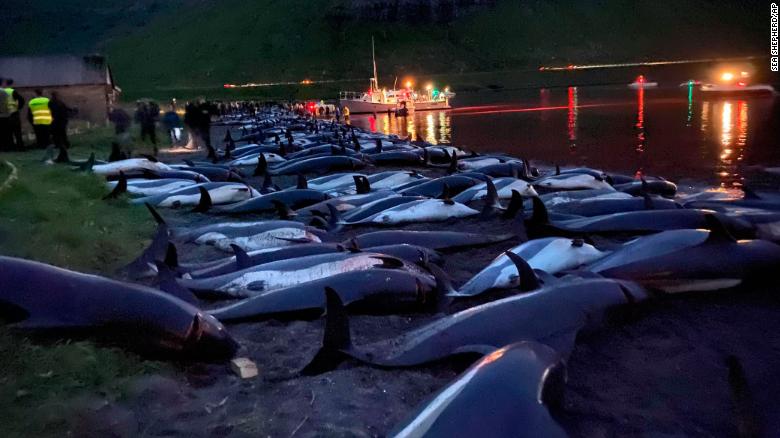
Updated 12:49 PM ET, Wed September 15, 2021The carcasses of white-sided dolphins lie on a beach after being pulled from the blood-stained water on the island of Eysturoy on Sunday, September 12, 2021.
(CNN)More than 1,400 white-sided dolphins were killed Sunday night in the Faroe Islands, in what local authorities said was a traditional whaling hunt.The killing has been denounced by marine conservation group Sea Shepherd as a “brutal and badly mishandled” massacre, and the largest single hunt in the Danish territory’s history.The organization said a super-pod of 1,428 Atlantic white-sided dolphins was corralled by speed boats and jet skis onto Skálabotnur beach on the island of Eysturoy, where they were then killed.
More than 1,400 dolphins were killed in the hunt.The Faroe Islands are an autonomous territory of the Kingdom of Denmark, lying about halfway between Scotland and Iceland in the Atlantic Ocean.
The annual whale hunt, or grindadráp in Faroese, has been a part of local culture for centuries — but it usually involves the hunting of pilot whales. Although it has long been criticized by animal rights groups, locals have defended the practice.
41-year-old Kristian Petersen, who is originally from the Faroese town of Fuglafjørður but now lives in Denmark, said he began participating in whaling at the age of seven — but in his village, dolphins were never targeted.”I have experienced that firsthand and also participated a bit,” Petersen told CNN. “As long as it has been for food only, I have supported it. But this recent catch that was this weekend, I’m against how it went on.
Petersen is one of several whaling supporters who have condemned Sunday’s killing, saying there were “so many errors,” including pursuing a large flock and prolonging the dolphins’ suffering by not having enough people on the beaches to kill them.
By killing whales, is Japan trying to revive a dying industry?In recent decades, the practice has come under strict regulation from the Faroese government, with guidelines for the authorization of hunts and how they should be conducted.Many, including Petersen, have questioned the legality of Sunday’s killing, with allegations that the local foreman, who is involved in regulating whaling in the area alongside the district administrator, was not informed in line with regulations. Sea Shepherd also claimed that several of those involved did not have the required licenses to participate.One foreman, Heri Petersen, has been quoted by local media outlet In.fo calling for accountability and confirming there were too few killers involved, meaning the dolphins struggled for breath on the beach until they were killed.The Faroese Executive Order on Hunting Pilot Whales and Other Small Whales, issued in January 2017, states either the district administrator or foreman must approve any hunts and gives them the responsibility to “ensure that enough people are available on shore to kill the whales.”Bjorg Jacobsen from the Faroe Islands Police told CNN the hunt had been legal, but he declined to comment further.
Iceland to let more than 2,000 whales be killed within the next five yearsIn a written statement, Faroese government spokesperson Páll Nolsøe told CNN the “notification about the sighting of the whales was given to the district administrator, and the district administrator, in consultation with the whaling foremen, designated the authorised whaling bay the whales should be driven into.”He said it “was organised and carried out in accordance with Faroese legislation” and “there were no breaches of law and regulations,” adding that this had been confirmed by the Faroese Ministry of Fisheries.Nolsøe added that everyone involved in killing must complete a pilot whaling course, and said hunting white-sided dolphins was a sustainable practice, with a yearly number of around 250, although it “fluctuates greatly” — making Sunday’s catch almost six times as large.”The meat from each whale drive provides a large amount of valuable food, which is distributed free in the local communities where the whale drives take place… the meat of the 1,400 dolphins caught on Sunday has likewise been distributed among the participants in the catch and the local community,” he added.However, Sea Shepherd alleged locals had said there was too much meat from Sunday’s hunt and there were fears it would have to be discarded, pointing to interviews published in Danish outlet Ekstra Bladet.
Striking new underwater traffic circle opening in the Faroe IslandsThis claim was contradicted by Steintór, a 61-year-old lobster fisherman from the village of Oyri, who did not wish to give his last name for fear of being targeted by anti-whaling activists. He said the meat from the dolphins would equal roughly 200 whales, and so was “not too much.””I think it’s very necessary to kill whales,” he said, arguing it was a sustainable practice favorable to the importing of beef. “And we do it in a very humane way, using veterinarian-certified tools … The problem in the Faroe Islands is that we have a public slaughterhouse. So everyone can see what is going on.”Although he said some locals were frustrated by the “not so well organized” hunt, and he was “surprised by the sheer number of the dolphins,” the killing itself was a “normal thing” and did not come as a shock, he said.Sea Shepherd further alleged that several dolphins had been run over by motor boats and “hacked by propellers,” resulting in reports to local police. The Faroe Islands Police did not respond to a CNN request for comment on the allegations.
“Considering the times we are in, with a global pandemic and the world coming to a halt, it’s absolutely appalling to see an attack on nature of this scale in the Faroe Islands,” Sea Shepherd Global’s CEO, Alex Cornelissen, said in a statement.The Faroe Islands Whales and Whaling body has continued to stand by the practice in recent years, stating on its website, “the average catch of around 800 whales a year is not considered to have a significant impact on the abundance of pilot whales, which are estimated at around 778,000.”




/cdn.vox-cdn.com/uploads/chorus_image/image/69860833/ben_george.0.jpeg)

 The carcasses of white-sided dolphins lie on a beach after being pulled from the blood-stained water on the island of Eysturoy on Sunday, September 12, 2021.
 More than 1,400 dolphins were killed in the hunt.The Faroe Islands are an autonomous territory of the Kingdom of Denmark, lying about halfway between Scotland and Iceland in the Atlantic Ocean.

 Exposing the Big Game