Florida teen speaks out after Covid-19 sent her to the ICU03:22
(CNN)With the more contagious Delta variant of Covid-19 sweeping across the country this summer, health care workers and officials are finding themselves returning to acrisis experiencedlast year when hospitals struggled to handle an influx of patients.In the Southeast, Georgia is now seeing its highest number of hospitalizations since the start of the pandemic, matching peaks experienced in January, according to US Health and Human Services Department (HHS) data.Dr. James Black, director of emergency services at Phoebe Putney Memorial Hospital in Albany, Georgia, told CNN’s Amara Walker Saturday that his hospital nearly doubled its ICU capacity yet is still faced with an overflow of patients.
“The emergency department is full and the hospital is…
The underwater cables that connect nations could go offline for months, the study warns.
A solar storm, or coronal mass ejection (CME), erupts from the sun in August 2012. (Image credit: NASA Goddard)
The sun is always showering Earth with a mist of magnetized particles known as solar wind. For the most part, our planet’s magnetic shield blocks this electric wind from doing any real damage to Earth or its inhabitants, instead sending those particles skittering toward the poles and leaving behind a pleasant aurora in their wake.
But sometimes, every century or so, that wind escalates into a full-blown solar storm — and, as new research presented at the SIGCOMM 2021 data communication conference warns, the results of such extreme space weather could be catastrophic to our modern way of life.
In short, a severe solar storm could plunge the world into an “internet apocalypse” that keeps large swaths of society offline for weeks or months at a time, Sangeetha Abdu Jyothi, an assistant professor at the University of California, Irvine, wrote in the new research paper. (The paper has yet to appear in a peer-reviewed journal).
“What really got me thinking about this is that with the pandemic we saw how unprepared the world was. There was no protocol to deal with it effectively, and it’s the same with internet resilience,” Abdu Jyothi told WIRED. “Our infrastructure is not prepared for a large-scale solar event.”
Part of the problem is that extreme solar storms (also called coronal mass ejections) are relatively rare; scientists estimate the probability of an extreme space weather directly impacting Earth to be between 1.6% to 12% per decade, according to Abdu Jyothi’s paper.
In recent history, only two such storms have been recorded — one in 1859 and the other in 1921. The earlier incident, known as the Carrington Event, created such a severe geomagnetic disturbance on Earth that telegraph wires burst into flame, and auroras — usually only visible near the planet’s poles — were spotted near equatorial Colombia. Smaller storms can also pack a punch; one in March 1989 blacked out the entire Canadian province of Quebec for nine hours.
Since then, human civilization has become much more reliant on the global internet, and the potential impacts of a massive geomagnetic storm on that new infrastructure remain largely unstudied, Abdu Jyothi said. In her new paper, she tried to pinpoint the greatest vulnerabilities in that infrastructure.
The good news is, local and regional internet connections are likely at low risk of being damaged because fiber-optic cables themselves aren’t affected by geomagnetically induced currents, according to the paper.
However, the long undersea internet cables that connect continents are a different story. These cables are equipped with repeaters to boost the optical signal, spaced at intervals of roughly 30 to 90 miles (50 to 150 kilometers). These repeaters are vulnerable to geomagnetic currents, and entire cables could be made useless if even one repeater goes offline, according to the paper.
If enough undersea cables fail in a particular region, then entire continents could be cut off from one another, Abdu Jyothi wrote. What’s more, nations at high latitudes — such as the U.S. and the U.K. — are far more susceptible to solar weather than nations at lower latitudes. In the event of a catastrophic geomagnetic storm, it’s those high-latitude nations that are most likely to be cut off from the network first. It’s hard to predict how long it would take to repair underwater infrastructure, but Abdu Jyothi suggests that large-scale internet outages that last weeks or months are possible.
In the meantime, millions of people could lose their livelihoods.
“The economic impact of an Internet disruption for a day in the US is estimated to be over $7 billion,” Abdu Jyothi wrote in her paper. “What if the network remains non-functional for days or even months?”RELATED CONTENT
If we don’t want to find out, then grid operators need to start taking the threat of extreme solar weather seriously as global internet infrastructure inevitably expands. Laying more cables at lower latitudes is a good start, Abdu Jyothi said, as is developing resilience tests that focus on the effects of large-scale network failures.
When the next big solar storm does blast out of our star, people on Earth will have about 13 hours to prepare for its arrival, she added. Let’s hope we’re ready to make the most of that time when it inevitably arrives.
LEE COUNTY — The Lee County Sheriff’s Office wants people to know that drivers who hit bald eagles need to notify authorities after a semi truck driver hit and killed one on Monday.
The incident happened just before 7 p.m. when Lee County deputies were called to 320th Street on Highway 27, nearArgyle, for a single-vehicle accident.
When deputies arrived, they found the driver of a semi truck who had hit and killed a bald eagle.
The driver told deputies he was heading northbound on Iowa 27 when the eagle came up from the shoulder of the road and struck the truck’s windshield, causing it to crack and cave in.
According to Lee County Deputy Jordan Maag, the driver seemed shaken up by the accident but was uninjured. The truck had no other damages besides the windshield and was driven away from the…
A Yellowstone National Park tourist on Saturday captured videofootageshowing a wolf repeatedly biting a grizzly bear’s butt.
The distant footage, captured by Gary Gaston in the northern portion of the park, also reveals a bear whose best defense seems simply to sit and become less vulnerable against the quicker wolf.
Gaston told FTW Outdoors that there was a large animal carcass – “probably an elk” – in a nearby thicket, which explains the presence of wolves, bears, and ravens in the same area.
Plant-based foods promotes “good” gut bacteriaShutterstock / Megan Betteridge
Plant-based diets cause men to fart more and have larger stools, researchers have found – but that seems to be a good thing, because it means these foods are promoting healthy gut bacteria.
Anecdotally, it is well-known that eating more plants – including fruit, vegetables, grains and legumes – creates bulkier stools and increases flatulence. However, few studies have measured these changes or related them to changes in gut bacteria.
Claudia Barberat the Liver and Digestive Diseases Networking Biomedical Research Centre in Barcelona, Spain, and her colleagues compared the effects of a Mediterranean-style diet mostly comprised of plants with a Western-style diet containing fewer fruit and vegetables on the guts of 18 healthy men aged between 18 and 38. Each participant was randomly assigned to follow one of the diets for two weeks, then after a break, they switched to the other diet for two weeks.
Advertisement
The men did a similar number of poos per day on the two diets, but each one was about double the size while they were on the plant diet. The men collected and weighed their own stools using digital scales and found they produced about 200 grams per day on the plant diet, compared with 100 grams on the Western diet.
This is because eating plants promotes certain types of bacteria in our guts that make food for themselves by fermenting plant fibre, says Rosemary Stanton at the University of New South Wales in Sydney, Australia. The added stool weight is made up of the spent bodies of these extra bacteria plus water and a small amount of undigested plant fibre, she says.
Some of the specific fibre-fermenting bacteria that became more abundant in the men’s guts while they were on the plant diet included Agathobaculumand anaerostipes and Agathobaculum butyriciproducens, an analysis of their waste showed.
The participants logged how many times they farted per day using a handheld counter and found they farted seven times more per day on average while on the plant diet than when they were on the Western diet. Each fart contained about 50 per cent more gas, as revealed when the researchers gave the men a test meal of stewed beans and measured subsequent gas production using balloons fitted to the men’s rectums.
Eating plants promotes farting because most fart gas is odourless hydrogen, methane and carbon dioxide that is produced by gut bacteria when they ferment plant fibre, says Stanton. The smell of farts comes from traces of hydrogen sulphide gas, which is a by-product of protein digestion.
Fibre-fermenting bacteria are known as “good” bacteria because they release short-chain fatty acids. These chemicals keep the large intestine healthy and protect against bowel cancer. Short-chain fatty acids can also be absorbed into the bloodstream where they protect against heart disease and diabetes by lowering cholesterol and regulating blood sugar.
The findings suggest that flatulence associated with eating more plants should be welcomed, says Stanton. “Our Western idea that farting is a sign of something being wrong is totally false,” she says. In most cases, “farting is a sign of a healthy diet and a healthy colon”, she says.
CNN)Firefighters in California made significant progress against theCaldor Fireover the weekend, allowing for some evacuation orders in the Lake Tahoe region to be downgraded. But as residents there began to breathe a sigh of relief, three new fires ignited in the state Sunday, according toCal Fire.Evacuation orders for the city of South Lake Tahoe were downgraded to evacuation warnings, nearly a week after thousands in the resort townclogged roadwayswhen officials told them get out because flames were racing into the area.
Colleges offer support as young people aim to devote their lives to battling the crisis
Hundreds of protesters march to the White House calling for climate action, including a Civilian Climate Corps.Photograph: Allison Bailey/Rex/Shutterstock
California isfacing a droughtso devastating, some publications call it “biblical”. Colorado now has “fire years” instead of “fire seasons”. Miami, which sees more dramatic hurricanes each year, is contemplating building ahuge seawallin one of the city’s most scenic tourist districts to protect it from storm surges.
“Once you learn how damaged the world’s ecosystems are, it’s not really something you can unsee,” says Rachel Larrivee, 23, a sustainability consultant based in Boston. “To me, there’s no point in pursuing a career – or life for that matter – in any other area.”
The attorney general said in a statement that federal prosecutors are still urgently exploring options to challenge the Texas law.
A flag flies in front of the Justice Department building in Washington, D.C. | Andrew Harnik/AP Photo
By ASSOCIATED PRESS
09/06/2021 12:49 PM EDT
WASHINGTON (AP) — The Justice Department said Monday that it will not tolerate violence against anyone who is trying to obtain an abortion in Texas as federal officials explore options to challenge a new state law that bans most abortions.
Attorney General Merrick Garland said the Justice Department would “protect those seeking to obtain or provide reproductive health services” under a federal law known as the Freedom of Access to Clinic Entrances Act.
Garland said in a statement that federal prosecutors are still urgently exploring options to challenge the Texas law. He said the Justice Department would enforce the federal law “in order to protect the constitutional rights of women and other persons, including access to an abortion.”https://55dec2c7e3577763e229746be3fab550.safeframe.googlesyndication.com/safeframe/1-0-38/html/container.html
The federal law, commonly known as the FACE Act, prohibits physically obstructing or using the threat of force to intimidate or interfere with a person seeking reproductive health services. The law also prohibits damaging property at abortion clinics and other reproductive health centers.
The new Texas law prohibits abortions once medical professionals can detect cardiac activity, usually around six weeks — before some women know they’re pregnant. Courts have blocked other states from imposing similar restrictions, but Texas’ law differs significantly because it leaves enforcement up to private citizens through lawsuits instead of criminal prosecutors.
Justice Department officials have also been in contact with U.S. attorneys in Texas and the FBI field offices in the state to discuss enforcing the federal provisions.
“The department will provide support from federal law enforcement when an abortion clinic or reproductive health center is under attack,” Garland said. “We will not tolerate violence against those seeking to obtain or provide reproductive health services, physical obstruction or property damage in violation of the FACE Act.”
New Delhi — Authorities in India’s southern Kerala state are racing to contain an outbreak of the Nipah virus. The virus, which is not related to the coronavirus behind the current global pandemic and is far more deadly, killed a 12-year-old boy in Kerala over the weekend, prompting stepped-up efforts to trace his contacts. New infections have been confirmed.
The boy was admitted to a hospital a week ago with high fever. As his condition worsened and doctors suspected inflammation of his brain (encephalitis), his blood samples were sent to the National Institute of Virology, where tests confirmed a Nipah infection. He died early on Sunday.
Two healthcare workers who came into contact with the victim were already showing symptoms of Nipah infection by Monday. They were admitted to a hospital and their blood samples sent for testing.
Authorities sealed off the area within about a two-mile radius of the boy’s home, and they were screening people for symptoms in all adjoining districts of Kerala state. The neighboring state of Tamil Nadu was also on high alert for any suspect cases of fever.
This is the second time in three years that a Nipah virus outbreak has been reported in Kerala, which is also reeling under a high rate of COVID-19 infections. The state reports about 68% of India’s approximately 40,000 new cases every day.
Fruit bats of the family Pteropodidae — commonly known as the “flying fox” — are the natural carriers of Nipah. They are known to transmit the virus to other animals including pigs, dogs, cats, goats, horses and sheep.
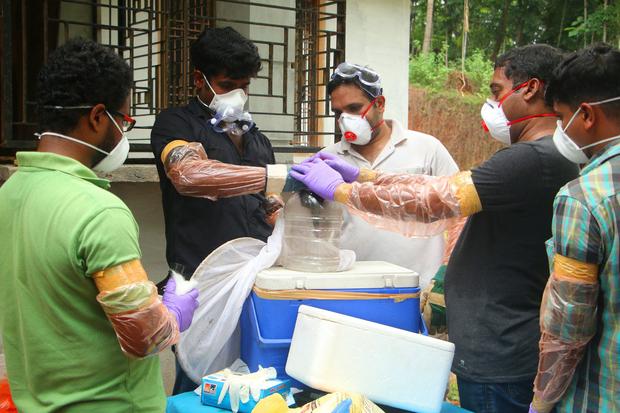
Animal Husbandry department and Forest officials deposit a bat into a container after catching it inside a well at Changaroth in Kozhikode in the Indian state of Kerala on May 21, 2018.GETTY
An infected human typically shows symptoms including fever and headache for anywhere between three days and two weeks, followed by a cough, sore throat and respiratory issues. The condition later progresses swiftly to swelling in the brain cells, leading to drowsiness, confusion, and then possible coma and death.
There is no cure or vaccine for Nipah yet, and patients are only given supportive medical care.
According to the World Health Organization, up to 75% of Nipah infections prove fatal. The mortality rate for the coronavirus, by comparison, is believed to be about 2%. About 20% of survivors experience neurological symptoms that can persist, including seizures and personality changes.
A wider threat?
The Nipah virus was first discovered in Malaysia in 1999 during an outbreak among pig farmers. Since then, there have been multiple outbreaks — all of them in South and Southeast Asia. In all, it is known to have killed more than 260 people.
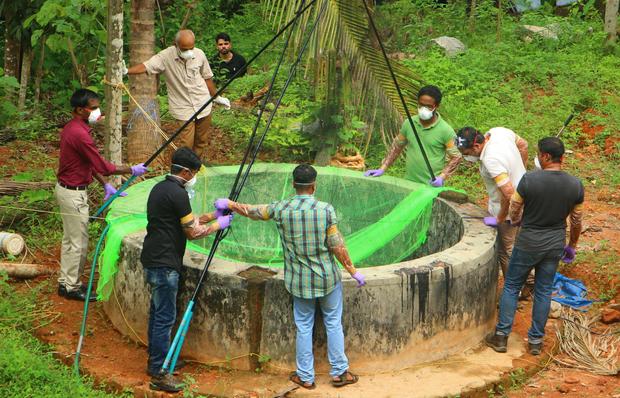
Animal Husbandry department and Forest officials inspect a well to to catch bats at Changaroth in Kozhikode in the Indian state of Kerala, May 21, 2018.GETTY
A 2004 Bangladesh outbreak was traced back to humans consuming date palm sap that had been contaminated by infected fruit bats. The last outbreak in India, which hit Kerala in 2018, killed 17 of the 18 people who caught it. Those infections were all traced back to fruit bats found dead in the water of a family’s well.
Nipah is considered less contagious than the coronavirus, but it’s much higher mortality rate, a longer incubation period of up to 45 days, and its ability to infect a much wider variety of animals all make Nipah a cause of significant concern for epidemiologists trying to predict and prevent the next pandemic.
Veasna Duong, head of virology at the Institut Pasteur research lab in Phnom Penh, Cambodia, has studied human-bat interactions in the region, and he told the BBC earlier this year that the close proximity that people and bats find themselves in at markets and other crowded places across Asia poses a serious risk.
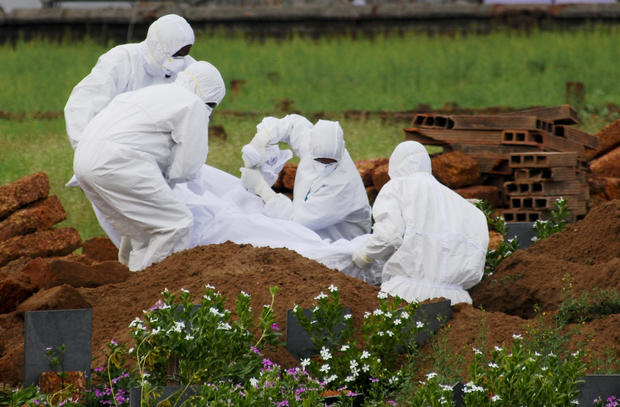
Paramedics bury the body of Valachekutti Mosa, who died of the Nipah virus, in Kozhikode, in the southern Indian state of Kerala, May 24, 2018.K.SHIJITH/AP
“This kind of exposure might allow the virus to mutate, which might cause a pandemic,” Duong told the BBC’s Future program, adding that in some circumstances, the virus could even find a host to carry it out of Asia.
“We observe [fruit bats] here and in Thailand, in markets, worship areas, schools and tourist locations like Angkor Wat – there’s a big roost of bats there,” he told the BBC’s Future program. “In a normal year, Angkor Wat hosts 2.6 million visitors. That’s 2.6 million opportunities for Nipah virus to jump from bats to humans annually in just one location.”https://www.cbsnews.com/embed/video/?v=4cf33c08c5e54dd0adb1328cd2a4181e#vVn7b9s4Ev5XDAHrHy5WrLfkLIKFkzTXYNs0SNoDDnFgUCJlc61XScnOA%2F7fb4aSLDlpm%2Baue01bUXzODL%2BZ%2BUZ50khV5kVCHrSjmCSSjTTK1jxi2hE05ArGtJG25pTl2tGTxkuWSu3o9kkrHwqcs84pjHMKTUL9iRsGTPdMMtEdLyI6sY1ANybOJIxC34uZBXPT4v6axRe4Ig%2F%2F%2BrfrrAJG8pNgvZhPLvP31oY5p2E0r67OXZgtk2oBM2ORp3q5ZDoR0ZKvmdSXVVbybKGvuagkkzC15GWCIp3D3AHMHbRzjwbv68mDbjJlK5gKjbhKkjetjEiWZzwiyee3rCp5ymRJ0kI7Mt1gYjqTwMA%2FIEklSMnzTDvyJ0H3%2BoGELIHdTfvIDGCDpH7PQFywd0oWsC1ciEQ7LsuykEez8WwchTJjG2keQoPDeSWPDqM8nY2XVTgb89lYzMaWYRmzseHOxiY8HY9ahuOFeuC4pu7YbqBPjNjQfcZ8axKRkE6C2bhcVmmYEZ7Mxp5j3NserLSYA9frTMxwYvgRNWlkB7ERWxPPszxvEs3GSn28KCaknpeCbXhGDd0yPAssoDc7Hf5VLEDB5Tc1sf9GTUwrMO593CIOzJBMiIlqRC7zKPFBm9h1bdNhJKZvUmU70goBPsQ2X0Syp5MsEvCsQ5Imi0Oez8akAD3WFu4O%2FjUbv%2BYPs3Gz8WzcOWWNCPVitW9xLlJSok8WeKQC1Gx8r6cFW3y5%2FgCLq2eibTabw8bktZkbkV51PCUKlxdpkUswzi6KQODgkQoZeK8OZdSgAdF9N6C6aTJLn1DT0g3DDGIWEMMIjc7bPUNPeVaVcFq%2BZgJ9BwHCmUApIFLdwpRBMwVGupfBbv4d3AIRLCs%2FoyCXJGVq48HH3ardficP9fDt%2Fnj3MvjU25UkST1V7wvwUuA7wAEruMwpbG1boBwjEt3cVe1FCrJBMIB2VcC1SrkzHZwwjSLoOUnyCMJUKSqGNv4imbipQhkJHjK6my6LPJO5aO9%2Bye6nZywmVYIAMEbwo6nek67Xnowcd%2BROYIBQvKR4U%2F8%2FT3i22gOGHxu%2Bf7g%2BjDepSA8zVgJswR8W4D5%2FRJLT4zXAZt5AZ96kjPmGhXNIDUMis82xaxm2aQ4jArNfg%2FgwTsji%2BDfrhKRRCA%2BWRgIeMikL9VCdX0v1gDSFjzgkFMcesggeWaUWEFbyYcpKcWwalj3spChEHjft3%2BzpP%2FN8kbCz6cXpzfRivjZgfC2y49vr6eXZp493Q7iX4nidksLE84gsnaHsqbQuepN%2Fn4P9Ms7gUrI5ON4c1L0yTo1T25%2BeQaQ4dXTn3bmvT88tVz95d3J6Ynpn54H7bghWgzst0Evn4JjHyvog3W%2FWOfx95prD9aKCnZ%2FUYzuUj8dPmL6ZmEv%2ByLbDJfjhKzsUmLxhGT62Q%2BWpx0%2FqsR3W2f%2F4qX5uh7B3ieFEnaJa2yEqyuUc3o%2Bf6ud2%2BBSncg4eR1K5%2FV1TzkdSlaIQJcgUfoATxCGYFX0D7YpJlv8kQUC8wMwDxMsBouUAsXKASDlAnBwgSg4QIweIkAPExwGiA6kI4ANcEAAy0vqnI0Zgz%2Fr16AVGUDtACcxorx56ECmoJWLlQCEF49meUoiW%2FUUvEQPjP4UZRWH2UPOjcI7ZAuECcxrcoHCP%2BNrHDsYJQM8rOxUN9Wvwo%2B1ivdZgSOtxyBZHuK7BT3NqjaXGCDWKcKTBk8qi3YKWim6huxQkWkEGUtjKUxnlgqk2pD%2FbMFwj8ABADqw6Pbm57OSOPOj6BwZJeMnkXJbzBYqIqtU9pJgTvKHL2Xi6mxOVCrymtetRFurvjVJFRN2EfBuJaVe9nvsPCQ3n9ynKnlb3VyIvIM88%2FMkgG2qW4zNKXM82fWq6DvBt07JtYnuodSinbT65ZpQLFr28YOWsOST2Iqma%2FL8hZbQElkV%2Fhpb8EZcQtU8vP0JC102DhKEXads75WFE0VS4tJItHrANfcuc1uSEZVRZT0FzL6W%2BoAKIsxp4CNkEzNnj%2FHuJG2gVdO0ozP0SqKJgACYGynQbzsYuUC8b%2FplAYp4Bi8t3GQkTTLN1%2BiWQ1aOETSsQXmD1cqs5th05TmTrvhkGuhOHrh4C9dVDN5oQZpuhF%2FuKMfSXtlSDCLkkdCAOB49ELIjoTVS1ETNtEtpRWJMlxzcobE4gHADJJsBJfRZE2m7JVRWegX6IBcMyoeTSDW8ApYMTHBl%2BN60tWYgShZccuA0ozQZlPojyrCQ8G1BGaPIwyHhBlnUBM8irMhSMrAYwDLSXk96O9ZXgYuAz86Z3FwGa4a6S5PKMrVFMlSIW7QSVFLC4xJuH53uOVPJW2%2BQioWga7LwB6KpCqemue5sdMP6CIwFFHUBSaYPSRY0r340dqER%2FTD7LHlFsDwCGK5oDsOzDOoynHBzI2VngJq%2BECnXgaYMmloSCZPSqCV9KhjbxocTzzhxA9RQ%2FlZ2yyNVIUi7RWI2tV0BUE2xAqMszoi5F2S%2BjLOUIA3VbejvQPtt725%2Bg8yxuLImGZXB3lIiHTo7m%2FBeDF1QNB4HjBZ7xYy7fXFljzkZ7NDLszasUXQyzLE96w7gAprAMAQKjVNv2yu3nxdSLigVbs3FtK31fXzCj3hpDB4CXy7puSSEgkqscDgZrNPfMUiTXNTr%2FjjNx38Ys%2F9V6FdVeFewN5du2LQIWRYmPEuIRK5s42KT22%2F8vKL%2FxCapHBmr%2FbmlIP3REKo%2F8rDn3sDYH9WpTnOZZzJXyUO2AT66wSTFqBZYHfv%2BVtC3I6Mgg6hcFWNXejno5DkknHA91FVMscVGThNunpg1zqpWyIlyM4Ey52AIVjAVaG1c9oplDNP5qgxZEVb9in1SRGKfwr6gNfkd5UKVnb3tSPd9e9WSPz%2BdJTp7PlLhj%2BoDmxuNrAKB3rDEWLlcKD7APJi%2F6JeMlrsK8n4fKtZ%2F63ZhiMaeWL%2FvVh7Fe51Ozw3nC7iH2qHDRuClIWiMCKSuuv7UtY%2BQad6NbYH8jq25Z5sg2sWF7IyvALqgUkAHfgXRRJcs8%2FdzHORCUDOjZmq0Uo4qMOIRMGtV4Z%2Ffv7qMlyRbsBoCm4rnlG3Zg1riMGNbydTcEQcc3J4rUdCpAiLHUKT8S%2BYWkIzXNgT78mLFT3%2Fp1CtjfUcAyXipgv12BPbHtXye2%2Bz2xzWdiX2TR%2Fyg1iIHC%2FCrJ%2FeeS3yJh80zPxXKxabpd0%2BuaftcMuuZk1%2FSMrml2Tatr2l2zO83rTvO607zuNK87zetO87vT%2FO40vzvN707zu9P87jS%2FO83vTvMDiCZ1QLgBerV6%2BNb97d%2BQrOf9skuafM%2BtLRvgpYQripch7Jt0J8qThBSSvUshXZ3xdVtNSFZesxg46%2FILJJsE6oybJC%2B7T4AwfpowIp6N1osplxhGL%2BBwTpIPOem%2BBb4cOs1TSMl10qmXM1XY3ICFEnbNvlYM69n%2B0BRz1jWUZkwoMzan1l8Pr3fpAlMRoZ8EVVT9rl39HuoHJk44pf3FtVxKp90FfcpQzu9r1VgIf%2F2D2mm7OVMKji1Y%2FQW10bw%2B%2FJoVDOu8KW1tiRSyrmyYqKsB0%2FZcSi07MBTuJJj2X1CN7SV8DfO49tOXqplt%2FSB7xcO3vl%2BgyRqiiXQLX2GHhlkTqlO%2B1jkFuibIg%2FqEHOX5ij%2BTYU6o1o7cMIFc6QoIjWKU%2BHEW9qkHFWEElifVlSFjqcKb3iswwHMuZHmFlVjnN3gh2%2B1%2FAA%3D%3D
The WHO says in its note on the Nipah virus that, “the risk of international transmission via fruits or fruit products (such as raw date palm juice) contaminated with urine or saliva from infected fruit bats can be prevented by washing them thoroughly and peeling them before consumption. Fruit with signs of bat bites should be discarded.”






.png)

 Exposing the Big Game