Cyclist shot by hunter in Girona after being mistaken for wild boar
Reply

CORNELL UNIVERSITY
CORNELL UNIVERSITY MEDIA RELATIONS OFFICE
FOR RELEASE: Feb. 13, 2024
Kaitlyn Serrao
607-882-1140
https://www.eurekalert.org/news-releases/1034331
Trail cameras track ‘critically low’ New York bobcat population
ITHACA, N.Y. – With thousands of strategically placed cameras covering more than 27,000 square miles in central and western New York, biologists have evidence that bobcat populations remain critically low in central and western New York state.
Despite reports of recent recoveries elsewhere, bobcat populations in New York State displayed low occupancy, according to research based on years of observation by Cornell University and the New York State Department of Environmental Conservation. Their latest report was published February in Biological Conservation.
“Bobcats probably displayed one of the more concerning trends that we saw,” said lead author Joshua Twining, a postdoctoral researcher in the New York Cooperative Fish and Wildlife Research Unit, which is a U.S. Geological Survey unit at Cornell led by Angela Fuller.
Due to the very low occupancy observed, “it would be impossible for us to detect a decline in bobcat occupancy in this region without the species being extirpated,” Twining said.
He explained that New York has variable hunting and trapping seasons for bobcats, depending on the region. Some areas surveyed were not open to bobcat hunting or trapping and he said that places along the Pennsylvania border have been open to bobcat harvest since 2013.
The researchers also tracked occupancies for several other animals. White-tailed deer in the region flourish; red fox and coyote populations remain abundant and stable; and eastern wild turkey and gray fox numbers remain low.
Funding was provided by the New York State Department of Environmental Conservation, from a Federal Aid in Wildlife Restoration Grant.
For additional information, read this Cornell Chronicle story.
Cornell University has dedicated television and audio studios available for media interviews.
https://www.nbcwashington.com/news/local/3-police-officers-shot-in-southeast-dc-sources-say/3543511

Three D.C. police officers were shot and wounded outside a home in Southeast D.C. early Wednesday and a shooter continued to fire gunshots there, police say. The officers are expected to recover.
The officers were serving an arrest warrant for cruelty to animals when someone opened fire at about 7:30 a.m., police said.
The shooting suspect remained barricaded in the house as of 1:45 p.m., over six hours later. The suspect continued to shoot at police hours after law enforcement shut down several city blocks, forcing multiple schools into lockdown.
Young children could be seen getting police escorts into their school on Valentine’s Day.
“This remains an active situation, and the individual has continued to fire from that location,” Metropolitan Police Department Chief Pamela Smith said at a midday news conference.
“We are asking everyone to please stay out of this location until we are able to apprehend the suspect,” the police chief said.
Police were communicating with the suspect by phone.
Report by RSPB and British Trust for Ornithology finds H5N1 has caused a loss of 75% of the great skua population and a 25% decline in northern gannets
The age of extinction is supported by

@phoeb0Mon 12 Feb 2024 19.01 EST
The UK has lost more than three-quarters of its great skuas on surveyed sites since bird flu struck, according to the first report quantifying the impact of H5N1 on seabird populations.
The deaths have happened over two years, since the outbreak of H5N1 in 2021. The UK is internationally important for seabirds, home to most of the world’s 16,000 pairs of nesting great skuas.
Jean Duggan, a policy assistant on avian influenza for the Royal Society for the Protection of Birds (RSPB), said: “To have that level of loss in a population we have international responsibility for is quite catastrophic.
“Globally, it’s very significant and has a knock-on effect for populations across the globe,” she said.
The UK also has more than half of the world’s northern gannets, which declined by 25% in the sites surveyed, according to the report by the RSPB, the British Trust for Ornithology and other conservation bodies.
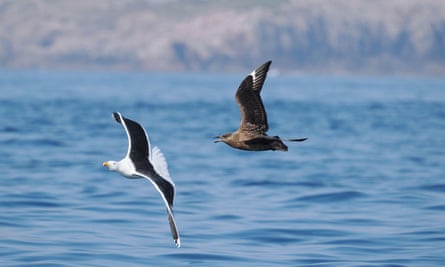
Gannets nest in a small number of large colonies, which means they are particularly vulnerable to the spread of disease. In Wales, the number of nesting northern gannets crashed by 54%.
“For the gannets and great skuas, we knew it was bad, but it’s worse than we thought,” said Duggan.
The report also found the virus had caused a 21% decline in the UK population of roseate terns, which is the UK’s rarest breeding seabird, with just one regular nesting colony.
Seabirds are typically long-lived animals that do not reach breeding age until they are about five years old. They generally only have a few chicks, so populations take longer to recover from an epidemic such as bird flu.
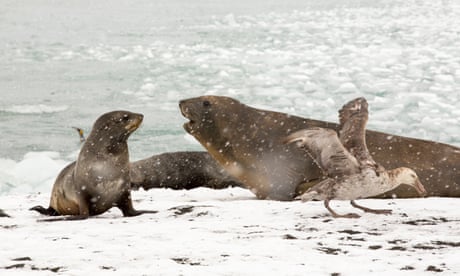
The H5N1 outbreak is thought to have killed millions of wild birds and has most recently been recorded among penguins in the Antarctic. H5N1 is “one of the biggest immediate conservation threats faced by multiple seabird species” across the UK and continental Europe, the report warned.
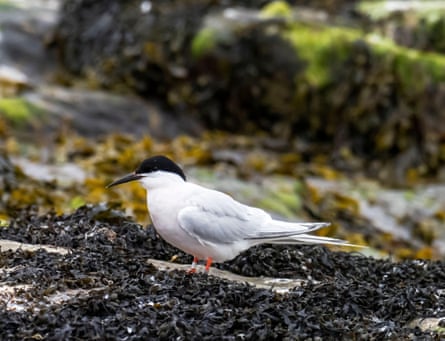
Populations of great skuas, northern gannets and roseate terns were increasing before avian flu struck, so researchers are able to pin the declines on bird flu. Declines in populations of sandwich and common terns – by 35% and 42% respectively – were also likely to be largely driven by bird flu, the report found.
In total, nine of the 13 species covered in the report had decreased by more than 10%, but many were already in decline before bird flu so it is not clear to what degree the virus was to blame.
Conservationists monitored seabirds for this latest report from May to July 2023. Even more birds died later in the summer, with black-headed gulls, guillemots and kittiwakes particularly badly hit.
This meant the impact of bird flu was “likely to be worse than indicated here”, the report warned. “There is also the potential for ongoing impacts as the disease progresses,” researchers wrote.
The latest Seabirds Count survey, published last November – which did not take into account the impact of bird flu – found almost 62% of seabirds were already in decline across the UK, driven by unsustainable fishing practices, the climate crisis, offshore windfarms and invasive mammal species.
Katie-Jo Luxton, RSPB’s director of conservation, said: “This new study shows that bird flu can be added to the long list of things that are devastating our seabirds.”
The RSPB is calling for action to reduce other pressures on seabirds so their populations are more robust and better able to cope with H5N1. Duggan said: “We had the census and now we have this. We need to act now; it’s about building resilience.”
In October, scientists confirmed that some wild birds had developed immunity to avian flu. They took blood samples of northern gannets and found that 30% of them had antibodies. About half of shags also had immunity. The sample size was small, and it remains unclear for how long the immunity will last.
 Exposing the Big Game