Lenawee County teen charged with open murder in November shooting death of hunter
Reply

Posted Tuesday, February 13, 2024 8:20 am
https://www.powelltribune.com/stories/wapiti-hunter-to-pay-15k-for-mistakenly-killing-grizzly,115947
By CJ Baker
A local black bear hunter who mistakenly killed a grizzly last spring must pay $15,000 in restitution and is barred from hunting over the next year.
At a Wednesday hearing in Park County Circuit Court, Patrick M. Gogerty of Wapiti pleaded guilty to a misdemeanor count of illegally taking a grizzly without a license. However, under a deal accepted by the court, Gogerty’s guilty plea was deferred and the case will be dismissed if he successfully completes a year of unsupervised probation.
Gogerty shot the bruin early on May 1 along the North Fork corridor in the Shoshone National Forest; he testified he didn’t realize it was a grizzly until approaching the carcass, and he then left the area.
Gogerty killed the bear within view of the Northfork Highway (U.S. Highway 14/16/20W), and passersby soon spotted and reported the carcass. Game Warden Travis Crane of the Wyoming Game and Fish Department was dispatched to the area around 9 a.m. He began investigating the killing in conjunction with the U.S. Fish and Wildlife Service, which oversees the region’s grizzly bears due to their status as a threatened species.
Meanwhile, bystanders’ photos of the dead, 530-pound boar were posted to social media. The posts drew widespread attention and eventual coverage from national outlets like USA Today, HuffPost and The New York Times.
Gogerty said he tried getting in touch with Game and Fish on the evening of May 1, but “they weren’t open,” he testified, “and I didn’t call.”
The retiree did call Game and Fish early the next morning — around 5:30 a.m. on May 2 — and reported his mistake; the Park County Attorney’s Office filed the criminal case on May 11.
“Gogerty should have turned himself in immediately,” North Cody Game Warden Travis Crane wrote in support of the charge.
At $15,000, the stipulated restitution came in higher than the $10,000 recently assessed on other local black bear hunters who immediately reported they had mistakenly killed a grizzly.
The Game and Fish wanted Gogerty’s hunting privileges to be suspended for three years, said Deputy Park County Prosecuting Attorney Larry Eichele, which would have resulted in the loss of any preference points the hunter had accumulated toward drawing a coveted license. However, as part of plea negotiations, Eichele reduced the suspension to one year and allowed Gogerty to continue purchasing preference points.
The prosecutor also agreed to let Gogerty accompany and potentially assist other hunters — something he’d let Gogerty do while out on bond last fall.

As he accepted the deal and imposed Gogerty’s sentence, Park County Circuit Court Judge Joey Darrah said that “if you’re like me, the loss of your ability to hunt is worse than the fine.” The judge noted that the prohibition will apply to every state that’s joined the Interstate Wildlife Violator Compact, which covers nearly the entire country.
Before joining the bench in late 2021, Darrah represented three different hunters who killed grizzlies, he said.
“I, myself, would not go hunting black bears where grizzly bears were, because it’s too easy to mistake them. And I wouldn’t allow my kids to go … bear hunting where grizzly bears were,” Darrah said. “It’s easy to make a mistake, but it’s a very costly thing.”
Although black bears can have darker fur than grizzlies, the Game and Fish warns that color is an unreliable way to tell the species apart. The department says grizzlies have a prominent shoulder hump, a dished facial profile, short round ears and long, straight claws, while black bears have a straight profile, tall, pointed ears and short, curved claws.
Gogerty reportedly told the Game and Fish that, until seeing the bruin’s claws, pads and head close up, he “felt confident it was a black bear as he could not see a hump on its back,” Crane wrote.
While the warden’s affidavit noted Gogerty’s delayed report, Judge Darrah told the defendant that “it sounds to me like you handled this appropriately.”
“I appreciate the way you handled it,” Darrah said.
The judge added that he hoped it would be a “live and learn” experience for the defendant.
“Definitely,” Gogerty replied.
Both he and his defense attorney, Brigita Krisjansons, made a point of thanking Eichele and Darrah for the case’s resolution.
Gogerty paid the first $1,250 of his restitution following Wednesday’s hearing and is set to make monthly payments going forward. In addition to the restitution, he must pay $70 in court costs and $150 for a crime victim compensation surcharge.
ENVIRONMENT13 February 2024
https://www.sciencealert.com/its-confirmed-a-major-atlantic-ocean-current-is-verging-on-collapse
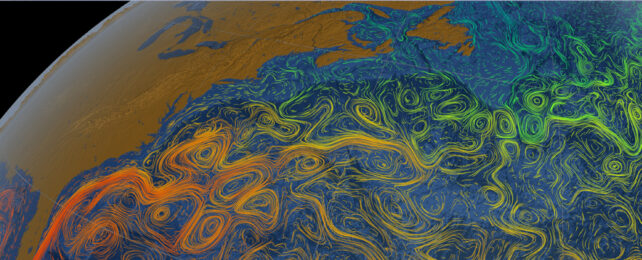 Currents closer to the ocean’s surface dancing across the Atlantic, colored according to sea surface temperature. (NASA/Goddard Space Flight Center)
Last year a concerning study suggested one of Earth’s major ocean currents is racing towards collapse. Unfortunately, new data now backs that up.
“The temperature, sea level and precipitation changes will severely affect society, and the climate shifts are unstoppable on human time scales,” the authors of the latest study warn in an article for The Conversation.
That’s a terrifying prospect, and one of the most important parts of the new study is an early warning system, identified by Utrecht University oceanographer René van Westen and colleagues.
This glimpse into the future could provide the world with at least some capacity to prepare for what’s to come.
“We were able to develop a physics-based and observable early warning signal involving the salinity transport at the southern boundary of the Atlantic Ocean,” Van Westen and team explain.
The Atlantic Meridional Overturning Circulation (AMOC) is a large system of ocean currents that transfers warm salty water northward. This water cools on its winding journey north, which makes it denser. As the cold water sinks, water from other oceans is pulled in to fill the surface, driving the circulatory system back down south again.
AMOC has been slowing down significantly since the mid-1900s.
With increasing contributions of freshwater from melting glaciers and greater rain, concentrations of salt in the sea water drop, and the saline water becomes less dense, disrupting the sinking process and weakening the entire physical cycle.
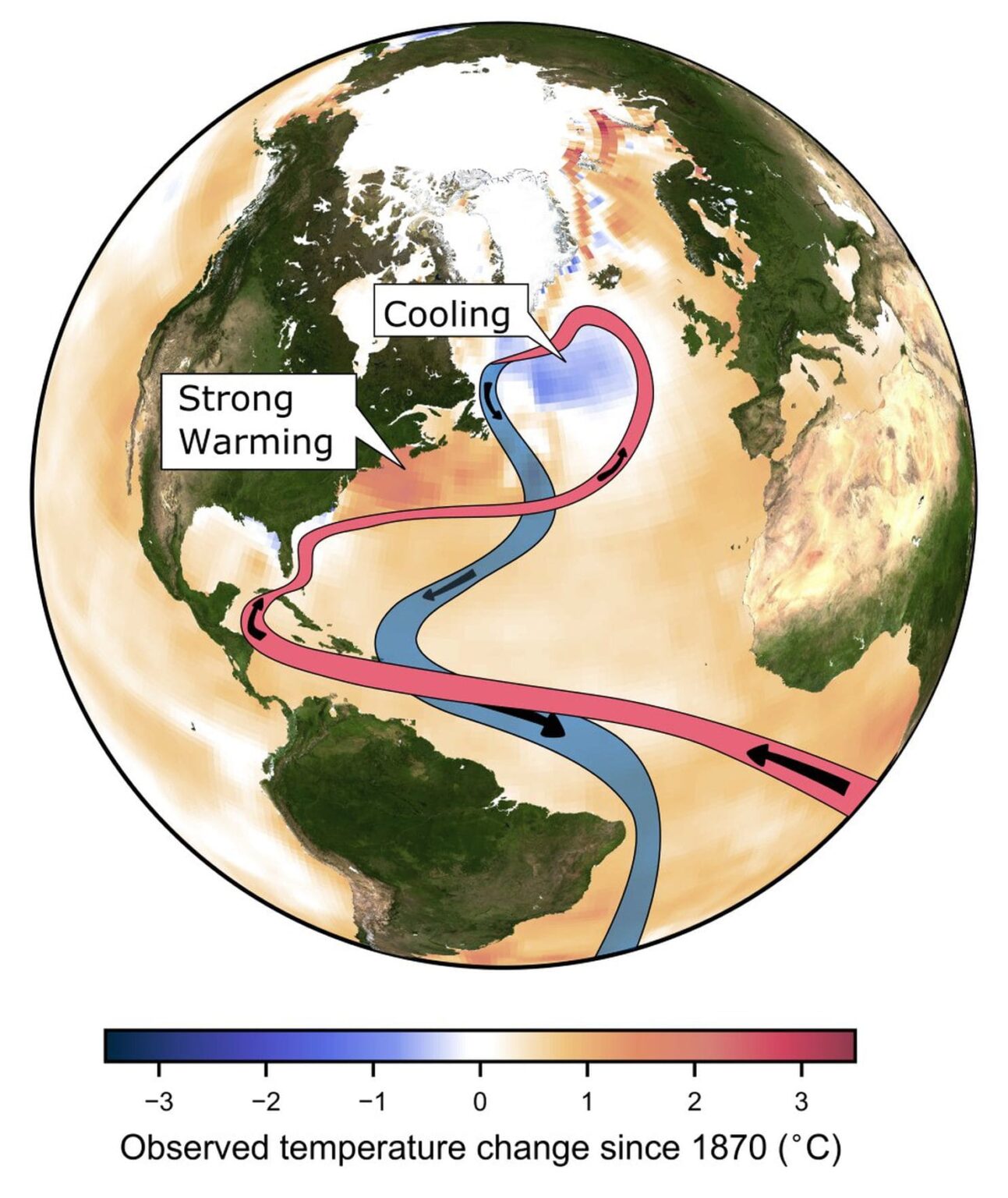
Now, by modeling these ocean systems, van Westen and colleagues have found a way to detect when the AMOC ‘tipping point’ is near: the decline in salinity will slow down at the southernmost boundary of the Atlantic.
“Once a threshold is reached, the tipping point is likely to follow in one to four decades,” say the authors.
AMOC has only been directly monitored since 2004, so it has not been long enough to understand the full trajectory of the current slowing trend. As a result, scientists have been using indirect indicators like salinity levels to try and fill in their knowledge gaps.
Van Westen and team have yet to amalgamate all the factors to accurately predict when the AMOC collapse will occur, but they believe that catastrophic moment is a lot closer than many current simulations suggest.
The new modeling explores the freshwater-induced tipping point itself, rather than trying to predict its timing. But the resulting data suggests AMOC is a lot more sensitive to changes than most climate models have accounted for.
“The new study confirms past concerns that climate models systematically overestimate the stability of the AMOC,” Potsdam University climatologist Stefan Rahmstorf, who was not involved in the study, explained for RealClimate.
AMOC impacts much of Earth’s climate, so it is one of the tipping elements in Earth’s climate system that researchers are most concerned about. Collapse of the AMOC happens cyclically over a million-year scale, and based on past occurrences, we know the Arctic should extend south during this time, leading to decreased temperatures in northwestern Europe by up to 15 °C, disrupting tropical monsoons and heating up the Southern Hemisphere even further.
The chain of reactions that follow will severely impact entire ecosystems and global food security.
“The new study adds significantly to the rising concern about an AMOC collapse in the not too distant future,” Rahmstorf told the Associated Press. “We will ignore this at our peril.”
This research was published in Science Advances.
 Exposing the Big Game