Indiana wants to change its rules for deer hunters. Here are the proposals, and how to comment
Reply

JANUARY 22, 2024 BY DONNY MOSS — LEAVE A COMMENT
Save
After receiving multiple complaints from constituents, New York City Council Member Bob Holden visited live animal markets in Queens and Brooklyn. In these storefront slaughterhouses, also called viveros, customers select the animals who they want to eat, and workers kill them on premises. Among the approximately 12 species sold in NYC’s 70 live markets are chickens, ducks, guinea fowl, turkeys, quails, rabbits, goats, sheep and cows. The large mammals are held in pens, and the rabbits and birds are stored in cages.
After touring the markets in Queens and Brooklyn, Council Member Holden, said he was “appalled” by what he found inside: “The conditions are horrendous and barbaric. The animals are packed in. We saw birds with open sores, and we saw sick and dead birds in the cages. I don’t know how anyone can buy these birds. We’re going to do some investigation to find out how this is allowed, and we’re going to try to put a stop to it. It’s unconscionable.”
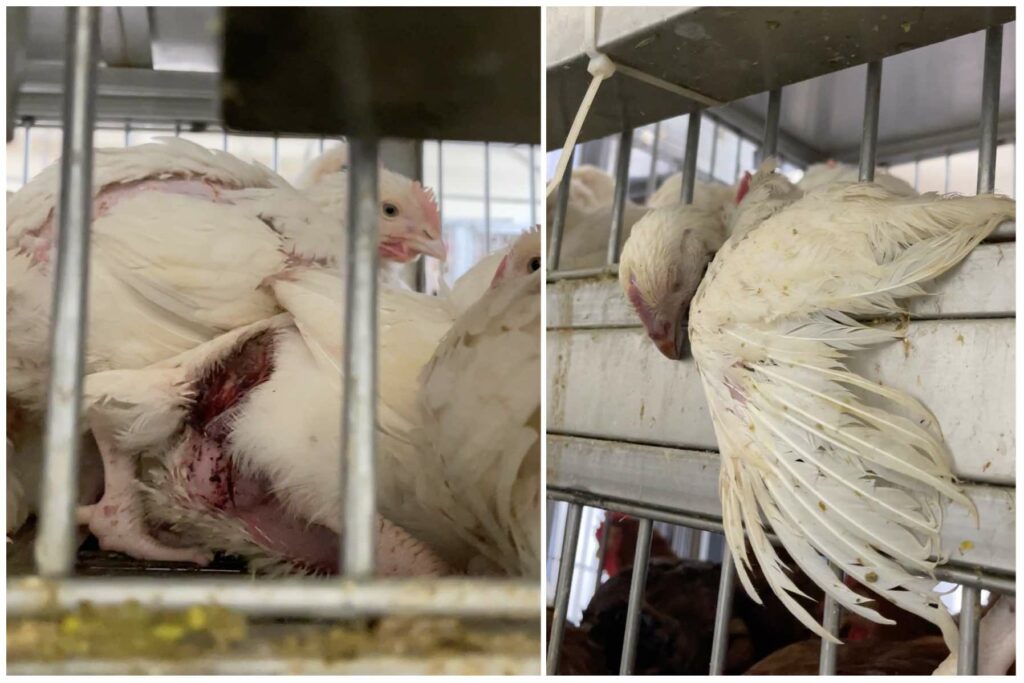
During an unannounced visit to a live animal market in Brooklyn, NYC Council Member Bob Holden encounters chickens with wounds and dead chickens mixed in with the living.
The city’s live animal markets were thrust into the national spotlight in early 2020 when the media reported that COVID was likely transmitted from animals to humans in a similar market in Wuhan, China. Despite this revelation, then Governor Andrew Cuomo deemed the state’s live markets “essential businesses.” Astonished by this designation, public health and animal welfare advocates staged protests in front of several of NYC’s markets to raise awareness of the public health risks.
During the first few months of the pandemic, media outlets reported on the ongoing efforts of advocacy groups to shut down the City’s 70 live animal markets
At the start of the pandemic lockdown, Dr. James Desmond, a veterinarian and infectious disease researcher based in Liberia, told TheirTurn, “Wet markets that sell live animals house different species in close proximity to each other and to humans. If different strains of influenza in any of these species combine to create a new flu strain, then a more lethal outbreak could occur, similar to the H2N2 pandemic of 1957.”
In response to constituent complaints, NYC Council Member Bob Holden visits a live animal market in his Queens district.
In 2021, Dr. Anthony Fauci, who was serving as the Director of National Institute of Allergy and Infectious Diseases, called for the closure of live animal markets in Asia, perhaps unaware of their presence in the United States. “I think they should shut down those things right away. It boggles my mind how, when we have so many diseases that emanate out of that unusual human/animal interface, that we don’t just shut it down.”
In 2022 and 2023, avian flu was detected in several live animal markets in New York City. Hundreds of birds were culled in an effort to contain the spread.
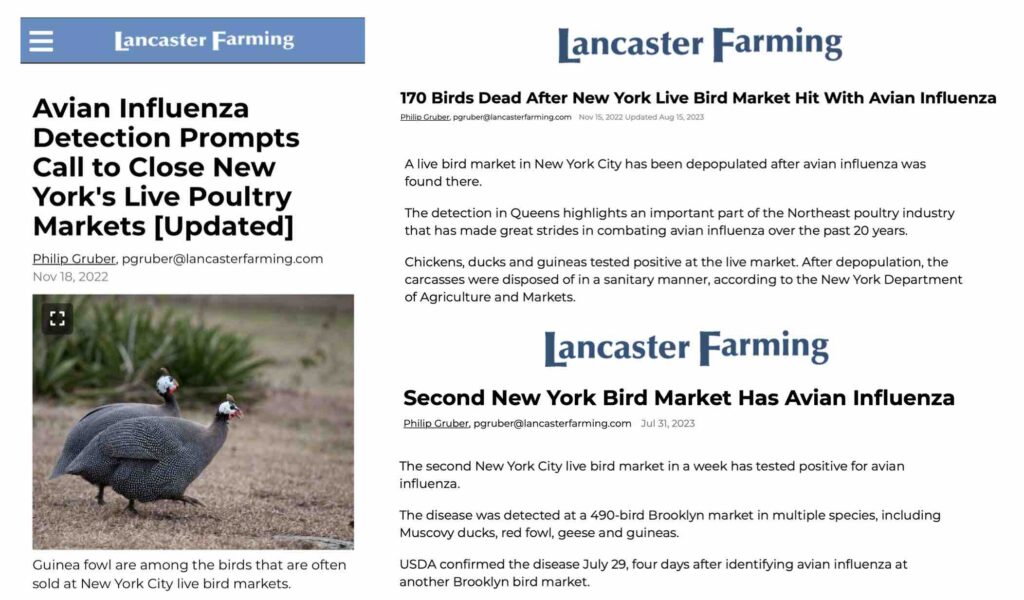
News coverage of avian flu outbreaks in live animal markets in NYC in 2022 and 2023
New York City’s live animal markets are regulated by the New York State Department of Agriculture & Markets. Based on the findings in Freedom of Information Act (FOIA) requests, the agency rarely cites the markets for violations of the city and state’s health and sanitation codes. It also rarely shuts down or suspends operations of the markets do have violations. Neighbors say that the lack of enforcement enables the owners to keep animals in squalid conditions and leave feces, urine and blood on the public sidewalks in front of the stores.
Two advocacy groups in NYC, Slaughter Free NYC and NYCLASS, have been campaigning to shut down the city’s live animal markets for several years. The Executive Director of NYCLASS, Edita Birnkrant, points to several reasons why they don’t belong. “In addition to violating health, sanitation and cruelty codes, many of the markets are likely violating zoning laws. Research conducted by The NYC Bar Association Animal Law Committee concluded that ‘many of the live animal markets are operating either without a certificate of occupancy or in potential violation of the uses permitted in the subject zoning district.’”
Map of live animal markets, or storefront slaughterhouses, in NYC created by the advocacy group Slaughter Free NYC
In recent years, several cows have escaped live animal markets and fled through congested city streets. In two cases, New Jersey-based Skylands Animal Sanctuary rescued the cows and gave them a forever home.
New York Times coverage of Freddie’s escape from a New York City storefront slaughterhouse
In posts on social media, many people credited their switch to a plant-based diet on the mainstream media coverage of the dramatic escapes and rescues. “I didn’t want to know about cows [being slaughtered] because I was addicted to cow ice cream,” said New York City resident Martha Mooney Waltien.” Then one day, Freddie ran from the slaughterhouse, and I saw his face. He was so scared, and he wanted to live. And I thought, ‘No more cheeseburgers.’”
New campaign from plant-based food brand, “Not So Happy Animals,” Aims to Transform the Food Industry Narrative

Have You Ever Seen a Happy Animal In the Logo of a Food Product? NotCo Unveils the Truth Behind the Fake Smiles (Photo: Business Wire)


January 24, 2024 09:24 AM Eastern Standard Time
NEW YORK–(BUSINESS WIRE)–NotCo, the leading food-tech company that leverages AI to create plant based food, is setting out to revolutionize the way consumers perceive the food industry with its groundbreaking campaign, “Not So Happy Animals.” The initiative aims to debunk the idyllic portrayal of happy animals in the logos of food products by shedding light on the stark contrast between these visuals and the actual conditions faced by animals in the food supply chain.
NotCo is challenging the conventional narrative by advocating for a shift towards plant-based alternatives that are not only delicious but also ethically and sustainably produced. The campaign encourages consumers to consider plant-based foods as a viable and compassionate alternative to traditional animal-based products.
Starting today, anyone in the US can go to nothappy.com and scan animal logos commonly found in public spaces. When they scan the website, the logo will be brought to life using AR and reveal a message about the animal in the form of a song. People will also be directed to discover and purchase one of the NotCo plant based products created by chefs with the help of proprietary AI.
Matias Muchnick, CEO and Co-founder of NotCo, expressed his enthusiasm for the campaign, stating, “If we really want to change the conversation, we need to be bold. We are using this simple yet powerful insight: ‘why do logos of happy animals actually sell dead animals?’ and start a proactive dialogue around the source of our food. The ‘Not So Happy Animals’ campaign goes beneath the surface to reveal, in an ironic way, the behind-the-scenes reality of the food supply chain, urging consumers to make informed choices that align with their values.”
As part of the “Not So Happy Animals” campaign, NotCo invites consumers to explore the range of plant-based products made that replicate the taste and texture of traditional animal-based foods. By making the switch to plant-based alternatives, consumers can contribute to a healthier planet while enjoying culinary experiences that are equally satisfying.
Join NotCo in transforming the narrative of the food industry. Follow @Notcous on social media and take a part in the conversation.
MEDIA
ALISON BROD MARKETING COMMUNICATIONS
notcokhc@abmc-us.com
Angeli Gabriel
Sat, February 3, 2024 at 12:13 PM PST·2 min read

PORTLAND – Seven California condors that were hatched and raised at an Oregon Zoo facility were recently released in central California, according to Oregon Zoo officials.
Officials noted the release marked an important step in the effort to save the species, which is the largest land bird in North America. For reference, by 1982, the number of California condors in the world had plummeted to 22.
In the more than 40 years since, California condors have been brought into human care to help the population bounce back from the brink of extinction.

One of those efforts includes the Oregon Zoo’s program at its Jonsson Center for Wildlife Conservation, where the seven recently released condors were born in the spring of 2022.
Zoo officials said the critically endangered birds were then released in December 2023 at a release site in San Simeon, California. They noted that the area is home to a growing population of free-flying condors inhabiting redwood forests and rocky shorelines.
OREGON ZOO’S HIGH-TECH ‘SMART EGG’ COULD HELP SAVE ENDANGERED CALIFORNIA CONDOR
The released birds were “soft releases,” officials said. This means that the birds, which were contained in flight pens with automated doors, were able to leave the pens on their own time.

“It’s so wonderful to see them take flight,” said Kelli Walker, the senior condor keeper at the Oregon Zoo. “We’ve had a lot of success with Oregon Zoo condors pairing off with their wild counterparts to hatch the next generation of free-flying birds.”
ENDANGERED CONDORS GET PROTECTION FROM DEADLY BIRD FLU IN ZOOS’ HISTORIC VACCINE TRIAL
In an announcement made Tuesday, the condors released in December seem to be thriving.
“The condors released last month are doing great so far,” said Joe Burnett, condor program manager at the Ventana Wildlife Society, which operates the condor release site in San Simeon. “They’re roosting in good spots and getting plenty to eat.”

Since 2003, more than 73 condors reared at the Oregon Zoo have gone out to pens for release, according to zoo officials.
Because of California condor conservation efforts like those by the Oregon Zoo, the number of California condors in the world has risen to 500, zoo officials said. Most of those birds are flying free.
Original article source: Critically endangered California condors released into the wild
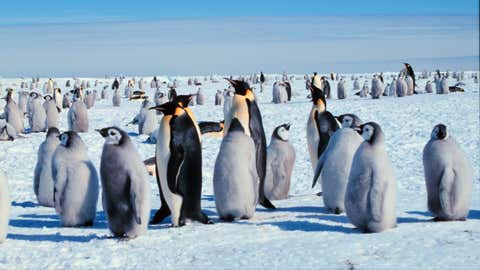
2024 seems to have begun on a somber note for wildlife conservationists as a concerning trend of ‘first-evers’ sparks chaos over the usually tranquil environs of Antarctica. In January, the first-ever polar bear death due to avian influenza came to light, with reports of the first penguin deaths due to the same bird flu following hot on its heels in February.
While we humans were engrossed in our own hellish lives amid the COVID-19 pandemic, a mini pandemic of sorts has been reigning terror over the wildlife in the Northern Hemisphere, around the Atlantic, Pacific Ocean and Southern Africa since 2022. A highly pathogenic strain of the bird flu virus has resulted in the deaths of hundreds of thousands of seabirds. And experts fear that the worst is yet to come.
Already, the deadly visitor H5N1, which probably reached Antarctica by air, water, or possibly both, has caused the death of several penguins in the region. This unwelcome guest, confirmed in two deceased gentoo penguins on Sea Lion Island, marks a chilling first for the Antarctic region. Further, at least 35 adults and chicks have also been reported as either symptomatic or dead.
At the Falkland Island, over 200 chicks, alongside a handful of adults, have succumbed, government spokesperson Sally Heathman told Reuters. Other seabird individuals, like the Southern Fulmar, Black Browed Albatross and the Skua, have also died on various islands of Antarctica, as per the Falkland Islands Department of Agriculture.
The situation is particularly concerning for penguins already facing diverse threats like climate change, pollution, and overfishing. This virus presents a unique challenge due to penguins’ lack of immunity and their densely packed colonies, perfect breeding grounds for rapid transmission. The devastating impact seen in South America, where thousands of Humboldt penguins perished, serves as a stark warning.
However, the ongoing events are far from surprising. Experts have been raising alarm about how we could be facing “one of the largest ecological disasters of modern times” if bird flu reached remote Antarctic penguin populations. And their predictions seem to be coming true, sadly.
The virus reached South Georgia in October 2023, infecting numerous bird species and marine mammals like seals and sea lions. The mass die-off witnessed in South America serves as a grim foreshadowing for Antarctica’s future.
While infections haven’t been confirmed on the mainland yet, experts fear the virus might be spreading undetected. The race is on to understand the scope of the outbreak and implement mitigation strategies to protect these vulnerable creatures. The fate of penguins and the entire Antarctic ecosystem hangs in the balance.
 Exposing the Big Game