Possibility of Wildlife-to-Human Crossover Heightens Concern About Chronic Wasting Disease
Reply

Share on facebook (opens in new window)
Share on twitter (opens in new window)
Share on linkedin (opens in new window)
Share on email (opens in new window)
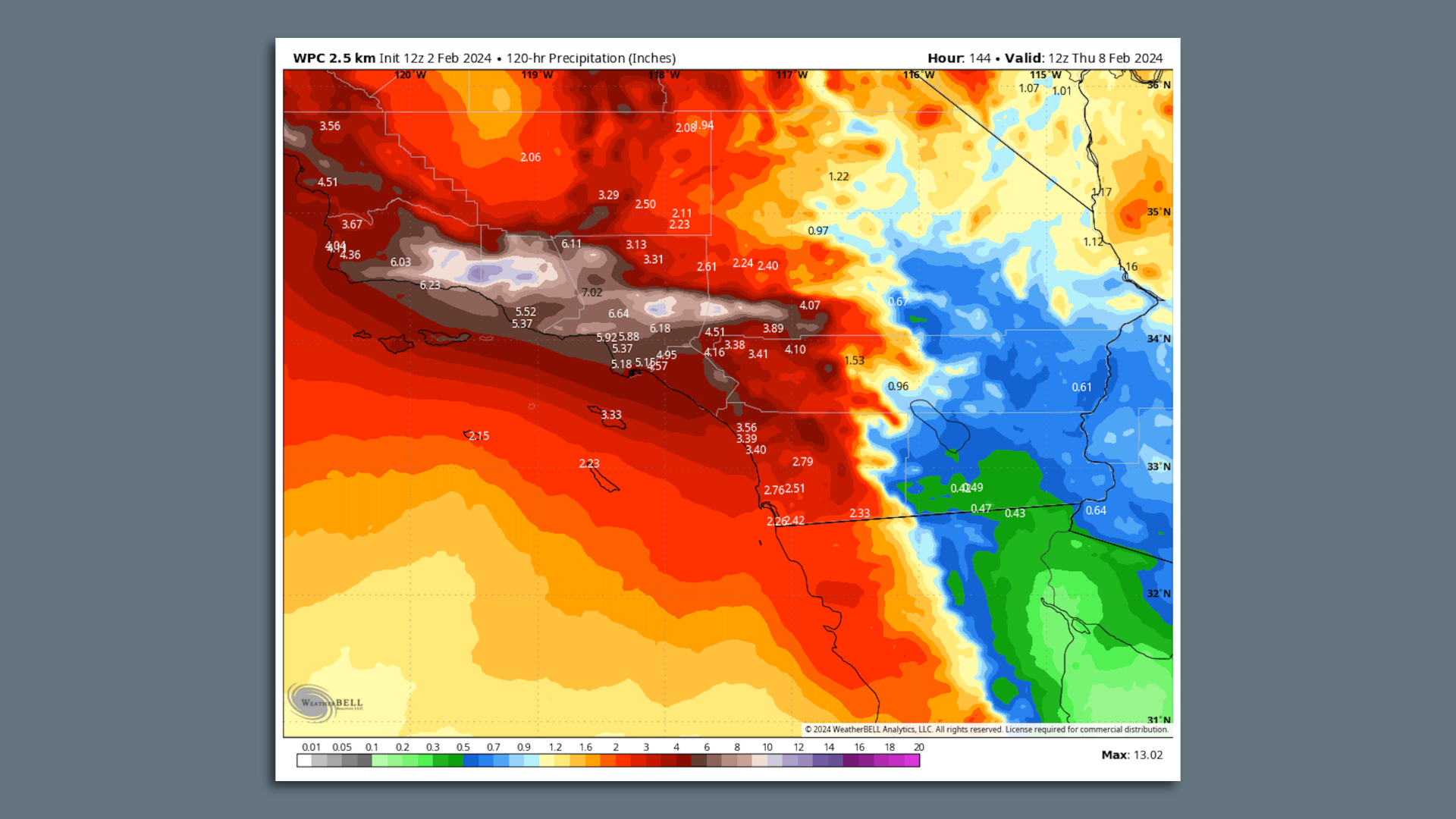
Californians are being urged to prepare for the strongest atmospheric river event of the season, which may deliver historic amounts of rain to SoCal.
Threat level: The National Weather Service warned early Friday that confidence is growing in “significant to extreme rainfall” from this storm across Southern California in particular.
What they’re saying: The National Weather Service forecast office in Los Angeles is calling the storm “very dangerous” and noting that flash flooding and river flooding will occur quickly on Sunday given that the ground is already saturated from recent rains.
State of play: The NWS said Thursday there is a 30-50% chance that some mountain areas could receive up to 15 inches of rain, and coastal and valley regions even see 6 to 10 inches of rain out of this storm, including LA.
Zoom in: The east-to-west oriented mountains in Southern California, known as the Transverse Ranges that are found in Santa Barbara, Ventura and Los Angeles counties, among others, could pick up a foot of rain as a firehose of tropical moisture is directed at them from the southwest.
Context: The storm will tap into a strong atmospheric river, which is a narrow highway of moisture at mid-levels of the atmosphere, and aim it at the California coast for a prolonged period.
Of note: 13.5 million people, including areas of LA County, are under a “moderate risk” for excessive rainfall Monday. The NWS is warning of significant urban, river and stream flooding, along with landslide dangers.
The bottom line: Californians won’t get much of a break between storms, but the NWS says preparations for the late weekend event need to get under way.
Editor’s note: This article has been updated with new forecast details.
https://imasdk.googleapis.com/js/core/bridge3.616.1_en.html#goog_1414012668
0 seconds of 47 secondsVolume 0%
First there were cafés that allowed pets. Then came cat cafés, where lattes took second place to furry fun with a feline. Now the latest craze in Japan is a cafe where you can have a slice of pig heaven (Tues January 30).Photos
18
https://apnews.com/article/japan-pig-cafe-trendy-animals-stress-8e8aa76abbae4c240c25258a0039ef4d
BY YURI KAGEYAMAUpdated 6:15 PM PST, January 29, 2024Share
TOKYO (AP) — First there were cafés that allowed pets. Then came cat cafés, where lattes took second place to feline interaction. The latest craze in Japan: The pig café.
“It was wonderful. Very relaxing and enjoyable,” said Brad Loomis, a software engineer from Pullman, Washington, after visiting Tokyo’s Mipig Café with his 21-year-old daughter, Paige.
They were among dozens of customers on a recent morning, taking selfies and breaking into huge smiles. The pigs, a miniature breed, trotted about the room, looking for a cozy lap to cuddle up.
ADVERTISEMENT
The pigs are surprisingly quiet, although they do snort now and then. They don’t like to be alone, making for great companionship. Unlike the stereotype, they’re very clean and don’t smell.
Customers pay 2,200 yen ($15) for the first 30 minutes in the company of the pigs. A reservation is required.
“Each pig is unique. Each one has his or her own personality. You may notice one may be strong-headed, and another may be gentle,” said Shiho Kitagawa, an executive at Mipig who refers to the pigs as “buta-san,” using an honorific.
The Mipig Café in fashionable Harajuku is among 10 such pig cafes the operator has opened around Japan. The first one opened in Tokyo in 2019. Two more are in the works for later this year.
ADVERTISEMENT
The animals, known as “micro pigs,” don’t get bigger than a corgi dog, even as adults. The cafés also feature adorable baby pigs the size of toy poodles.
Pig lovers say they make great pets. They can be purchased for about 200,000 yen ($1,350) from Mipig, have already been toilet-trained and are used to being with people. Micro pig food is also for sale. Mipig says it has sold 1,300 pigs as pets.
A drink dispensing machine is in the corner of the café, but hardly anyone was bothering to get a drink, being too occupied with the pigs.
ADVERTISEMENT
Foreign tourists visiting the café said they found out about it on Instagram and other social media. The café does not invest in advertising. They made sure to include a visit during their trip to Japan, along with the usual tourist spots like the ancient capital of Kyoto, they said.
Australian Ben Russell smiled when a pig finally climbed into his lap. Although this was his first encounter with a real pig, they have always been his favorite animal, he said, although he wasn’t sure exactly why.
Sophie Mo’unga from New Zealand, in Japan with her husband and two children, was a big hit with the pigs, with several of them fighting over her lap.
“They were cute. I think they were all keeping each other warm,” she said.
ADVERTISEMENT
The pig café is the latest in a series of animal coffee shops that have popped up in Japan, including ones that feature owls, hedgehogs, birds and even snakes.
Some people have raised ethical questions about whether the animals enjoy the experience as much as the humans.
“It must be stressful to be touched and fondled by a bunch of strangers,” said Sachiko Azuma, head of Tokyo-based PEACE, which stands for Put an End to Animal Cruelty and Exploitation.
“The animals have become tools for a money-making business,” she said.
ADVERTISEMENT
Her group mainly opposes animal experiments and “petting zoos.” Cafés tend to be tiny and don’t provide enough of a natural environment for cats or small pigs, and those that entrap wildlife are abhorrent, Azuma said. She approves of cafés run by shelters trying to find owners for abandoned pets.
Dr. Bruce Kornreich, professor of clinical sciences at Cornell University’s College of Veterinary Medicine in Ithaca, N.Y., said interacting with animals can lower one’s blood pressure and reduce headaches and the risk of cardiovascular disease. It also enhances a sense of well-being and helps people cope with stress, he said.
“How they do these things, I’m not sure we know the answer,” said Kornreich, who is also part of the Cornell Feline Health Center, which advocates the study and well-being of cats.
To the editor,
I am writing about the unnecessary death of a wild one-year-old filly in the bait trapping operation currently being conducted in the McCullough Peaks herd near Cody, Wyoming.
I have been visiting and observing and photographing the wild horses in this herd 2 – 3 times per year since 2004. When the BLM’s plans for this bait trapping were announced, I commented against it and encouraged others to do so as well because this is an aging herd, with a significant portion of the horses being over 20 years old, and the likelihood that at least 10 would die over the winter. Since summer, 10 horses have already died this winter, bringing the count to be only 171 wild horses. The herd’s numbers have been successfully kept in check using PZP birth control. And in the BLM’s Environmental Assessment Plan, there was no range data, nothing to show if the horses were causing range degradation, and thus a need for removal.
The time of year is also critical. In the Cody Resource Management Plan, record 4151, it says “apply seasonal restrictions from February 1 to July 31 to prevent foal abandonment or jeopardy of wild horse health and welfare, as appropriate, to surface and disruptive activities in the McCullough Peaks HMA” and record 4154 states, “Avoid wild horse gathers 6-weeks before or 6-weeks after peak foaling season. To the extent possible conduct wild horse gathers in the fall, after peak foaling season has occurred.”
It is now February 1. They should not be capturing any more horses.
Regarding the tragic events of January 24, the BLM captured 10 horses. They were only supposed to remove horses between one year old and five years old. They separated a four-month-old, a five-month-old and two yearlings from their mothers, released the mothers, then left the foals and yearlings alone, unmonitored, overnight, and one of them, a filly named Kat Ballou, was found dead in the morning with an acute head and neck injury. The excuse from the BLM was that they were quiet when BLM staff left. I contend that anyone who knows anything about wild horses or domestic horses knows that what they did was negligent and wrong. These youngsters had never been without their mothers. They had never been penned up in a corral before. This was a dangerous situation to put these young horses in. I own three mustangs myself, one of whom came from McCullough Peaks after the 2009 helicopter roundup, and these horses need to be allowed to become accustomed to being confined in a pen or corral. They can become injured if panicked. I have owned horses for over 50 years.
The lead on this bait trap gather is inexperienced with wild and domestic horses. He made a decision that resulted in the death of one of these horses that did not need to happen. Because BLM staff has not admitted that they have done anything wrong, I am very concerned that there will be more deaths as this bait trapping continues. This ill-conceived and ill-managed bait trapping should be stopped now.
Carol Walker,
Colorado
 Exposing the Big Game