Missoula man runs-down wolves, brags on Facebook
1

BY PROJECT COYOTE | APR 15, 2024 | IN THE NEWS, MEDIA RELEASE
April 15, 2024
Media Contacts: info@projectcoyote.org, 415.326.4110
LARKSPUR, CA — Wildlife Services, often known as the killing arm of the U.S. Department of Agriculture (USDA), just published their 2023 program data detailing the number of animals killed and the methods used. The numbers were as staggering as always with 1.4 million animals killed nationwide.
The USDA’s Wildlife Services program has been using indiscriminate and inhumane tools to kill wildlife across the country for over a century, including traps, snares, poisons, and aerial gunning. Wildlife Services claims that its goal is to allow people and wildlife to coexist, but nothing could be further from the truth. Instead, they use public taxpayer dollars to kill millions of wild animals held in the public trust, damaging ecosystems and putting public safety and health at risk. Wildlife Services wasn’t created to serve wildlife—it was created to kill wildlife largely at the behest of commercial agriculture.
“The USDA Wildlife Services program has failed to integrate the best available science and shifting public attitudes toward wildlife; instead they continue to emphasize lethal, cruel and often indiscriminate killing methods for addressing livestock-wildlife conflicts,” says Camilla Fox, founder and executive director of Project Coyote. “This federal agency has an opportunity — and a public duty — to bring its program into the 21st century by shifting its focus to humane, ecologically sound, science-based nonlethal conflict mitigation policies and practices.”
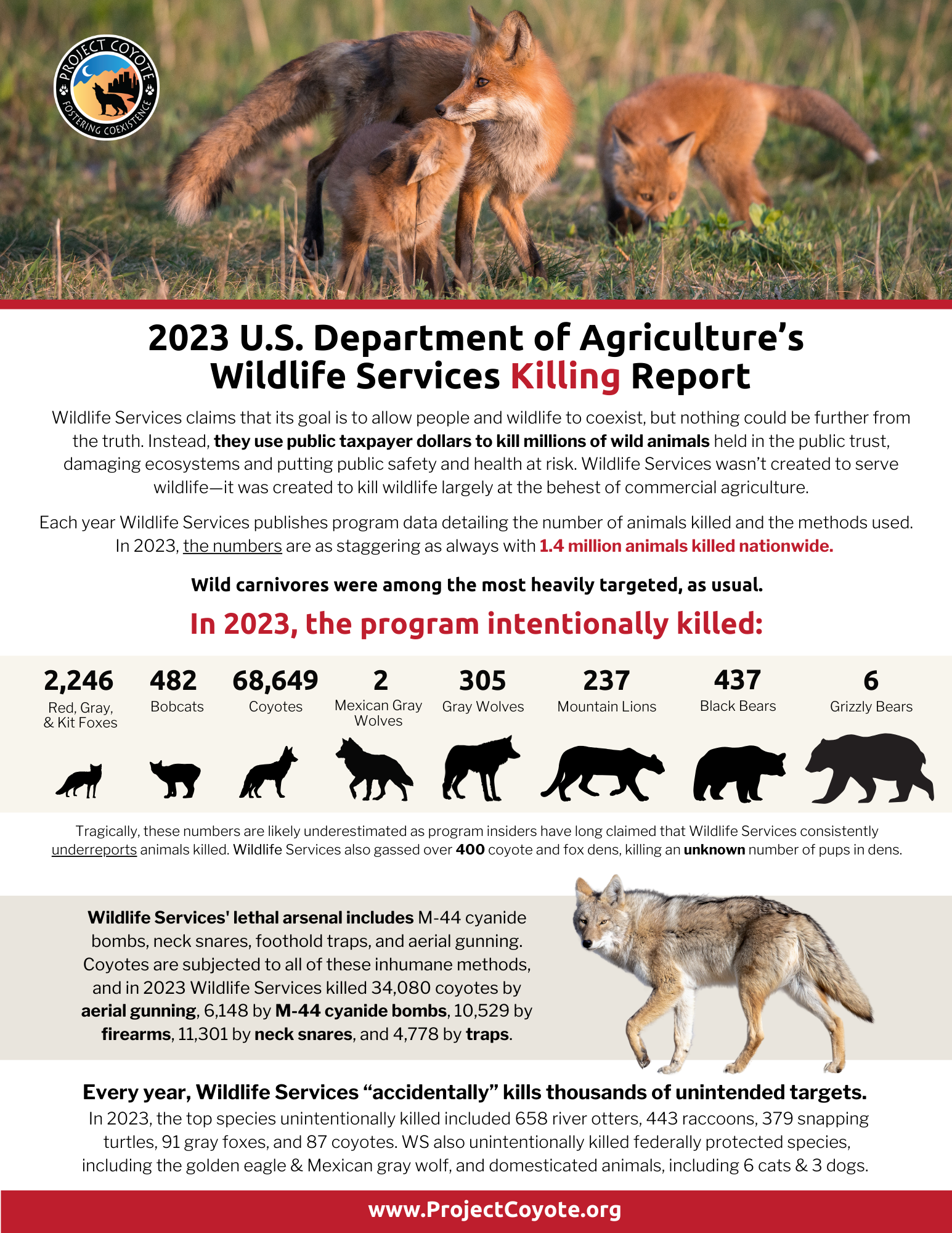
In 2023, wild carnivores were, as usual, among the most heavily targeted species, with the program intentionally killing 68,649 coyotes, 305 wolves, 2 Mexican gray wolves, 237 mountain lions, 437 black bears, 2,246 foxes (including red, gray, and kit species), 482 bobcats, and 6 federally protected grizzly bears. Wildlife Services also gassed over 400 coyote and fox dens killing an unknown number of pups in dens.
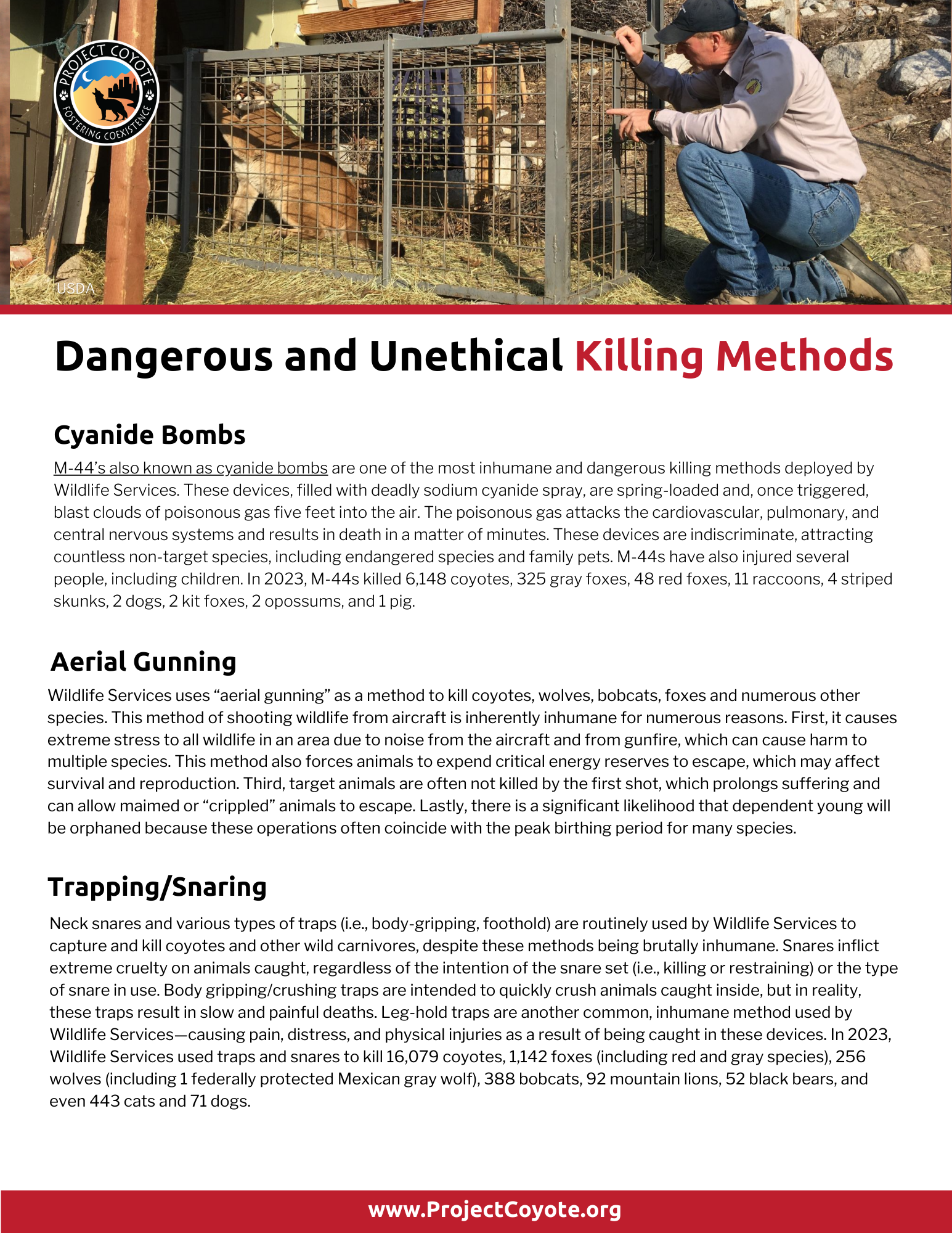
Wildlife Services uses M-44 cyanide bombs, neck snares, foothold traps, and aerial gunning in their “lethal arsenal”—methods as cruel as they are indiscriminate. These reckless practices resulted in the unintentional killing of federally protected species including the golden eagle and Mexican gray wolf, as well as many other species including 658 river otters, 443 raccoons, 379 snapping turtles, and 91 gray foxes. Even our companion animals are at risk, with numerous cats and dogs meeting their untimely end from Wildlife Services.
“Year after year Wildlife Services, a federal taxpayer funded program, kills millions of wild animals, using archaic lethal methods such as aerial gunning, snares, and poisons, that endanger the public and cause immense animal suffering,” said Renee Seacor, carnivore conservation director for Project Coyote. “It’s past time for Wildlife Services to abandon their outdated practices and replace this killing with ethical, science-based conflict resolution methods”
Our annual Wildlife Services Report details the numbers of wild carnivores lost in 2023 and the dangerous and unethical killing methods used to accomplish this killing.
Project Coyote has been working for nearly 16 years to reform and raise awareness about the USDA’s Wildlife Services program. Recently, alongside the Animal Legal Defense Fund, Center for Biological Diversity, the Animal Welfare Institute, and WildEarth Guardians, we petitioned the USDA to adopt a comprehensive regulatory framework to govern Wildlife Services. We are still awaiting a response to this petition.
In California, Project Coyote and allies have been successfully challenging Wildlife Services activities county by county, persuading Marin, Mendocino, Sonoma, Shasta, and Siskiyou counties to end their contracts with Wildlife Services. Most recently, Plumas and Sierra Counties also suspended their Wildlife Services contract after Project Coyote and allies sued in 2022.
We also continue to advocate for the removal of some of the most inhumane and dangerous killing methods used by the program, including M-44 cyanide bombs. Late last year, due to years of consistent pressure from wildlife advocacy organizations, the Bureau of Land Management (BLM) announced a ban on the use of M-44s by Wildlife Services on 245 million acres of BLM managed lands. In June of last year, U.S. Representatives Huffman (D-CA), Steve Cohen (D-TN), and U.S. Senator Jeff Merkley (D-OR) reintroduced “Canyon’s Law” (H.R. 4068/S. 1940)—named after a 14-year-old boy who tragically lost his dog and was injured due to an M-44 device. The legislation would completely ban the use of M-44 devices on all federal and state public lands. The bill has been referred to the relevant House and Senate committees with no hearing date scheduled. Project Coyote will continue advocating for this critical legislation until it becomes law.
Show audio player
Wyoming just gave us the clearest example possible of why the state is unfit to oversee the recovery of gray wolves: Cody Roberts’ $250 fine.
By now, most people know that Roberts ran over a wolf with a snowmobile, taped its mouth shut, showed it off at a bar and then shot it. His behavior is despicable and horrifying, but the fact of his paltry penalty is further evidence that wolves need federal protection.
When a state entity that is charged with providing the protection of wildlife allows, even justifies, animal cruelty, this entity demonstrates their inability to responsibly manage carnivorous animals. Wolves are designated as “predatory animals” across 85% of Wyoming, exempting them from the standard limits on killing and seasons that apply under state wildlife management principles. The exclusion of “predatory animals” in Wyoming from protections against animal cruelty, ostensibly to shield the livestock industry, stands in stark contrast to scientific findings that demonstrate the ineffectiveness and counterproductive outcomes of lethal predator control measures.
https://embed.audiocdn.com/?feed=aHR0cHM6Ly9mZWVkLmNkbnN0cmVhbTEuY29tL3pqYi9mZWVkL2Rvd25sb2FkLzE2L2U3L2ZiLzE2ZTdmYjUyLTczNjItNGVhMC05YTJjLWE1NjdkMDk5NzU5Yi54bWw=&pbg=EFEFEF&lbg=F9F9F9&pt=353D58&st=676E85&bbg=FFFFFF&bi=353D58&limit=10Listen now and subscribe: Apple Podcasts | Google Podcasts | Spotify | Stitcher | RSS Feed | SoundStack | All Of Our Podcasts
Indeed, the perpetrator of the torture of this gray wolf should be held responsible for his actions, along with all those complicit. But this highlights a larger problem with Wyoming state law, which has been outlined in scientific studies like Chapron and Treves’ 2016 paper, “Blood does not buy goodwill: allowing culling increases poaching of a large carnivore.”
The findings indicate that permitting the culling of wolves is more likely to escalate poaching activities rather than diminish them. Lax regulations on wolves in Wyoming, coupled with a complete lack of federal protections for populations in Wyoming, Montana and Idaho, encourage abuse of these animals. Absence of federal oversight might lead to more instances of such behavior, especially given the prevailing pro-livestock industry bias within the state’s legal and political frameworks.
Policies allowing for wolf torture can communicate a lesser importance of wolves and perceived value of each animal within the species, normalizing inhumane treatment. The persistence of wolf poaching in Wyoming, with cases documented annually, indicates a deep-seated problem that is exacerbated by the lack of federal protections for wolves. This situation not only threatens the wolf population with extinction but also emboldens those who, devoid of remorse, target these animals. The recent lawsuit by conservation groups against the U.S. Fish and Wildlife Service for failing to protect western wolves under the Endangered Species Act highlights the urgency of re-evaluating and strengthening federal protections for these animals.
Wyoming’s narrow interpretation of animal cruelty laws, which excludes not only wolves but other predators such as coyotes, jackrabbits, porcupines, raccoons, red foxes, skunks, or stray cats, reveals a broader issue of inadequate animal protection laws in the state. This legislative gap not only facilitates the mistreatment of these animals but also places Wyoming at the bottom tier of state animal protection laws nationwide. Animal abuse is frequently seen as a sign of psychopathic tendencies and is regarded as a precursor to more severe forms of violence against humans, underscoring the pressing importance of this legislative deficiency.
In 2019, Rep. Mike Yin introduced a bill that would have criminalized running over wolves and coyotes with snowmobiles, which happened in the Daniel incident, but the bill was killed in committee. The reluctance of Wyoming’s legislature to amend these laws expresses a depraved extinction agenda for native predators. Let us not forget the primary justification for predator control is the protection of livestock.
The torture and killing of this gray wolf behind a Wyoming bar is a stark reminder of the need for a major overhaul of how predator species are protected and managed, not just at the state level but also federally. This case highlights the need to reevaluate the adequacy of regulations, and to institute reforms that prioritize ethical treatment, science-based wildlife management, and sustainable coexistence between wildlife and human industries.
By Logan Smith
April 14, 2024 / 3:52 PM MDT / CBS Colorado
A Wyoming man who was fined $250 after he reportedly hit a wolf with his snowmobile, transported the animal to his home and later showed it off at a local bar before killing the animal would encounter much greater penalties had his alleged offense been committed in Colorado, a state wildlife official confirmed.
The ongoing case – and the demands for revisions in Wyoming’s state statutes coming from some sectors of the public since the incident went viral this month – illustrates the distinct difference in animal protections between Colorado and its neighbor.
The Wyoming man, identified by Cowboy State Daily as Cody Roberts, was issued a misdemeanor citation by the Sublette County Sheriff’s Office following the Feb. 29th incident. His offense: Possession and transportation of live, warm-blooded wildlife.
In Colorado, such actions would first be prosecuted federally at the behest of the U.S. Fish and Wildlife Service, Travis Duncan of Colorado Parks and Wildlife told CBS News Colorado, because gray wolves are currently protected under the service’s Endangered Species Act. Following a conviction for the illegal possession of an endangered species, a person could face a fine between $2,000 and $100,000 and up to a year behind bars, Duncan said. Hunting privileges can also be suspended.
Additionally, state officials could also pursue animal cruelty charges against someone accused of similar actions to those alleged in the Wyoming incident.
RELATED Wolves in Colorado: North Park Rancher loses 2 cows in 2 days, says his “hands are tied” (2022)
Neither federal or state laws apply in most parts of Wyoming like they do in Colorado, however.
Federally, the gray wolf was delisted from Endangered Species Act in Wyoming (as well as Montana, Idaho and portions of Oregon, Utah and Washington) by Congress in 2011. The bill was introduced as a provision during federal budget negotiations. After Congress passed it and the legislation survived court action, it went into effect in 2012.
It was the first time and only time, according to the International Wolf Center, that Congress removed a specific creature from the list on its own rather than accept or deny proposals from Fish and Wildlife.
There is still federal protection of wolves inside the Yellowstone or Grand Teton national parks. Plus, wolves can only be hunted during certain times of the year and only with permit requirements and limits to the number taken.
There is no hunting of wolves on the Wind River Indian Reservation, either.
But in the rest of the state – 85% of the it, as reported by Cowboy State Daily – is classified as a “predation zone.” Within these areas, there are no limits to the killing of wolves.
RELATED Wolves killed in Wyoming may have been part of Colorado pack (2022)
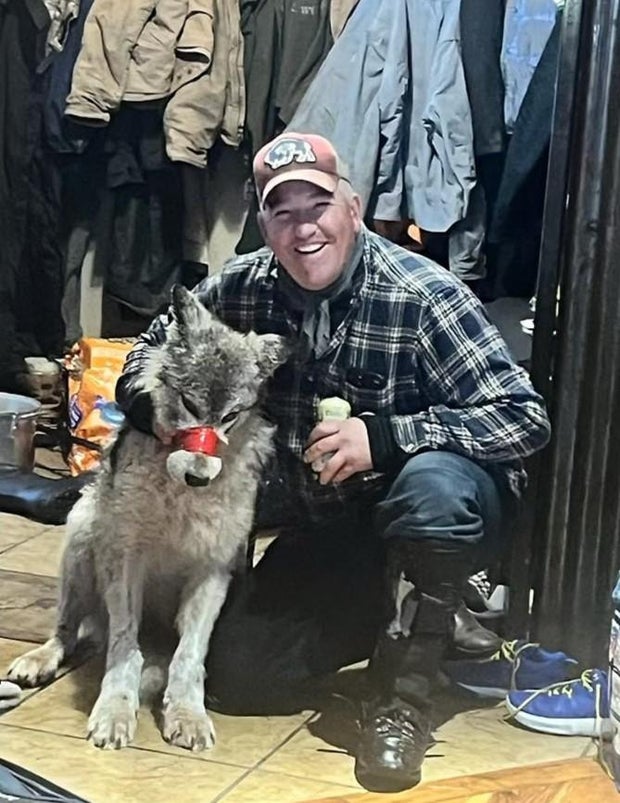
According to Cowboy State Daily, Cody Roberts was reported to the Wyoming Game and Fish Department by an anonymous source the day after the Feb. 29 incident. According to that outlet’s account relayed by two anonymous sources and a report from Wyoming Game and Fish, Roberts, who was hunting at the time, injured the wolf with his snowmobile. Roberts later brought the wolf to his home in Daniels, in southwest Wyoming, then to a local watering hole where at least one photo and video were recorded with him posing next to the wolf. The wolf’s mouth was taped shut in the photo shared with CBS News Colorado.
Roberts allegedly took the wolf behind the establishment and shot it, fatally, later that day.
More recent reports from Cowboy State Daily link to videos that have since emerged. One allegedly shows the struggling wolf lying on the floor of the bar, its mouth covered in a black muzzle. Another has Roberts bending down to kiss the snarling but prone animal on the snout.
The Sublette County Sheriff’s Office stated recently it is coordinating with Game and Fish to further investigate the wolf’s death and, along with the local district attorney’s office, whether further charges are warranted.
Some in the legal field believe they are.
“My sense,” said Tom Delehanty, a senior attorney in Earthjustice’s Rocky Mountain Office, “just from reading Wyoming’s animal cruelty statute, is that it applies to Cody Roberts. “The statute carves out hunting, capture, killing, etc. of predators that’s done ‘in any manner not otherwise prohibited by law.’ But Roberts’ behavior was already found to be ‘otherwise prohibited’ because he was cited for violating laws against possessing live wildlife. So he shouldn’t be shielded by that carveout.”
“I believe Colorado’s state laws would interpret this horrific incident as a clear violation of criminal law,” wrote Lindsay Larris, the Denver-based Conservation Director for Wild Earth Guardians. “I am unfamiliar with state animal cruelty laws in Wyoming but, in Colorado and many other states, mandatory mental health evaluations are standard with crimes involving such depraved cruelty to animals. We know the link between cruelty to animals and cruelty to humans (especially as related to child abuse and domestic violence) and ignoring this reality makes the wolf killing incident in WY even more disturbing.”
RELATED Colorado releases 5 wolves under controversial reintroduction program
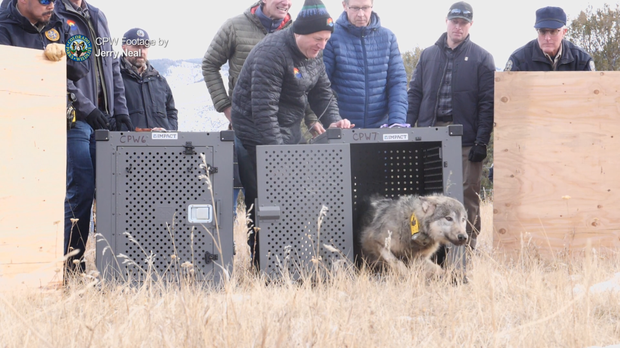
Rob Edward is Strategic Advisor and co-founder of the Durango-based Rocky Mountain Wolf Project, an organization devoted to repopulating wolves through the northern Rocky Mountains. That effort, too, separates Colorado from Wyoming to a large degree.
“From my perspective, it is important to note that Colorado isn’t in the same legal boat as Wyoming because our cultural ethos has evolved beyond the 1800s. Wyoming, on the other hand, revels in anachronism. The chest beating and faux repentance of Wyoming’s pols, pundits and even their Game & Fish Department over this incident rings very hollow given that killing wolves by any means, at any time of year is legal throughout all of the state outside of Yellowstone.
RELATED Some wolves reintroduced into Colorado came from packs with history of attacking livestock
Much of the general public has reacted with more intensity.
A Facebook page has been created for the sole purpose of berating the bar.
Meanwhile, the sheriff’s office posted on social media last week with a plea for restraint.
“(O)ur Office as well as Game & Fish have been inundated with thousands of calls and emails about the situation from all over the world,” the office stated. “We have become aware of a number of individuals who have resorted to threats of violence as their means of expressing frustration. Please understand that such actions endanger the lives and the peace of the residents of Sublette County, State and County employees, and innocent people outside Sublette County not at all involved in the situation. Threats of violence against Mr. Roberts or his family are also not appropriate. Additionally, expressions of violence and harassment can also result in hindering law enforcement investigations as potential witnesses choose not to come forward or cooperate for fear of retribution.”
In March, two Wyoming congressional representatives endorsed a letter to the director of the U.S. Fish and Wildlife Service requesting the agency abandon its consideration of relisting wolves under the Endangered Species Act.
“Decisions from Washington that led to listing and delisting this species created a mess of management practices that the states have been left to clean up,” Sens. John Barrasso and Cynthia Lummis wrote. “Wyoming has managed wolf populations to appropriate levels. Best management practices are led by people in the State who are directly impacted and have spent many years balancing stakeholder priorities…We request that the U.S. Fish and Wildlife continue to honor Wyoming’s state management of its wolves.”
 Exposing the Big Game