CDC, states prepare to prevent additional cases of bird flu in humans
Reply

by Max Martin on 9 April 2024
A white-throated kingfisher, a horseshoe crab, a whale shark and an Asian elephant are some of the species found entangled in ghost nets in India, mostly along the coasts.
An international team has spotted 144 animals belonging to 35 species, 13 of them endangered or vulnerable, entangled in abandoned, lost, or otherwise discarded fishing gear (ALDFG) in the coastal waters and freshwater bodies of India, as part of a social media study.
Such derelict fishing gear includes nets, lines, pots and traps, often made of durable, water-resistant and light plastics. These plastic-made fishing gear float in the ocean for years, trapping or getting eaten by fish and other animals or carrying alien species, scientists said.
The study led by Kannan Gunasekaran, a marine biologist at the Chulalongkorn University, Bangkok, scanned Facebook, Twitter, Instagram, and YouTube posts from 2012 to 2023. The results were published in the journal Biological Conservation in March 2024.
“We looked at entanglement sightings on social media, listed species affected, and identified potential hotspots,” Gunasekaran told Mongabay-India. Most of the reports came from the east coast.

Gunasekaran and colleagues found 44 sea turtles, including 37 olive ridleys (Lepidochelys olivacea) and 33 fish, mostly whale sharks (Rhincodon typus), the largest living fish. There were five green turtles (Chelonia mydas), a leatherback (Dermochelys coriacea), and a hawksbill (Eretmochelys imbricate).
Among the marine mammals, the researchers found nine spinner dolphins (Stenella longirostris) and a humpback dolphin (Sousa plumbea), a little Indian porpoise (Neophocaena phocaenoides), four sea cows (Dugong dugon), and three whales – a Bryde’s whale (Balaenoptera brydei), a dwarf sperm whale (Kogia sima) and another Balaenoptera. A fifth of all cases of entanglement were marine mammals.

Other animals trapped in ALDFG included crabs, sponges, and, less frequently, seahorses (Hippocampus kuda) and sea snakes (Hydrophis schistosus). Most of the trappings in the freshwater bodies involved birds, including spot-billed pelican (Pelecanus philippensis) and white-throated kingfisher (Halcyon smyrnensis).
More than half of all entangled animals (73) were dead, and the fate of 71 found alive was not known. The elephant was found alive, caught in a net in the Ramganga river that flows through the Corbett National Park, he added.
The spread of ghost nets on the east and west coasts and freshwater bodies and the diversity of the animals they entangled indicate the scale of the litter menace in India, Gunasekaran and colleagues noted in their paper. India is the second-largest contributor to mismanaged plastic in the ocean. Out of 5.6 million tonnes of plastic waste generated annually, 0.6 million tonnes end up in the ocean, the paper noted. Rivers, lakes, and wetlands also receive massive amounts of plastic waste.
A large share of this litter involves ghost nets, a global environmental problem. “The issue poses a severe threat to India’s marine ecosystems. It not only affects endangered species but also impacts the fishing industry’s sustainability and economy,” said P R Jayachandran, a marine ecologist focusing on the Kerala waters. “Over 90% of trapped species are commercially valuable, exacerbating the financial toll.”
A recent study in Kerala revealed that, on average, each year, 11.6% of the total gear used is lost, 7.5% is abandoned, and 2.3% is discarded – that is roughly a fifth of an average of over 500 kg of gear each vessel carries. About 60% of the ALDFG comprised lost gear, as the study noted.
As such, about 5.7% of fishing nets, 8.6% of traps, and 29% of fishing lines get lost in the ocean, annually adding about 1.14 million tonnes of derelict gear to the oceans of the world, studies show.
The reason for abandoning or losing gear differs across types of boats and fishing. Bad weather is a key reason. “Drawing a net can take one or two hours of hard work. When there is high wind, sometimes we have to cut off the net cast in the sea and come ashore quickly,” said Davidson Anthony Adima, a fisherman from Fathimapurm village in Thiruvananthapuram.

Adima and colleagues operate a 34-foot boat with twin outboard engines, and each of their nets can cost Rs. one lakh or more. Discarding them involves huge losses, and the cut-off nets float, trapping fish and other creatures across great distances.
“Sometimes ghost nets get spread over parts of underwear reefs that are rich fishing grounds, scaring fish away,” Adima said. Traditional raft fishers said the best way to fish over reefs involves the hook and line method, an eco-friendly fishing technique. Or nets need to be carefully cast beside or over the reefs without getting too close, the fishers said. However, such precision fishing requires a good knowledge of the underwater structures, an exclusive domain of the local veterans. “Some fishermen cast their nets too close to the rocky reefs, and they get entangled on the jagged reef edges,” Adima said.
There are other underwater obstructions, such as discarded boats and shipwrecks, that eventually become underwater habitats for flora and fauna that attract fish. The Kerala study noted that different kinds of underwater obstruction were the most common reason with regard to trammel nets.
“Trawl and shore seine were abandoned due to bad weather, whereas ring seine was abandoned due to attacks by marine animals,” the Kerala paper notes. “Regarding gill nets and mini trawls, gear conflict was the most common reason for abandonment…Several reasons, such as cetacean attacks, jellyfish blooms, and pufferfish bites, were reported to result in the huge loss of ring seine nets.”
A review and meta-analysis found that while bad weather led to the reasons for gear loss (69%), gear conflict was the second most common cause (57%), with over a fifth of all studies reporting loss due to conflict between towed and static gears. Hitting against obstructions on the sea bottom was the third most common cause of gear loss reported (31%).
Ghost nets are often found covering reefs. “I have found ghost nets on our reefs while diving,” said Kumar Sahayaraju, a fisherman and an ocean scientist from Thiruvananthapuram. Another diver and coordinator of the conservation NGO Friends of Marine Life, Robert Panipilla, said his team often found ALDFG during their dives off the shores of Thiruvananthapuram. One brief clean-up drive yielded over 400 kg of derelict gear, he said.
In February, remnants of ghost nets washed up on the shores of Puthenthope village in Thiruvananthapuram. Looking at the girth of the ropes, local fishers, mostly raft and shore seine operators who use traditional gear, said they were probably discarded from large vessels that sometimes intrude their coast from elsewhere. As such, marine litter can travel 100s of miles, scientists note.

Puthenthope is a nesting site for sea turtles, including Olive Ridleys. Local observers said turtles sometimes get entangled in discarded nets.
ALDFGs are dangerous as they entangle marine life about four times more than all other marine debris combined. The Kerala study notes that fishers often discard damaged nets onto beaches or in the sea as there is no proper disposal mechanism and it takes too much effort.
Scientists say many countries and regions lack observation, monitoring, surveillance or enforcement systems to address the ALDFG problem. They call for better data and governance frameworks.
“To address this, raising awareness, repurposing old gear, and implementing stricter regulations are essential,” Jayachandran said. “Collaboration among various stakeholders is crucial, including NGOs, researchers, governments, and international bodies like the Global Ghost Gear Initiative, to safeguard India’s coastal communities and marine biodiversity.”
Read more: Traditional raft fishing threatened as reefs choke on plastic
Banner image: Sometimes, the ghost nets get spread over parts of underwear reefs that are rich fishing grounds, scaring fish away, say the fishermen. Photo by Tim Sheerman-Chase/Wikimedia Commons.
April 9, 2024
BY
KITTY BLOCK AND SARA AMUNDSON
SHARE https://www.humanesociety.org/blog/horrific-wolf-killing-wyoming-shows-urgent-need-increased-protections

Gray wolves in some U.S. states experience extremely brutal treatment, as a recent alleged wolf killing in Wyoming shows.
Alamy Stock Photo
Last week, reports surfaced that a man in Wyoming allegedly ran down a wolf with a snowmobile. He then reportedly taped the injured wolf’s mouth shut, paraded the helpless and terrified animal around at a local bar and posed for a photo with the injured wolf before going outside and killing the animal. According to news reports, the Wyoming Game and Fish Department cited the man only for possession of a live wild animal and levied a paltry $250 fine before washing its hands of the matter.
A mere slap on the wrist is unacceptable, and we’re calling on local authorities to prosecute this individual under state felony animal cruelty laws.
No animal should be forced to endure the extreme level of stress, fear and agony this wolf experienced. While the appalling events described in news reports about this incident are extreme—and they were brought to light only because of an anonymous tip—this incident serves as a glaring reminder that many wolves in Wyoming and throughout the Northern Rockies experience similar brutalities. About 85% of Wyoming is designated as a “predator zone,” where wolves can be killed in virtually any manner and number any time of the year. They are frequently run down with snowmobiles, ATVs and pickup trucks, gunned down from helicopters and airplanes, or suffer excruciating pain and death in steel-jawed leghold traps and strangling neck snares. And there are no bag limits, either—meaning trophy hunters and trappers can kill as many animals as they can find.
Every wolf killed by a trophy hunter or trapper is an intelligent individual, often with a rich social and family life. Wolf packs are families, consisting of parents, pups and older siblings who help take care of the young. Adult wolves have even been observed bringing sticks and other toys back to pups, sacrificing themselves to protect family members, and letting small pups win play fights. Due to their close, complex and interdependent social structure, killing a single wolf can have devastating and reverberating consequences for the whole pack. It can lead to the orphaning of pups, the abandonment of territory and the collapse of the family.
In Wyoming’s predator zone, entire wolf families—including pups—can be killed in their dens. The same is true in Idaho. Wolves in the West—and the Great Lakes states, when they can be legally hunted and trapped—are also often killed using night vision equipment, packs of dogs, bait and electronic calls that mimic prey animals or young in distress. Bounty-like payments are made in Idaho and Montana for dead wolves. Wolves caught in traps and snares in Montana, Idaho and Wyoming are left to struggle against the brutal device for hours or days before the trapper returns to kill them. The brutality many wolves face is overwhelming.
Such killing practices are not traditional, subsistence hunting methods. They are deliberate and heinous acts of cruelty. The fact that states allow such methods to kill wolves only feeds into the sentiments of many trophy hunters that wolves deserve no compassion or humane treatment. It may even increase poaching.
While it’s important to protect wolves and other wild animals for their sake and for the benefits they bring to our lives, our environment, and our economy, there are also serious public safety reasons to support increased protections. Violence does not exist in a vacuum—animal abusers can also abuse people. There is a correlation between committing acts of intentional cruelty to animals and committing violence against humans, and law enforcement is taking it seriously. The FBI is now tracking incidences of crimes against animals in addition to other serious crimes like murder, burglary and domestic abuse.
The outrage over the torment of this wolf demonstrates the overwhelming public support to protect wolves from the persecution they endure under state management each year. We are working closely with our allies on the ground in Wyoming to see justice done here and seek stronger protections for all wolves.
This incident and the ongoing war on wolves is why we are fighting for federal protections for wolves in the Northern Rockies in court. Reckless state management isn’t only cruel, it threatens the viability of the wolf population in the region. Protection under the Endangered Species Act would take jurisdiction for managing wolves out of the hands of the Northern Rockies states that have proven to be mercilessly intent on exposing them to all kinds of cruelty.
You can call upon the Wyoming Office of Tourism to demand changes to Wyoming’s draconian, backward laws as well as state policies targeting wolves. State lawmakers must protect animals, including Wyoming’s native wildlife, not only from wanton acts of cruelty but from reckless public policy that allows cruel killing methods to continue.
Sara Amundson is president of the Humane Society Legislative Fund.
Protecting Wildlife , Banning Trophy Hunting
Kitty Block is President and CEO of the Humane Society of the United States and CEO of Humane Society International, the international affiliate of the HSUS
| by Stephen Capra, Bold Visions Conservation VISIT BOLD VISIONS CONSERVATION TODAYWe just learned of the savage violence that one man can inflict on wildlife. The man, if you can call him that, Cody Roberts, went into a bar with a wolf whose mouth was taped shut. He had worn the wolf out by chasing him with a snowmobile and ran him over before showing off the terrified animal to the patrons of the bar, then took it out back and shot it, likely laughing. This disgraceful act is the direct result of the livestock industry, trophy hunting interests, the Game and Fish Commissions of Wyoming, Idaho, and Montana, and the leadership of these states. They have done all they can to make wolves the enemy. They use ignorance and cowboy ideas of wildlife to allow some of the most important species to be hanging on in lands where they should be thriving. Why can a person use a snowmobile to wear out an animal? Who calls this sport? Many sportsmen in these states have a lot to answer for! They support trappers; they do not hunt with a leopolian approach. Instead, they use drones and guns with long-range scopes; they set up on the border of Yellowstone and bait and call out wildlife. This is not hunting; it is a disgrace.Game and Fish Commissioners, who should enforce more ethics and use science to guide them, are political pawns. They answer to their Governors, who want predators destroyed. Governor Gianforte, besides wishing to sell off public lands, enjoyed killing a wolf that had suffered in a trap for days; he killed a collared Yellowstone Mountain lion; why? Because he lacks the ethics to be a real sportsman. This takes us back to Cody Roberts, a person who clearly thought the horror he imposed on this animal was all just good fun. Besides the fact that he should be sent to federal prison and never be allowed to hunt, trap, or be around any animal, the odds are he will get a $250 fine. We live in some of the most beautiful lands in the world, and we have more diversity of wildlife than we ever could people. Yet there remains a “kill” mentality towards wildlife and wolves in particular. The time has come for a change in Montana and these other states. We must rebuild from the ground up the Game and Fish agencies, which in Montana have gone from great to an embarrassment. There remains cruelty towards many species that radiates in the rural parts of our state. Trappers show the callousness that Mr. Roberts displayed; you can find it in their posts. Martha Williams, the head of the US Fish and Wildlife Service, had the chance to relist wolves but allowed politics to overrule the need to end this slaughter. She should be forced out if Biden wins reelection. We live in a painful time for wildlife, one that, in generations to come, will be viewed as barbaric, ignorant, and sad. If Wyoming had the courage, Mr. Roberts would pay a severe price for this malicious action. But the odds are the agency and commission will write him off as just a bad apple. The reality remains the real bad apples are on the commissions; they are in our capitol, and all of this makes clear that these states have no business managing wolves, grizzlies, or any other species that is not a deer or an elk. People are outraged, and well, they should be; this is not ethical hunting, and it is happening more and more as states like Idaho push to allow wolves to be trapped by outfitters and suffer for days before a slob client shows up to shoot the wolf, we must force real change. This is not human behavior; it is dangerous and sick behavior.This should never be allowed, and moving forward, we must demand respect for all species and an end to violence against wildlife. We must also push for jail sentences for those who live to torture and harm such innocence. Bold Visions demands that Cody Roberts of Daniel, Wyoming, be jailed for animal cruelty by the Sublette County Sheriff’s Office. We believe such cruelty requires him to be subject to psychological evaluation. In addition, Cody Roberts should not be allowed to own a pet. We demand that the Wyoming Game & Fish Department ban Cody Roberts for life from hunting and trapping privileges. This kind of behavior is abnormal and cannot continue unchecked. PLEASE SIGN OUR PETITION TO REMOVE PAT TABOR |
…of a tortilla.


Livestock bosses celebrate outcome at online summit, while critics condemn failure to tackle meat and dairy consumption
Rachel Sherrington
Mon 8 Apr 2024 05.00 EDTShare
Lobbyists for the world’s biggest meat companies have lauded a better than expected outcome at Cop28, which they say left them “excited” and “enthusiastic” for their industry’s prospects.
US livestock bosses reflected on the conference’s implication for their sector on a virtual panel, fresh from “sharing US agriculture’s story” at the climate summit in December.
Campaigners and climate scientists had hoped the summit, which was billed as a “Food Cop” because of its focus on farming, would result in governments agreeing to ambitious action to transform food systems in line with the goals of the Paris climate agreement.
But while more than 130 governments vowed to tackle agriculture’s carbon footprint, a slew of announcements and initiatives failed to set binding targets, or to broach the question of reducing herds of ruminant livestock such as cattle and sheep, which are agriculture’s largest driver of emissions.
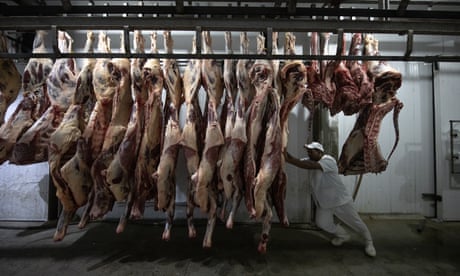
In the online discussion, which was hosted by the trade publication Feedstuffs, meat lobbyist groups made it clear they felt Cop28 resulted in a positive outcome.
The three representatives all said there had been widespread recognition at the Dubai summit that agriculture was a “solution” to the climate crisis, despite livestock accounting for more than 30% of anthropogenic methane emissions.
Outcomes at the summit were characterised as “far more positive … than we anticipated” by Constance Cullman, the president of the Animal Feed Industry Association (AFIA), a US lobby group whose members include some of the world’s biggest meat and animal feed producers.
She added that this was the first time she had “felt that optimistic” after a “large international gathering like this one”.
Cullman also praised the UN Food and Agriculture Organisation (FAO)’s “Global Roadmap” to tackle the climate crisis and end hunger, which she described as “music to our ears”, saying she particularly welcomed the report’s emphasis on “production and efficiency” over “looking at reduced consumption of animal protein”.
Academics described the FAO report’s failure to recommend cuts to meat-eating as “bewildering” in a March submission to the journal Nature Food.
According to a March paper, which surveyed more than 200 environmental and agricultural scientists, meat and dairy production must be drastically reduced – and fast – to align with the Paris agreement.
The report concludes that global emissions from livestock production need to decline by 50% during the next six years, with “high-producing and consuming nations” taking the lead.
The FAO said in a statement that its roadmap took a “balanced” approach to animal agriculture, saying that its report had “acknowledged the importance of livestock for poor people in traditional agrifood systems” and referred to the need for dietary shifts.
“We believe that some comments on the change in diets and the role of animal products in them are either misinformed because people have not properly read the roadmap report, or deliberately disingenuous for the sake of feeding vested interests narratives,” it said.
Another industry panellist, Eric Mittenthal, had attended Cop28 on behalf of lobby group the Meat Institute (formerly the North American Meat Institute, or Nami). He emphasised the importance of sharing the message that animal agriculture was necessary for nutrition and sustainability.
The Meat Institute represents hundreds of corporations in the meat supply chain, including the meat sector’s three largest companies, JBS, Cargill and Tyson Foods, which together have emissions equal to a major oil company on the scale of BP or Shell.
Sophie Nodzenski, a senior campaign strategist on food and agriculture at Greenpeace International, said it was “unsurprising” that industrial meat producers felt positively about Cop28’s outcomes “given that their interests essentially took the central stage there”.
The number of lobbyists for big meat and dairy companies tripled at Cop28, as revealed by DeSmog and the Guardian, amid rising scrutiny of the food sector’s climate impact, while smallholders and family farmers at the summit said they felt “drowned out”.
“Cop28 has rightly put the spotlight on the link between food production and the climate crisis, but the sheer number of Big Ag lobbyists present gave them an outsized influence,” Nodzenski said.
Documents seen by DeSmog and the Guardian show that the meat industry was poised to “tell its story and tell it well” before and during the Dubai conference, which it described as a “notoriously challenging environment”.
Cop28 had promised to increase action on food systems transformation, but campaigners and experts said its declarations and reports fell far short of what was needed.

On the second day of the summit, the leaders’ declaration on sustainable food systems, which was signed by more than 130 countries, committed to food systems transformation.
But while it was praised for moving food up the global climate agenda, the International Panel of Experts on Food Systems co-chair Lim Li Ching criticised the declaration for its “vague language” and noted the lack of any reference to “reducing overconsumption of industrially produced meat”.
The long-awaited FAO roadmap followed. While it proposed a 25% reduction in livestock methane emissions by 2030 to put the agriculture sector on track to reach global climate goals, it again failed to explicitly recommend a cut to meat and dairy consumption.
A reduction in “excess meat eating” – which is prevalent in high-income countries such as the US and UK – is a key recommendation of major scientific bodies, and has appeared in reports from the UN’s Intergovernmental Panel on Climate Change and the recommendations of the EAT-Lancet commission.
The third Cop28 agreement that failed to tackle food system emissions was the “Global Stocktake”, in which agriculture was mentioned only in the context of adaptation to climate impacts, not mitigation, despite food systems making up around a third of greenhouse gas emissions overall.
Jamie Burr, a representative of the US Pork Board who spoke on Feedstuff’s panel, said he was “excited to see” the roadmap recognise efficiency as the best pathway to emissions reduction, going on to describe US agriculture as the “most efficient in the world”.
Industrial meat companies emphasise emissions intensity and efficiency over absolute cuts to emissions, or dietary shifts that would lead to a drop in production.
This is especially true in the US, where livestock methane emissions as reported to the UN Framework Convention on Climate Change have increased by about 5% since 2010 according to the Institute for Agriculture and Trade Policy, and have increased about 20% since 1990.
Cullman also welcomed the FAO’s proposals – including its plug for the role new technologies could play in bringing down methane emissions.
Numerous assessments have found that there is a role for efficiency and innovation to cut livestock emissions, although many technologies are unproven at scale. But to be effective, they should also be accompanied by a shift away from meat in diets, and, researchers caution, should not be used to delay demand-side policy.
Scrutiny of the FAO’s relationship with industry has grown in recent years. Last autumn, former officials said their work on livestock emissions had been censored because of pressure from industry and diplomats from large producer countries. Experts have called on the FAO for greater transparency, querying the lack of authors on the roadmap.
The FAO said: “The Global Roadmap has been developed with reference to and based on existing scientific and peer-reviewed publications. In no stage of the development of the roadmap were livestock industries consulted, or any inputs received from them.”
AFIA, Nami and the US Pork Board did not respond to a request for comment.
The meat lobbyists, whose industry enjoyed many routes to influence at the summit, also celebrated the cut-through of their message that industrial animal agriculture has an important role to play in addressing global hunger.
Cullman said that she was pleased to see there had been a “strong recognition” at Cop28 that animal products “had a real role in meeting the nutritional needs of folks around the globe”.
Burr added that Cops provided an opportunity for US agriculture groups to demonstrate how they “feed the world”, while Mittenthal said the Meat Institute had showcased how agriculture can be a “solution” for “healthy people and a healthy planet”.
A spokesperson for the Global Alliance for the Future of Food said the argument that industrial agriculture is “critical to address hunger” is one of the greatest “myths” shared by the industry.
As well as helping to drive global heating, which is undermining food security worldwide, the meat industry is also the leading driver of deforestation and ecosystem loss, while the overconsumption of animal products has been linked to a greater likelihood of developing illnesses such as heart disease.
 Exposing the Big Game