
In addition to fireworks and Budweiser, hot dogs make up the third element of the traditional trifecta of American freedom, based on Fourth of July celebrations in recent years. And some people like to really go all out.
Just today, 29 year old Joey Chestnut (known in hot dog eating circles as “Jaws”) broke his own record of 68 franks and scored his 7th straight win at Nathan’s Coney Island hot dog eating contest, choking down 69 of the putrid meat-pups.
(Chestnut is not expected to reach 30.)
According to the Huffington Posts’ Weird News, “In the world of competitive eating, the Nathan’s hot dog eating contest is the gut-busting and artery-clogging equivalent of the Super Bowl. It’s by far, the most coveted eat-off.”
Only in America.
Seasoned spectators in the standing room only crowd watched from just out of range of any potential projectile vomitter in the competition.
Huff Post goes on to say, “Chestnut was expected to easily defend his title. Supporters carried him to the stage before the event in a mustard-yellow chair like an Egyptian pharaoh.”
(No doubt he was carried away on a stretcher.)
Here’s what 69 hot dogs looks like:
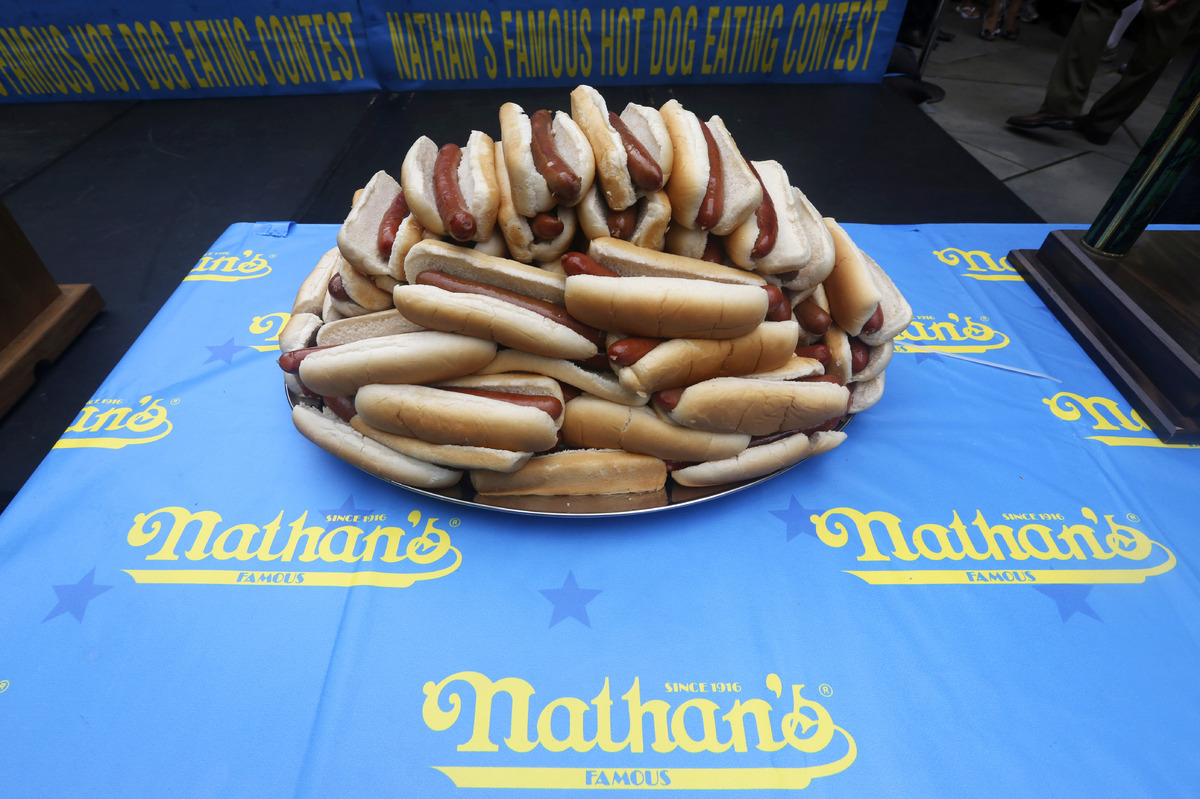
Now that’s a fuck of a lot of wieners! I mean, where does he put it all? The guy must be the carrion-eaters’ equivalent of Linda Lovelace.
Still want to know more about hot dogs?
Treehugger.com’s Melisa Breyer tells us: What’s Really Inside? Shocking Anatomy of a Hot Dog
Last year, Americans purchased more than 700 million packages of hot dogs at retail stores (and that’s excluding sales from Wal-Mart, which doesn’t report numbers). Figure in restaurants, food carts, circuses, ballparks and the like, and that’s a lot of dogs. In fact, the National Hot Dog and Sausage Council estimates that Americans consume 20 billion hot dogs annually.
The country’s most beloved tube of meat is Sara Lee’s Ball Park brand, which eclipsed sales of Oscar Mayer in 2010. Other media outlets have pulled back the curtain on hot dog ingredients in the past — and since we’re at the start of prime hot dog season, it seems as good a time as any to take another look at the who’s who of hot dog ingredients.
So without further ado, before the Fourth of July grills are aflame, here’s the skinny on America’s winning wiener, the Original Ball Park frank:
Mechanically separated turkey: Looking more like strawberry frosting than blended meat and bone bits, the USDA defines mechanically separated poultry (MSP) as “a paste-like and batter-like poultry product produced by forcing bones, with attached edible tissue, through a sieve or similar device under high pressure to separate bone from the edible tissue.” Hot dogs can contain any amount of mechanically separated chicken or turkey.
Pork: According to 1994 USDA rules, any meat labeled as the meat it is can be taken off the bone by advanced meat recovery (AMR) machinery that “separates meat from bone by scraping, shaving, or pressing the meat from the bone without breaking or grinding the bone.”
Water The USDA states that hot dogs must contain less than 10 percent water.
Corn syrup: A combo of cornstarch and acids, corn syrup is used as a thickener and sweetener, as MSNBC notes — it contains no nutrients but does add extra calories.
Beef: In 2004, to protect consumers against Bovine Spongiform Encephalopathy (mad cow disease), mechanically separated beef was considered inedible and prohibited for use as human food, so be glad you won’t be finding it in your dog.
Salt: Hot dogs are salty, that’s part of their job. And in fact, each one has about 480 milligrams, the rough equivalent of 20 percent of your recommended daily allowance.
Potassium lactate: This hydroscopic, white, odorless solid is prepared commercially by the neutralization of lactic acid with potassium hydroxide. The FDA allows its use as as a flavor enhancer, flavoring agent, humectant, pH control agent, and for inhibiting the growth of certain pathogens.
Sodium phosphates: Any of three sodium salt of phosphoric acids that can be used as a food preservative or to add texture — because texture is important when you’re eating a tube of meat paste.
Flavorings: Under current FDA guidelines, most flavoring agents allowed to be listed as “flavor” rather specified individually, so, this remains a bit of a mystery.
Beef stock: You know the drill: Boiled water with pieces of muscle, bones, joints, connective tissue and other scraps of the carcass.
Sodium diacetate: This is a molecular compound of acetic acid, sodium acetate, and water of hydration. The FDA allows its use as an antimicrobial agent, a flavoring agent and adjuvant, a pH control agent, and as an inhibitor of the growth of certain pathogens.
Sodium erythorbate: A sodium salt of erythorbic acid, it is often used as a preservative and helps meat-based products keep their rosy hue. Side effects have been reported, such as dizziness, gastrointestinal issues, headaches and on occasion, kidney stones.
Maltodextrin: Basically, a filler and/or thickening agent used in processed foods, it’s a compound made from cooked starch, corn, or wheat.
Sodium nitrate: This common preservative helps preserve the red color of cured meat — although studies have shown that consuming sodium nitrite may increase cancer risk and trigger migraines. Animal studies have linked sodium nitrates to an increased risk of cancer.
Extractives of paprika: An oil-based extract from the paprika plant — natural ingredient! — used for color and longer shelf life.
For natural, organic hot dogs that have a minimal ingredient list, try hot dogs from Applegate Farms or other all-natural meat makers.
 Exposing the Big Game
DISGUSTING!!!!!
Thanks for this post! I didn’t know how much garbage was in hot dogs!!
I wish I didn’t know…
There is something inherently wrong with a society that glorifies gluttony. It speaks volumes about selfishness and lack of empathy for those in poverty. Kind of where the Roman Empire was at its end times…
Thank you for brining that up. I meant to mention gluttony in terms of starving people and the millions of animals who suffer miserable conditions to provide fodder for the gluttonous.