
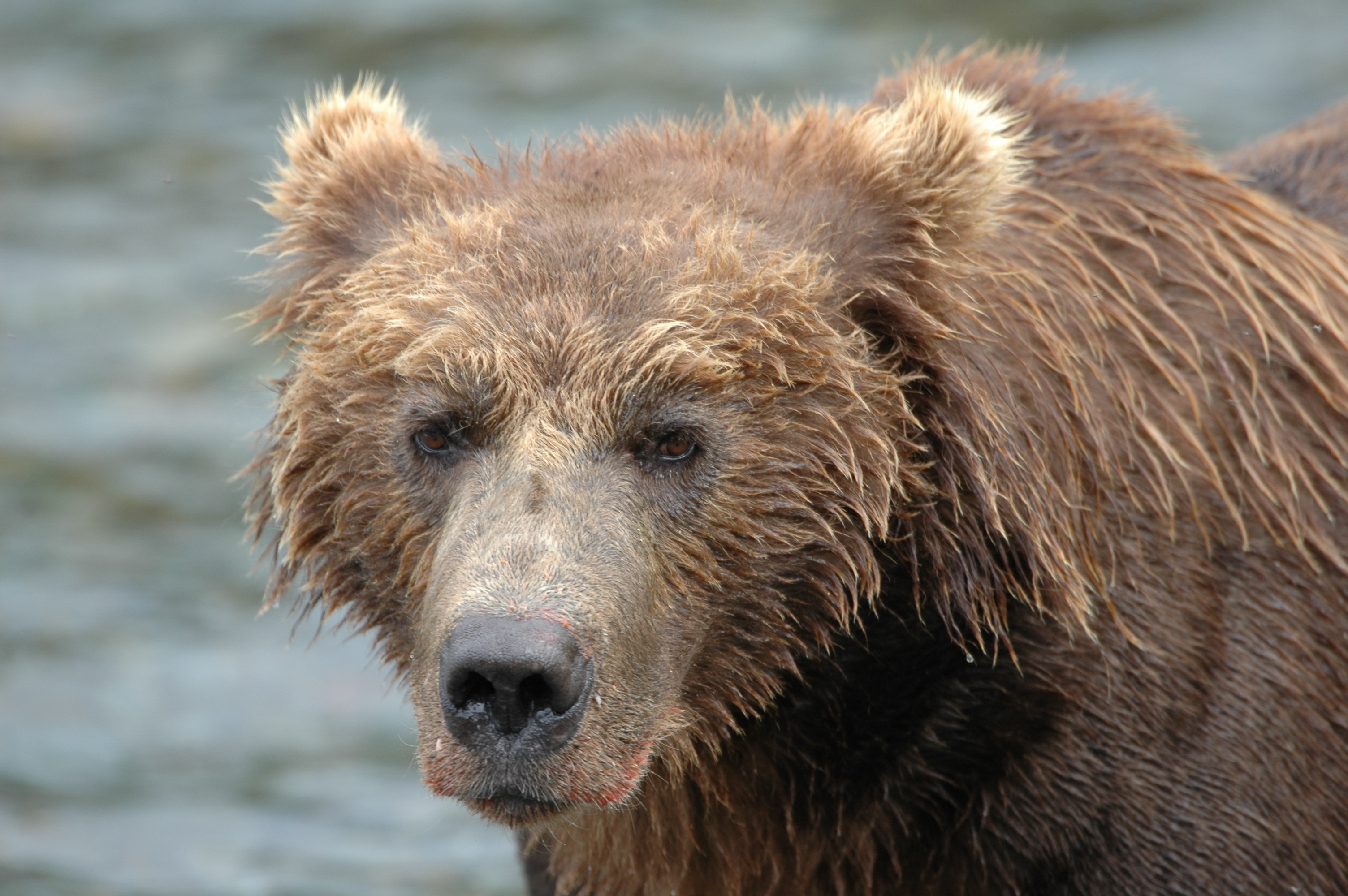
Wildlife Photography ©Jim Robertson, 2013. All Rights Reserved
A professional hockey player killed Cheeky.
By Jude Isabella
In Bella Bella, British Columbia, a First Nations community about 700 kilometers north of Vancouver, I met Larry Jorgensen, founder of the Qqs Projects Society, a program for Heiltsuk First Nation youth.
“Are you here about the kill?” he asked.
Someone shot a grizzly bear in Heiltsuk Territory, in Kwatna Inlet, part of the Great Bear Rainforest. The killer? Clayton Stoner, an NHL defenseman for the Minnesota Wild. The victim? A 5-year-old male named Cheeky.
Stoner’s kill outraged the indigenous community. It outraged many other British Columbia residents. At the same time, hunters united around the hockey player’s right to hunt. Hunting is big business. But so is bear viewing, especially in an area stung by economic hardship and stripped of one natural resource after another—except bears. Living bears. Parts of the Great Bear Rainforest, 32,000 square kilometers of habitat along the B.C. coast, are protected and closed to hunting. Some parts are not—residents can still hunt grizzlies here, and in most of the other grizzly habitats in the province. It’s legal. So far it looks like Stoner is a legal resident who killed the bear in a non-restricted area, and therefore he didn’t break the law.
But he did violate the First Nations’ hunting policy. Last year, the Coastal First Nations, an alliance on B.C.’s central and north coasts and the islands of Haida Gwaii, announced a ban on hunting bears in their territories. The ban is for a number of reasons, including distaste for the practice, ecological considerations, and a growing bear viewing industry.
The province of British Columbia, however, did not ban hunting and has no plans to, and its laws govern where hunting is allowed in the Great Bear Rainforest. Hunters kill about 300 grizzlies a year in the province, harvesting the skin and paws, leaving the rest to rot in the bush.
Canadian opposition to the grizzly hunt centers here, in the Great Bear Rainforest, an ecotouring powerhouse where bears are shot with high-priced cameras wielded by ecotourists, some wealthy, some splurging their savings on the trip of a lifetime. The Raincoast Conservation Foundation, which is against hunting, came up with a clever strategy to limit the practice: It purchased two guided hunting territories, including Kwatna, where Stoner shot Cheeky. To hunt in British Columbia as a nonresident, hunters must hire a guide or accompany a resident with a special license. Raincoast’s purchase put the brakes on hunting by nonresidents, but not residents.
It took one professional hockey player to do in one day what Canadian scientists and the First Nations have struggled to do for the past decade: put British Columbia’s grizzly bear hunt in a media spotlight.
The attention should grow this month with a new study led by Kyle Artelle, a biologist with the Raincoast Conservation Foundation. It provides evidence that too little is known about the grizzly population to call the current hunt sustainable. The fate of grizzly bears in British Columbia, Artelle writes, is being determined by a management game of Russian roulette.
“By ignoring what they don’t know about British Columbia’s grizzly bears—their actual population sizes, how many are poached, and so on—managers are taking a considerable gamble with their current hunt management approach,” Artelle told me shortly after Stoner shot the bear.
Sifting through hunting data from between 2001 and 2011, Artelle and his co-authors found evidence of “overmortality”—more bear fatalities than a population could endure—in 26 of the 50 bear populations open to the hunt. Overmortality ranged from one to 24 bears. “Almost all, 94 percent, of total overmortalities could have been avoided by reducing or eliminating the hunt,” Artelle says.
To count bears is no simple task. Rugged terrain and their natural wariness usually cloak bears in invisibility. The best way to interpret bear populations is through DNA analysis of bear hair caught on barbed-wire hair traps. Analysis of the hairs can reveal population levels, health, and the movements of individual bears.
 Exposing the Big Game
Trophy hunting and trapping are diseases, imposed by hunters, trappers and wildlife agencies, extreme minorities of the general population, upon game species and the public. Hunting is not good for the wildlife ecology, upsetting the health of game species and the balanced ecology of prey and predator. It is absurdly asinine as management tools (excuse for hunting). Man no longer needs hunting or trapping for subsistence. Predators, such as the wolf, bear, lion, coyote cull the weak, vulnerable, and make the herds move, thereby increasing their health. Man hunting, blood sports, especially trophy hunting, kills the strong and healthy and the teachers and caretakers of the young, and disrupts families. Man hunting (predation) is additive to game herds, a negative viability effect. Hunting is not healthy for man or targeted animals. It is a rationalization of hunters and wildlife agencies for killing wildlife, called management or recreational opportunity. Wildlife viewing, especially adding in wildlife photography, can be just as challenging. Wildlife viewing is also more of a revenue benefit for the economy and 5 times more popular than hunting. If the state wildlife agencies, and USFWS, and USDA Wildlife Services could be switched from wildlife killers to wildlife enhancers and facilitators of wildlife viewing, it would be better for wildlife, the public, and even the mental health of the hunters and trappers; and would move mankind closer to what we entertain ourselves as: humane, humanity, a part of nature instead of apart from it, but no longer subsisting on it.
Killing the Grizz . . . killing Spirit Bear . . . this is very wrong. It is a crime on so many levels. May Cheeky’s death serve to bring light to this darkness. And much power to the Fist Nation’s peoples in their quest to protect the Bears. Bears are powerful medicine and beings. Not to be messed with. I am respectful of scientists and their work to protect these animals and understand the necessity but it is an ethical crime, above all else.
I have said this before and I will say it again, and again, and again. I will never understand why some people feel the need to hunt innocent animals. What drives them? Why do they have such an insatiable urge to kill? When I see a beautiful animal, I am in awe, I feel no desire to shoot it! WTF? ARGH!
WTF is the question, and ARGH the only reasonable answer.
Reblogged this on Wolf Is My Soul and commented:
NO. An easy answer to a big question it seems.