
Canadian Blog
by Barry Kent MacKay,
Senior Program Associate
Born Free USA’s Canadian Representative
<http://www.bornfreeusa.org/weblog_canada.php?p=3936&more=1>
Saving the Deer of Invermere
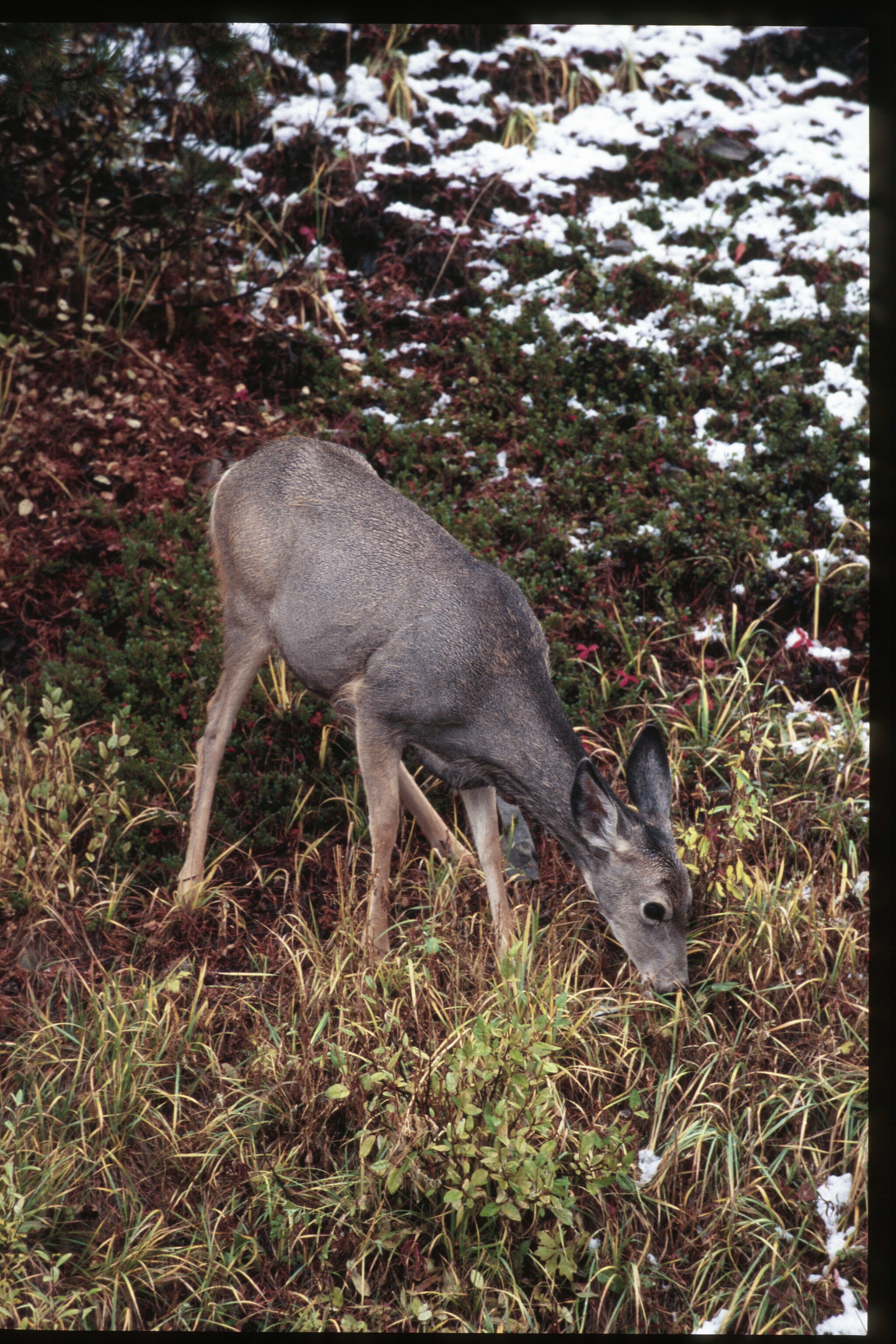
Photo Co Jim Robertson
Part 1: There’s No Paradise on Earth, but…
Published 11/13/13
When I drove into Invermere, population near 4,000, in the Columbia River
Valley of the interior of British Columbia, I was both enchanted and
worried. Animals totally fascinate me (and that includes human animals, as
I’ll discuss in a future blog) and I greatly enjoy seeing them, drawing and
painting them (I am a wildlife artist, too), photographing them, interacting
with them, and being in their presence. It’s just the way I am; not everyone
is like that. We’re all different. Diversity itself is as natural as a
beaver’s dam, a robin’s song, or the wide-eyed, innocent expression of a
baby screech-owl.
But, of course, the beaver’s dam may flood a roadway; the robin’s song may
awaken an exhausted shift-worker; and there could be a trace of blood and
fur or feathers on the beak of the baby owl. I get that.
Still, what I saw in Invermere was a community that I could envy, where a
dusky grouse strode boldly up to us, where a pileated woodpecker met us near
the door of a home we visited, and where mule deer wandered on lawns, in
parks, and on sidewalks, even crossing roads.
We tend to think that wild animals “should” be afraid of us-should flee-and
deer usually do, unless left alone. These deer were different (although not
unlike mule deer I’ve seen in California). Indeed, I met my first mule deer
when I was six years of age. She walked up to me at Mount Wilson Observatory
near Los Angeles, reached down, and chomped off the top half of the banana I
was eating. Was I terrified? Nope. I ate the second half. But that’s me. I
have touched a wild beluga whale, have had chickadees alight on my shoulder,
and have had foxes, who have never met a human, trot up to give me a sniff.
Animals fear us, but not necessarily instinctively; we give them ample
reason.
I was in Invermere with my Toronto-based colleague, Liz White, to help
support a “no” vote in a referendum that asked Invermere’s residents if the
town’s deer should be baited to enter a large, square frame, where they
would be trapped until men arrived to collapse the trap around them, holding
the panicked, struggling animals down. Then, a metal bolt would be driven
into their brains, sometimes after many botched tries-ultimately rendering
them unconscious so that they could be bled from the back of a truck into a
pail, until dead. (That’s not how the ballet was worded; it just asked if
the deer should be culled.) Doing that would, citizens were told, prevent
the things about deer that concerned them.
We tried to expose the truth, which is hard to do with a population that’s
unaware of wildlife population dynamics, with both real and imagined
concerns about the deer. With our colleagues, local citizens banded together
as the Invermere Deer Protection Society (IDPS). We methodically canvased
every part of town (about 1,000 houses), speaking to approximately 300
people about why culling does not work. It seemed that the majority of
people supported us. But, when the vote was held on November 2, only 26%
agreed with us and voted “no.”
Do we stop there? No. As I will explain in a future blog, the canvasing
reinforced formal studies in why people act illogically. Based on figures
from the cull in Cranbrook (see
<http://www.bornfreeusa.org/weblog_canada.php?p=3833&more=1> here and
<http://www.bornfreeusa.org/weblog_canada.php?p=3487&more=1> here), it’ll
cost the good folks of Invermere more than $600 per deer removed, with, as I
suspect they will discover, no significant improvement.
Luckily, the referendum is not binding. So, we have something to build on: a
means to show a less costly and more effective suite of options. The night
of the poll, we were already planning for the work ahead-and, by the next
morning, we had already met with IDPS members to strategize.
 Exposing the Big Game