
[This is just north of Yellowstone, where wolves should be allowed to take care of the elk “problem”…]
BILLINGS — Cattle ranchers in the Paradise Valley asked the Fish and Wildlife Commission on Thursday to extend the season for lethal elk removals in the area to May 15 and to pay for fencing to keep elk out of feeding and calving areas.
The controversial proposals were drawn up by a subcommittee of the upper Yellowstone watershed group as a way to reduce the transmission of the disease brucellosis from infected elk to cattle during the spring, which is when brucellosis is spread through contact with aborted fetal tissue from infected animals.
Fish, Wildlife and Parks currently has a policy to pay for fencing materials to block wildlife from raiding haystacks. The fencing supplies are provided to landowners who allow public hunting.
In what has been deemed the designated surveillance area for brucellosis around Yellowstone National Park, FWP allows elk hazing and fencing to help landowners from Jan. 15 through June 15. Lethal elk removals are allowed through April 30, but the number of elk killed is limited to 10 each time. Hunters on a roster are called to remove the elk.
Defending idea
Although admitting the fencing proposal is “a little scary” because it lacks details about the type of fencing and costs, Paradise Valley rancher Druska Kinkie told the commission the finer details would be worked out by the landowner and Fish, Wildlife and Parks to address specific situations on different properties. Each project would be unique.
“The goal is not to stop elk but to get them to take a different route,” she said.
Eric Liska, the Department of Livestock’s brucellosis program veterinarian, supported the proposals, noting that landowners have only two tools to fight brucellosis infection: vaccination of their livestock, which isn’t 100 percent effective, and keeping their livestock separated from elk during the spring.
Wildlife groups opposed
The proposal immediately came under fire from people attending the meeting or listening in.
Park City resident J.W. Westman said the Laurel Rod and Gun Club was opposed to the proposals, placing the blame for spread of the disease on some ranches that provide a safe harbor for elk during the hunting season. He also pointed to the surrounding states of Idaho and Wyoming which have elk feedgrounds where disease is more easily spread as being at the root of the problem.
Kathryn QannaYahu, a Bozeman environmentalist, said such measures seem extreme and possibly expensive and said the risk of brucellosis transmission from elk to cattle is only .00024 percent.
“This is about depopulating, removing a forage competition ungulate from the landscape, sportsmen’s dollars subsidizing their socialized agriculture and game ranching,” she wrote in an email.
Working groups rapped
Others expressed concern that the group making the proposal contains no members of sporting groups, hunters or other members of the public to provide a balanced recommendation.
“These working groups have become more or less dysfunctional,” said Bill O’Connell, a Bozeman-area farmer who was once a member of a similar group in the Madison Valley.
Mark Albrecht, a Bozeman veterinarian and member of the statewide elk working group, agreed the local working groups need help. He also said that if the department decides to extend the season for lethal elk removals, an environmental assessment should be conducted. He said that without studying the issue, FWP could be promoting more elk abortions caused by stressing the animals. If that were the case, the agency would be increasing the risk of transmission by trying to remove more elk.
“Let’s not forget the science,” Albrecht said.
Public’s chance
Fish and Wildlife Commission chairman Dan Vermillion, who lives in Livingston, supported the Paradise Valley landowners for coming forth with recommendations to address the problem. He noted that some of the ranches where infection has occurred were open to public hunting, that elk numbers are within FWP’s objectives and that the elk causing problems aren’t showing up during the hunting season, but arrive in March.
But he also expressed concerns about the methods landowners proposed and the difficulty of solving an issue when Wyoming and Idaho continue to congregate elk on feedgrounds during the winter.
“It’s now time for Montanans to weigh in,” Vermillion said, noting that proposals will come before the commission again at its April 10 meeting. Comments will be taken until March 21.
“Let us know what you think, because this is huge,” he said.
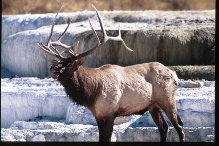
Photo Copyright Jim Robertson
 Exposing the Big Game
He also said that if the department decides to extend the season for lethal elk removals, an environmental assessment should be conducted. He said that without studying the issue, FWP could be promoting more elk abortions caused by stressing the animals. If that were the case, the agency would be increasing the risk of transmission by trying to remove more elk.
Why do that when they can blame wolves for reduction in elk calves???
If the presence of wolves around cattle is allegedly affecting weight etc., from stress to cattle, then wouldn’t it stand to reason that the presence of hunters around elk would do the same thing? I wish these people would stay away from Yellowstone.
There seems like there may be a lot wrong with fencing proposals to keep elk out, and killing elk to protect cattle, especially when it likely involves public land leased for a pittance by ranchers. The major problem is continuing rancher encroachment on wildlife and wilderness. If so, some of if it is mostly public land, it should primarily be prioritized as wilderness/wildlife land, available to elk and other wildlife. If any or part is public leased land, it is the ranchers that should be managed. They should move their cattle during elk migrations and elk or cattle birthing times. An even better idea would be to start retiring leases in and around wilderness and primary wildlife habitat and wildlife feeding seasons. The ranchers are already encroaching on bison with thousands having been slaughtered by them or for them. And they encroach on most forms of wildlife, flora and fauna. It is time to look at management of ranchers at least as much as wildlife and public land is managed for them; time to be teaching ranchers to live with wildlife when they are on public land and to prioritize wildlife on public land and not the ranchers, and not subsidize rancher encroachment further. FWP should not pay for any fencing if it primarily involves public leased land. Aside from all this, transmission of brucellosis from elk to cattle has about a 0.002 % chance and could be reduced even further to near zero with better rancher husbandry (management of their stock Vis a Vis wildlife). There is no documented transmission of brucellosis from bison to cattle in any setting except a Texas A&M lab experiment deliberately quartering infected bison and cattle close together.
So the wolves didn’t take their elk now?
Can’t have it both ways dudes!
All these troubles,because man has refused to believe nature had the best management.
Reblogged this on Ravens-Tree.com.
I totally agree with you, Roger. Here we go again with these public lands ranchers: if it isn’t the wolves, coyotes, prairie dogs,it’s the elk! It’s time to get these moochers off all public lands. These lands are needed, now, more than ever, for the native wild animals. If the Livestock Industry can’t make it on private lands–tough. Wild animals must now contend not only with exotic livestock all over their habitat, but with the issues on Extreme Climate Changes, including on-going drought. http://www.foranimals.org
Gee, all this after they have been crying about wolves eating the elk and how the wolves supposedly have eaten so many elk the elk are almost extinct.