
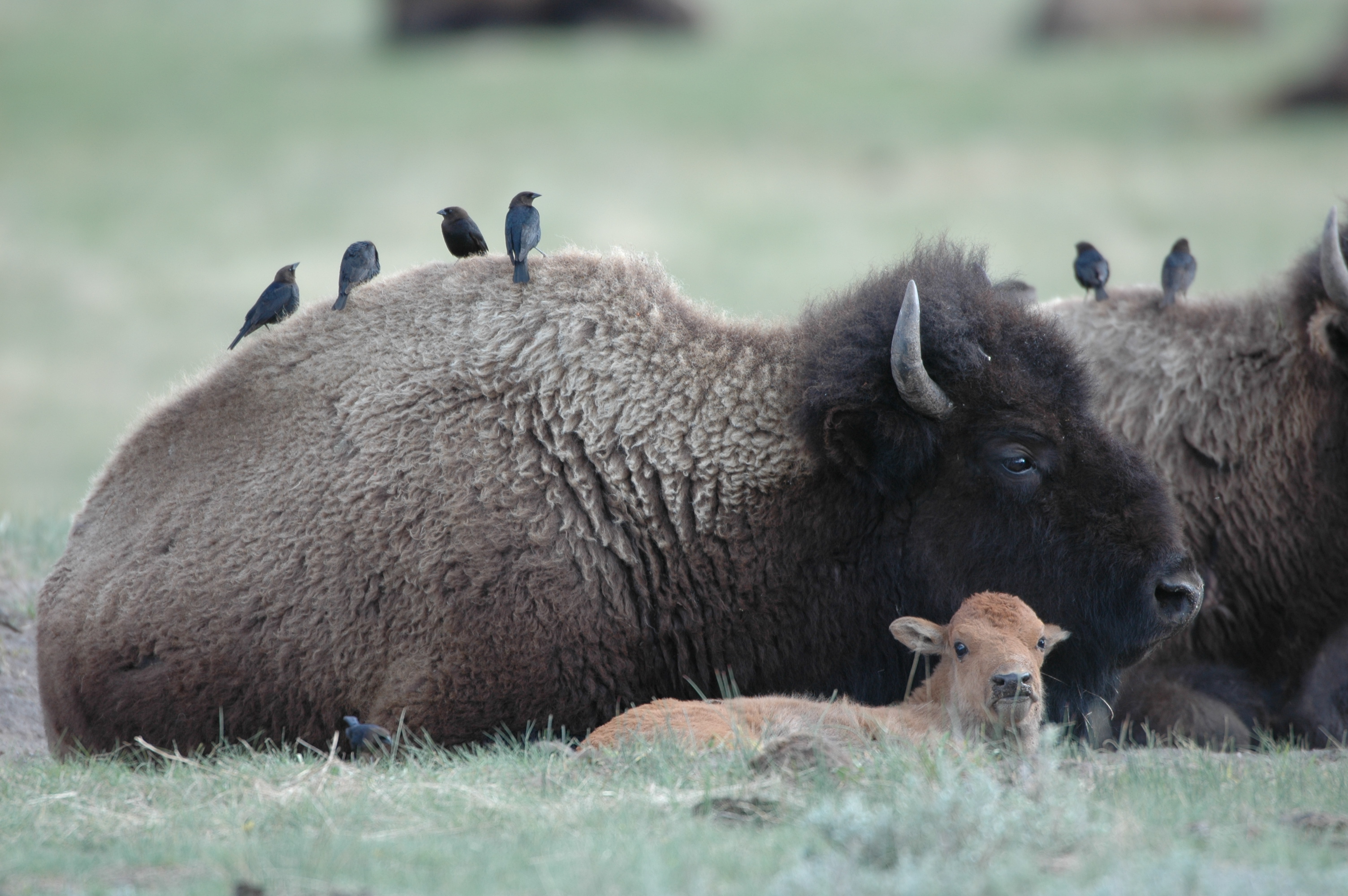
Photo Copyright Jim Robertson
http://www.reuters.com/article/2014/03/07/us-usa-yellowstone-bison-idUSBREA261U520140307
By Laura Zuckerman SALMON, Idaho Fri Mar 7, 2014
(Reuters) – Angered by the killing of pregnant bison outside Yellowstone National Park, a Native American tribal member tried to deliver a bloody bison heart to Montana’s governor this week, the latest skirmish over the management of the iconic animal.
James St. Goddard, a member of the Blackfeet Nation in Montana and former member of the tribe’s governing council, said he found the heart where hunters from another tribe discarded it after gutting a bison killed when many females are well along in their pregnancies. At another location, he said, he found several fully formed fetuses cut out of bison cows.
“These are atrocities. Why are they killing these babies? Are we all ignorant of our own Indian culture?” said St. Goddard, who was prevented by authorities from presenting the bison heart to Montana Governor Steve Bullock at his office in Helena.
St. Goddard’s protest, which was not sanctioned by the Blackfeet Nation, highlighted controversy over practices – which have divided some tribal members – in which bison that stray out of Yellowstone have been killed in extended tribal hunting seasons.
The protest against the actions of other tribes came amid broader tensions about the management of the nation’s last band of wild, purebred bison, or buffalo, over concerns by Montana ranchers that the animals could transmit the cattle disease brucellosis to cows that graze near Yellowstone.
The buffalo at Yellowstone, which cuts through parts of Wyoming, Montana and Idaho, are all that remain of the herds that roamed vast grasslands west of the Mississippi until systematic hunting drove them to the edge of extinction in the 19th century. There are more than 4,000 bison at the park, Yellowstone figures show.
Yellowstone’s bison are prized by visitors as a symbol of the American West and by tribes whose religious, cultural and dietary traditions are centered on the animals.
Tribes have asserted hunting rights granted in 19th century treaties for animals that migrate to traditional hunting grounds, and they largely set their own rules on the timing of their seasons. Some tribal hunting seasons extend into March, ahead of a birthing season that can begin in April.
Yet within the tribes, some members have taken issue with the hunts.
The Nez Perce Tribe in Idaho defended its late season hunting as an ancient custom halted over a century ago by the U.S. government amid Western settlement, near-elimination of the herds and forced relocation of tribes to reservations.
Nez Perce Chairman Silas Whitman faulted St. Goddard, whose own tribal government has not opposed the hunts, for criticizing the exercise of off-reservation hunting rights gained by treaty.
“He’s creating controversy where there is no cause. He’s talking as an old enemy, and we’re not going to bend to the will of our enemies,” he said.
Ervin Carlson, the Blackfeet’s buffalo project manager and a member of a federal, state and tribal team that oversees Yellowstone bison, said St. Goddard’s sentiment did not represent the tribe.
“Those tribes have their treaty hunting rights. We wouldn’t step into their concerns,” he said.
FEARS OF CATTLE DISEASE
Licensed hunting of bison that leave Yellowstone’s snow-covered high country to seek food in lower Montana elevations was sanctioned in 1985, then banned after public outcry as hunters lined up outside the park to shoot bison.
Regulated hunts were reinstituted with “fair chase” provisions in 2005 to help keep a burgeoning buffalo population in check. Four tribes have since asserted their own independent hunting rights spelled out in historic treaties.
Montana currently offers limited licenses, decided by lottery, in a season that ends in mid-February, partly to protect heavily pregnant bison, said Pat Flowers, a regional supervisor at Montana Fish, Wildlife and Parks.
The hunts and a program that sends wandering buffalo to slaughter are in part a response to worries by Montana ranchers that bison will infect nearby cattle with brucellosis, which can cause stillbirths in cows.
About half of Yellowstone’s bison have been exposed to brucellosis, and roughly 300 animals that strayed from the park this winter were sent to slaughterhouses or to the U.S. Department of Agriculture for reproductive experiments. An additional 263 animals have been killed by hunters, most of them tribal hunters, in Montana.
Conflicts over the way bison are managed escalated further on Thursday with the arrest of a man who protested their killing by blocking a road to a park facility where wayward bison are penned, Yellowstone spokesman Al Nash said.
The protest by a man who anchored himself to a 55-gallon drum was celebrated by Buffalo Field Campaign, which opposes the hunts and slaughter, and sends members into Yellowstone to monitor the wintering herd.
In a sign that not all tribal members agree with their governments, James Holt, a Nez Perce member who sits on the Buffalo Field Campaign board, said it was disheartening to see tribes support the activities.
“Buffalo were made wild and free and should remain so. It is painful to watch these tribal entities take such an approach to what should be the strongest advocacy and voice of protection,” Holt said in a statement.
Among tribes with hunting rights, the Confederated Salish and Kootenai Tribes of Montana restricts its season to the end of January to avoid killing pregnant bison cows, which calve in spring, Tom McDonald, the tribes’ wildlife agency manager, said.
“Our regulation is based on the votes of the people, who don’t want big-game animals harvested past the end of January because they’re pregnant. But we don’t point fingers at other tribes for their regulations,” he said.
Carl Scheeler, wildlife program manager for the Confederated Tribes of the Umatilla Indian Reservation in Oregon, said the reality of gutting a two-ton animal means fetuses may be discarded from pregnant bison killed in a tribal hunting season that stretches to mid-March.
“There’s a certain level of public sensitivity to viewing large and persistent gut piles, and hunters are directed to move them out of view to the extent that’s possible,” he said.
(Editing by Cynthia Johnston and Douglas Royalty)
 Exposing the Big Game
Bison and wolves and bears and wild horses and ranchers and hunters:
Surely we can find a place for the bison to roam, and manage them outside Yellowstone and elsewhere maybe even without hunting, like shooting a cow in a field, call it harvesting at least, no just call it killing, not hunting. This is one of the last best places, right? Tourists don’t come here to see cattle and fences. Both people living in Montana and visitors think of it as somewhat wild. A real heritage would be to preserve and restore the wildness of Montana. How much bad PR can Montana create for itself with regard to bison and wolves and other wild critters? Montana is giving itself terrible PR with regard to bison, wolves, wild horses, and soon maybe grizzlies. I was glad to see FWP pushing the idea that there are other places in Montana for bison other than Yellowstone thereby ensuring their survival and biodiversity. Speaking of YNP, why cannot bison wonder outside the Park to traditional winter grazing grounds on public land instead of leasing that land to ranchers? Retire some leases. Manage the ranchers I say. Even ranchers near YNP on private land are very self-centered not to manage their herds with regard to wildlife. Why cannot we find other public land in the state also? Ranchers and farmers are granted 772 permits on national forest lands in Montana, 3776 permits on BLM land in Montana, 26,000 permits in 16 western states. Who is encroaching? Man on wildlife? Let’s start retiring some of those permits and a lot of them and create permanent conservancy easements for wildlife on any leased land, and a buffer zone around Yellowstone and Glacier protecting wildlife.
Why are we so ruled by the oppositional opinions of ranchers and hunters (“sportsmen”} and misinformed pubic and rancher politicians and conservative rancher legislators? You cannot confuse them with the facts. Per Lewis Carroll, “I have said it thrice, what I say three times is true.” It has been suggested and even planned that bison be designated for placement (by FWP Montana) in other parts of the state. They are brucellosis free, tested, repeatedly so. Yet public meetings about the issue are attended almost unanimously by rancher-farmer crowds yelling, “No way!” Bison wander out of Yellowstone into traditional winter grazing ground, and ranchers protest and stockmen corral them, haze them and slaughter them. Instead of managing the cattle and ranchers around Yellowstone, ranchers want to manage the bison and keep them from going into a traditional outlet for grazing near Gardiner. The reports on any brucellosis of the past 70 years passing from bison to cattle are anecdotal, unproven, and none documented, only once in a Texas A&M lab setting closely confined with cattle. Brucellosis is more likely by elk who are more numerous and routinely come and go by the thousands, but even that does not seem to be much the case, but then elk are protected by sportsmen and FWP, farmed really, and ranchers probably did not want to step on that sacred set (sportsmen) of toes. Now ranchers are proposing killing elk and fencing them off from their herds. Montana FWP, US Dept. of Agriculture Wildlife Services, and USFWS are agencies that serve ranchers, farmers and sportsmen more than wildlife. For a change, on a larger species, other than elk or deer, FWP was somewhat of an advocate for conservation and preservation of an American icon; but then folds vis a vis stockmen.
You are so right. Time to manage the welfare ranchers. Better yet, give ’em the boot. Bunch of moochers sucking on the teat of the government. Makes me sick as hell. How can they hold so much power? It is ridiculous.
Thank you for your thoughtful reply. You are absolutely right. This is absolutely horrible and unbelievable.
Idiots! Bad enough they are killing our bison, but leaving bloody body parts and murdered babies lying around??! They can’t even explain the killing as part of any native tribal tradition, that wastefulness wasn’t a part of any native tradition. How is it that they are even allowed to kill them? They are highly endangered (not that it would matter if they weren’t, I just don’t see how this is justified legally).
please share widely https://secure.avaaz.org/en/petition/US_National_Park_Service_and_Interagency_Bison_Management_Plan_Stop_the_capture_and_slaughter_of_Americas_last_wild_migr/?Day2Share
petition looks closed.
Thanks Anja.
Reblogged this on running for the buffalo.