
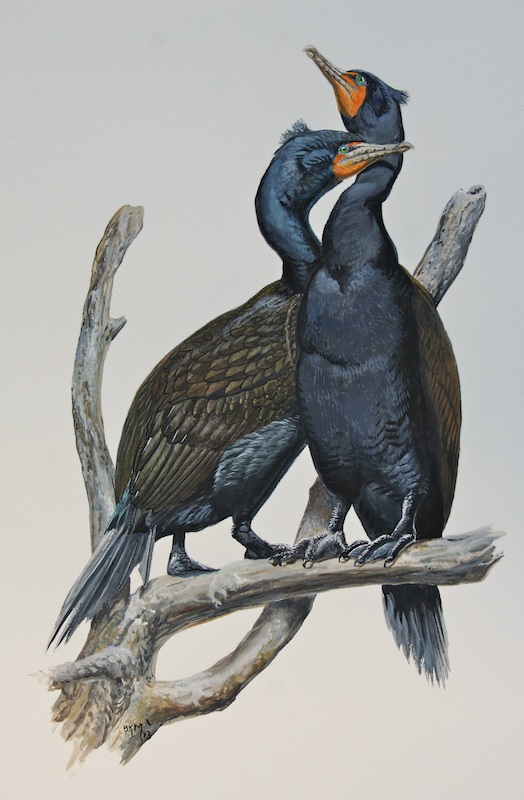
Painting Courtesy Barry Kent MacKay
Thursday, July 31, 2014 1:36 pm
A plan to kill 16,000 double-crested cormorants on East Sand Island has some residents on the North Coast scratching their heads.
Although still in the proposal phase, the plan drew many to an open house in Astoria last week to ask questions of the federal agencies involved.
“I can’t believe in this day and age we can’t come up with an alternative solution to killing things,” said Tommy Huntington of Cannon Beach.
The Alternative C plan is the preferred option of the U.S. Army Corps of Engineers to stem the ravenous consumption of juvenile salmon and steelhead each year. A final decision won’t be reached until after a public comment period and a review process are completed by the end of this year.
“I don’t want them to shoot the birds anymore than anyone else,” said Nancy Holmes of Seaside, explaining that she believes many people feel the same way.
The Army Corps released its plan to reduce the East Sand Island colony to 5,600 breeding pairs June 12. A public comment period has been extended to Aug. 19 after organizations advocated for more time. The federal agency, which manages hydropower dams and dredges the Columbia River, is required by the Endangered Species Act to come up with a management plan to control the burgeoning seabird population.
There were about 100 breeding pairs on the island in 1989, according to officials, but it has grown to 14,900 breeding pairs today. Dredge spoils were dumped there in the 1980s creating a perfectly flat and sandy location for the birds to nest.
The colony is estimated to have consumed about 11 million young salmon and steelhead annually over the past 15 years. Endangered and threatened wild stocks as well as hatchery fish are scooped up mostly in May by the seabirds as they head for the Pacific Ocean.
Since 1997 the Army Corps has done research on juvenile predation by the black birds. In 2008, they began to try out nonlethal methods to move nesting away from the mouth by hazing with lights, reducing nesting habitat and scaring them off. The available habitat is about 11 acres on the western portion of the island. In 2011, researchers began focusing on reducing that by putting in barrier fences and forcing birds from the nondesignated areas. They eventually restricted it to 4.4 acres, reducing 75 percent of prime nesting area. The federal agency even marked cormorants with satellite transmitters and banded hundreds of adults to provide information about where they moved during the restrictive period.
The Army Corps presented four options for reducing the colony to a size that would lessen the impact on endangered and threatened fish. A federal Biological Opinion of endangered Columbia River stocks requires the Army Corps to manage predation as one of three federal agencies that oversee hyrdoelectric dams on the river.
Alternative C was considered to be the best solution by the agency. The three other options did not include killing the cormorants, but forms of hazing and removal of nesting habitat.
“We feel it’s the one that gives us the most certainty of achieving the requirements that have been put upon us by the Biological Opinion,” said Joyce Casey, chief of the agency’s environmental resources branch in Portland. “It’s the most cost effective and it’s the one that has the best likelihood of not moving the problem somewhere else.”
The proposed plan includes land- and boat-based hazing and taking a limited amount of eggs, all with an “adaptive management” approach over four years. About 20 percent would be killed each year with 5,230 being taken the first year. The agency will have to file an annual depredation permit with the U.S. Fish and Wildlife Service for the “take levels.” The killing would take place on and off the island within the 15.5 mile foraging range around the island.
“It’s not a great plan,” said Holmes, adding that she’s at least glad that an adaptive management strategy is being used.
Huntington said he acknowledges the strong feelings that fishermen have about fish runs being consumed, but that the management plan shouldn’t have to be one or the other.
“You have to kill one to save the other one?” Huntington said. “It doesn’t make any sense.”
The federal agency also has to take into consideration the Caspian terns, brown pelicans and other birds on the island. The total number of nesting birds is about 60,000.
Casey said the preferred option also provides a balance because the agency wouldn’t have to eliminate all cormorant habitat on the island. With Alternative C, she said inundation of part of the nesting site will create habitat for shorebirds searching for food in the shallow water.
The Army Corps is also in the process of reducing habitat for Caspian terns on the island by about a third. The terns accounted for about 5.5 million juveniles consumed annually between 2000 and 2009.
 Exposing the Big Game
I absolutely HATE the word: “Culling”. I really do. Let’s call it what it is: MURDER!