
Back by special request:
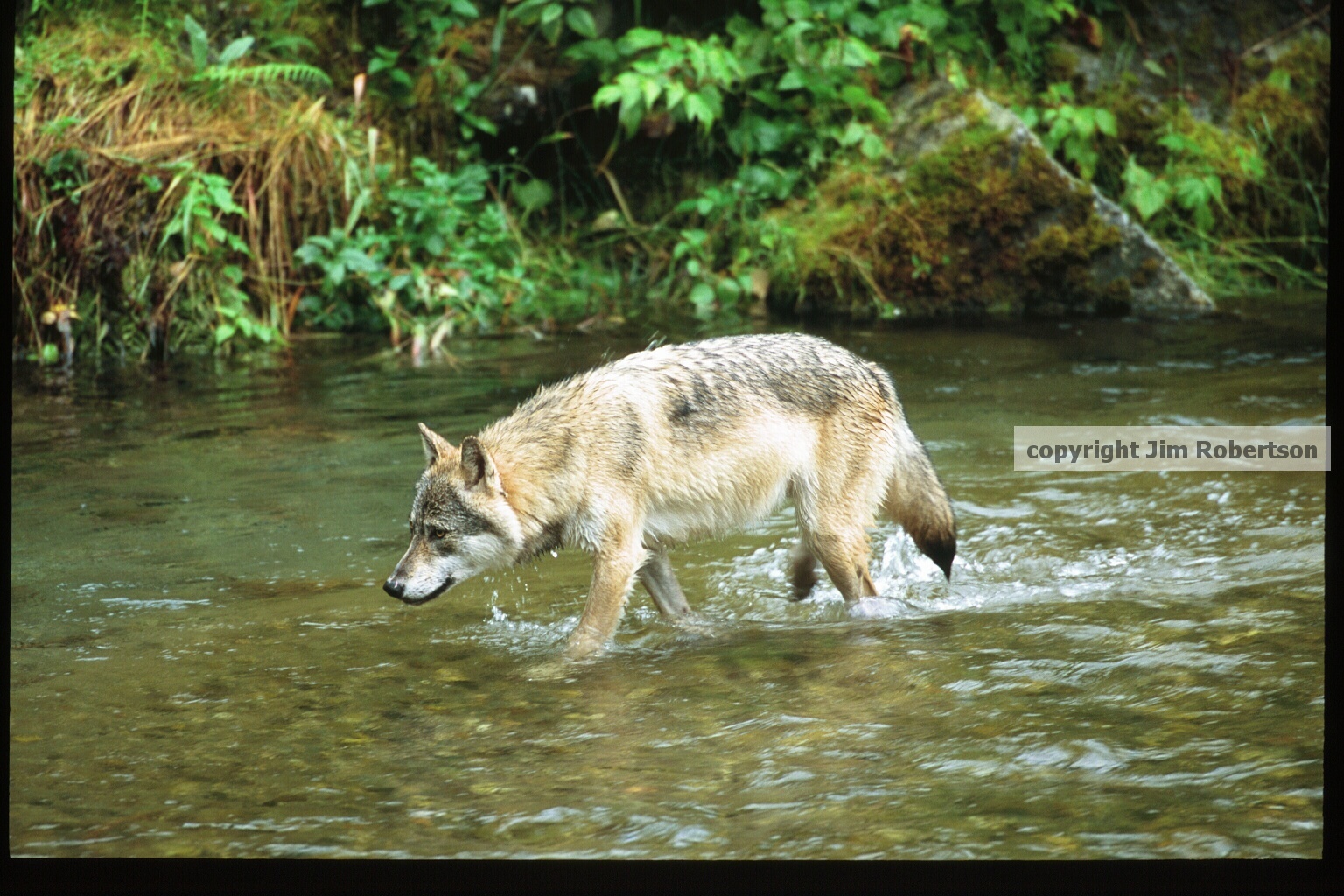
Just recently this question arose once again when the Canadian Journal of Zoology (CJZ) published a research article by Dave Hervieux, Mark Hebblewhite, Dave Stepnisky, Michelle Bacon and Stan Boutin titled “Managing wolves (Canis lupus) to recover threatened woodland caribou (Rangifer tarandus caribou) in Alberta” that presented the outcome of an “experiment” in mass killing in which 890 Canadian wolves suffered and died using aerial gunning, trapping and poisoning with strychnine. The strychnine also killed other animals who were not part of the study. Minimum “collateral damage” that was deemed acceptable by the researchers and the CJZ included 91 ravens, 36 coyotes, 31 foxes, 8 marten, 6 lynx, 4 weasels and 4 fisher. (For more on how wolves are highly stressed when hunted please see “Wolves: Hunting Affects Stress, Reproduction and Sociality.”)
Part of the methods section of this paper reads as follows (references can be found in the link above):
Wolf packs were located from a helicopter and one or more wolves per pack were captured using net-gunning techniques and fit with a VHF radio collar. Using a helicopter, we then subsequently attempted to lethally remove all remaining members of each pack through aerial-shooting throughout the winter (sensu Courchamp et al. 2003; Hayes et al. 2003), with the radio-collared wolves removed at the end of winter. Wolf captures were conducted according to Alberta Wildlife Animal Care Committee class protocol No. 009 (Alberta Sustainable Resource Development 2005)
Furthermore,
We also established toxicant bait stations, using strychnine, to augment aerial shooting and to target wolves that could not be found or removed using aerial-shooting. Strychnine is permitted for use in Alberta for the purpose of predator control (authorized by Government of Canada Pest Management Regulatory Agency following specific provisions outlined in Alberta Fish and Wildlife Division’s ‘Standards’.
It’s important also to note that this mass killing did not work — not that it would even be remotely justified if it did. As stated in the abstract of the research paper, “Although the wolf population reduction program appeared to stabilize the Little Smoky population, it did not lead to population increase.”
When I told some colleagues and friends about this study they were incredulous and aghast. Cloaked in a lab coat and under the guise of conservation biology, this egregious study raises serious questions about oversight and approval of lethal research involving wild animals. It is hard to imagine any other scientific investigation of a wild mammal being organized around the principle of mass killing. The inhumane methods used to experimentally “euthanize” the wolves are of the type used years ago and widely abandoned as unethical because of their inhumaneness. And, of course, the wolves were not euthanized, which suggests they were killed to end interminable pain and suffering.
The approach demonstrated in this paper reflects exactly why animal care committees were created to provide oversight on research methods and to avoid research being conducted and published that clearly fails to meet even minimum ethical standards. This research and publication represents the systematic moral failure of the Alberta government, participating universities, the Canadian Journal of Zoology, and individual scientists who carried out the study.
Of course, the main question at hand is, “How did this study ever get approved and conducted?” This question must be aired and discussed openly and widely. One colleague asked me, “How can these researchers sleep at night?” Frankly, I have no idea. I also pondered why a study like this can be approved, conducted and published in a peer-reviewed journal, yet people get furious, as they should, when a dog is shot, trapped or poisoned.
I was sickened when I learned about this so-called study, and remain incredulous that it was conducted. Simply put, this reprehensible study sets an unethical, inhumane and horrific precedent that must be universally opposed.
This essay was written with Dr. Paul Paquet who works with the Raincoast Conservation Foundation.
Follow Marc Bekoff on Twitter: www.twitter.com/Marc Bekoff
 Exposing the Big Game
Are you fucking kidding me????? I am vomiting, enraged, and unable to contain my feelings on this. Canada has become a REAL problem in terms of taking care, (note the choice of words), of its wildlife.
This past year, the Nevada Department of Wildlife discontinued a study being conducted to see if killing large predators – mostly cougar – would improve the number of deer species in a particular area.
The study was to last for four years. After nearly 300 cougar were killed, the numbers of deer species continued to decline. Somehow (!) it was discovered that the deer were responding to a deepening DROUGHT, with it’s attendant lack of water and forage availability. (Apparently, wildlife exercise their OWN population control when resources are thin. Imagine that…).Too late to help those 300 cougar, though.
Similarly, a few decades ago, Los Angeles County went on a tangent in an effort to reduce coyote populations by lethal methods. The initial consequence was an overgrowth of ‘nuisance’ animals – jack rabbits and small rodents. Then the agency responsible discovered some troubling trends in the coyote’s bid for survival: Precocious maturity in females – becoming capable of reproduction earlier in their lives – and an increase in the size of their litters. Who knew (well, those of us capable of rational thinking, I s’pose).
Every effort to ‘manage’ a natural environment comes with consequences that require yet another method of ‘management’. Those of us who don’t see the Apocalypse in the occupants of the wild understand this. What I don’t understand is those who ‘manage’.