
Those who are still harboring fantasies about a time of peace and harmony, sustainability, or inherent respect for nature in human kind’s pre-Columbian past should read, Constant Battles, by Steven A. LeBlanc, which explodes the myths about the peaceful, noble savage and the notion of early conservation ethics.
Here’s an excerpt from that book’s chapter, “Enter Conflict:”
“What sets humans apart from almost all other animals is their ability to take resources from other groups, by group action. A large male bear can chase other bears from the best fishing spot along the river, and a male lion can defend its pride’s territory from other lions, but humans developed this process much further. They can cooperatively take over the territory or resources of another group—either by killing them off or driving them from the resources. Such aggression is not without risk, but it is achievable. The ability to engage in social cooperation sets up a dynamic among population growth, carrying capacity, and the potential for conflict.
“Not only are human societies never alone, but regardless of how well they control their own population or act ecologically, they cannot control their neighbors’ behavior. Each society must confront the real possibility that its neighbors will not live in ecological balance but will grow its numbers and attempt to take the resources from nearby groups. Not only have societies always lived in a changing environment, but they always have neighbors. The best way to survive in such a milieu is not to live in ecological balance with slow growth, but to grow rapidly and be able to fend off competitors as well as to take resources from others.
“To see how this most human dynamic works, imagine an extremely simple world with only two societies and no unoccupied land. Under normal conditions, neither group would have much motivation to take resources from the other. People may be somewhat hungry, but not hungry enough to risk getting killed to eat a little better. A few members of either group may die indirectly from food shortages—via disease or infant mortality for example—but from an individual’s perspective, he or she is much more likely to be killed trying to take food from the neighbors than from the usual provisioning shortfalls. Such a constant world would never last for long. Populations would grow and human activity would degrade the land or resources, reducing their abundance. Even if, by sheer luck, all things remained equal, it must be remembered that the climate would never be constant: times of food stress occur because of changes in the weather, especially over the course of several generations. When a very bad year or series of years occurs, the willingness to risk a fight increases because the likelihood of starving goes up. …
“Now comes the most important part of this overly simplified story: The group with the larger population always has the advantage in any competition over resources, whatever those resources may be. Over the course of human history, one side has rarely had better weapons or tactics for any length of time, and most such warfare between smaller societies is attritional. With equal skills and weapons, each side would be expected to kill an equal number of its opponents. Over time, the larger group will finally overwhelm the smaller one. This advantage of size is well recognized by humans all over the world, and they go to great lengths to keep their numbers comparable to their potential enemies. This is observed anthropologically by the universal desire to have many allies, and the common tactic of smaller groups inviting other societies to join them, even in times of food stress.
“Assume for a moment that by some miracle one of our two groups is full of farsighted, ecological geniuses. They are able to keep their population in check and, moreover, keep it far enough below the carrying capacity that minor changes in the weather, or even longer term changes in the climate, do not resort in food stress. If they need to consume only half of what is available each year, even if there is a terrible year, this group will probably come through the hardship just fine. More important, when a few good years come along, these masterfully ecological people will not grow rapidly, because to do so would mean that they would have trouble when the good times end. Think of them as the ecological equivalent of the industrious ants.
“The second group, on the other hand, is just the opposite—it consists of ecological dimwits. They have no wonderful process available to control their population. They are forever on the edge of carrying capacity, they reproduce with abandon, and they frequently suffer food shortages and the inevitable consequences. Think of this bunch as the ecological equivalent of the care-free grasshoppers. When the good years come, they have more children and grow their population rapidly. Twenty years later, they have doubled their numbers and quickly run out of food at the first minor change in the weather. Of course, had this been a group of “noble savages” who eschewed warfare, they would have starved to death and only a much smaller and more sustainable group survived. This is not a bunch of noble savages; these are ecological dimwits and they attack their good neighbors in order to save their own skins. Since they now outnumber their good neighbors two to one, the dimwits prevail after heavy attrition on both sides. The “good” ants turn out to be dead ants, and the “bad” grasshoppers inherit the earth.
“The moral of this fable is that if any group can get itself into ecological balance and stabilize its population even in the face of environmental change, it will be tremendously disadvantaged against societies that do not behave that way.” The long-term successful society, in a world with many different societies, will be the one that grows when it can and fights when it runs out of resources. It is useless to live an ecologically sustainable existence in the “Garden of Eden” unless the neighbors do so as well.”
 Exposing the Big Game
Okay, so I just ordered another book! This volume excellent, from the small description above. It seems to be a book that is not determined to be optimistic, to tell us what we want to hear. That is a good thing. The constant drumbeat against pessimism and negativity makes it difficult to face the hard truths. As far as the peace and harmony in pre-Columbian America–step back and take a look at the Maya and the Aztecs. The Mayan civilization declined, and by the time Cortez arrived, the pressures of overpopulation were being felt by the Aztecs. Some scholars suggest that the growing number of flower wars (conflict waged in the name of religion, whose warriors went to paradise to escort the sun god from dawn to zenith every day–no promised virgins, though) and the growing number of human sacrifices were a response to population pressures. Some have suggested that the cannibalism involved with the human sacrifices may actually been a result of protein-seeking.
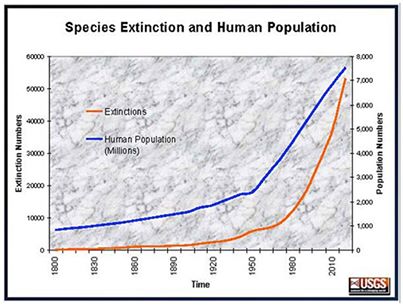
We can see some of the pressures today in the burgeoning human growth, with planet set to possibly reach 9 billion by mid-century, and religious and political pressure against population control. The increasing numbers seeking to immigrate to other countries to avoid poverty and crowding in their own is being felt around the world. Of course, the greatest victims are the animals who are being crammed into factory farms and trucked to slaughter houses, which are speeding up production to keep up with demand, again at the expense of the animals’ suffering. Wildlife is being destroyed, both by development (too many people again), by hunting, and by the millions of deaths on busy highways. The sad tale is endless, has been going on since human numbers starting depleting resources, and there is no end in sight. What is there to be optimistic about? Maybe not much. Individually we to be responsible enough to not contribute to the chaos and carnage and to help those, such as the innocent animals, who are not accountable for the human stupidity, irresponsibility, and harm but who pay the biggest price.
The greatest victims, the animals, are having to pay the price as humans steal their carrying capacity and force them into factory farms to unnaturally increase our species’ carrying capacity…