
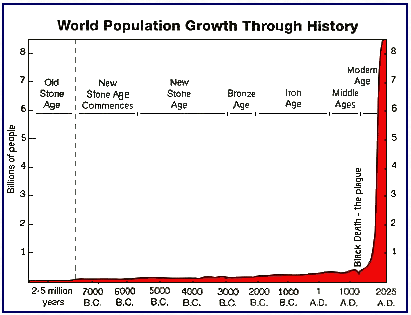
Looking back through some old copies of the National Wildlife Magazine, I came across an article from April/May, 1990, by John Nielsen entitled, “Whatever Happened to the Population Bomb? Two decades after Paul Ehrlich’s doomsday predictions, the biologist answers his critics with a new book.” The article came out at the time of Ehrlich’s then new book, Population Explosion, 22 years after his best-selling book (more than 20 million copies), Population Bomb. Ehrlich told National Wildlife, “What we were seeing on a global scale, was the rise to total dominance of a single species, man. This phenomenon was absolutely new and it threatened to wreck the planet.”
The article states, What about the population bomb? What happened to the notion that exponential population growth is the cause of almost all environmental woes? If to Ehrlich his 1968 message was clear, to his more extreme critics it has proved inaccurate and wrong-headed.
Like other ‘doomsayers,’ economist Julian Simon says, ‘Ehrlich underestimates the human ability to respond to change.’
But what about the rest of nature’s ability to respond to change wrought by humans?
Other critics point to Ehrlich’s erroneous predictions of traffic riots in Los Angeles, cataclysmic famines and dead oceans…
We may not be hearing a lot about traffic riots in LA—aside from road rage and regular drive-by shootings, but over-exploited fisheries and massive dead zones are cropping up in oceans across the globe.
Meanwhile, Right- to-Life activists attack him for favoring abortion. His notions of coercive population control in countries such as India and China have been called inhuman.
The problem with these charges, he says, is that they miss the point. Ehrlich admits that some of the scenarios that he made did not unfold [yet]. But he maintains, scenarios are not predictions and being out of date is not the same as being wrong.
Though a new environmental awareness is sweeping the United States [again, this was 1990], population control doesn’t seem to be generating as much concern in the press…The very notion, charges Ehrlich, is becoming ‘taboo’. “Politically, the pressure has been on to stay away from this issue,” he says.
“Each hour,” Ehrlich writes, “there are 11,000 more mouths to feed.”
Nowadays that number is roughly 16,000 per hour. (But of course that’s not taking into account people’s ability to respond to change.)
About his then new book, The Population Explosion, Ehrlich concedes that readers might ignore him this time around. They do so, he says, at the peril of their children’s world. Either way, this will be the last written warning.
“About the only thing I can guarantee is that this will be the last book on population by Paul Ehrlich,” he says. “You can only spend so much time alerting people to a problem. After that, they do their own thing.”
 Exposing the Big Game
Come on, people, let’s discuss the Big Problem! Paul Ehrlich also wrote another great book titled “The End of Affluence.” I wish I still had it. Any one else who has read it, besides me? I am surprised that up to now, we have no comments.
Population is the major factor in all this destruction: increasing wars, crowding, endless growth, pollution, poverty, hunger (we never have “fed everyone” & never will, as if that is the answer to the problems), deforestation, climate change, soil & water depletion, species’ extinctions, increasing epidemics, human insanity, to name just a few.
“Whatever your cause, it’s a lost cause, with population control.”– Paul Ehrlich
http://www.foranimals.org
“without” you mean?
Thank you! I am using keyboard with left hand right now, due to an injury to the right.
Correction:
“Whatever your cause, it’s a lost cause without population control.” Paul Ehrlich
I figured it was something like that. Now, it’s the classic, quotable line I’ve heard before: “Whatever your cause, it’s a lost cause without population control.” Paul Ehrlich
Thanks, Jim. I will begin to write about this journey shortly–I must give my right hand a rest. We also have just taken in a foster feline family (mother with 4 babies) and we are settling them in. We get them ready for adoption, after spay/neuter, etc. Something profound hit me on this journey that I am making the core of this article, which is my connection with an Maine island 12 miles off the coast. You are a gem–thanks for all you do!
it continues to amaze me that while our North American society sluggishly grows aware of the threat of global climate change (here in Canada I think the Prime Minister believes it will actually help Canada’s ruling elite, the only people that, if any, matter to him) the obvious and co-related issue of literally unchecked population growth is ignored even by environmental/conservation groups. Meanwhile the mechanical infrastructure that is less than a few centuries old, but upon which we are so dependent for our survival, is naturally deteriorating and already major cities increasingly can’t afford basic services. There’s a boom on where I live, in Markham, Ontario, (the Greater Toronto Area), so I could say “I’m alright Jack” and ignore it all, but basic common sense says you can’t simply keep adding 11,000 people per hour to the planet and also supply the demand for more or less even distribution of finite resources. The population shifts, wars, starvation, droughts and so on are all happening, and slowly they engage even us, if at first in relatively trivial ways — goodbye green lawns of L.A. — or in small numbers — too bad those people who can’t afford water from their taps in NJ, but the rest of us still can, and where I live, in abundance. The stress can only continue, even here, and while Ehrlich was wrong on many details or overstated them in his first go-around, fundamentally he not only was right, but we can, if we look, see that he was.
Thanks Barry for pointing out how everything is deteriorating. Here in the U.S. it is so apparent, yet people remain in denial, and get used to it. I just traveled from New Mexico to the East Coast and back. The few passenger trains we have are in bad shape–along with the tracks. The trains are running full, but government has made a big cut, and things will get worse with the remaining trains. Yet, I love to travel on them. I think I will write something about my latest journey and send it to Jim!
Looking forward to it!
In the meantime, we have people agonizing over the fate of embryos and wanting to bestow legal personhood (spiritual personhood already established) on fertilized eggs!
But as Garrett Hardin noted, “the sanctity of life finds no support in Nature,” and if people will not face up to the problem and they continue to hide behind religion, to call those who advocate population control racists, and to deny there could ever be too many people, then Nature will deal with our excesses someday, and we will rue that day.
Yes, Paul Ehrlich was wrong about some things. So was Malthus. But I would like to refer to a little allegory from the second edition of Malthus’ “An Essay on the Principle of Population.”
According to the speaker, “A man who is born into a world already possessed, if he cannot get subsistence from his parents on whom he has a just demand, and if the society do not want his labor, has no claim of right to the smallest portion of food, and, in fact, has no business to be where he is. At Nature’s mighty feast there is no vacant cover for him. She tells him to be gone, and will quickly execute her own orders if he does not work upon the compassion of some of her guests. If these guests get up and make room for him, other intruders immediately appear demanding the same favor. The report of a provision for all that come fills the hall with numerous claimants. The order and harmony of the feast is disturbed, the plenty that before reigned is changed into scarcity; and the happiness of the guests is destroyed by the spectacle of misery and dependence in every part of the hall, and by the clamorous importunity of those who are justly enraged at not finding the provision which they had been taught to expect. The guests learn too late their error in counter-acting those strict orders issued to intruders by the great Mistress of the feast, who, wishing that all guests should have plenty and knowing she could not provide for unlimited numbers, humanely refused to admit fresh comers when her table was already full.” Quoted in The Ostrich Factor by Garrett Hardin p. 100.
It sounds strangely harsh in a culture that tells us that, indeed, every life is sacred and must be saved. At the same time the planet’s population swells and boatloads of people from poverty-stricken and failing states sail for a Europe that is feeling less friendly and overwhelmed by the influx. Maybe this is the warning that the feast will end. If we fail to recognize the problem then eventually the earth will solve it for us.
Amazing how a speck of frozen protoplasmic goo can be more important to so many people than an entire species of animal life!
And for the sake of the historical record if nothing else, let’s remember who exactly derailed the zero population growth movement in the 1980s. As Dave Forman points out, back then we were well on our way to actually achieving ZPG in the US. So, what changed? Three things came along to f*** everything up: Jerry Falwell and his “Moral Majority”, President (or is it Saint now?) Reagan, and Pope (or is it Saint now?) John Paul. These environmental criminals are hopefully burning in Hell about now, but we the living will have to endure the coming catastrophe they facilitated. As everyone should know by now, dumb political decisions can have enormously distasteful consequences. And who made those political decisions? Why, “we the People”. In a political democracy you don’t get to blame it all on some tyrannical ruler. Just as societies tend to get the criminals they DESERVE, democracies get the leaders they elect. And in this case the two occupations are pretty much interchangeable.
“Those who fail to learn the lessons of history, are condemned to repeat them.”