
First there were the global warming skeptics and anthropogenic climate change deniers; now we are hearing from the downplayers and confuse-the-issuists like those who keep blaming everything on El Nino—a temporary, natural, cyclic phenomenon, not linked with human-caused climate change.
Another example of an effort to hold humans harmless is the debate around what is to blame for the early mass extinction of Pleistocene megafauna: humans or climate change? (unbelievably, still being debated after all these years.) Indeed, Discover.com has recently put out two differing articles with opposite titles, one blaming humans for what is known as the Pleistocene overkill (in an article entitled: “Humans Blamed for Extinction of Mammoths, Mastodons & Giant Sloths“, the other backing the climate change as the agent primarily to blame, (Still, even that new study blames humans for the coup de grace that finished off the species now extinct).
Recently there has been much clamor over the damage done by “invasive species,” yet, those species transported by humans’ ships, etc., cannot be blamed for “invading” the areas that they hadn’t yet populated. In every case, the exotic species were part of humans’ “wrecking crew” as John Livingston referred to them. Livingston went on to say in his 1994 book, Rogue Primate:
“There is no doubt about the identity of the first runaway exotic species, or of the role of that species in the extinction of other species worldwide. As ecologists Paul and Ann Erlich say, ‘It seems highly likely that humanity got an early start at the business of extinction.’ The prehistoric evidence, circumstantial though it may be, is persuasive; in the historic period the evidence is no longer circumstantial…The extinction events of the last 100,000 years or so may well rival the [five] great kill-offs of the distant geologic past…
“Even those who oppose the human-overkill theory cannot deny that the mega fauna extinctions coincided remarkably with the movements of Homo over and between the continents.
“Although the Pleistocene overkill theory is not accepted everywhere in academic circles, it really does not matter whether it is accepted or not. What does matter is the sum of the human accomplishment in historic time. It is estimated that between 1600 and 1900 we eliminated about 75 birds and mammals (there is no count of other taxa), and between 1990 and the present another 75 (again species other than birds and mammals not being monitored). The British ecologist and resource manager Norman Meyers remarked: ‘The rate from the year 1600 to 1900, roughly one species every four years, and the rate during most of the present century, about one species per year, are to be compared with a rate of possibly one per 1,000 years during the great dying of the dinosaurs.’
“Many authorities feel that by the time we entered the decade of the 1980s, we were already disposing of species (of all kinds) at the rate of one per day, and the number for the 1990s could well be one per hour. No longer of course, are we concentrating on ‘megafauna’: we have worked our way well down the scale of size. We have reduced, simplified, homogenized, and pauperized Nature everywhere on the planet to an extent that cannot be biologically recoverable. Extinct species never rides again; new species require untrammeled heterogeneity and purity of habitat. Neither would appear to be in the cards. The human achievement has been breathtaking in its suddenness, total in its scope. This could only be the work of a placeless being—in an ecological sense, one utterly lacking in both intrinsic inhibitions and extrinsic controls…[up until now, with global warming—a fever, if you will ] there was no immune system on Earth to repel the exotic invader. Everywhere, the transplant ‘took’.
“The Pleistocene produced an array of very large animals. Then, all at once, the megafauna was drastically reduced. The great creatures fell like dominos in an extinction spasm the like of which had not occurred, it would seem, since the obliteration of the dinosaurs. What made it dramatically different from other such events that had preceded it was the fact that species vanished without replacement….”
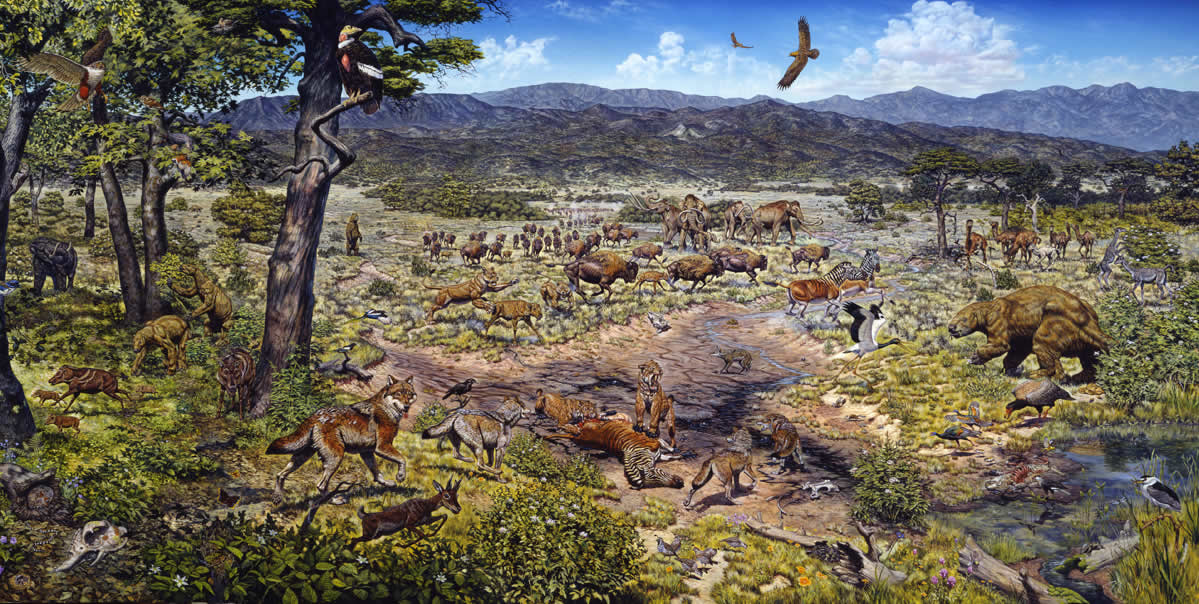
 Exposing the Big Game
Pingback: Screw the Sceptics—Humans Are to Blame! | GarryRogers Nature Conservation and Science Fiction (#EcoSciFi)