
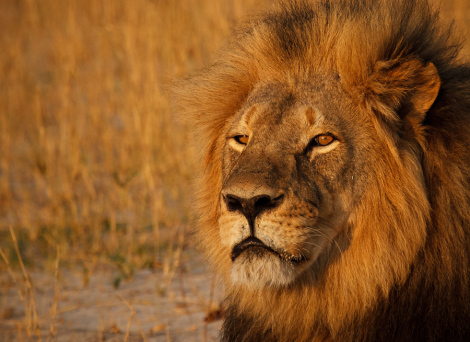
IN THE wake of the international outcry over the death of Zimbabwe’s most famous lion, the country’s wildlife authority has suspended the hunting of lions, leopards and elephants in the areas outside the park that the black-maned Cecil made his home before he was lured to his death. Conservationists hailed the move as a good first step. But more than a temporary stop in hunting in one African country will be needed if threatened and endangered species are to be saved.
Circumstances of the death of Cecil, a 13-year-old lion popular with tourists at Hwange National Park and being studied by scientists, are well known. Shot with an arrow after a dead animal was allegedly used to draw him out of his sanctuary, Cecil was tracked for 40 hours before being shot with a gun, skinned and beheaded. Walter Palmer, the American dentist who admitted killing Cecil, expressed regret, saying he relied on local guides and thought the hunt was legal. Officials in Zimbabwe and the United States are investigating.
What must not get lost in the hunt for justice for one celebrity lion is that Cecil’s death is part of a larger problem. The decline in population of African lions has been dramatic, from 500,000 to 600,000 at the turn of the 20th century to about 30,000 today. Other animals — elephants, rhinoceros, apes — are in equal, sometimes greater, danger. The Post’s Kevin Sieff pointed up the contrast in attention between Cecil’s killing and that of five nameless elephants slaughtered in Kenya by poachers marketing in ivory.
Hunting, legal and illegal, has not been the main cause of the decline in animal populations; that honor goes to the encroachment of civilization on natural habitats. Indeed, some hunting enthusiasts even argue that trophy hunting can be a boon to conservation by generating big fees to support sanctuaries, attract tourists and discourage local residents from killing animals or taking over their habitats.
Whether trophy hunting is beneficial to wildlife is a matter of some dispute. A 2009 report from the International Union for the Conservation of Nature said it had produced “mixed results.” Countries (Namibia is an example) that tightly regulate trophy hunting (paying close attention to the population of species), are vigilant about enforcement and are transparent about where the monies go can claim some overall benefits in helping wildlife. Too many countries, though, sell permits with lax regulations, no enforcement and no idea of the impact on animal populations.
The African Wildlife Foundation is asking all African governments to consider placing a moratorium on the trophy hunting of lions. Delta has joined other airlines in banning the shipment of big-game trophies on its flights. The United Nations has called on member states to increase efforts to fight poaching of endangered species, and the U.S. Fish & Wildlife Service has proposed listing lions as threatened under the Endangered Species Act. All are prudent moves that we hope will prove to be more than a sop to those mourning Cecil.
 Exposing the Big Game
Lions, along with giraffes, elephants, giant sloths, saber tooth tigers, and other mega fauna, once lived in this country, about 13,000 yrs ago. They did not last long once Homo sapiens appeared on the scene, hunting them to extinction. The few large mammals which now survive,, (as in Africa and around the world), are now also facing extinction due to human encroachment, hunting, wars, livestock grazing, and exploding human population. This is why it is critical that anyone who purports to “care” about The Wild, start getting involved, active, on wildlife issues. Human-caused Climate Change is also now exacerbating the crisis.
As a plant-based eater, for 25 years, I do not use the word “Vegan” anymore, because I have had far too many experiences with those who call themselves vegans, who have not an iota of understanding about wildlife & wild habitat, or how important Biodiversity is. And it isn’t found in Domesticates, be it domestic non-humans or humans. They appear to only have one solution for the multitude of serious conditions facing non-humans: Be Vegan. Well, actually some do add “I’m vegan, and I drive a Prius, so I do my part…” Sorry but that is myopic nonsense, indicating a lack of Critical Thinking.
It is not a panacea for all the ills of this planet, my friends. and frankly, I believe it actually is hurting the cause for a meat- free lifestyle, because many are turned off by such arrogance.
Want to stop hunting? Be Vegan, want to stop trapping? Be Vegan, want to stop vivisection? Be Vegan, want to stop Fur Wearing? Be Vegan. Frankly this kind of shallow, non-critical thought is why so many who do become ‘Vegan” do not stick with it for long. Many are leaving the fold. It sounds far too much like another religion to many.
I plan to expound more on this subject soon. Thanks for listening.
http://www.foranimals.org
The fact that humans killed off American lions, ground sloths, etc., 13,000 years ago says something about human nature that isn’t being addressed by those who still eat animals. As long as humans still kill and eat 60 billion animals per year, that side of their human “nature” will be fed and passed on to all the future generations of humans (who are despoiling and overrunning the planet). When I first started being active for animals, I was immersed in wildlife issues, my circle of compassion grew to include all animals, wild or (forcibly) “domestic.” I’ve probably spent more time out in the wild, natural world than anyone on this list, but I’m not ashamed to use the word vegan. Those who suggest going vegan will stop everything from trapping to sport hunting, etc., may actually be thinking that if everyone were vegan, no one would even consider abusing animals in those (or any other) ways. No, we may not have time to wait for everyone to extend their circle of compassion to all beings, but neither, I’m afraid to say, do we have time to see a return of Earth’s biodiversity before anthropogenic climate change makes the planet uninhabitable for most of life. Already, the oceans are dying all around us. If the oceans go, we all go (in the words of another caring animal activist/vegan). Petty in-fighting among animal activists is a waste of time for all–especially now…
Trophy Hunting Part of The American Zeitgeist
The US government has long been in the wildlife killing business and is oriented toward seeing wildlife as renewable recreational killing opportunities (see Wildlife Management Wikipedia) and as objects of pest control. The “conservationist”(exalted) Aldo Leopold, was an avid hunter, saw animals this way and believed in cultivating “sporting” game. He started off with game animal farming ideas and elimination or marginalization of predators. Wildlife agencies reflect these attitudes today and largely exist for hunters. Deep pocketed African wildlife trophy hunters have little conscience regarding wildlife, so it is up the the rest of society to bring them into check by legal means and public condemnation. Hunters have no or little, sense of right or wrong when it comes to wildlife, or trappers, seeing animals as objects of profit and recreational killing opportunity or competition for game. So, it is really little surprise that our government has been looking the other way when comes to African wildlife sport killing (aka hunting), poaching, and animal parts import. We, as a total population, need to bring pressures to bear, social and legal, to control our less evolved human elements and to redefine the meaning of conservation, animals as sentient, and value of biodiversity, and re-wilding concepts/outlook to the forefront. Concepts and practices of balanced wildlife ecology, apex predator cascading healthy effects (values of predators), re-wilding, buffer zones around preserves, biodiversity protections, animals rights, animals as sentient, are relatively new and not at the forefront of wildlife agency functioning.
References:
https://exposingthebiggame.wordpress.com/2015/08/06/cecil-the-lions-death-highlights-the-work-to-be-done-to-protect-wildlife/
https://exposingthebiggame.wordpress.com/2015/08/05/trophy-hunter-serial-killer/
Wildlife Management, Wikipedia
Aldo Leopold, Wikipedia
Sand County Almanac, Aldo Leopold
http://blog.humanesociety.org/wayne/2015/07/cecil-lion-killed-by-trophy-hunter.html?credit=web_hpfs1-cecil-072915_id93480558