
http://www.scmp.com/news/china/policies-politics/article/2074048/bird-flu-outbreaks-become-more-common-china-and
Experts argue whether blame for spread of virus lies with factory farming or live poultry markets

In a book published last month, Stephen Hinchliffe, a professor of human geography at the University of Exeter in Britain, argues that mass livestock production is driving molecular changes in diseases that could lead to human pandemics.
WHO calls on Beijing to vigilant in monitoring H7N9 bird virus
According to the United Nations Food and Agriculture Organisation (FAO), the world raised more than 21 billion chickens in 2014, up from 19 billion in 2011, or about three fowls for every person on the planet. The bulk of that production came from the United States, China and Europe.
Rapidly rising global poultry numbers, along with selective breeding and production techniques that have dramatically altered the physiology of chickens and other poultry, have made the planet more “infectable”, Hinchliffe and three co-authors argue in their book, Pathological Lives: Disease, Space and Biopolitics.
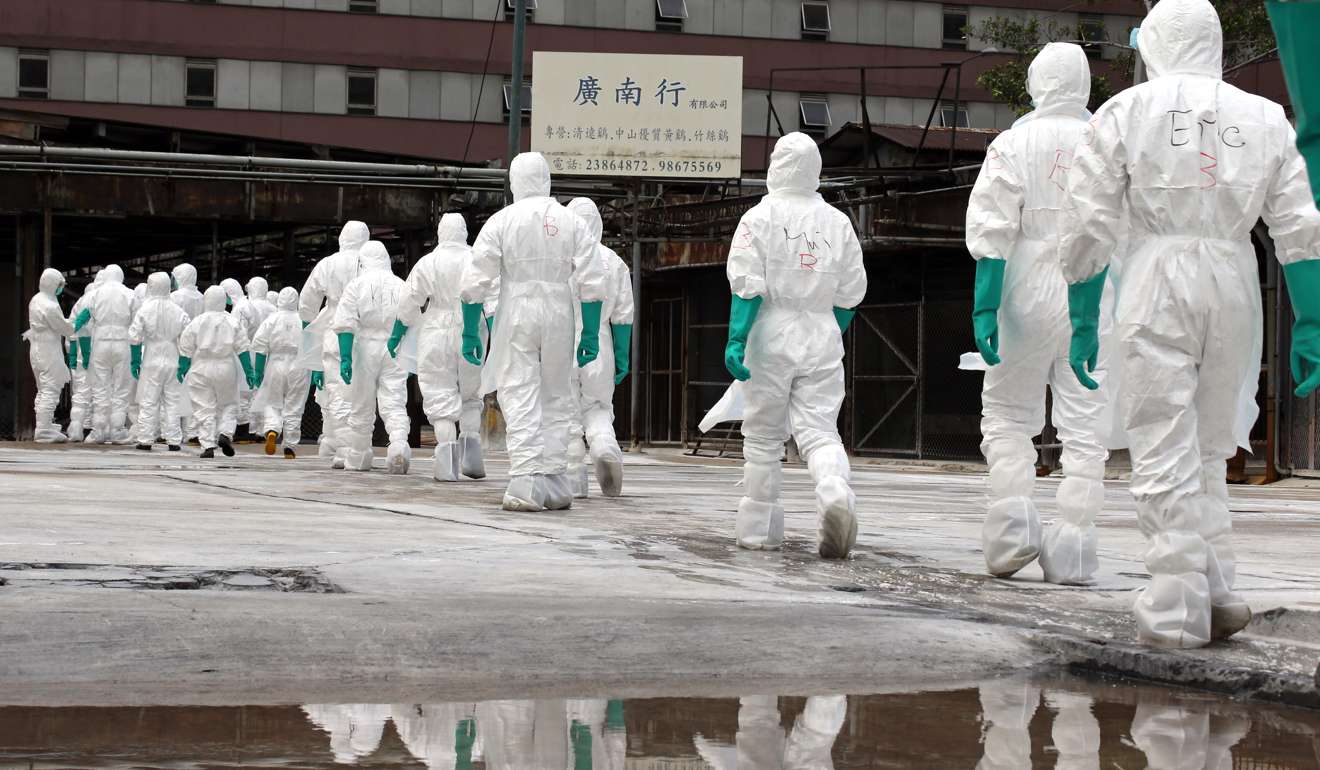
But other researchers say poultry farms are just victims. The biggest culprits in the spread of bird flu viruses, they say, were the live poultry markets in China and Southeast Asia, which should be reformed if not eliminated.
More than 90 people on the mainland have died in the latest seasonal outbreak of H7N9 bird flu. Taiwan has also began culling hundreds of thousands of domestic birds to contain the spread.
Hinchliffe argues that the bird flu crisis stems from “our economies and modes of organising life”.
“We question the sustainability and security of the kinds of intensive protein production that are being rolled out across the planet,” Hinchliffe said.
Take the threat of bird flu seriously
Some current forms of bird flu can infect people. Some scientists warn that the current “swarm” of flu viruses in circulation are cause for heightened concern.
“Avian flu has been around for a long time, circulating in wild birds without being too much of an issue. But as inexpensively produced protein-rich diets become a worldwide norm, poultry populations, growth rates and metabolisms have changed accordingly,” Hinchliffe said.
Economic considerations were driving selective breeding, feed and dietary supplements, and sometimes the inappropriate use of pharmacueticals, especially antibiotics.
“Raising a bird to market weight takes a third of the time it did 30 or so years ago, with the result that disease tolerance is often compromised,” he said.
“Between that and sheer numbers, flock densities and global connectivity, humans have created a new set of conditions for viral selection and evolution.
China approves human trials of vaccine for deadly bird flu strain
“As any epidemiologist will tell you, a microbe can only become deadly or pathogenic if there are the right environmental and host conditions.
“Bird numbers and altered bodies have, in short, made the planet more ‘infectable’,” Hinchliffe said.
Dr Chen Quanjiao, associate researcher of bird flu epidemiology at the Wuhan Institute of Virology, under the Chinese Academy of Sciences, disagreed.
The detection rate of bird flu at poultry farms was usually “very low”, she said. Farmers regularly jabbed birds with vaccines and erected nets to fence out wild species.
The outbreak of bird flu happened in live poultry markets where birds from different places were kept in the same cages, sometimes for days, which gave the virus a chance to mutate and spread to humans.
“Hong Kong has implemented a very effective method to regulate its live poultry market. If other places in China and Asia can follow Hong Kong’s practice, we can significantly reduce the risk,” Chen said.
 Exposing the Big Game