

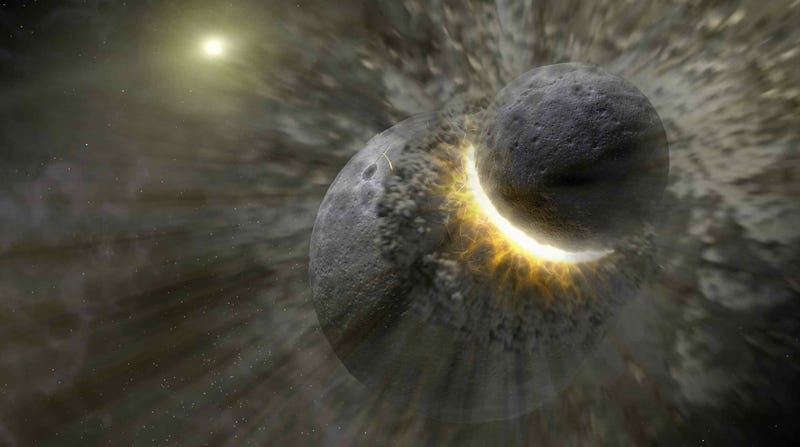
New research suggests that much of the material that made life possible on Earth arrived after a cataclysmic collision between our planet and a Mars-sized object billions of years ago—likely the same collision that produced the Moon, the scientists say.
For life to emerge on an otherwise dead planet, an assortment of chemical compounds, or volatile elements, are required, including carbon, nitrogen, and sulfur. Conventional thinking has it that Earth’s volatile elements arrived through the steady bombardment of ancient meteorites. New researchpublished today in Science Advances proposes an alternative delivery mechanism: a catastrophic collision between Earth and a Mars-sized object, sometimes referred to as Theia, some 4.4 billion years ago. This hypothetical collision, which would have happened while our planet was still forming, seeded our baby planet with the volatile elements required…
View original post 1,289 more words
 Exposing the Big Game