
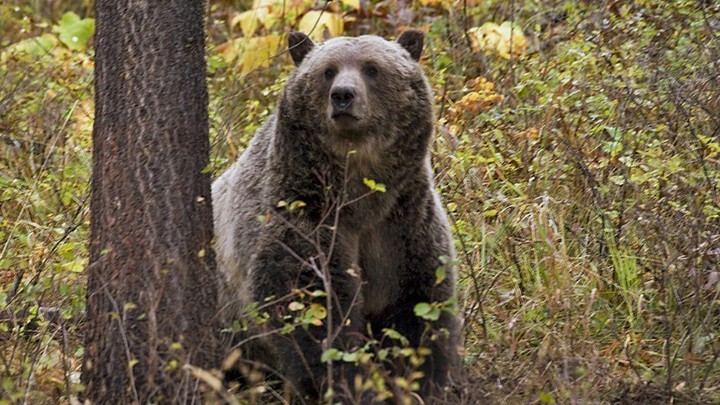
To protect their livestock from the booming bear population, many local cattle ranchers have installed electric fences. They require less maintenance than barbed wire does and are safer for migrating elk, Stone explained. Since improving his fencing, he no longer has to worry about grizzlies killing his cows and calves.
As grizzlies continue to expand their range in Montana, more communities will have to face the question of how to coexist with them. Strategies such as installing electric fences, distributing special garbage cans, and encouraging communities to share the lessons they learn can help. But the most effective solution may be one of the hardest to achieve: trust between rural landowners and government agencies.
But the grizzly boom has brought with it a rise in human-bear conflicts. In September, for example, four hunters were injured in three separate attacks in southwestern Montana. These encounters are bad news for the grizzlies as well: Last year, about 50 bears were killed or removed from the Northern Continental Divide Ecosystem, a record high for Montana.
Read: Grizzly bears have a human problem
Nonprofits such as the Blackfoot Challenge, located in the Blackfoot Valley, are helping communities deal with these conflicts. Stone, who chairs the organization’s board of directors, has helped implement its three-pronged approach to managing grizzlies: building electric fences, moving dead livestock to designated compost plots, and employing range riders to protect cattle. All told, conflicts with grizzlies in the Blackfoot Valley dropped by 74 percent from 2003 to 2013, according to a 2017 case study on the Blackfoot Challenge.
But in the small town of Condon, in nearby Swan Valley, where tall conifers rather than rangelands dominate the landscape, the residents face different problems. One of the biggest challenges is teaching people how to manage backyard bear attractants, such as garbage cans and chicken coops, says Luke Lamar, the conservation director at the nonprofit Swan Valley Connections. The organization offers electric-fencing installation, bear-resistant garbage containers, property consultations, and educational events. Once a bear knows where to find free food, it tends to return to the area, Lamar says. “That cycle will most likely continue until the bear is caught and removed by agency bear managers or by other means, such as a resident shooting the bear.”
Read: Can humans and bears coexist?
Communities have different reactions to grizzlies and may need different methods to manage them. Sara Halm, a graduate student at Idaho State University, is interviewing people who live in three Montana communities to learn how grizzlies impact their rural towns. Many locals are scared for their children, who can no longer play outside alone the way their parents once did. For some, electric fences help lessen that fear. But fences make other residents feel confined. “This is deeper than just an economic issue of protecting people’s livelihoods,” Halm says. People have to redefine their relationship with the environment and wildlife.
This post appears courtesy of High Country News.
 Exposing the Big Game