

ByNicoletta Lanese-Staff Writer6 hours ago
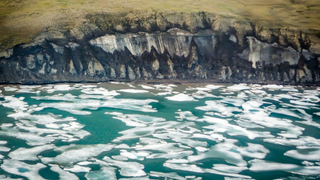 The coastline of the Bykovsky Peninsula in the central Laptev Sea, Siberia retreats during summer, when ice-rich blocks of permafrost fall to the beach and are eroded by waves.(Image: © 2017, P. Overduin)
Millions of tons of organic carbon and methane beneath the Arctic Ocean thaw out and ooze to the surface each year. And climate change could speed up this release ofgreenhouse gases, new research suggests.
Thecarbontied up in organic matter and methane (a carbon atom bound to four hydrogen atoms) are currently trapped in subsea permafrost, which is frozen sediment that became covered by 390 feet (120 meters) of seawater toward the end of the Paleolithic ice age about 1,800 to 1,400 years ago,according to the U. S. Geological Survey(USGS). Most subsea permafrost sits on the continental shelf under the Arctic Ocean, said study…
View original post 628 more words
 Exposing the Big Game