
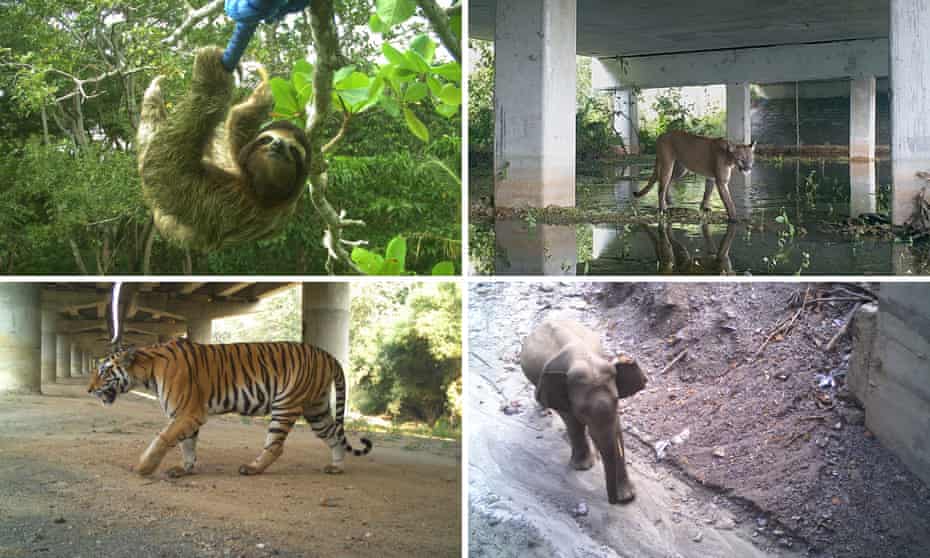
India’s tiger corridor and Australia’s possum ‘tunnel of love’ are among the myriad infrastructure projects providing safe passage
- How creating wildlife crossings can help reindeer, bears – and even crabs
- Read more in our series Biodiversity: what happened next?
The age of extinction is supported by

About this contentPatrick Greenfield@pgreenfieldukWed 29 Dec 2021 05.15 EST
From a tiny railway bridge for dormice in the UK to elk, deer and bears benefitting from a slew of new animal crossings in Colorado, wildlife bridges are having a moment. As the human footprint on the planet continues to expand, a growing number of roads and railways include provisions for wildlife to pass through fragmented landscapes.
In January, we reported on Sweden’s plans to build a series of “renoducts” to help reindeer traverse the country’s main roads. The Swedish Transport Administration has since completed an ecoduct over the E6 in Skåne in southern Sweden, the third in the county. In southern California, work is due to begin on the largest wildlife bridge in the world in 2022, to connect isolated mountain lion populations north of Los Angeles that are becoming dangerously inbred. Joe Biden has earmarked $350m (£260m) of his $1.2tn infrastructure package for wildlife bridges to lessen the multibillion annual cost of collisions.Advertisementhttps://8ef1763cc532385f2086720612434a47.safeframe.googlesyndication.com/safeframe/1-0-38/html/container.html
“Ten years ago, wildlife bridges were experimental. We didn’t know whether they would work or not. Now they’ve shown they get huge reductions in collisions. In some cases, 85% to 99% reductions,” says Rob Ament, a road ecology expert at Montana State University. “You can design them for many species. Even out in the plains, we’re getting moose crossings in North Dakota.”
Wildlife bridges are found on every continent: there is an elephant underpass near Mount Kenya; the Netherlands has a network of ecoducts that may help the country’s first wolf pack in more than 140 years gain a foothold across the densely populated country; suspended water pipes are helping Java’s endangered lorises; and a bison bridge may help the animals cross the Mississippi.
Here are five projects from around the world helping animals make their way:
Alligator Alley, Florida
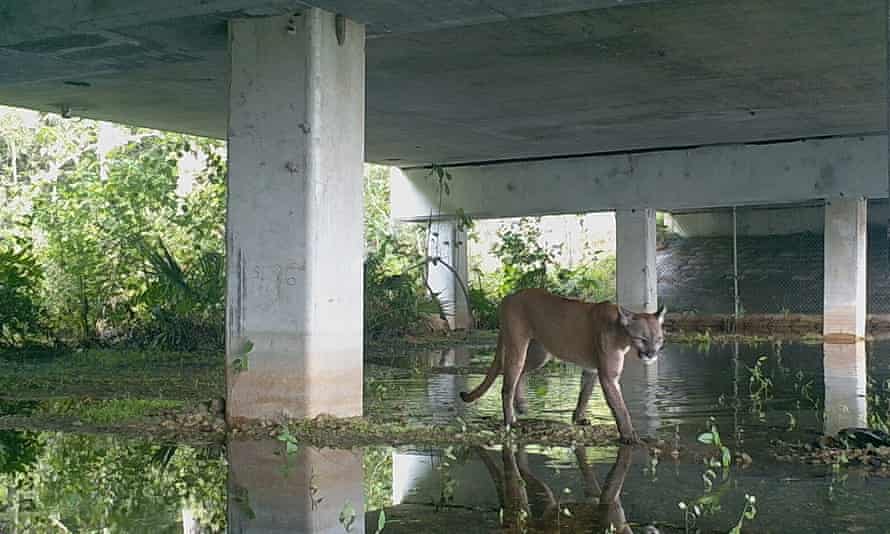
The 129km (80-mile) stretch of road between Naples and Fort Lauderdale bisects the Everglades, an enormous wetland that is home to thousands of alligators, deer and the endangered Florida panther. It used to be notorious for high-speed collisions with wildlife until the road was upgraded to a four-lane motorway and crossings were installed. Today, dozens of underpasses and fencing help wildlife navigate the road. A camera trapping exercise found panthers, black bears, skunks, deer, bats, birds and even fish use the crossings, and hope is growing the state’s wildlife bridge network could be extended north to connect potential habitats for the Florida panther. “Fencing is critical along Alligator Alley. It is a 10ft-high chain link fence with three-strand barbed wire on top. That’s to keep the wildlife off the roadway and on the crossing,” says Brent Setchell, a design engineer at Florida Department of Transportation, who identifies potential crossing sites by monitoring road collisions with panthers and bears. “The fascinating thing is we just started monitoring the crossings four or five years ago. We found an abundance of wildlife.”
‘The tunnel of love’ on the Great Alpine Road, Australia
Advertisement
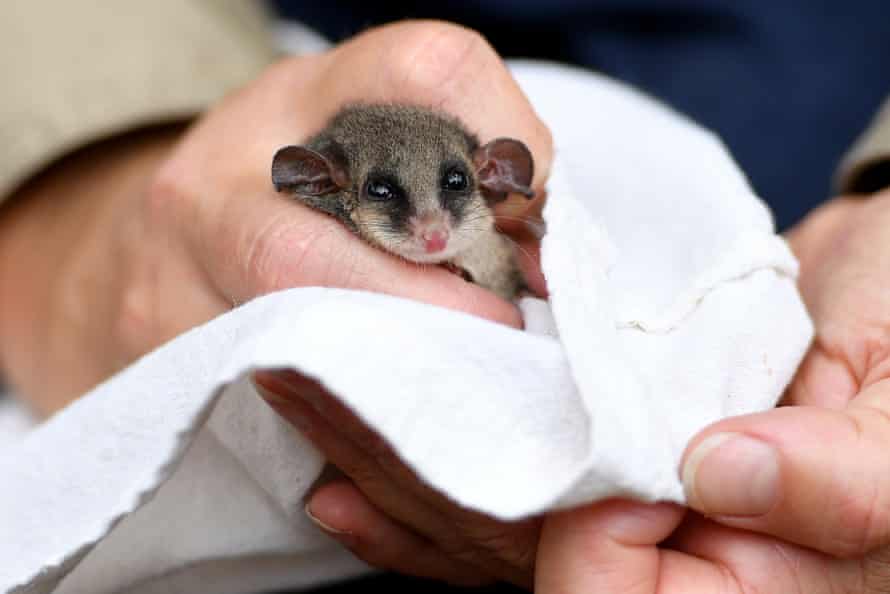
Stretching through the Victorian Alps in south-east Australia, the Great Alpine Road posed an existential threat to a colony of critically endangered mountain pygmy possums. Even though there are only about 150 of the marsupials on Mount Little Higginbotham, testing revealed genetic differences between sub-groups separated by the road, which are also threatened by fire, disappearing food sources and invasive species. Conservationists decided to build a “tunnel of love” between the isolated groups to improve mixing and strengthen their chances of survival. Over the last two summers, 30 possums have been identified using the tunnel of love, often in spring when they wake up from hibernation. The tiny marsupials can cross the nearly 15-metre tunnel in just 15 seconds – sometimes too fast for remote sensing cameras to capture them.
India’s tiger corridor
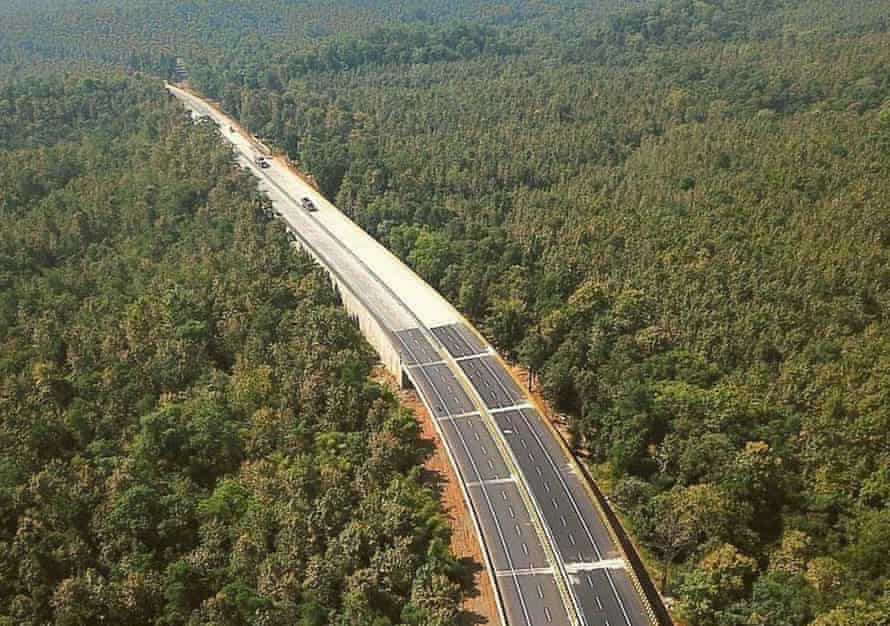
India’s first dedicated wildlife underpasses were a hard-fought victory for environmental campaigners. The nine crossings in the Pench tiger reserve were a court-ordered mitigation measure on the country’s longest road, the 4,112km National Highway 44, which runs down the middle of the country. Collisions with big cats still happen on the multi-lane motorway, but environmentalists say the underpasses have highlighted the need for more wildlife crossings on India’s road network. A 2019 camera trapping exercise found at least 18 species use the crossings, including tigers, wild dogs, sloth bears, civets and leopards. “According to our calculation, some 55,000km of roads pass through India’s forests and protected areas, many of them through wildlife corridors,” Milind Pariwakam, a road ecologist with Wildlife Conservation Trust Mumbai, told the Hindu. More infrastructure projects now have wildlife passes, including the 1,380km Delhi-Mumbai expressway currently under construction, which includes India’s first animal bridges.
Bhutan’s elephant crossing
Advertisementhttps://8ef1763cc532385f2086720612434a47.safeframe.googlesyndication.com/safeframe/1-0-38/html/container.html
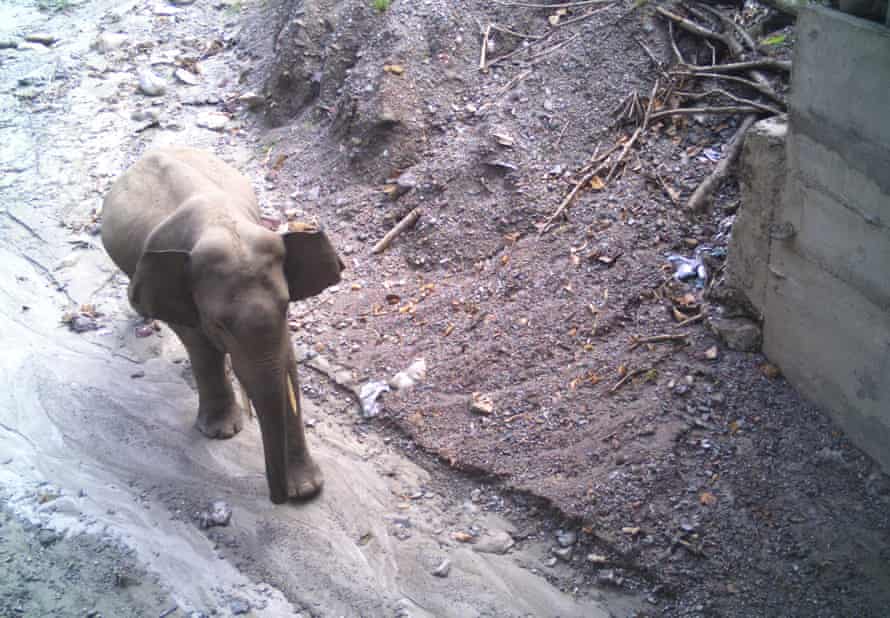
Nearly 700 Asian elephants roam Bhutan’s forest on the eastern edge of the Himalayas. The small Buddhist country sandwiched between China and India is known for its dramatic landscapes and environmental leadership, as one of the few carbon negative countries in the world. On the 183km east-west motorway, Bhutan’s first elephant underpasses were constructed to help the threatened animals move through the landscape.Monitoring from 2015 to 2017 found that 70 groups of elephants were recorded near the passes, with three-quarters passing through the structures.
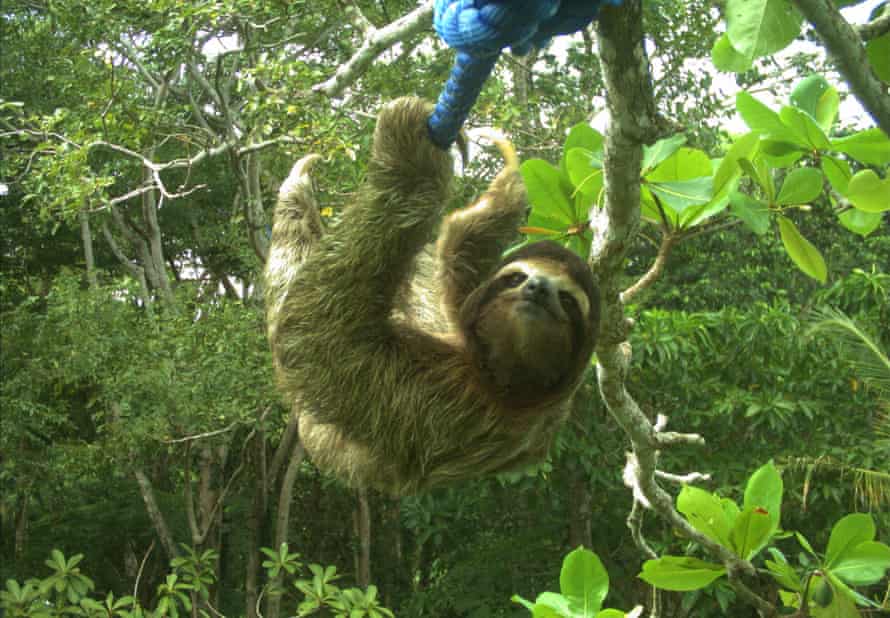
Sloth bridges in Costa Rica
Wildlife passes are not always bridges or underpasses. In Costa Rica, canopy bridges are used to help sloths, monkeys and other wildlife cross roads to combat collisions, dog attacks and electrocutions on power lines. The rope bridges, which cost about $200 (£150), are installed by the Sloth Conservation Foundation in areas where rainforest has been interrupted by human development on the country’s Caribbean coast. Crossing roads is often deadly for the slow-moving creatures and the canopy bridges also help combat inbreeding. “People look at them and think that they’re so poorly equipped to survive because you see them crossing roads and trying to move around and they look so awkward and useless,” Rebecca Cliffe, head of the Sloth Conservation Foundation, told Bloomberg earlier this year. “But if you put them in a well-connected rainforest, then they are masters of survival.”
Find more age of extinction coverage here, and follow biodiversity reporters Phoebe Weston and Patrick Greenfield on Twitter for all the latest news and features
 Exposing the Big Game
All of the critters are using them – it is wonderful!
Humans are everywhere, with Earth’s wildlife an afterthought. These efforts hopefully will increase before more animal life is exterminated.
Btw, has anyone read that story about the endangered tiger at a zoo who had to be destroyed because it had bitten a man’s arm? I tried to avoid the story all day because I knew it would be upsetting. Just how upsetting I didn’t have any idea about. I saw it on the evening news.
I thought it would be just another stupid visitor. How wrong I was. It was a 26-year old guy from their cleaning service!, and just how did he make his way into the tiger’s cage, how did he get keys? The zoo may charge the guy, but I think the zoo itself is negligent.
This poor endangered tiger had to be shot. But at least comfort can be taken in hearing the idiot’s blood-curdling screams.
I saw that and couldn’t read it for the same reason as you. I have to object to the use of the words, “had to” though. Just because the endangered tiger bit some idiot, doesn’t mean it “has to” be killed. Not in my book.
I agree, Jim. We humans have set up a very useful language tool to enable us to continue our destructive behaviors. Whether it be “game dept.’s with their “management” jargon, or the industry use of “pits” by Los Alamos Nuclear Lab to hide behind the fact that such “pits” are nukes as well–to be used to “detonate” a larger weapon of mass destruction–or the Forest Service using its specialized jargon to further justify destroying our remaining forests to “save them.”
We need to discuss why we humans justify enslavement of wild animals in zoos, circuses and other “entertainment” venues. At the local Albuquerque “Biopark” (no longer called “zoo”, two baby elephants have been ill, one dying in 2015 due to a strange virus. I am depressed, sickened and frankly do not see much hope for our planet. Nothing positive came out of the last Climate Conference.
Am I crazy? I sometimes think so, because the species I belong to, is crazy. Is it “normal” to be depressed in these times? My humble opinion is: if I am not, Something is wrong with me–Boulder, Colo. & Louisville next door to it, just lost anywhere from 500 to 1,000 (or more, perhaps) dwellings–100 mph winds. It looks like a bomb dropped. And, Colorado was even greener in some spots up there, as compared to NM. I do not think Homo will go easily, or well. I have premonitions of a hot fire raging over the pinon foothills right down to our El Dorado community.
We still have coyotes, badgers, bobcat, snakes, etc. here.
Thanks for listening.
https://www.krqe.com/news/albuquerque-metro/abq-biopark-zoos-elephant-jazmine-tests-positive-for-eehv/
Absolutely. The more I read about it, the madder I get. They did not bring any pepper spray or tranquilizer. The guy was stupid. It wasn’t an attack, but lack of impulse control on the janitor’s part. I have read that he lost his arm, but I don’t know how true it is. One can only hope!
The worst thing in an article I read was ‘there is not word on whether the zoo will acquire another endangered tiger. There are only 200 left in the world’.
Absolutely no way can this zoo be trusted with another endangered animal! I understand there weren’t even any security cameras.
One last thing: Stupid people will never become an endangered species, unfortunately. Even with behavior like this! They are a dime a dozen.
https://www.yahoo.com/news/florida-zoo-facing-boycott-calls-150302713.html