
Spoiler alert: You can’t get it at a fast food chain.
Illustrated by Lais Borges/Mic; Getty Images
FOOD https://www.mic.com/impact/agrihoods-urban-farming-sustainable-food
6.28.2022
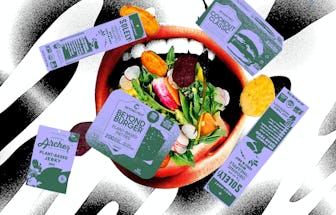
In the past decade, the meatless meat market has kind of exploded. In the olden days — aka the 90s — vegetarians basically had to choose between salty, hard-pressed cardboard and bland, mushy cardboard as meat alternatives. Nowadays, though, plant-based meats — especially plant-based ground beef and burgers — literally bleed for our attention. But are all fake meats equally healthy and tasty? I contacted nutritionists to weigh in on what to look for and what to avoid when shopping for plant-based meat.
First of all, it’s crucial to remember that fake meat brands and companies are in the market for different reasons. “Some are designed to appeal to meat lovers as a plant-based alternative, with the look and feel of actual meat,” Maddie Pasquariello, a registered dietician in Brooklyn, tells Mic. These are products like Impossible Burger or Beyond Burger, which are meant to mimic the meat-eating experience as closely as possible. Others are designed simply to be healthy meat alternatives and don’t necessarily taste like meat, cook like meat, or even resemble meat at all, Pasquariello explains.
So when you shop for plant-based meat alternatives, you should first consider what you want out of fake meat. Do you want it to look and taste like animal meat, provide a good source of protein and other nutrients, be good for the environment, or some combination?
The best meat imposters also tend to be the most processed.
If you’re trying to find the most meat-like experience, Impossible Burger and Beyond Burger are tops, and they have the added benefit of being greener than most actual meat, Dana Ellis Hunnes, a registered dietitian in Los Angeles, assistant professor at UCLA Fielding School of Public Health, and author of Recipe for Survival: What You Can Do to Live a Healthier and More Environmentally Friendly Life, tells Mic. “Beyond and Impossible Burgers have good flavor, but are higher in processed products that are also higher in saturated fats,” she says. That doesn’t mean they’re bad for you, per se, but Hunnes recommends against making them an everyday staple.
Plant-based meat made of whole foods is more nutritious.
“Typically, the most nutritious plant-based meat you’ll find will be the ones made from whole, simple ingredients,” Pasquariello says. She recommends reading the labels to make sure that what you’re buying contains fiber, protein, and limited additives.
And, Hunnes notes, you should be especially vigilant about the sodium content and fat. “[Plant-based meats] are still a highly processed food, and they often have a lot of sodium added to them, and depending on the brand, a lot of saturated fat,” she explains.
If you’re not educated about how to read food labels, Pasquariello has some advice. “Try to look for plant-based meat alternatives that contain at least 8-10g protein per serving (or more — some offer upwards of 20-30g), with at least 5g fiber per serving, and 300mg of sodium or less per serving,” she says.
But don’t just focus on the nutritional content; look at the ingredients, too. “Ingredients that sound like an actual food tend to be less processed and healthier than those that are highly processed and unrecognizable,” Hunnes says.
Nutritionist’s recommended plant-based meats may be surprising.
One of Pasquariello’s favorites is a black bean burger made by the brand Actual Veggies. “These contain plenty of protein, as well as fiber, and have zero saturated fat. The ingredient list is super simple, and they’re high in vitamin A and magnesium, while being relatively low in sodium — a lot of bang for your buck,” she says. While they may be a relatively unknown option, a quick search reveals they’re in the refrigerated section of several grocery stores, as well as a few online markets.
Hunnes likes Dr. Praeger’s Perfect Burgers best because they contain recognizable ingredients and have a healthier nutritional profile than a lot of processed food. In fact, many of the dozens of dietitians I contacted for this article said these veggie burgers are their favorite, citing the good balance of taste and nutrition. Frankly, I was surprised by this; I’ve been vegetarian for decades and never tried these. The packaging looks a bit medical, and I’m always skeptical of products packaged under a doctor’s name — shades of Dr. Atkin’s — but it just goes to show that you can’t judge a burger by its cover.
You probably shouldn’t eat plant-based meat every day.
I don’t know who needs to hear this, but you shouldn’t eat meat at every meal, even if it’s plant-based. “I would be hard pressed to say that any vegan meat burgers are a ‘health’ food,” Hunnes says. “Most of them are not a health food, nor are they necessarily meant to be health foods. They are an environmentally friendly and humane food, and as a vegan myself, from those two perspectives, I recommend vegan meats as a ‘treat’ food or a once-a-week food, rather than an everyday food — but animal meats should not be an everyday food either.”

5 good news stories about climate changeIMPACTWhere is the post-Roe outrage?Stories that Fuel Conversations
I’D ALSO LIKE TO RECEIVE:Up NextSubmit
INSIDE THE MOVEMENT TO TURN RESIDENTIAL COMMUNITIES INTO FARMING COLLECTIVES
The rise of the “agrihood” could be a boon for more sustainable eating.

Illustration by Dewey Saunders
A GREEN NEW WORLD
4.22.2022
For most Americans, by the time a piece of fruit or vegetable lands on your counter or in your refrigerator, it has traveled about 1,500 miles. For residents of Detroit’s North End community, it’s a matter of a couple of city blocks.
About a decade ago, Tyson Gersh and a crew of students from the University of Michigan started the Michigan Urban Farming Initiative (MUFI), part of a growing trend of urban farms that were cropping up around the city. The all-volunteer effort set down stakes in a two-square-block area of the North End neighborhood and built up its campus with the goal of reducing food insecurity by making production-scale farming within the community itself. By 2016, the group had built the country’s first sustainable urban agricultural neighborhood — also known as an agrihood.
In the years since it launched, MUFI has become a model for a neighborhood that centers around community farming. More than 10,000 volunteers have offered up more than 100,000 hours of support and service to the project, which has yielded over 50,000 pounds of produce, including 300 different types of vegetables. That food has been distributed to more than 2,000 households located within a 2-square-mile radius of the MUFI campus, as well as local churches and food pantries. Community members pay what they can.
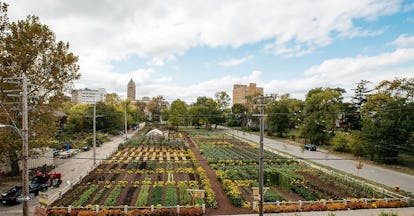
“We’ve grown from an urban garden that provides fresh produce for our residents to a diverse, agricultural campus that has helped sustain the neighborhood and attracted new residents and area investment,” Gersh said in 2016.
MUFI has its foot in the door on two separate but growing movements: urban farming, which has taken hold in Detroit in particular but is making its way across the county, and the agrihood trend. Both efforts seek to build communities around agriculture, but agrihoods are rethinking planned neighborhoods and land usage in a more wholesale way — driven largely by millennials who want to make more of their green space.
Throughout the 1950s and 1960s, as the population of United States boomed, developers started building neighborhoods around amenities that appealed to the young adults of the era. At the time, golf courses were a centerpiece of planned communities; at one point, 1 in 4 golf courses built in the U.S. were created as part of a real estate development. That arrangement worked at the time, but has fallen out of favor for a number of reasons — not least of which is the fact that homes in these communities come at a premium, pricing out younger buyers who both have less to spend than previous generations and, frankly, couldn’t care less about golf.
Instead of fairways and greens — which are a deeply wasteful use of land, by the way — the new generation of homeowners seeks sustainability, healthier lifestyles, and a sense of contributing to social good. Hence, the agrihood.
The concept isn’t new, exactly; community gardens and urban agriculture projects were once quite popular during the Great Depression. But it has been newly formalized among housing development projects. In 2016, the Urban Land Institute provided a definition of an agrihood: a master-planned housing community with food-based amenities like working farms. Currently, there are about 200 agrihoods located in 28 states across the U.S., with more planned by developers looking to attract younger homebuyers.
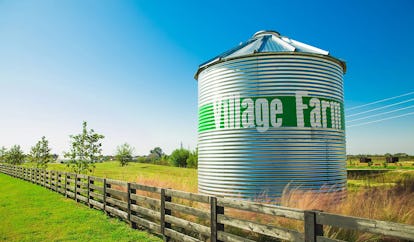
Like any neighborhood, agrihoods can take on a variety of shapes, as they’re often tailored to their surroundings and needs of the community they serve. Dennis Durban, an industry adviser who came to work with agrihoods through his food businesses, points to winery-focused agrihoods popping up in the West, like the Mesilla Vineyard Estates in New Mexico, which grows and sells local grapes and offers bottles at a discount to the community. Durban says he’s seen agrihoods comprised of as small as 20 homes to as large as 500 crop up in recent years, all centralizing around the agriculture that makes sense for their region.
Brett Coleman, the owner and founder of Agrihood Living, has perhaps seen more of these living arrangements up close than anyone. Over the course of several months in 2018, Coleman and his family visited 21 different agrihoods in 10 states. During that time, Coleman met people who weren’t just prioritizing sustainability with food, but also with relationships.
“You can live in a neighborhood for 10, 15 years and say ‘hi’ to your neighbors once or twice. If you’re lucky, you’ll have a good close relationship with maybe one or two neighbors,” Coleman tells Mic. “With these neighborhoods, they bring everybody together.” That was a major draw for Coleman and his wife, who wanted to see their son, now 7 years old, grow up in a place that instilled a sense of community. After touring agrihoods across the country, they settled into one themselves.
The scale of participation in the farming project for agrihood residents can vary. Often, it’s less about the work itself and more about the connection it gives you, both with the land and the people, Coleman says. “It gets you visiting with your neighbor, being outside and communicating,” he explains.
The scale of these communities is often small, but the impact that they can have on the households involved is significant. Agrihoods offer farm-to-table living, with freshly grown produce readily available. That can be hard to come by in many neighborhoods. For produce to be good produce — not just in taste, but in actual nutritional value — it has to be pretty fresh; just one week from harvest, some foods can lose 30% of their nutrients. Having fruit and vegetables grown nearby allows the community to eat better, and in a period of supply chain problems and increased delays in shipping, it also negates some concerns of food shortages. Plus, it shortens that 1,500 miles of travel for produce to almost zero, which means far fewer emissions that harm the planet.
 Exposing the Big Game
Reblogged this on Committee to Abolish Sport Hunting Blog.