
BY ARISTOS GEORGIOU ON 8/21/22 AT 5:00 AM EDT02:45
Permafrost: The Tipping Timebomb
SHARE https://www.newsweek.com/man-who-wants-release-thousands-woolly-mammoths-arctic-1735273
Share on FacebookShare on TwitterShare on LinkedInShare on RedditShare on FlipboardShare via EmailComments
TECH & SCIENCEEXTINCTIONWOOLLY MAMMOTHGENETICSCRISPR
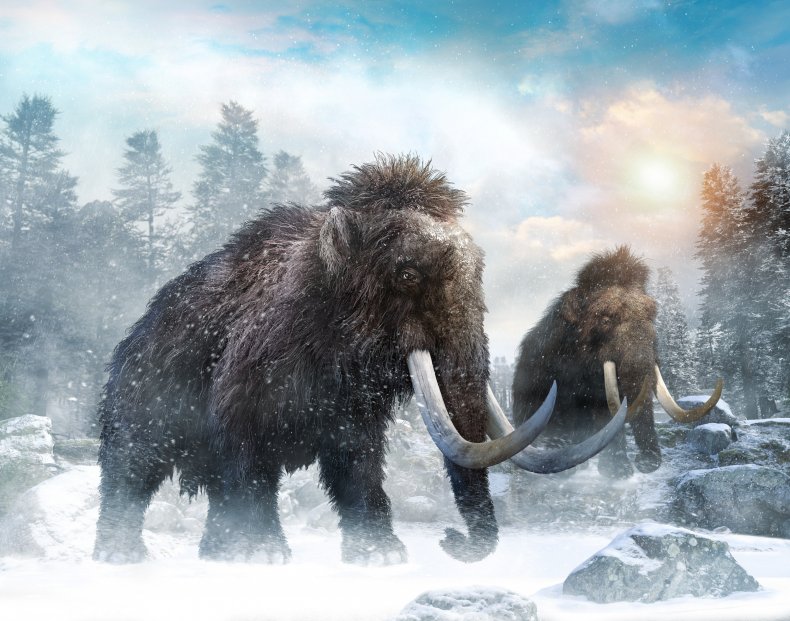
Woolly mammoths, the iconic giants of the last ice age, went extinct around 4,000 years ago.
But one company is trying to revive the species—or at least something resembling it—and the scientist at the head of the project envisions thousands of these animals roaming the Arctic.
Colossal Biosciences is a start-up launched by tech entrepreneur Ben Lamm and renowned geneticist George Church that is aiming to resurrect the woolly mammoth, or more accurately to create a genetically engineered Asian elephant that will be cold-resistant and have all the core biological traits of its extinct relative.
The company also announced this week that it is working on the de-extinction of the thylacine, or Tasmanian tiger.
While not an exact replica, the hybrid animal will look like a woolly mammoth and be capable of inhabiting the same ecosystem that the extinct animal once roamed.
The science side of the ambitious (and somewhat controversial venture) is being guided by Church, whose pioneering work has contributed to the development of DNA sequencing and genome engineering technologies.
Church leads synthetic biology research efforts at Harvard University’s Wyss Institute for Biologically Inspired Engineering. He is also a professor of genetics at Harvard Medical School, while also holding positions at the Massachusetts Institute of Technology (MIT), among other institutions.
NEWSWEEK SUBSCRIPTION OFFERS >
Church has co-authored hundreds of scientific papers, has dozens of patents to his name, and has set up more than 20 companies. He has long dreamed of bringing back the woolly mammoth, and after teaming up with Lamm, this dream could become a reality, although significant scientific and logistical obstacles will need to be overcome first.
Genome Editing Examples
Colossal’s aim to create a hybrid elephant with woolly mammoth traits—such as thick fur and layers of insulating fat, among other cold climate adaptions—will involve the use of advanced gene editing technology.
Church told Newsweek that the approach is very similar to research one of his companies has demonstrated with pigs, where scientists made roughly 40 edits to the genome of these animals in order to make their organs suitable for transplantation into humans.
He said Colossal was planning to make a similar number of edits in cells taken from Asian elephants, an endangered species that is the woolly mammoth’s closest living relative, sharing around 99.6 percent of its DNA.
“Indeed, the Asian elephant and the woolly mammoth are closer to each other than either of them is to the African,” Church told Newsweek.
In order to determine which edits to make, Colossal’s researchers have to compare elephant genomes to that of the woolly mammoth to identify where the key differences are. Fortunately, some mammoth remains have been preserved remarkably well, with some tissue samples containing intact DNA, from which researchers can build at least partial genomes.
Once the differences are identified, scientists can begin making genetic edits to cells taken from Asian elephants with the aim of creating a more mammoth-like animal. The number of edits will be similar to the 40 or so made to the pig genome in previous research.
“We’d typically use CRISPR [Clustered Regularly Interspaced Short Palindromic Repeats], or a variety of other editing tools, to edit the cell by going in and adding DNA. And then we take the nucleus out of that cell and put it into an egg.
“Then we implant that into a surrogate mother and wait, in the case of elephants, 22 months. Then you’ve got a calf. That’s classical cloning, as was done with Dolly the Sheep,” Church said. “The point is not to resurrect a species, but to resurrect individual genes in a constellation that would help specifically with cold tolerance.”
Artificial Womb or Surrogate Mother
Another method that the Colossal team is working on in parallel is to develop the elephant-mammoth hybrid embryo in an artificial womb instead of using a surrogate mother.
The surrogate would likely be an African elephant rather than an Asian one because it is a larger species that will have less difficulty delivering an elephant hybrid and is slightly less of a conservation concern.
“We will let it develop outside the body as kind of happens for a little while in in vitro fertilization. But then, we want to carry it further, all the way to term,” Church said.
This has never been done before for any mammal, but researchers have previously made headway in some animals. For example, a team at the Children’s Hospital of Philadelphia managed to support a fetal lamb for four weeks, although the size of a mammoth calf, which usually weighs more than 200 pounds at birth, will present a far greater challenge.
While using a surrogate mother is more feasible because the technology has already been demonstrated (to some extent at least) in other mammals, Church said most of the team favors the artificial womb approach—despite the technological challenges—because it can scale better and doesn’t interfere with the reproduction of living elephants.
Colossal’s goal, which Church said was “not necessarily a promise,” is to produce a viable elephant-mammoth hybrid in six years.
Environmental Benefits
If Colossal does manage to achieve this, the company hopes that introducing enough of them into the wild could restore the health of the Arctic environment and decelerate melting of the Arctic permafrost, a process which releases vast quantities of greenhouse gases, threatening efforts to curb climate change.
Mammoths were keystone species that were vital to maintaining the health and biodiversity of the ecosystems in which they inhabited. The loss of mammoths over the last few thousands years has contributed to a reduction of grasslands, which once efficiently absorbed carbon, in the Arctic regions. Now this ecosystem is dominated by mossy forests and wetlands.
Restoring these grasslands could help to prevent the thaw and release of greenhouse gases within the arctic permafrost, according to Colossal.
“Elephants tend to knock down trees, and hence restore grasslands,” Church said. “So, there’ll be a mixture of trees and grass, rather than right now, there’s almost no grass.”
“The main side effect that we’re interested in is the maintenance of cold arctic soil by [elephants] trampling the snow to let the cold air in in the winter.”
In addition, grasslands do a better job of reflecting sunlight than trees currently found across the Arctic because they are lighter in color. Thus, more grassland, would help to cool the ecosystem.
Church said Colossal is focusing on the regions of the Arctic that have the highest carbon content because more methane—a potent greenhouse gas—would be released if we let the permafrost thaw from these areas.
“The carbon content of these carbon-rich areas add up to more than the rest of the forests of the world put together,” Church said.
 Exposing the Big Game
Reblogged this on The Extinction Chronicles.
I just want to know what this “scientist guy” is smoking. Yes, just put these poor specimens of animal torture in a hot world which will be on fire, not with ice and snow.
The last time I was in Alaska it was so smokey that no mammoth would recognize the place…
What a tragedy that Humans have spoiled this Earth to the extent that Life will not be able to flourish much longer. So now, even Alaska!