
NATURE04 November 2022
https://www.sciencealert.com/a-host-of-bizarre-creatures-has-been-found-at-the-bottom-of-the-ocean
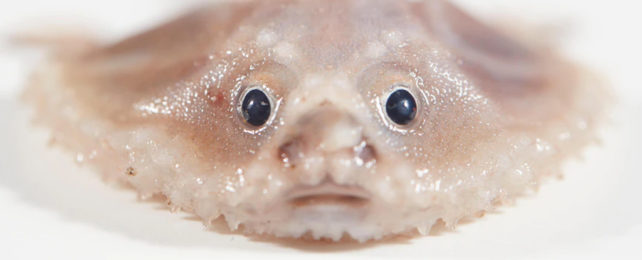 A deep-sea batfish. (Ben Healley/Museums Victoria)
From fish on stilts to creatures of ooze, the strange denizens of the deep uncovered during investigations of two new marine parks located 2,500 kilometers (about 1,500 miles) off Australia’s western coast were a dream come true for researchers.
Even before the expedition departed on 30 September 2022, Museums Victoria (MV) senior curator of marine invertebrates Tim O’Hara anticipated a discovery or two would be made.
“We know the region is covered with massive seamounts formed during the dinosaur era and we know the region sits at a critical juncture between the Pacific and Indian Oceans,” O’Hara said.
“We are really excited about the prospect of discovering new species, perhaps even new branches of the tree of life, which until now have remained hidden beneath the waves in this unexplored region.”
On their way to the new marine park territories that will protect 740,000 square kilometers (about 285,000 square miles) of ocean around Cocos Keeling and Christmas Islands, researchers observed a dazzling array of winged fishes casting themselves into the air.
These animals risk being snapped up by hungry seabirds to escape larger fish, Australian Museum Research Institute fish biologist Yi-Kai Tea explained in a blog post about the voyage.
Using sonar, teams on the research vessel (RV) Investigator mapped the seabed over 35 days of exploration on their 13,000 kilometer voyage, uncovering ancient sea mountains, volcanic cones, canyons and ridges. The extinct volcanoes formed 140 to 50 million years ago.
The sonar revealed Cocos Keeling Islands were twin peaks of a massive sea mountain rising nearly 5,000 meters from the sea floor. A third submerged peak was also identified, 350 meters below sea level.
The crew reported collecting a big treasure haul of species after sampling habitats with small trawl nets from 60 meters down to a depth of 5,500 meters below the surface.
O’Hara estimates up to one-third of these species may be new to science. This includes a potentially new type of blind cusk eel, with loose, gooey see-through skin.
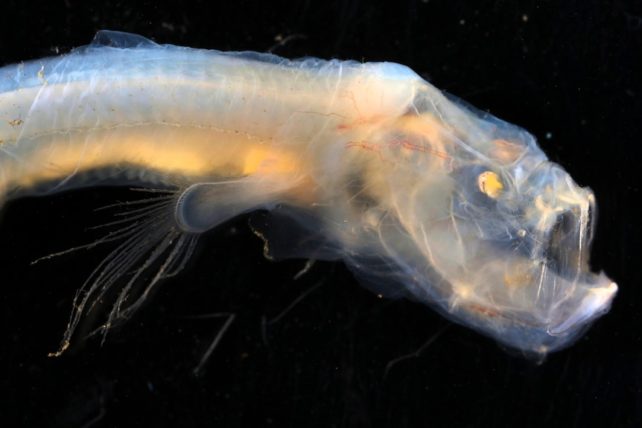
“These fish have really reduced eyes. In fact, if you see the picture you’ll find they’re like little golden depressions in the skin. They’ve got really loose, flabby, gelatinous skin and they’re incredibly rare,” MV senior collections manager Dianne Bray told the Australian Broadcasting Corporation.
Then there is the adorable deep-sea batfish, which looks like a bit of limbed, well-cooked ravioli with a ‘please love me’ expression on its tiny face. This odd little creature shuffles its way along the seabed on stubby little fin-legs with big ‘feet’.
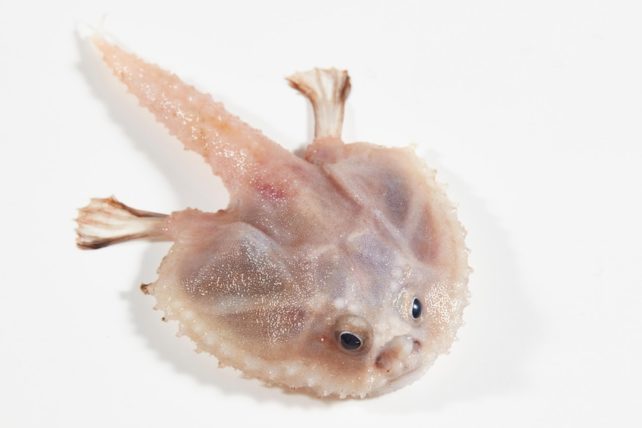
“These are tiny little anglerfish relatives … they’ve got a tiny little lure that sits in a depression on their snout that they can actually move to attract prey and they essentially walk over the floor on their modified arms and legs,” Bray explains.
Another fish was caught anchored to the ground with bizarrely elongated stilt-fins, with which it can hover effortlessly just above the seafloor, waiting to pounce on unsuspecting prey below.
The teams also discovered a hermit crab using a deep-sea colonial zoanthid coral as its shell. These goopy soft corals tend to incorporate sand or other bits of materials that happen to be lying around to give themselves some structure – including crabs it would seem.https://www.instagram.com/p/Cj03TEQSG8C/embed/captioned/?cr=1&v=14&wp=648&rd=https%3A%2F%2Fwww.sciencealert.com&rp=%2Fa-host-of-bizarre-creatures-has-been-found-at-the-bottom-of-the-ocean#%7B%22ci%22%3A0%2C%22os%22%3A8014%2C%22ls%22%3A3226.2000000476837%2C%22le%22%3A3876.7999999523163%7D
Fancy sea cucumbers, plenty of sea stars and lots of sea snails also call this region home as do many other strangelings of the deep.https://www.instagram.com/p/CjlcO2DBqHz/embed/captioned/?cr=1&v=14&wp=648&rd=https%3A%2F%2Fwww.sciencealert.com&rp=%2Fa-host-of-bizarre-creatures-has-been-found-at-the-bottom-of-the-ocean#%7B%22ci%22%3A1%2C%22os%22%3A8025.400000095367%2C%22ls%22%3A3226.2000000476837%2C%22le%22%3A3876.7999999523163%7D
Once the vessel returns to the mainland, the sampled creatures will be studied by taxonomists who specialize in different animal groups to confirm their identity or describe new species, using DNA extracted from the animals as a vital source of information.
“The research outcomes from this voyage will be invaluable to our understanding of Australia’s deep-sea environments and the impact humans are having on them,” explained MV CEO Lynley Crosswell.
You can catch the latest from this and other RV Investigator expeditions here.
Banking for Early-Stage StartupsBridge Bank|
Venture debt insights: what you need to know.Bridge Bank|
2022 QuickBooks holiday hub: A prep guide for your businessQuickBooks|
7 ways a Phone System Helps Your Small Business Look BiggerRingCentral|
Holiday rush and your mental health: Are business owners prepared?QuickBooks|
Building Tech For A Better FutureChan Zuckerberg Initiative|
4 Megatrends That Have the Potential for Disruptive ImpactCustom Content from WSJ | McKinsey|
TaylorMade® TP5/TP5x Golf BallsTaylorMade|
Moving in Winthrop? See the Latest Apartment Listings HereApartments.com|
Love looks like healthy, meat-first dog food.Blue Buffalo|
Before Being Ritually Sacrificed, This Nazca Child Was Drugged With PsychedelicsScienceAlert
Here’s How Long a Cannabis High Actually Lasts, According to ScienceScienceAlert
Men Are Obsessed With These Shorts. See WhyFabletics|
The Cost Of Unsold Furniture In Winthrop May Shock You (See Deals)Furniture Deals | Search Ads|
The 2021 Subaru Lineup Is Turning Heads And Finally On SaleAll Things Auto | Search Ads|
High-Yield Savings Accounts To Protect Against InflationHigh-Yield Savings | Search Ads|
New Hybrid Virus Discovered as Flu And RSV Fuse Into Single PathogenScienceAlert
6 Credit Cards You Should Not Ignore If You Have Excellent CreditNerdWallet|
William Shatner Felt Crushed When He Finally Made It to Space. Here’s WhyScienceAlert
85 Years After It Was Abandoned, Explorers Find a Historic Cache of Camera GearScienceAlert
Trending News
Mouse Study Suggests a Surprising Link Between Nose-Picking And Alzheimer’sHEALTH3 days ago
85 Years After It Was Abandoned, Explorers Find a Historic Cache of Camera GearHUMANS3 days ago
Scientists Just Discovered an Entirely New Way of Measuring TimePHYSICS4 days ago
 Exposing the Big Game
Reblogged this on The Extinction Chronicles.