
Scientists measured canine brain waves to shed light on language learning.
BY LAUREN LEFFER | PUBLISHED MAR 22, 2024 11:00 AM EDT
SHARE
When a dog follows a command or fetches a ball, it’s hard to know what’s really going on inside its canine cranium. Do dogs understand and respond to tone of voice, the syllables of words, accompanying hand motions and body language, or just the situational context? Behavioral studies have offered some clues, but new research brings additional evidence that our favorite furry friends really do grasp the meaning behind words.
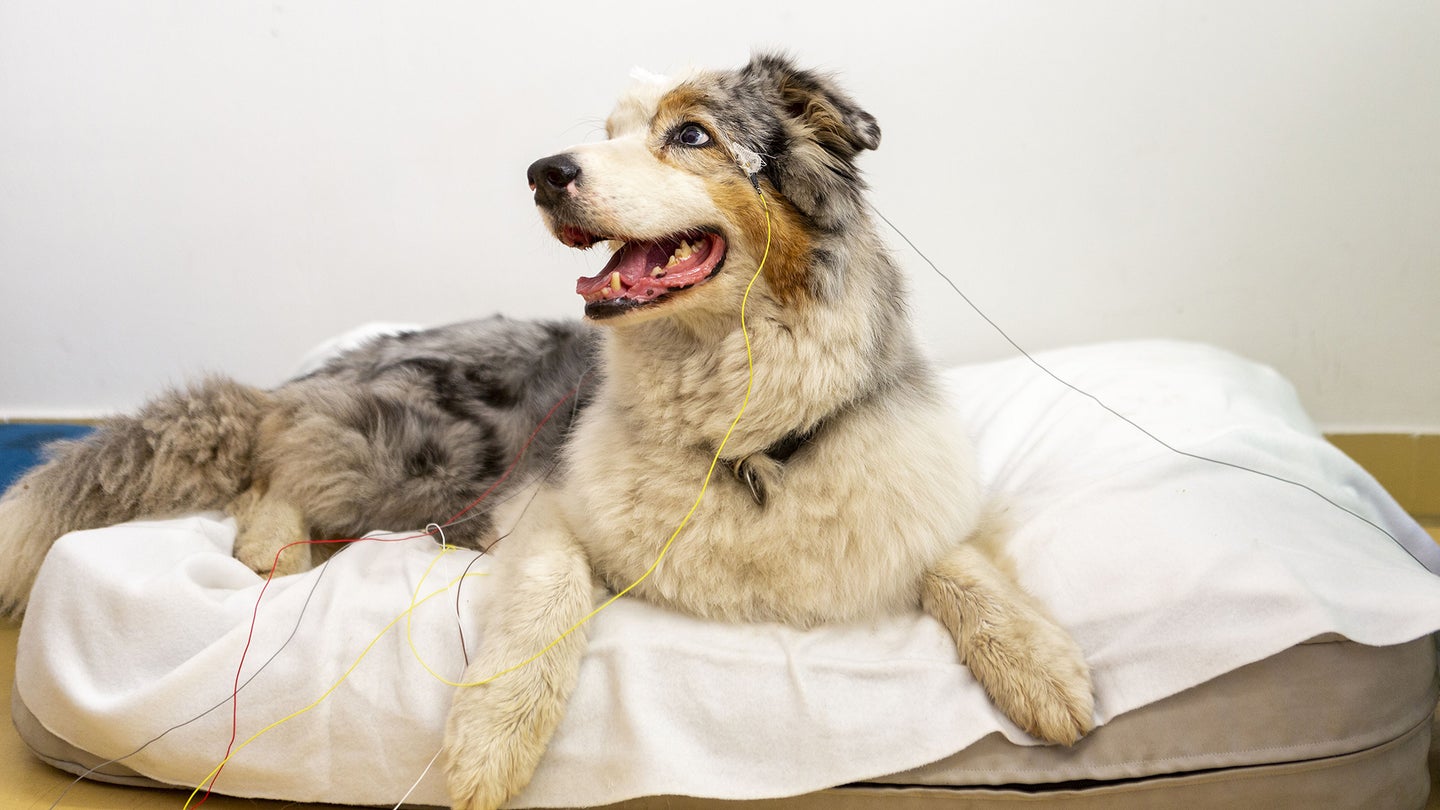
Dogs show a pattern of neural activity that seems to indicate they can differentiate between words for different objects, and are even surprised when presented with words and objects that don’t match up, according to a study published March 22 in the journal Current Biology. A team of neuroscientists and animal behavior researchers used non-invasive electroencephalogram (EEG) testing to measure the electrical pulses inside 27 pet dogs’ brains during an experiment involving the dogs’ owners and some well-loved toys. They found an electrical impulse pattern similar to a known signal in humans. The findings shed light on canine noggins and also add to our knowledge of the origins of complex language.
“We were interested in whether dogs understand words the way humans do.”
“It’s wonderful to have studies like this,” says Ellen Lau, a neuroscientist studying linguistics at the University of Maryland who was not involved in the new research. Applying EEG to dogs, instead of the more invasive techniques that are often used to study animal brains, allows for more direct comparisons between humans and non-humans, she explains. “If we want to understand what’s common across humans and animals, we need to have more of this kind of data.”

00:00
02:23
Read More
https://imasdk.googleapis.com/js/core/bridge3.629.1_en.html#goog_892967630
https://imasdk.googleapis.com/js/core/bridge3.629.1_en.html#goog_892967631
https://imasdk.googleapis.com/js/core/bridge3.629.1_en.html#goog_892967632
https://imasdk.googleapis.com/js/core/bridge3.629.1_en.html#goog_892967633
A vocabulary test for babies, adapted to dogs
Among animals, family pups are unique for how much exposure they get to human language. “You can probe a lot of interesting questions about language experience with dogs, because they’re some of the only animals that live in our houses and pay attention to us,” says Amritha Mallikarjun, a neuroscientist researching canine cognition at the University of Pennsylvania who was not involved in the new research.
The study scientists set out to test if dogs grasp the relationship between words and their corresponding objects. “We were interested in whether dogs understand words the way humans do,” says Lilla Magyari, co-lead author and a cognitive neuroscientist and psychologist at the University of Stavanger in Norway. Some standout dogs are able to demonstrate their vocabulary through behavioral tests, but not all dogs are as abiding, capable, or well-behaved. The scientists wanted to know if even dogs that don’t display exceptional abilities still have some language sense.
The bigger the surprise, the bigger the signal.
People have internal references for what words mean, or the ability to “picture” an object inside their minds’ eye from memory. However, it’s unclear if any other animals share this capacity to imagine something that’s not there from an associated sound. To explore this question, Magyari and her colleagues adapted a cognitive test previously used in studies of infants. The assessment compares EEG readings from a subject told a word or phrase, and then either shown a corresponding object or an object that doesn’t match the description.

In humans, even those too young to speak, an observable effect called the N400 appears on EEG read-outs when people encounter language and other stimuli. It’s a characteristic signal that peaks around 400 milliseconds after a stimulus is presented, and gets larger when objects or images and words don’t match up. The bigger the surprise, the bigger the signal. Many scientists interpret the effect as evidence of understanding and proof of an internal reference for a word’s definition, even in non-verbal subjects.
In order to make the test canine friendly, Magyari and her co-researchers made some careful adjustments, controlling for the dogs’ comfort, potential variability in voice, and other movements or communication signals between dogs and owners that might influence results.
“I think this study is beautiful,” Lau says–noting the thorough and well-considered design. “I think they really did everything you need to be doing in animal cognition work.”
The dogs, all healthy companion animals, were recruited via social media and were selected based on an owner’s assessment that their pet understood at least three object words. After a period of acclimating to the lab, owners and dogs were separated by an electronic window that could quickly toggle between transparent and opaque. The scientists attached electrodes to the dogs’ heads at key points. Over multiple trials, the pets were played recordings of their owners’ voices calling their attention to one of five familiar objects (e.g. ‘Fido, look, the ball’), while being shown their owners’ faces through the window. Then, after a brief period of opaque blankness, the window would reveal the owner holding up one of the objects–either a match to the previously played phrase, or a mismatch. Meanwhile, the EEG recorded the electronic pulses going on inside their brains.
Out of the 27 dogs that started the experiment, 18 were included in the final analyses. Nine were excluded, mostly because they wouldn’t sit still enough to yield clean EEG data. But even accounting for the challenges of wiggley animal subjects, the scientists still found clear patterns in their results.
 Exposing the Big Game