
May 07, 2024 | 10:14 am ET
By Emma Cotton
Description
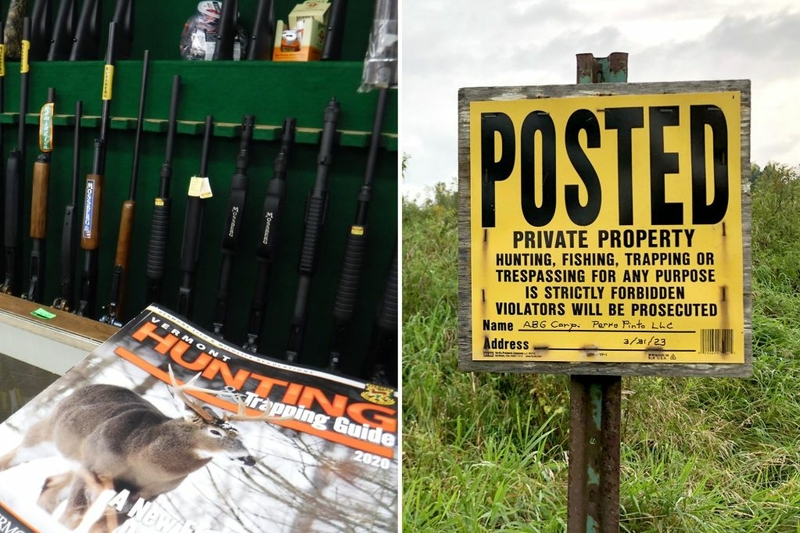
A sporting goods store display, left, and posted sign. Photos by Kevin O’Connor and Natalie Williams/VTDigger
This is the first story in a two-part series that examines the increasingly inflamed debate about wildlife management in Vermont. Part I of the series looks at the voices that are most often heard in the Legislature and in Vermont media. Part II analyzes the opinions of the broader public and asks whether it’s possible to find common ground.

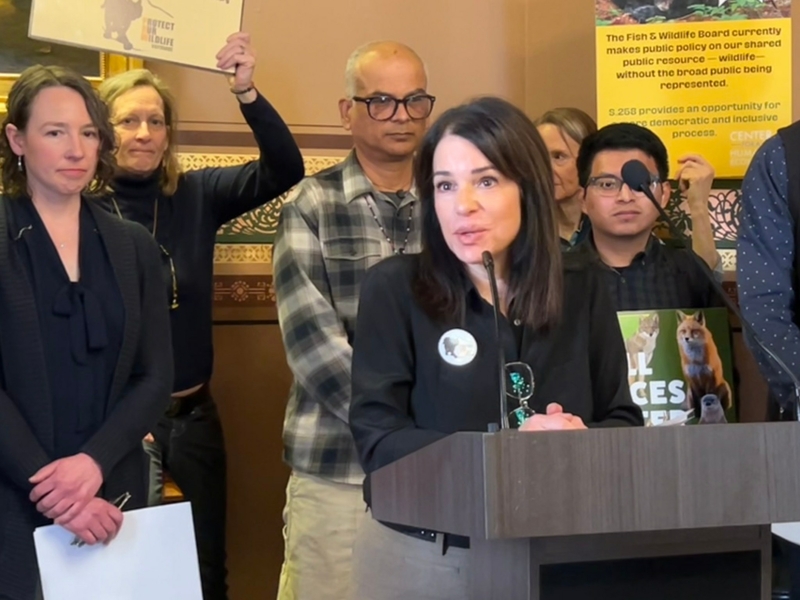
MONTPELIER — In early April, more than a dozen people stood at one end of a carpeted room in the Statehouse holding signs with slogans such as “hunting coyotes with hounds IS legalized dog fighting” and “all voices matter.”
At the other end of the room stood Mike Covey, executive director of the Vermont Traditions Coalition, which advocates for rural interests in the Statehouse. He was observing and sometimes recording video. Two reporters stood in the middle, the only other people in the room.
Brenna Galdenzi, who was standing among the group holding signs, addressed the room.
“I just want to take a minute to say that (we) are not animal rights terrorists, extremists. We are not ‘antis.’ We are not invasive species taking over Vermont,” said Galdenzi, president of Protect Our Wildlife, a Stowe-based organization that has advocated for increased hunting regulations.
Her ad-libbed comments at the press conference, held to support a bill related to wildlife management, show how polarized conversations about wildlife management have become. Across Vermont, people’s experiences and views related to wildlife come in shades of gray. But at the Statehouse and in the press, they often appear in black and white.
In the Legislature, much of the conversation has been focused on the membership of the Fish and Wildlife Board. Currently, its 14 citizen members, appointed by the governor, create and approve all of the hunting, trapping and fishing regulations for Vermont’s game species. The board is typically made up of active hunters, trappers and anglers.
READ MORE
As wildlife adapts to stressors such as climate change and habitat loss, a growing range of people want to see the animals’ needs prioritized over those of hunters. They argue that the board unfairly prioritizes the interests of hunters, who represented about 10% of Vermont’s population in 2023, according to data from the Vermont Fish & Wildlife Department.
In the past few years, the dispute has become increasingly pitched. Some influential lawmakers have moved to address that perceived disparity, along with complaints about the impacts of certain hunting and trapping practices on landowners.
Their proposals have raised the hackles of many hunters and trappers, who defend the current composition of the board and see ongoing debate as a threat to their way of life.
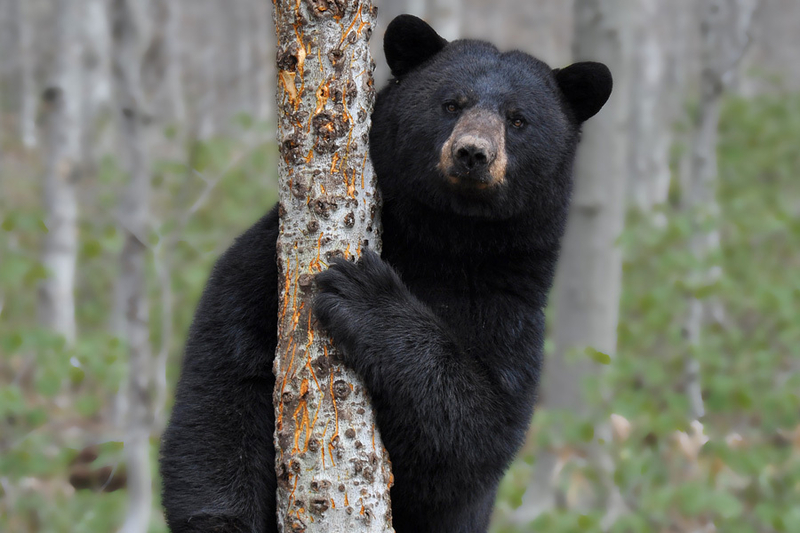
This legislative session, the conversation has focused on S.258, a bill that would significantly tweak Vermont wildlife management by adding two new members to the Vermont Fish and Wildlife Board whose primary backgrounds would not likely be hunting and trapping. The bill would also ban the controversial practice of hunting coyotes with hounds.
Perhaps most significantly, S.258 would shift rulemaking authority from the board to the Vermont Fish & Wildlife Department. Staffed with 150 people, many of whom are wildlife biologists, the department currently provides advice and recommendations to the board, which are largely accepted.
When the bill reached the Senate floor earlier this year, Sen. Russ Ingalls, R-Essex, told lawmakers that the measure is “the biggest anti-hunting bill that’s ever reached the Senate, in my opinion.”
“If this bill passes, this is the end of hunting as we know it in the state of Vermont,” Ingalls said.
Ingalls and other opponents of the bill argue that people who hunt, trap and fish have the appropriate experience to craft regulations related to those activities.
Vermonters who have grown up in a hunting culture often describe the potential for humans to be a healthy part of the ecosystem. Hunting has the capacity not only to provide food for families and protection of people and property, but also to serve as a valuable wildlife conservation tool, they argue.
Additionally, hunters express concern about newcomers to Vermont who have had the resources to buy land that is rapidly growing more expensive. They feel that those new residents are sometimes advocating for change before understanding the cultural nuances of their new home.
“It’s been expressed recently that some folks on that side feel it’s a culture war,” said Covey, of the Vermont Traditions Coalition. “And I would agree with that.”

This framing troubles Sen. Chris Bray, D-Addison, the lead sponsor of S.258. Bray said he’s been concerned “about not wanting this to become so divisive that it would fracture community, because I think that it’s something we have in Vermont still.”
The bill cleared the Senate in March with enough votes to override a likely veto from Gov. Phil Scott, but it appears support is waning in the House, where it’s currently in the hands of the Energy and Environment Committee. On Wednesday, Rep. Amy Sheldon, D-Middlebury and the committee’s chair, indicated that the House may not have enough votes to override a veto.
“We’re not going to move it if it doesn’t look like it has a future,” Sheldon said in an interview on May 1.
In 2022, the Legislature passed a bill that banned wanton waste of wildlife, requiring humans to eat, mount or skin all animals killed through hunting or trapping, except coyotes. It took three years to push that change through, Sheldon said.
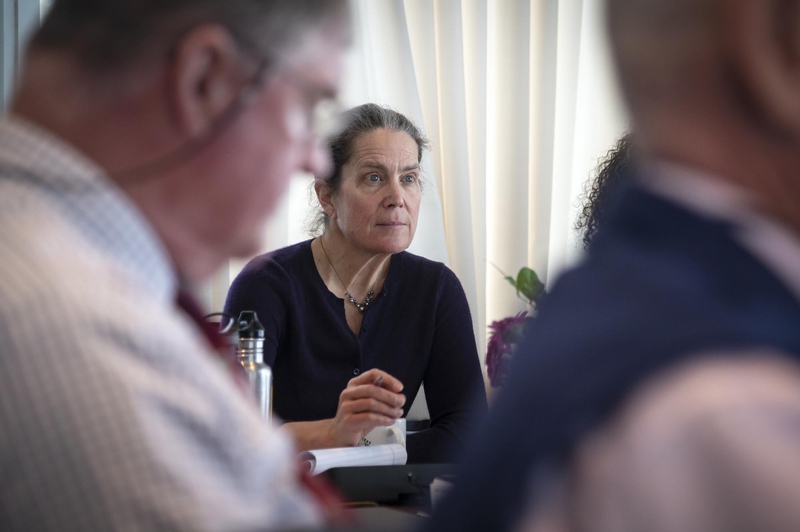
“I think we took some very helpful testimony on this — even though we have stopped taking testimony — in terms of, what are the things that people are afraid of in this conversation? And how do we address those the next time we bring it up?” Sheldon said.
A public trust
The North American Model of Wildlife Conservation, which guides state wildlife agencies in the U.S., is based in part on the Public Trust Doctrine. The legal premise holds that natural resources, including fish and wildlife, are not owned by any particular entity, but rather held in trust for present and future generations by state and federal governments. In short: Wildlife belongs to all people.
But what does it mean to hold wildlife in public trust when the public can’t agree about how to manage it? Vermont is not alone in contemplating this question. Washington, Oregon, Colorado, New Mexico and Arizona are among the states engaged in similar debates.
“These changing attitudes and cultural interests related to wildlife conservation seem to be playing out across the country,” said John Austin, who directs the Wildlife Division at the Vermont Fish & Wildlife Department.
In Washington state, Kim Thorburn, an avid birdwatcher, made headlines in 2023 when Gov. Jay Inslee did not reappoint her to the state’s Fish and Wildlife Commission. He had expected her to advocate against certain hunting policies, but Thorburn surprised him when she defended them, she told VTDigger. She served on the commission for eight years, but in the last two, the panel became “absolutely packed and overrun” with animal welfare advocates, she said.
The opposite situation appears to have occurred in Colorado. Gary Skiba, who was appointed to that state’s commission by Gov. Jared Polis in July 2023, relinquished his seat in March after it looked unlikely that the Colorado Senate would approve his appointment. A former wildlife program manager for an environmental group and state wildlife biologist, he was opposed by “a growing chorus of recreation and hunting groups — along with commissioners in the hunter-reliant counties of Grand and Teller,” according to the Colorado Sun.
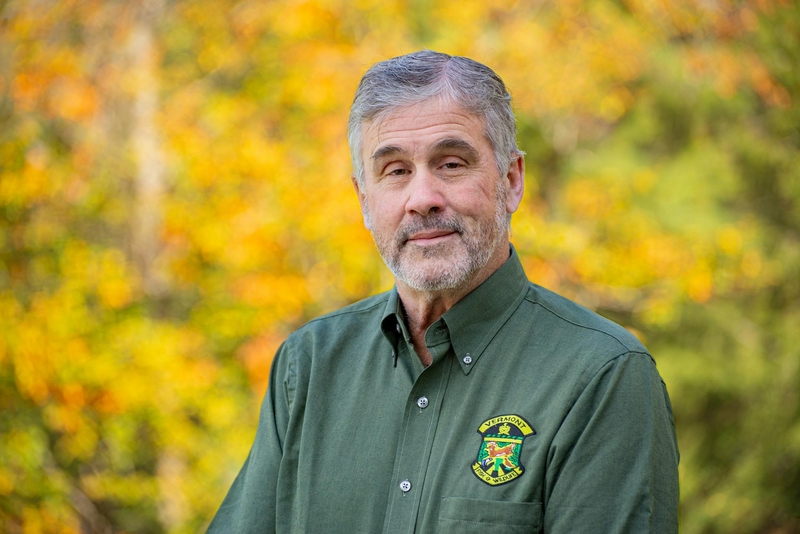
In Vermont, staff at the Fish & Wildlife Department said that they often feel caught in the middle between people who want to protect the right to hunt and people who argue for more hunting regulations. Asked what the department’s mission might say about the divide, Commissioner Chris Herrick referenced the Public Trust Doctrine.
“We hold all wildlife in trust for everyone, and for future generations,” he said. “That’s it.”
‘Impenetrable’
Galdenzi, from Protect Our Wildlife, is far from the only person in Vermont who wants to see more restrictions on hunting and trapping. Organizations such as Vermont Wildlife Patrol, Animal Wellness Action, the Humane Society and Project Coyote are all active in advocating for updated wildlife policies in the Green Mountain State.
But when hunters speak about the animal welfare movement — and when reporters in Vermont document it — Galdenzi’s name is often the one that surfaces.
A photo of a trapped bobcat, its paw crushed and bloody, sparked the fire for Galdenzi, she said. She was volunteering for a group called Green Mountain Animal Defenders in 2010, which was focused on banning trapping, she said. Soon after, she founded Protect Our Wildlife.
“It caused me to go on this path of like — no, this is inflicting prolonged suffering to an animal. This is not hunting. This is animal cruelty,” she told VTDigger in an interview.
People have become proponents for change in Vermont’s wildlife management for a variety of reasons.
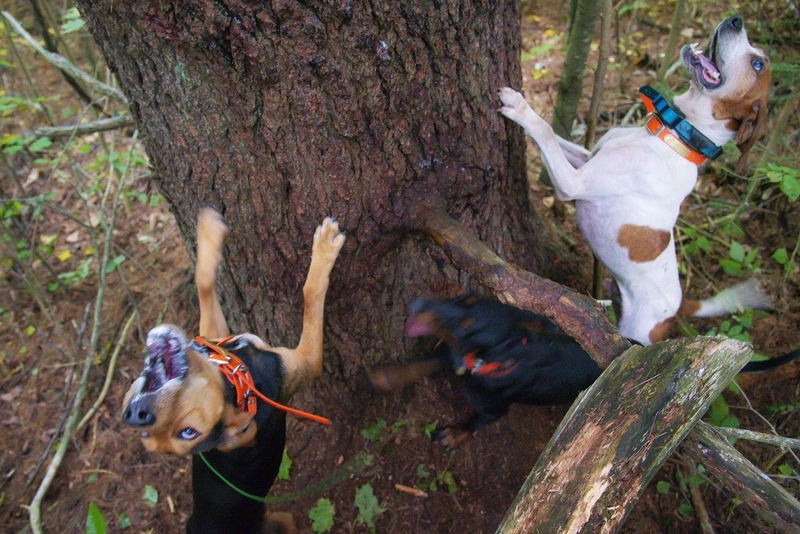
Some are concerned about non-target species and pets that have been killed in traps (though at least some of these instances have occurred because of traps that were set illegally). Others are fed up with the behavior of hunting dogs, who have traversed onto posted property. Collectively, they feel the board is not open to addressing their concerns.
“I have seen folks excited to get involved with wildlife management, and to share their knowledge and experience with the board, and then give up and not attend meetings in the future because they feel that their voices are not heard, and their perspectives are not valued by the current system,” said Bob Galvin, the Vermont state director for the nonprofit Animal Wellness Action and the Center for a Humane Economy, at the April press conference.
Over time, as Galdenzi and other advocates have taken their concerns to the Vermont Fish and Wildlife Board, they describe meeting repeated obstacles.
Galdenzi said she has petitioned the board twice for regulated coyote seasons — currently, the animals can be hunted every day of the year. She pointed to studies that show that coyote populations stay stable even when humans try to manage them. Nothing came of the efforts, she said.
“The system right now is just impenetrable,” she said.
Asked about the petition for coyote seasons, Herrick, the commissioner of the Vermont Fish & Wildlife Department, said the internal conversation about how to advise the board on petitions “always ends up being a serious discussion.”
Staff at the department look at a number of factors, including the impacts on both the wildlife and on humans. “It’s not a 10-minute meeting with a few people. Oftentimes, we’ll say we’re gonna take a month, maybe two months to really dig into this,” he said.
Those who are frustrated with the system feel that the department, despite its deliberations, still does not consider the merits of their arguments.
Indeed, Herrick himself told lawmakers at a Senate Natural Resources and Energy Committee hearing in February that “hearing every voice does not mean doing everything they say.”
“I’ve used this example, and I don’t mean it to be condescending in any way, but I have kids that are grown up now,” he said. “I certainly listened to them growing up, but I didn’t do what they said every time because they weren’t always right.”
‘A Rorschach test’
Galdenzi and others said that feeling unheard is what led them to bring their ideas to lawmakers in the Statehouse, who were more receptive.
Bray, who chairs the Senate Natural Resources and Energy Committee, told VTDigger that “folks who are oriented to animal welfare have been the folks who have come forward” to talk about a variety of issues since he started in the Legislature in 2007.
“It made me think about things I hadn’t thought about before,” he said.
Bray has also adjusted bills based on feedback from the hunting community, he said. He used an example from 2022, when lawmakers in Bray’s committee introduced a trio of bills that, together, would have banned leghold traps and hunting coyotes with hounds while stripping the board of its authority to make regulations, leaving it with only advisory power.
After hearing a large volume of testimony from hunters and trappers, lawmakers rolled the bills back. The version that became law required the board to create new rules for coyote hounding and trapping.
Last summer, the Fish and Wildlife Board completed that process, submitting the new rules to the Legislative Committee on Administrative Rules (LCAR), which is charged with approving state regulations created by the executive branch.
Then came more controversy: Members of LCAR, including Bray, made four objections to the rules, saying they didn’t meet the law’s intent. For example, they argued that a new rule to require GPS collars on hunting hounds still wouldn’t give hunters enough control over their dogs to effectively avoid conflicts with landowners.
Members of the Fish and Wildlife Board voted to pass the rules anyway — prompting a lawsuit from Protect Our Wildlife. While a judge denied the organization’s request for immediate action, the case remains pending.
With his concerns still unresolved after the yearslong process, Bray responded with S.258.
READ MORE
In practice, the bill would alter the makeup and authority of the Fish and Wildlife Board, establish criteria for board members and ban coyote hunting with hounds. But both parties see a larger meaning in the bill: evidence that the other side was unwilling to compromise.
To Bray, it feels like “a Rorschach test, in that what people see in it is what they bring to it.”
Many of the concerns that hunters and trappers have brought to him aren’t directly related to his proposal, he said.
“The response to the bill is not an entirely rational response. It’s an emotional response,” he said. “And the chief emotion I sense is fear. And I think that the fear part is a fear of loss of something.”
New suspicion
A strong early spring sun shone on the day of the bill supporters’ press conference, drawing people outside to bask on the front steps of the Statehouse, including Bray, who sat to take a rest amid a packed meeting schedule. Covey, with the Vermont Traditions Coalition, eyed Bray warily as Covey sat to answer a reporter’s questions.
 Exposing the Big Game