
Japanese government confirms it will allow whalers to catch and kill up to 59 fin whales, a species conservationists consider vulnerable
- Follow our Australia news live blog for latest updates
- Get our morning and afternoon news emails, free app or daily news podcast
Graham ReadfearnWed 31 Jul 2024 22.57 EDTShare
The Australian government is “deeply disappointed” by Japan’s decision to add the world’s second-largest whale species to the list of species its commercial whale hunters will target.
Tanya Plibersek, the environment minister, attacked Japan’s decision to hunt fin whales – the world’s second-longest whale and considered vulnerable.
The Japanese government this week confirmed it would allow itself to take up to 59 fin whales in its commercial hunt, which is confined to the country’s economic zone.
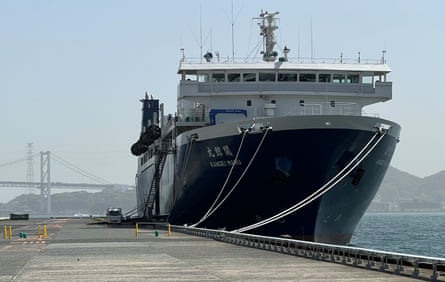
Japan’s new US$47m (A$71m) whaling ship, the Kangei Maru, is being readied for its maiden hunt and has a deck long enough to haul whales up to 25 metres long.
“Australia is deeply disappointed by Japan’s decision to expand its commercial whaling program by adding fin whales,” Plibersek said.
Japan left the International Whaling Commission (IWC) in 2019 after previously killing whales under a clause that allowed whaling for scientific research – a rationale challenged by conservationists.
Japan already catches Bryde’s, minke and sei whales. Fin whale numbers globally are thought to be rising, but remain vulnerable according to the International Union for Conservation of Nature. The giant mammals can live up to 90 years.
Plibersek said: “Australia is opposed to all commercial whaling and urges all countries to end this practice.
“Australia’s efforts through the International Whaling Commission have contributed to a whaling-free Southern Ocean and a decline in commercial whaling around the world. Australia will continue to advocate for the protection and conservation of whales and the health of our ocean for future generations.”
Darren Kindleysides, a whale campaigner and the chief executive of the Australian Marine Conservation Society, called the hunts “inhumane, cruel and unnecessary”.skip past newsletter promotion
Sign up to Afternoon Update
Free daily newsletter
Our Australian afternoon update breaks down the key stories of the day, telling you what’s happening and why it matters
Enter your email addressSign upPrivacy Notice: Newsletters may contain info about charities, online ads, and content funded by outside parties. For more information see our Privacy Policy. We use Google reCaptcha to protect our website and the Google Privacy Policy and Terms of Service apply.
after newsletter promotion
“We welcome this strong statement from [Plibersek] in protection of whales and opposing commercial whaling,” he said.

00:05
02:24
Read More
https://imasdk.googleapis.com/js/core/bridge3.653.0_en.html#goog_71263746
https://imasdk.googleapis.com/js/core/bridge3.653.0_en.html#goog_71263747
https://imasdk.googleapis.com/js/core/bridge3.653.0_en.html#goog_71263748
“Australia has a long and bipartisan history of opposing commercial whaling and we expect Australia to take a strong stance when the IWC meets next month in Peru.”
In 1986 the IWC put a global moratorium in place on commercial whaling. Norway and Iceland have remained members of the commission, but have hunted under loopholes.
Whales are also caught by a small number of countries under IWC rules that allow for some indigenous and subsistence whaling.
Kindleysides said: “The world’s great whales have populations that are threatened. We still know relatively little about whales, but we do know for species like fin whales that they are at risk following the legacy of whaling in the 18- and 1900s, so we must do what we can to protect them.
“We have learned that whales are worth more alive than dead. We have a multimillion-dollar whale watching industry now on the back of the recovery of humpback whales.”
 Exposing the Big Game