
Aug 7, 2025
Steve Schulwitz
News Staff Writer
sschulwitz@thealpenanews.com
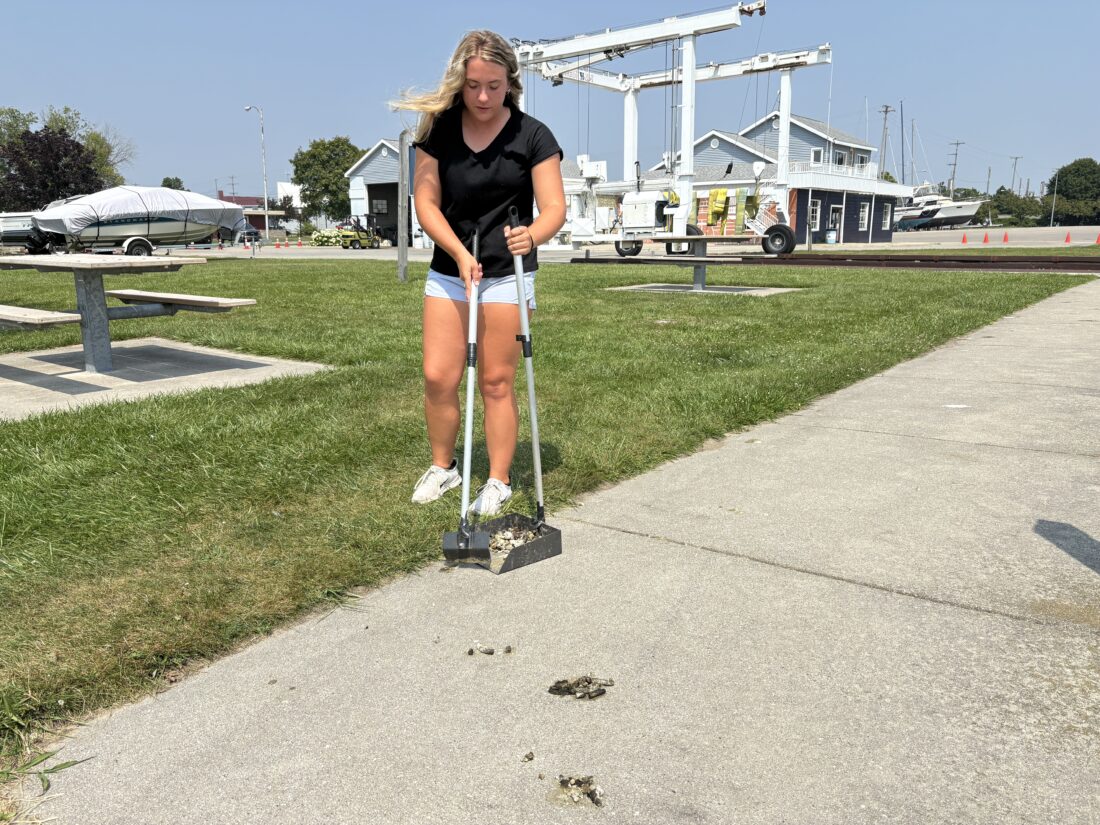
News Photo by Steve Schulwitz Ezrah Williams, a summer employee for the City of Alpena, cleans up goose feces from the sidewalks near the boat harbor in Alpena on Wednesday. The Alpena Municipal Council voted Monday against having the annual goose hunt, which is a tool the city uses to try to reduce the population of the geese. The geese make messes all over Alpena and can become aggressive when people near them.
ALPENA — The Alpena Municipal Council decided Monday to take at least a year off from having the annual goose hunt in the city that is used to help limit the number of local geese in the area.
Council voted 4-1 against a motion to have the hunt this year and instead will continue to implement other population control methods, which has thus far shown only a little success.
The feces from the geese litter the lawns at local parks, ball fields, parking lots, and sections of the bi-path that are near water. The large birds also can become aggressive if people get too close to them, especially if they are near their babies.
By taking a year off, the council hopes to get a clearer picture of whether the hunt is effective and to see if other measures that may help to scare away the water fowl can be as effective.
One member of council, Kevin Currier, even suggested removing the word “hunt” when discussing the population control method and to find an alternate term for future presentations.
It is unknown how much amplified cleanup from the goose droppings and goose egg oiling will cost the city, especially if the canceled hunt leads to an increase in the number of local geese.
Over the past nine years, goose hunts have taken place in the city during the regular Michigan goose hunting season at the fairgrounds adjacent to the Alpena Wildlife Sanctuary, and at Mich-e-ke-wis Beach as part of the effort to control the goose population in and around the city. Last year, the hunt removed a total of 41 geese, which was down significantly from the previous harvest of 118. As another control measure, the City’s Department of Public Works (DPW) is permitted through the USDA APHIS Wildlife Services program to oil Canada goose eggs within the Alpena Wildlife Sanctuary, Lake Besser, each spring. This method involves oiling the eggs with a vegetable-based oil, which prevents the geese from renesting. In late April and early May of this year, the DPW oiled 122 eggs from 15 nests.
Councilwoman Karol Walchak said the council nearly canceled last year’s hunt, but the vote at the time fell in favor of continuing with the local hunt. She said this year is a good time to take a hiatus from the hunt and measure the goose population again next spring to see what the impact was. She added that she also struggles with the thought of the birds being shot and killed.
“Let’s step up the oiling and see if it is more efficient,” she said. “Seeing these geese be killed has kind of scared me for a while. It’s not an easy thing to watch.”
Courier appeared on the fence about how he was going to vote but ultimately voted against the hunt. He said he would like to see the word “hunt” removed from the city’s information about its population control updates and public informational updates.
“Can we call this something besides a hunt?” he said. “Is it possible to just take the word ‘hunt’ completely out of it? A hunt really doesn’t really show what the end result is or what it is really for. To some people it may be just a hunt.”
Councilman Danny Mitchell was the only one to vote in favor of having a goose hunt this year. He said he believes some strides have been made in trying to limit the amount of local and migrating geese settling in Alpena, but as of now, it should still be included as another tool in the city’s toolbox to help control the animal. He added the oiling and mannequins of predators that are placed strategically around the city have produced limited results, including oiling the eggs the unborn birds grow in.
“Destroying the nests and oiling the eggs does not stop the geese,” he said. “They simply rebuild and relay the eggs. It would be great if the harassment tactic worked, but so far they haven’t. It seems for now, to reduce the number, there needs to be a hunt, too.”
Each year, the city conducts a census of the geese in Alpena, but numbers fluctuate and it is hard to tell how accurate the count is. It is also hard to predict how many migratory geese stop in Alpena while enroute north. Changes in weather patterns and things like the smoke from the Canadian wildfires can change migration patterns and skew numbers.
For now at least, the city will bank on the egg oiling, and a few other measures to try to limit the geese and the impact they have on Alpena’s infrastructure.
 Exposing the Big Game