
By
,
Michael Rios
Updated 1 hr 32 min ago
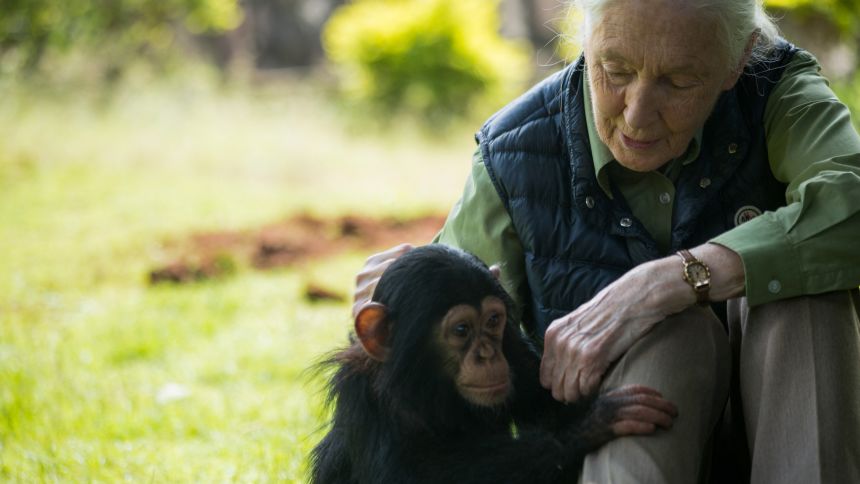
How Jane Goodall broke the glass ceiling
0:56
How Jane Goodall broke the glass ceiling
0:56
Bronx resident says it felt like ‘an earthquake’ when high-rise building partially collapsed
0:33

Video shows damage to partially collapsed Bronx building
0:59
See what Schumer said in the past about government shutdowns
1:54
Video shows ICE agents grab, shove journalists in NY immigration court
1:17

Rep. Jeffries: ‘Unhinged behavior’ led to government shutdown
2:28
Survivors pulled from rubble in collapsed school in Indonesia
0:47
Border agents chase bicyclist yelling, ‘I’m not a US Citizen’
1:11
CNN fact-checks Trump’s claim about Biden and the military
4:15
The federal government might shut down after midnight. Here’s how you may be affected
2:23
Dozens trapped in collapsed school in Indonesia
0:38
‘Definitely a slippery slope’: CNN military analyst reacts to Trump’s plan for Portland
1:13

FBI searches for a motive behind MI church attack
0:32
Netanyahu says ‘Israel will finish the job’ if Hamas rejects Trump’s deal
0:47
Greta Thunberg says her mission to deliver aid to Gaza ‘should not have to exist’
2:14

CNN anchor questions Speaker Johnson about potential government shutdown
2:51
This AI film took 200 creatives and a 1000 prompts per image
2:53
Tracking Assata Shakur: How a CNN intern landed an interview with the FBI’s most-wanted fugitive
3:28

CNN analyst breaks down the current odds for the NYC mayoral race
4:33
Inside the months-long process of hand washing windows on one of the world’s tallest towers
2:31
ICE arrests popular Iowa school superintendent
1:11

Officials respond to deadly shooting and fire at church in Michigan
0:37

Shooting at North Carolina waterfront bar leaves 3 dead
1:40
Russian military personnel to teach children at new drone school
1:48
CNN anchor questions Speaker Johnson about potential government shutdown
2:51

Analysis: Ryder Cup has been a ‘disaster’ for Team USA
1:38
Acting US attorney says there is an ‘overemphasis on slavery’ at the Smithsonian. Comedians react
1:25
US revokes Colombian president’s visa
1:03

Video shows ICE agent drop gun during chaotic arrest
0:42
Hear whether House minority leader thinks a shutdown can be averted
2:05
‘Never able to get me’: See what Comey told CNN back in May about Trump
0:59
Dozens walk out of UN as Netanyahu speaks
0:20
Trump says Comey’s indictment is about justice, not revenge
0:59

Man admits to killing parents in TV interview
1:24
James Comey posts video message after being indicted
1:04

Federal grand jury indicts Former FBI Director James Comey on two charges, declines a third
3:30
Jane Goodall, whose lifelong work as a primatologist helped broaden the world’s understanding of animal behavior and emotions, has died, her institute said Wednesday. She was 91.
Her field studies with chimpanzees not only broke barriers for women and changed the way scientists study animals, but documented emotions and personality traits within these primates that blurred the line between humans and the animal kingdom.
She passed away due to natural causes in California during a speaking tour in the United States, according to her institute.
“Dr. Goodall’s discoveries as an ethologist revolutionized science, and she was a tireless advocate for the protection and restoration of our natural world,” the institute said in a statement on social media.
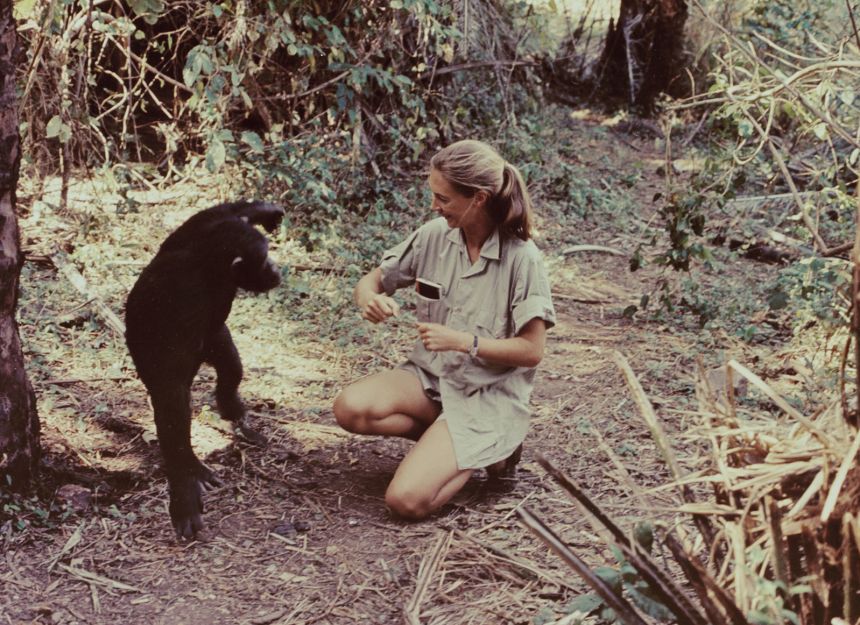
Goodall appears in the television special “Miss Goodall and the World of Chimpanzees” originally broadcast on CBS, Wednesday, December 22, 1965, in the Gombe Stream National Park, Tanzania. CBS Photo Archive/Getty Images
The United Nations, which named her a Messenger of Peace in 2002, mourned her death, said on X she “worked tirelessly for our planet and all its inhabitants, leaving an extraordinary legacy for humanity and nature.”
Goodall arrived in Tanzania’s Gombe Stream Chimpanzee Reserve in 1960 at the request of her boss, renowned anthropologist and paleontologist Dr. Louis Leakey. There, the 26-year-old who had long been fascinated with Africa and its animals – but had no formal higher education – began her groundbreaking work observing and studying these intellectual primates in their natural habitat.
ADVERTISING
At first, the chimps ran away from her.
“They’d never seen a white ape before,” Goodall told Deepak Chopra in 2019.
That all changed when she met an older chimp she named David Graybeard. After following David through the forest, she offered him a palm nut.

“He took the nut, he dropped it, but very gently squeezed my fingers,” Goodall recalled. “That’s how chimpanzees reassure each other.
“So in that moment, we communicated in a way that must have predated human language.”
Living among the chimpanzees in Gombe, Goodall discovered that chimps ate meat and not only used tools – but made them too.
“I watched, spellbound, as the chimps set off to a termite mound, picked a small leafy twig, then stripped of it of its leaves,” Goodall said in the 2017 documentary “Jane.” The chimps poked the stripped twigs into the mound and easily gathered clumps of termites to eat.
“That was object modification, the crude beginning of tool making – it had never been seen before.”
This young Briton, who was pursuing her Ph.D in animal behavior despite not having an undergraduate degree, spent months ingratiating herself with the local chimpanzee population, instead of studying them at arm’s length. She gave them names and learned to read their emotions.
“When I first began studying the chimpanzees there was nobody to tell me how I do it,” Goodall recalled. “In 1960, the world knew nothing about chimpanzees in the wild.”
Goodall’s discoveries and her methodology caused quite a stir within academic and scientific circles: Crawling through the forest to study chimpanzees that she named instead of numbered, documenting their personalities and feelings — this shocked her fellow ethologists. She was told she’d conducted the whole study wrong, but Goodall held firm in her beliefs.

On GPS: Jane Goodall on what she learned from chimpanzees
“My observations at Gombe would challenge human uniqueness,” Goodall said. “There were some who tried to discredit my observations because I was a young, untrained girl and should therefore be disregarded.”
Goodall was one of three women selected by Leakey to study primates in their natural habitat as part of his effort to better understand human evolution. While Goodall focused on chimps, Dian Fossey studied gorillas and Birutė Galdikas studied orangutans. They were sometimes referred to as “Leakey’s Angels” – a nod to the 1970s TV hit series “Charlie’s Angels.”
The world would learn about Goodall and her work in 1963 after her first article appeared in National Geographic titled “My Life Among Wild Chimpanzees.”
Leakey secured a grant from the National Geographic Society for Goodall to continue her work, and in 1962, National Geographic sent filmmaker Baron Hugo van Lawick to Gombe to document Jane’s work with the chimpanzees. The two fell in love, married in 1964 and had a son three years later.
Goodall earned her doctorate in ethology – the study of animal behavior – from Cambridge University in 1965, and that same year she and van Lawick established the Gombe Stream Research Center.
To this day, the small forest of Gombe on the banks of Lake Tanganyika is home to the longest, most detailed study of an animal in its natural habitat anywhere in the world.
A budding scientist
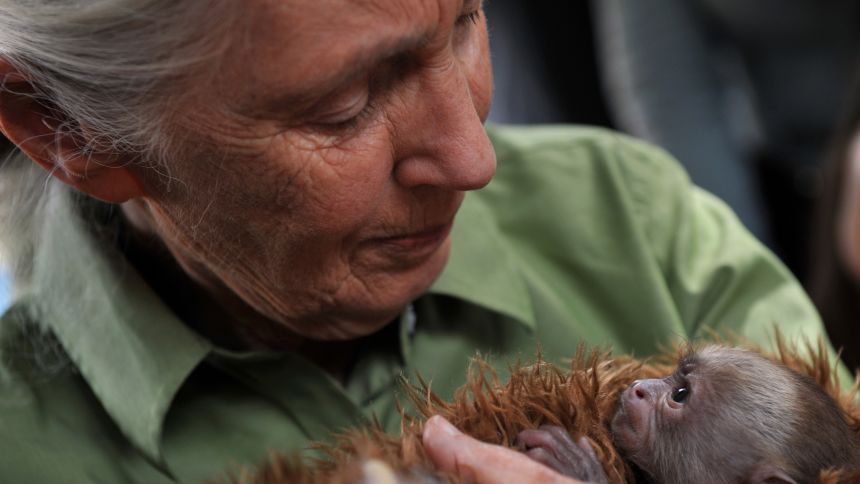
Goodall holds a baby Cariblanco monkey during her visit to the Rehabilitation Center and Primate Rescue, in Peñaflor, Chile, on November 23, 2013. Hector Retamal/AFP/Getty Images
Born in London, Goodall says her fascination with animal behavior was sparked when her mother took her to visit a country farm when she was four and a half years old.
“It was really exciting, I can still remember meeting cows and pigs and sheep face to face,” Goodall recalled in 2019 on Chopra’s Infinite Potential podcast.
At the farm, she wandered off to an empty henhouse where she waited patiently to observe a hen laying an egg.
“Mom had been desperately looking for me, nobody knew where I was, they’d called the police,” Goodall said.
“You can imagine how worried she was, but when … she saw my shining eyes (she) sat down to hear the wonderful story of how a hen lays an egg.”
She credited her mother’s support at that moment – and later in life – for paving the way for her career.
“A different kind of mother might have crushed that scientific curiosity – and I might not have done what I have done.”
Goodall spent much of her childhood outside, at the top of her favorite tree reading “in my own private world … daydreaming about life in the forest with Tarzan.”
That’s when she decided she wanted to go to Africa to live with the animals and write about them.
She never wavered from her dream and, as a young woman, she worked and “saved every penny I could” to travel to Africa.
“Everybody laughed at me because I was just a girl, we didn’t have any money (and) World War Two was raging,” she recalled.
She was always encouraged by her mother, who told her to “work hard, take advantage of opportunity, but above all, never give up.”
Taking her message to the world
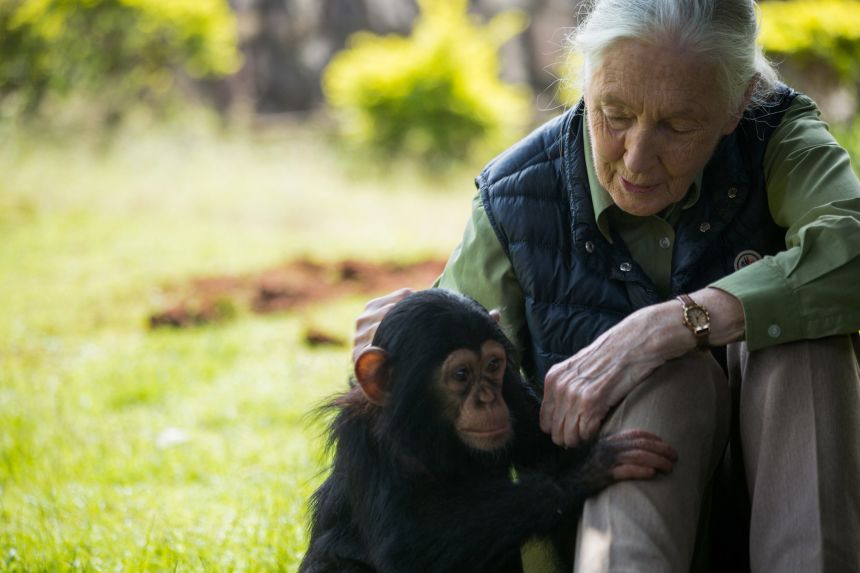
Goodall visits chimp rescue center on June 9, 2018 in Entebbe, Uganda. Sumy Sadurni/AFP/Getty Images
Jane Goodall’s original mission in Gombe was to learn everything she could about chimpanzees – humans’ closest living relatives – in the hopes that their behavior “might provide us with a window on our past,” she said.
“I always am amazed at how similar we are to chimpanzees and, for that matter, other animals, too – sharing emotions like fear and pain and anger and things like that,” Goodall said.
“Chimpanzees learn by observing … but (humans) can with words discuss the past and tell stories about it, and perhaps make use of it. Chimpanzees can certainly make plans for the immediate future – but we can make plans for what we’re going to do 10 years ahead.”
And she said that ability to communicate verbally gives humans a unique responsibility to preserve the planet.
“Isn’t it bizarre that the most intellectual creatures to ever walk the planet is destroying its only home? It seems to me there’s a disconnect between this extremely intellectual mind and the human heart, which is love and compassion.”
Goodall started focusing her efforts on environmental preservation after attending a conference on conservation in Africa in 1986.
“It was shocking to see right across Africa, wherever chimps were being studied, forests were disappearing,” she said.

Jane Goodall is world-famous for her work with chimpanzees. Now her focus turns to a different crowd
“That’s when I realized that … the role that I must play was to make sure the next generation was better stewards than we’d been. And I needed to take that message to the world.”
“I went to the conference as a scientist. I left as an activist.”
Today, the Jane Goodall Institute that she founded in 1977 devotes a huge portion of its efforts to wildlife conservation, working closely with Gombe National Park’s surrounding communities to advance human prospects and guard its natural treasures.
In 2017, the Institute partnered with Google Earth, using the state-of-the-art satellite technology to closely monitor the park and its chimps.
Goodall showed no signs of slowing down in her 80s, traveling some 300 days a year to meet with world leaders about climate change, visit conservation projects, and support her Roots & Shoots youth environmental program.
The Covid-19 outbreak brought her travel to a halt in 2020, but Goodall continued spreading her message virtually, speaking out about climate change as well as her thoughts on what led to the coronavirus pandemic.
“Our too close relationship with wild animals in the markets or when we use them for entertainment has unleashed the terror and misery of new viruses,” she said on Anderson Cooper Full Circle.
When asked what she thought her legacy should be, Goodall told CNN’s Becky Anderson that she hoped it would be “giving young people hope and … a sense of empowerment.”
 Exposing the Big Game