Hunting Accident Season is Upon Us

The days are getting shorter, leaves are starting to change colors and hunters are beginning to shoot one another—it would appear that hunting accident season is already upon us. With almost two weeks to go before fall officially begins, the guns of autumn are gearing up for another season of fatal mishaps.

According to the International Hunter Education Association, roughly 1,000 people in the US and Canada are accidentally shot by hunters each year; around a hundred of those victims are fatalities. Though the majority of unintentional targets are hunters themselves, innocent bystanders are also routinely injured or killed.

Hunting is one of the few outdoor activities that endangers the entire community (not just the willing participants), yet the perpetrators are almost never charged with manslaughter or any lesser crimes. As long as they are “lawfully” pursuing a recognized blood sport, the shooting of their fellow human is acceptable.

A case in point of a shooter hitting the wrong target (sent to me by an alert reader) happened just today in West Columbia, Texas, when a grandfather was aiming at a stray cat and accidentally shot his 3-year-old granddaughter in the leg.

The grandfather, Gary Van Ness, said some cats have been known to come inside his ratty trailer home uninvited. “The cat is brave enough to come in there and got him a couple of loaves of bread,” said Van Ness, adding, he’s already decided he’ll start trapping cats now, rather than shooting them. Granted, this one wasn’t a legitimate hunting accident, but he clearly had the same mindset, and armed response towards, “nuisance” animals as the typical nimrod…or game manager.

If that doesn’t fit your idea of a bona fide hunting accident, this other one that made headlines today surely will, as it was a clear cut case of one New Zealand deer hunter, Henry Worsp, mistaking his partner for prey. A local police commander called it, “another tragic reminder of the absolute necessity for hunters to properly identify their target before they shoot.” That’s no shit. But far too often hunters blast away at the sound of rustling in the bushes with a casual, shoot first, ask questions later attitude. I was shocked the first time I heard a hunter brag about getting off a “nice sound shot,” but now I know it’s just business as usual for some of them.

Today’s incident was New Zealand’s third hunting death so far this year. Cam McDonald, 29, was shot dead by another hunter in Aorangi Forest Park, on April 7. A few weeks earlier, 26-year-old Southlander Mark Richard Vanderley was killed by another man in his hunting group while spotlighting for deer. Of the 12 hunting-related deaths in NZ between 2002 and last year, 10 were caused by someone in the same hunting party.

And who can forget Dick Cheney’s world famous allegedly inadvertent peppering-in-the-face with birdshot pellets of Texas campaign contributor, Harry Whittington while at a Corpus Christi ranch, hunting quail? (No, not that other former Republican Vice President whose last name is Quayle; Cheney was out stalking small inoffensive birds this time.)

Whittington had just shot a quail and had dropped back to retrieve it and, upon rejoining the group, Mr. Cheney let him have it (apparently mistaking the tall, lanky fellow Republican for a small, inoffensive ground-dwelling bird, witnesses said). Though hit with pellets in the face and chest, to the 78 year old Whittington’s credit, he never lost consciousness. As though expecting trouble, an ambulance had been posted at the ranch while Cheney was hunting, and after debriefing, Whittington was taken to the hospital.

The owner of the ranch called the former Vice President “a very conscientious hunter,” adding “I would shoot with Dick Cheney everywhere, anywhere, and not think twice about it,” while at the same time cautioning, “The nature of quail shooting ensures that this will happen. It goes with the turf.”

Instead of perceiving the whole fiasco as a black eye for the Republican Party, it appears they see all the negative media attention Cheney received as a good thing (why else would they have chosen avid hunters Sarah Palin and Paul Ryan as Vice Presidential candidates?). In that way, the Republican camp is a lot like PETA.

Text and Wildlife Photography Copyright Jim Robertson


Leave Wolves the Hell Alone

Northeastern Washington cattle rancher Len McIrvin has made it clear: he really hates wolves—especially members of the local Wedge pack. Though the rancher way of life depends on government handouts and write-offs, he’s been unwilling to accept compensation for the cows he claims to have lost to wolves, fearing it would legitimize protection of the natural predators.

It may not be fair to compare him and his son to poachers Bill White and son, who illegally killed most of the Lookout Pack (Washington’s first confirmed wolf pack to return home from Canada), since the McIrvins appear to operate above board by deferring to the state game department to do the dirty work for them. But they are all cut of the same cloth—cattle ranchers who think wolves serve no Earthly purpose and should be eliminated (once again).

It’s no wonder some ranchers feel they can get away with murder, so to speak. They’ve gotten used to having everything handed to them, ever since the government paid for the cavalry to wage war with the Indians and bankrolled bounties and poisoning campaigns against wolves to make room for their private ranches—and ensure “Manifest Destiny” (the doctrine or belief prevalent in the 19th century that the United States had the God-given right to expand into and possess the whole of the North American continent). But Western ranchers aren’t satisfied with keeping cows on their vast tracts of private land (possibly given to their ancestors free of charge back in the homesteading era); they want the Feds to throw in a few thousand acres of cleared national forest land so they can expand their claim out into the neighboring wildlife habitat.

The US Forest Service contends that grazing fees bring in funds as part of their “Multiple Use” policy, but ranchers contribute only about $1.35 per “Animal Unit Month” (a detached, depersonalizing term for a cow and calf pair feeding for four weeks on public forests). According to a 2005 Government Accounting Office report, that paltry one dollar and thirty-five cent fee covers only a tiny fraction of the grazing program’s administrative costs, making this in essence just another a subsidy program in disguise.

Still, McIrvin feels entitled to prevail upon his buddies in the game department and local politicians to do whatever they can to make the entire Wedge pack disappear. He recently told the Capital Press that the only compensation he’s interested in is a dead wolf for every dead calf, copping a Bill White-like attitude: “This isn’t a wolf problem, we always could take care of our own problems,” adding that the only acceptable option is trapping and poison. Now he’s at it again, making extreme statements in any paper that’ll print them. Yesterday he showed his hand by making this fanatical comment to the Seattle Times: “Wolves have never been compatible with raising livestock.”

Okay, so you want to be an extremist, eh, rancher? (I’m doing the Clint Eastwood talking to a chair bit now…) Go ahead, punk, make my day. Two can play at that game; I’ll show you extreme. Hows about you damned cattle barons gettin’ your cows off my national forest and leavin’ my wolves the Hell alone. The wolves were here first and your poor cows don’t want to be livin’ out on some steep, brushy clearcut anyway. In fact, maybe it’s time you got outta cattle-ranchin’ altogether and started growin’ some healthy, organic crops insteada turnin’ your introduced livestock out into the woods to tempt the wolves and compete with the native deer, elk and moose who belong there.

Text and Wildlife Photography © Jim Robertson

How are wolves ever supposed to recover if people are hunting them right outside the narrow confines of Glacier National Park?!?

Nabeki's avatarHowling For Justice

The wolf slaughter is in full swing in Montana and Idaho. Four wolves have been killed in Idaho and 1 wolf was slaughtered with bow and arrow in Montana, a horrible way to die. The Montana wolf died in zone 110, which borders Glacier National Park.  This breaks my heart to think the killers are out in the woods stalking these innocent animals, who don’t understand why this is happening to them. We must work to see their ESA protections restored and quickly.


View original post

Homo sapiens is No Ordinary Species

When did big game hunters first start driving other species to extinction? If you go by the Young Earth Creationist’s calendar, even before the dawn of time. In this, the third installment of our series on detrimental denial, we’re going to look at how hunting by humans has been wiping out our fellow animal species since the earliest of times.

According to Richard Leaky and Roger Lewin, authors of The Sixth Extinction: Patterns of Life and the Future of Humankind, “…In recent years it has become undeniable that the evolution of Homo sapiens was to imprint a ruinous signature on the rest of the world, perhaps from the beginning periods.”

In a chapter examining the sudden loss of North American mammals, such as elephants, mastodons, giant sloths, horses, camels and the American lions, paleoanthropologist Leaky and his co-author wrote: “Within a flicker of geological time, between 12,000 and 10,000 years ago, these animals were among some 57 similarly large mammal species to go extinct in North America while a much larger number did so in the southern continent.”  In naming the culprit, Leaky went on to say that stone-aged peoples’ “…north to south population expansion left a trail of destruction, as hunters were easily able to kill large, lumbering prey unused to a new kind of predator. The animals probably had no innate fear of humans, as is often the case in regions of the world that have evolved in the absence of humans; they would therefore have been particularly vulnerable to efficient hunters.”

In the mid-1800s, Scottish geologist Sir Charles Lyle noted of the disappearance of so many North and South American megafauna, that human hunting “is the first idea presented to the mind of almost every naturalist.” But it wasn’t until 1911 that Alfred Russel Wallace, co-developer of the theory of evolution and natural selection, decided, “I’m convinced that the rapidity of…the extinction of so many large mammalia is actually due to man’s agency.”        

Expounding on that concept, University of Arizona paleontologist Paul Martin in 1967 dubbed the over-kill hypothesis the “Pleistocene over-kill.” He noted that the megafaunal extinction phenomenon coincided exactly with the arrival of prolific human hunters armed with new technology: the Clovis spear-points, along with the spear thrower or Atlatl, which (like the “Chuck-it,” a popular kind of tennis ball thrower used in playing fetch with dogs inclined to retrieve) greatly increases throwing distance and accuracy.

Martin calculated that during their southward advance, human numbers could have grown to 600,000 within the 350 years it took them to reach the Gulf of Mexico and to many millions by the time they reached the southern tip of South America, within 1,000 years.

UCLA physiology professor and author, Jared Diamond, concurs with the Pleistocene overkill theory in his book, The Third Chimpanzee: the Evolution and Future of the Human Animal, “…the interpretation that seems most plausible to me, the outcome was a ‘blitzkrieg’ in which the beast were quickly exterminated—possible within a mere 10 years at any given site. If this view is correct, it would have been the most concentrated extinction of big animals since an asteroid collision knocked off the dinosaurs sixty-five million years ago. It would also have been the first of a series of blitzkriegs that marred our supposed Golden Age of environmental innocence and that have remained a human hallmark ever since.”

But the theory is not without its detractors, most notably those who blame climate change alone (the Earth was entering into a post-glacial period) as the driving force of that extinction event, and those who date the arrival of Paleo-Indians in the Americas much earlier.

Leaky addresses the latter with: “It is possible to imagine a series of migrations into North America when glaciation lowered sea levels sufficiently to expose the Bering land bridge that joins Alaska with Siberia. Pre-Clovis entry may have been sparse; in any case, the archaeological imprint implies that significant population growth did not result from them. Only with the coming of the Clovis people does the evidence suggest rapid population expansion, in numbers and in territory occupied. Whatever the date of the first entry, it does not detract from the overkill hypothesis linked to the end-Pleistocene expansion of the Clovis people.”

Meanwhile, Paul Martin addresses the climate issue with: “If ice age climate changes were important in determining the extinction of American large mammals, it is not obvious why earlier glaciations and interglacial warm-ups were unaccompanied by faunal losses.” But the case of the North American wooly mammoth may be the most damning of all to the climate-change-alone theory. An ice-age adapted species that disappeared from most of its range at the end of the Pleistocene epoch 10,000 years ago, isolated populations of the wooly mammoth were able to go on living on St. Paul Island, Alaska, up until just a few thousand years ago, roughly 3750 BC, and on Wrangel Island until 1650 BC—again, coinciding with the arrival of the first humans to those locations.  

Contemporary researchers, such as John Guilday, suggest that the extinctions could be a result of a combination of the deadly impact of human hunting and a changing climate. As he put it, “In any event their combined effect was devastating, and the world is much the poorer.”

Like the global warming skeptic who isn’t comfortable placing blame on human activity for changing the Earth’s climate to the detriment all, the Pleistocene overkill denier has a hard time accepting that humans are responsible for diminishing biodiversity by hunting species to extinction. And some folks might wonder, ‘what’s the point of digging up the past, unearthing the dark side of primitive cultures that we’ve grown fond of thinking of as noble and beyond reproach?’ As Richard Leaky explains, “…human colonization of pristine lands is an extreme example of an invading species and the consequences of that invasion on existing [animal] communities. Mature, species-rich communities can often resist invasion attempts by most species. But Homo sapiens is no ordinary species, and its attempts at invasion are almost always successful and almost always devastating for the existing community. If we are to assess the impact that humans are having on the world today, we need a historical perspective.”

And Paul Martin adds, “The distinction between African and American Pleistocene extinctions is seen in the difference between gradually developing [humans] evolving for millions of years with large animals on one continent, compared with the onslaught of a highly advanced hunting society at the height of its power suddenly arriving on the other. Had America rather than the Old World been the center of human origins, the late Pleistocene record of extinction might well have been reversed.”

In other words, the overkill hypothesis is not meant to just pick on the Paleo-Indians, the Paleo-palefaces were cut of the same loin cloth. Unpopular as the subject may be, the only way to get to the root of the problem of human hunting is to cast off the Rousseauean fantasy that primitive hunting was somehow acceptable or harmonious. No other natural predator launched lethal projectiles from a distance or torched the landscape to drive entire herds of animals off cliffs. 

Washington State Resumes Hunt for Wolves With Aim to Destroy Wedge Pack

For Immediate Release, September 5, 2012

Contact: Noah Greenwald, Center for Biological Diversity, (503) 484-7495 Bob Ferris, Cascadia Wildlands, (541) 434-1463

Washington State Resumes Hunt for Wolves With Aim to Destroy Wedge Pack

OLYMPIA, Wash.— Following two depredations last week, the state of Washington’s Department of Fish and Wildlife ended its brief wolf-hunting reprieve and is again gunning to kill up to four wolves in the Wedge pack, with the aim of potentially breaking up the pack.

“These wolves should not be killed,” said Noah Greenwald, endangered species director with the Center for Biological Diversity. “As long as Washington’s wolves remain endangered, every effort should be made to resolve wolf-livestock conflicts through nonlethal means, and by compensation of ranchers — which in this case has already occurred.”

Unlike some of the previous incidents of injury or death of livestock, which the department appeared to have erroneously determined were caused by wolves, the two depredations late last week appear to have indeed been caused by wolves, according to outside experts.

Minimal action was taken to resolve the conflict with the Wedge pack using nonlethal means, including moving calving to areas not used by wolves, turning the calves out later and sending cowboys to check on the cows more frequently, according to information on the Washington Department of Fish and Wildlife website. Many other actions designed to avoid fatal conflicts between livestock and wolves were not taken, including the use of a range rider or guard animals, or the practice of hazing wolves when they come near livestock. Resolving conflicts using nonlethal measures before killing wolves is a requirement of Washington’s wolf-management plan.

“Regardless of whether or not it is ultimately determined that wolves clearly killed livestock in the Wedge area, the experience to date has indicated that the department needs to take some time to get its ducks in row,” said Bob Ferris, executive director of Cascadia Wildlands. “Endangered species such as wolves need to be managed with clear rules and solid procedures by people adequately trained in this process, and we hope to see that in the future.”

The department killed a female wolf from the Wedge pack — so named because its range includes a triangle-shaped area defined by the Canadian border and the Kettle and Columbia rivers — on Aug. 7.

Wolves are just beginning to make a comeback in Washington after a government-sponsored program of poisoning, shooting and trapping the animal to extinction in the state. Since the historic return of wolves to Washington in 2008, eight packs have become established in the state. This past December the state’s Fish and Wildlife Commission adopted the “Wolf Conservation and Management Plan for Washington,” a stakeholder-developed framework that outlines recovery and management objectives for wolves in Washington.

###

http://www.biologicaldiversity.org/news/press_releases/2012/wolves-09-05-2012.html

No Offense, but You’re an Animal

I’m an animal, and if you don’t know it yet, it’s my duty to inform you, you’re one too. All we animals, the big-brained two-leggers, the furry four-leggers, the feathered and the finned are carbon-based creatures made up of the same ingredients. Every last earthling oozed from the same original, primordial stew pot.

The sooner we accept that we’re all animals, the sooner we can make peace with the others of this planet, rather than doing battle with them. Ultimately, it’s to our detriment that we deny evolution any longer. Humankind can’t live in a vacuum. We need all our best science to figure how to live with the many diverse, interconnected life forms that help keep this planet hospitable.

Bill Nye, ‘the Science Guy,’ recently stated in his Big Think video (which has been viewed nearly 3 million times so far), “I say to the grownups, if you want to deny evolution and live in your world, that’s completely inconsistent with the world we observe, that’s fine. But don’t make your kids do it.”

In rebuttal, the spokesman of a group of ‘Young Earth Creationists’ proclaimed, “No, we are not just evolved animals as Nye believes; we are all made in the image of God.” Young Earth Creationists, or ‘Biblical Creationists,’ as they prefer to be called, believe in a literal interpretation of the creation story in the book of Genesis. They say the weeklong account of God creating the earth and everything in it represents six 24-hour periods (plus one day of rest) and date the age of the earth between 6,000 and 10,000 years.

Nye’s view falls in line with the vast majority of scientists, who date the age of the earth and the universe as 4.5 billion years old. “The idea of deep time of billions of years explains so much of the world around us. If you try to ignore that, your worldview becomes crazy, untenable, itself inconsistent,” Nye said in his video. Still, polling from Gallup has shown for the past 30 years that between 40-46% of the survey respondents believe in creationism: that God created humans and the world within the past 10,000 years.

Granted, there are folks whose belief in creationism compels them to treat “God’s creatures” with compassion. As far as I’m concerned, people can believe whatever they want—as long as it promotes kindness to all sentient beings. Although I’ve never read it, I understand the Bible contains a number of passages that promote benevolence toward the vulnerable. (Before someone says something like, ‘If you haven’t read the bible, you’re ignorant of what you speak,’ I will argue that a person could end up even more ignorant and confused after reading it.)

Unfortunately, for the majority of believers, creationism leads to a sense of human superiority and the self-serving notion that we humans are in a higher realm of importance than the rest of the animal kingdom. This convenient fallacy has been used to justify the exploitation of animals over the centuries and continues to have widespread acceptance to this day.

For example, my uncle, a hunter who boasted of killing the largest black bear in the state, held to a word for word interpretation of the Bible which led to his belief that, “Humans were meant to subdue the earth” drawing his own conclusion, “There’s no earthly purpose for cougars.” His reasoning, shared by so many people the country over, was: to make life better for humans we should rid the world of species like cougars, bears, coyotes and wolves. Another example of this kind of stinkin’ thinkin,’ Republican vice Presidential candidate Paul Ryan is a “pro-life” creationist bow-hunter who doesn’t see the hypocrisy in committing the sin of killing non-human animals for sport.

The idea of creationism was abandoned by the mainstream scientific community shortly after Darwin introduced The Origin of Species in 1859. By 1880 nearly every major university in America was teaching evolution. Bill Nye summed up his video with, “In another couple centuries I’m sure that worldview [creationism] won’t even exist. There’s no evidence for it.” While it seems only logical that any continued cultural advancement would include the acceptance of sciences such as geology, paleontology and evolution, I’m not so sure I share his optimism for the further progress of humanity.

Text and Wildlife Photography ©Jim Robertson

It Ain’t Gonna be Pretty

Over the ages, humans have more than proved their point—they’re the dominant ones. Nowadays they’re just rubbing Nature’s face it in. But they won’t feel so dominant when Mother Nature decides to really put up a fight. Once she gets started, it ain’t gonna be pretty, and man, you’ll curse the day you were born. It’s not like she hasn’t given plenty of fair warning, but every time she summons up an epic hurricane in the Gulf of Mexico, for example, humans react like a ants at  an anthill, and scurry to raise their levees, dikes and sea walls a little higher and rebuild their off-shore oil platforms.

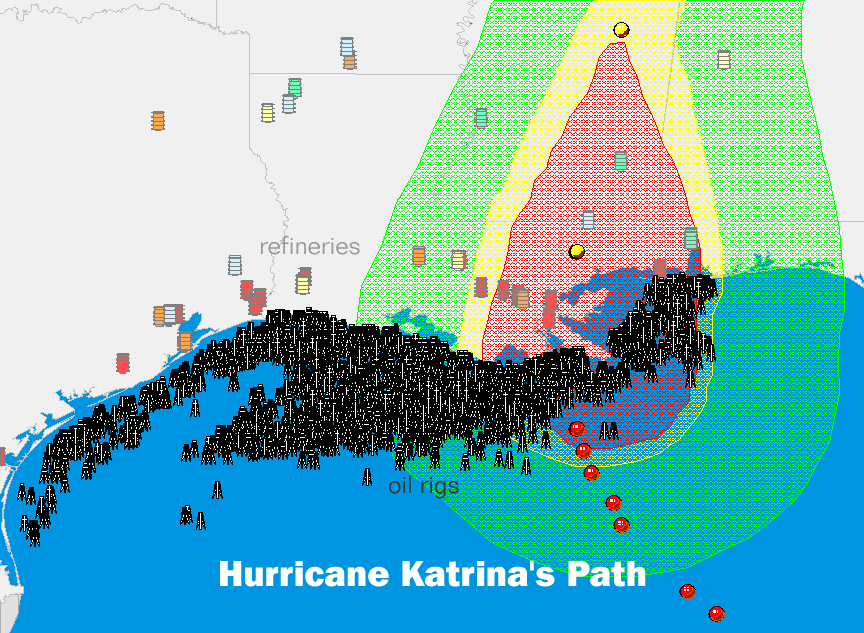
Hurricane Katrina destroyed over 100 off-shore oil rigs (one of which floated for 50 miles before coming to rest in the shallows), while this year’s Isaac put 44 of them out of commission. The financial pages were quick to share the news that the Gulf of Mexico oil production was reduced by 901,726 barrels per day as a result of Hurricane Katrina. Yet the media barely covered the massive oil spills then, and we never heard much about the half million gallons of oil that sloshed into the Gulf after Hurricane Ike in Texas. Nor is there ever much talk of the persistent leaks and pollution that comes from the rigs; spills of more than 60,000 gallons scarcely make the news outside southern Louisiana.

It wasn’t long ago that there were no oil platforms in that pristine body of water that’s been a spawning ground for blue fin tuna and home to sea turtles, manatees, dolphins and an astounding array of bird life. Now oil derricks in the Gulf are considered a fact of life—but the ecosystem has suffered dearly for it.

Are we going to see a repeat of this scenario in the Arctic, now that anthropogenic climate change has caused the polar icecap to retreat far enough that the President just approved Shell oil to start drilling up there?

Carbon is a waste product of life and the atmosphere needs a certain amount of it to keep temperatures comfortable enough for life to thrive here. Yet never before in the long history of the earth has one species tapped into the vast pools and veins of carbon, safely stored underground for millions of years, and lit a match to it.  Now the one species who prides itself in being smarter than the others is using up its limited brain capacity devising ways to commandeer the planet’s carrying capacity, while smothering the atmosphere with the carbon of the eons in just a few short centuries.

From fashioning the first tools out of stone (a feat that our vegan cousins the bonobos have accomplished as well) to learning to raise food crops, experimentation has brought our species to where it is today. But now we’ve turned the whole planet into our own personal petri dish. God only knows what sort of punishment Mother Nature has in store for us when she wearies of our infernal domination games.

Hey Humans, Slow the Fuck Down

The following is the first of a series on Deniers and the Damage They Do…


By now you’ve more than likely read that the Arctic Ocean’s floating sea ice has already retreated to a record minimum.  And you’ve probably heard that every scientist who hasn’t been bought off agrees: global warming is to blame. And you might have even heard that Greenpeace activists have been staging protests and attaching themselves to oil rigs and ice breakers en-route to the polar region. You may already be one of the 1.6 million people who have signed the group’s online petition urging world leaders to declare the Arctic a global sanctuary, off limits to oil exploration and industrial fishing. And there’s an off-chance you’re one of the dozens of celebrities, including Robert Redford, Paul McCartney and Penelope Cruz, who have announced your support for Greenpeace’s campaign.

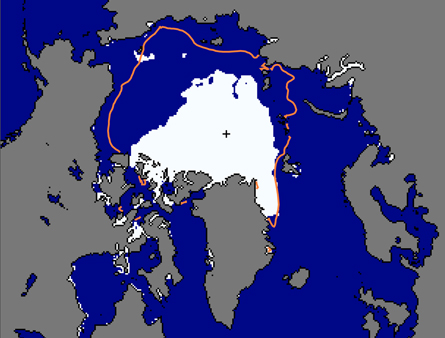
The following map and excerpt from a Science News article titled, “Arctic sea ice hits record low and keeps going,” reveals the present status of the Arctic ice cap. The average ice coverage for the 21 years between 1979 and 2000 is demarked by the orange line that can be seen running from the Greenland Sea, west and north of Svalbard, through the Laptev Sea to Russia’s Wrangel Island and through the Beaufort Sea to the Canadian Archipelago. The difference between that area and the area presently covered by ice is at best, shocking. … 

The six lowest sea-ice extents on satellite record have occurred in just the last six years. More melt means more open water exposed to sunlight. In turn, that water absorbs more heat and causes feedback loops that heat the Arctic even more.

As of August 26, Arctic sea ice covered 70,000 square kilometers below the previous satellite-era record from 2007, according to the National Snow and Ice Data Center in Boulder, Colo.

“The ice cover is now just so thin and weak in the springtime that large parts of it can’t survive the melt season,” says NSIDC director Mark Serreze.

Arctic sea ice grows in winter and melts partly away each summer. Overall, more sea ice has been lost each year as temperatures rise. From 1979 to 2011, the amount of sea ice left in September at the end of each melt season dropped by an average of 12 percent per decade.

The ice isn’t just shrinking; it’s also thinning. The Arctic used to contain lots of thick ice — some 3 to 4 meters thick — that survived year after year. Now it’s dominated by thinner ice only 1 to 2 meters thick and just one to two summers old. “It’s almost like parts of the Arctic have become a giant slushee at this time of year,” says Walt Meier, a sea ice expert at NSIDC.

In 2007, the previous record year, winds, cloud cover and other weather conditions were just right for a lot of ice to melt away. “There were a number of people saying [2007] was a one-off and you’ll never see this perfect storm again,” says Serreze. “What Mother Nature is telling us is that you don’t need a perfect storm anymore, just because the ice is so thin now.” …

_____________________________________

Meanwhile, in answer to these new conditions, oil companies are poised to begin installing offshore oils rigs and drilling in the backyards of walrus and polar bears. Greenpeace and other environmental groups say an oil spill in the Arctic could cause irreparable damage to wildlife and marine ecosystems. That’s no shit. With a brief growing season and comparatively little seawater circulation, the Arctic Ocean must be one the most delicate environs on the planet.

Fears that the oil industry is unprepared to operate in the hostile conditions of the far north where storms are frequent were accentuated when a floating oil rig capsized off eastern Russia last December, killing more than 50 workers.

Surely halting any new oil and gas drilling in the fragile north is an important step in solving the world’s problems. But considering that the loss of the polar ice cap is a direct result of global warming, and global warming is a direct result of human activities (chiefly the burning of fossil fuels for energy, transportation and meat production), wouldn’t the real answer be to put a halt to ALL further oil exploration and drilling everywhere? When you take into account that further planetary warming could well result in a steady flow of cold Arctic melt-water into the North Atlantic, thereby disrupting the deep sea conveyer that cycles weather as we know it, while fueling the very vitality of the living oceans, the answer must be a resounding, if reluctant “Yes!”

So what does all this have to do with deniers and the damage they do?

Chances are if you’ve heard of global warming, you’ve heard of global warming deniers. Maybe you are one yourself. If so, it’s time to wake up and smell the methane! The planet can’t wait for people to quit bickering and decide to make some major changes. If we don’t curtail our daily carbon output and change our consumptive ways, the climate is going to change for us, and leave our mechanized world in the dust.

Like “young Earth” creationists who still deny evolution because they don’t like to think of humans as mere animals, or hunters who don’t want to admit their species’ role in the ongoing extinction spasm, global warming deniers don’t want to accept humankind’s hand in radically changing the climate—to the detriment of all who’ve adapted to it over the eons. It’s time to evolve out of this hyper age of planes, trains and automobiles, put away our motorbikes, jet boats and snowmobiles along with the rest of our gas-burning toys, slow the fuck down and try to live at pace more in keeping with the rest of this living planet—while we still have one.

Text and Wildlife Photography ©Jim Robertson

Give Paul Ryan the Grand Slam

Are you tired of hearing about Paul Ryan yet? I know I am. After learning that he is a ‘diehard’ bowhunter, I didn’t think anything else about him would surprise me. But during a recent interview in Deer and Deer Hunting magazine he let slip just how much of a trophy hunter he really is.

Though he seems to actually enjoy getting his hands all bloody butchering his victims himself, the killing is clearly not about procuring cost-effective food for him—in Ryan’s own words, his fantasy dream hunt would be costly: “…one of my goals is to get a ‘grand slam’ of sheep with a bow,” Ryan told the deer-snuff magazine. “It would be very tough and very expensive.” For those lucky readers who don’t know what a ‘grand slam’ of sheep is, it’s the brutal murder of one each of the four different North American wild sheep, which include Alaska’s Dall sheep, Stone sheep (found only in northern Canada), Rocky Mountain bighorn and the Mexican desert bighorn. It’s like a golf tour for psychopathic animal killers.

Text and Wildlife Photography ©Jim Robertson

Paul Ryan told Deer Hunting his idol is the first archer who shot and killed all 27 species of North American ‘big game’ during a despicable form of legal serial murder known as the ‘super slam.’ “I’m just pretty typical for a Wisconsin guy,” Ryan added, confessing: “I love hunting and fishing. Bowhunting is my passion…preparing food plots, the strategy of where a dominant buck is living or will be moving and then being in position to get a shot, that’s really exciting.” (Hmm, he and I have an altogether different idea on the definition of passion and excitement, although I suppose another one of his fellow serial killers could relate.)

There’s malevolence in the act of bowhunting and Ryan is admittedly obsessed with doing it. (The same issue of Deer and Deer Hunting that features his interview includes an article titled, “How to Recover a Bow-Shot Deer.” Obviously it’s pretty much impossible to make a ‘clean,’ instantaneous kill with an arrow.) He may never be inducted into the ‘Bowhunters Hall of Fame,’ but there’s a very real, very frightening possibility of him eventually becoming President of the United States.

The thought of a trophy bowhunter, among the most sadistic of ‘sportsmen,’ being just a heartbeat away from the presidency of the country with the most nuclear weaponry at its disposal is cause for concern, to say the least. Who’s to say he won’t get a wild hair and decide to take out a small country or two just for the sport of it? So much for compassionate leaders—half our registered voters are considering making a conscious-less animal killer our next commander-in-chief-in-waiting.

And we thought having Ronald Reagan in control of the red button was scary.