When an activist friend asked me to write an overview of the wolf situation, my first thought was: “What a daunting and extremely depressing task that would be.” But having followed the wolves’ story since long before their reintroduction to Yellowstone and the Idaho wilderness, I suppose it’s only natural that I take this on. After all, I’ve covered the issue many times in articles, on my blog, and I devoted two chapters of my book, Exposing the Big Game: Living Targets of a Dying Sport, to the plight of wolves.
At the time I wrote the book’s chapter, “From the Brink of Oblivion and Back Again,” wolves were still federally protected and their removal from the Endangered Species List was just someone’s bad idea that had yet to see its dark day—I never quite realized just how apt that title would soon be. Until recently I remained hopeful that any wolf hunting would be strictly monitored and regulated, and that abusers would be fully prosecuted. Frankly, I thought we would be a little more evolved as a species by now.
But time and again states have proven themselves unworthy by declaring open seasons on wolves, without regard for the species’ future or for the welfare of individual wolves. Indeed, the ongoing warlike attack on wolves is anything but sporting or humane, with kill methods ranging from traps and snares to aerial hunting, running them down with dogs or luring them in and sniping at entire packs with semi-automatic rifles—depending on a given state’s predilection. At the same time, many hunters and trappers go out of their way to express their hatred for wolves through horrific acts of overkill. They seem to take sick pleasure in further degrading their victims by glibly posing in morbid photos of trapped or bloodied wolves, then spreading their snuff shots across the internet, fishing for praise, while taunting wolf advocates.
Text and Wildlife Photography ©Jim Robertson, 2013. All Rights Reserved
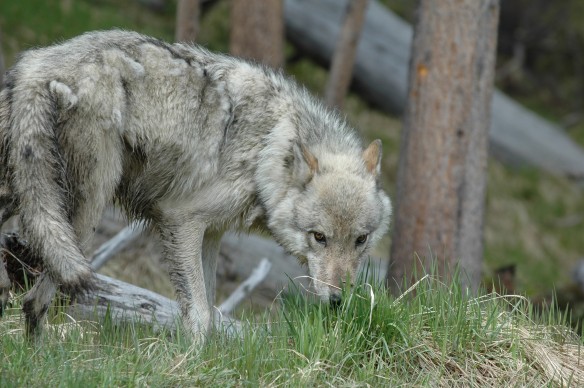
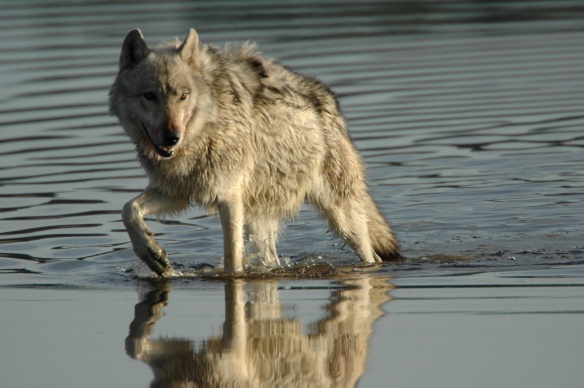
For thousands of years, wolves played a central role as keepers of nature’s balance across the American landscape. Wolves are the personification of untamed wilderness; their presence is a sign of an ecosystem relatively intact.
But bigotry toward wolves has thrived across the country since colonial times and wolves have long been the object of unwarranted phobias. Today’s wolf-haters panic at the thought of natural predators competing for “their” trophy “game” animals and loath anything that might threaten their exploitive way of life. They view the federal government as the enemy in their ongoing combat against wilderness, and grasp for local control of species like wolves, who, until recently, were all but extinct in the continental U.S. Far from being their foe however, the federal government has actually been a fervent ally.
The contentious removal of wolves from the federal endangered species list—long before they were truly recovered—was a coldly calculated course set in motion by the Bush Administration, dutifully followed by the Obama Administration and rendered the law of the land through an underhanded act of Congress in 2011. This crooked covenant, conjured up for the sake of ranchers and trophy hunters, left the wolves’ fate in the custody of hostile western states…and fits right in with a centuries-old, historic norm.
In 1630, Puritans of the Massachusetts Bay Colony—known for holding the first Thanksgiving Day celebration…and Salem witch hunts—felt biblically impelled and duty-bound to “subdue the earth.” Hence, they were the first to establish a bounty on wolves. Soon the other colonies followed their example and set bounties of their own, and a systematic genocide of wolves in America spread west with the “settling” of the land.
In 1818, Ohio declared a “War of Extermination” against wolves and bears. Iowa began their wolf bounty in 1858; in 1865 and 1869 Wisconsin and Colorado followed suit. State by state wolves were shot, trapped and poisoned to extinction. As the demand for wolf pelts increased, “wolfers” began killing grazers like elk or bison and poisoning the meat as bait, decimating whole packs of unsuspecting canines in one fell swoop.
By 1872, the year President Grant created Yellowstone National Park, 100,000 wolves were being annihilated annually. 5,450 were killed in 1884 in Montana alone, after a wolf bounty was initiated there. By the end of 1886, a total of 10,261 wolves were offered up for bounty (sixteen times Montana’s 2011 population of 653 “recovered” wolves). Wyoming enacted their bounty in 1875 and in 1913 set a penalty of $300 for freeing a wolf from a trap.
Not to be outdone, the US government began a federal poisoning program in 1915 that would finish off the rest of the wolves in the region—including Yellowstone. By 1926 wolves had been completely extirpated from America’s premier national park.
Having no more regard for wolves than those who originally caused their extinctions, willfully-ignorant wolf-haters in the tri-state area of Idaho, Montana and Wyoming have not received their reintroduction with open arms but rather with loaded arms, hoping to turn the clock back to the dark ages of centuries past. The posture they assume on the subject of wolves is as warped and ill-informed as any Massachusetts witch hunter’s.
With the wolf population in the tri-state area at only a fraction of its historic sum, the federal government unceremoniously removed them from the endangered species list (and consequently from federal protection) in 2009, casting their “management” (read: eradication) into the clutches of eager states that wasted no time implementing wolf hunting seasons. Montana quickly sold 15,603 wolf permits, while their confederates in Idaho snatched up 14,000 permits to hunt the long-tormented canids.
For its part, Wyoming has stubbornly held to a policy mandating that wolves be shot on sight anytime they wander outside Yellowstone, allegedly to safeguard range cattle (who are actually 147 times more likely to fall prey to intestinal parasites). Wolves have killed a grand total of only 26 cows (out of 1.3 million head of cattle in the state). Still, the livestock industry is in control of their wolf management decisions. Though hunters there have killed 74 wolves this season, as of March 1st the state of Wyoming has expanded and extended its season indefinitely, declaring an open, year-round hunt on them. Winter, spring and summertime hunts are particularly harsh since this is when wolves are denning and raising their newborn pups.
On the other side of Yellowstone, the disingenuously but suitably named “Idaho Anti-Wolf Coalition,” backed by a well-funded trophy elk hunting industry, filed and circulated an initiative petition in 2008 calling for the removal of “all” wolves there “by whatever means necessary.” Fortunately, even in the state famous for potatoes, militias and neo-Nazi compounds, they failed to gain enough public support to move forward with their avaricious initiative. Even so, the Idaho government has been quietly carrying out the “whatever means” approach by adding aerial hunting, trapping, snaring and baiting to their wolf devastation arsenal. This last season, 169 wolves were killed by trophy hunters in Idaho, while trappers there claimed the lives of 76.
It should come as no great jolt that Idaho hunters felt they could get away with asking for the renewed obliteration of an entire species—their governor, “Butch” Otter, publicly proclaimed he hoped to be the first to shoot a wolf as soon as they lost federal ESA protection. Failing that, Otter used his gubernatorial powers to declare his state a “wolf disaster area,” granting local sheriffs’ departments the power to destroy packs whenever they please.
“Meanwhile,” according to Defenders of Wildlife’s president, Jamie Rappaport Clark, “the federal government is sitting idly by as Idaho almost singlehandedly unravels one of our nation’s greatest wildlife conservation success stories. This is totally unheard of—never before has a species climbed its way back from near extinction only to be quickly decimated once again.”
Montana started out seeming to be the sensible state, appearing almost tolerant of wolves. But between their state legislature and their wildlife policy makers, they’ve made an about face and quickly caught up with their neighbors, displaying a total disregard for the public trust doctrine which holds that wildlife, having no owners, are res communes, belonging “in common to all of the citizens.” They’ve recently passed bills barring any protected zones outside Yellowstone Park, while legalizing silencers for wolf hunting and the use of recorded calls to attract wolves, as well as allowing five wolf tags per hunter, 12 years and older. (And a new state bill is proposing lowering the legal age of hunters to nine years old.) Legislators also proposed a cap of 250 on their state wolf population. Last year’s wolf hunt kill totals for Montana were 128 wolves shot to death and 97 killed in traps.

Text and Wildlife Photography ©Jim Robertson, 2013. All Rights Reserved
Since Congress stripped wolves of their Endangered Species status, an estimated 1,084 wolves have been killed in the Northern Rockies. Again, that’s ONE THOUSAND AND EIGHTY-FOUR living, breathing, social, intelligent wolves killed by scornful, fearful, vengeful and boastful hunters and trappers, often in the most hideous ways imaginable.
Thanks to a federal judge’s 2010 decision, the wolf was granted a one-year stay of execution. But in 2011 our federal legislators on Capitol Hill attached a rider to a budget bill circumventing that judgment. This serpentine, backbiting end-run around science and public opinion played right into the hands of anti-wolf fanatics in Idaho and Montana and cleared the way for the bloodiest butchery of wolves in almost a century. Case in point: the opening week of Montana’s nascent hunting season on wolves saw sportsmen set up just outside the park boundary gun down every adult in Yellowstone’s well-known and much-loved Cottonwood pack, leaving their dependent pups to starve.
As if that weren’t enough, on December 6, 2012, the familiar, radio-collared alpha female of the park’s Lamar Canyon pack was shot and killed by a hunter. Suddenly the average American was aware of the atrocities of wolf hunting, yet in spite of widespread public outcry, wolf-killing states have stepped up their single-minded assault.
Wyoming’s expanded wolf-killing season is all the more tragic given that spring is the time of year that wolves are denning. As Defenders of Wildlife points out, “This expanded hunt puts the most vulnerable population of wolves – pups and pregnant or nursing mothers – in greater danger of being shot on sight. This kill-at-will approach is exactly the kind of flawed policy we knew would happen if wolves prematurely lost their Endangered Species Act protection – this is why Defenders is suing the U.S. Department of Interior to restore ESA protection for wolves in Wyoming.”
It’s not like the administration didn’t know what might happen when the fate of the wolves was turned over to states with extreme anti-wolf plans already in place. In just two years nearly 1,100 wolves have been ruthlessly murdered by hunters and trappers eager to relive the gory glory days of the 1800s.
All this is going on in spite of well-documented proof that wolves are beneficial to a given environment, and despite the fact that the majority of Americans, including most visitors to Yellowstone and the tri-state area, want to see wildlife unmolested. They are not there to hunt—the money they spend reflects their strong interest in the quiet enjoyment of nature. A 2011 National Park Service report shows that the 3,394,326 visitors to Yellowstone spent $332,975,000 in communities surrounding the park. But these figures could drop dramatically if Yellowstone wolves continue to be slaughtered.
Yellowstone is fertile ground for watching and learning about wolves. Biologists studying the Yellowstone ecosystem have found that since their reintroduction to the park, wolves have kept elk herds on the move, thus allowing over-browsed streamside riparian habitats to regenerate. Among the species that rely on a healthy riparian zone—and therefore benefit from the presence of wolves—are moose, trumpeter swans, warblers, wrens, thrushes, beavers, muskrats and the Yellowstone cutthroat trout. Everywhere they’re found, wolves play an important role in maintaining the health of ungulate herds by preying primarily on infirm or diseased animals, ensuring a healthy gene pool. And the remains of their kills provide a welcome relief for hungry scavengers, from bears to ermine to wolverines to bald eagles.
But the number of animals killed by wolves is grossly overplayed by their detractors. According to Yellowstone National Park data for 2011, project staff found that wolves barely took a bite out of Yellowstone’s rich and varied biota. And it’s long been established that wolf populations, left alone, are self-regulating; data from Yellowstone backs that up as well. Like humans, when they feel the pinch of too many of their own kind in a given area, they start to turn against one another. 2011 saw seven wolves killed in intra-pack quarrels. Yellowstone’s fluctuating wolf population has declined from 174 in 2003 to around 80 in 2012. Since then, hunters and trappers targeting wolves along the park’s borders have brought the current population down to the low 70s, as of this writing.
In addition, scientists studying the relationships between keystone predators, trophic cascades and biodiversity have found that ecosystems which include these predators have more diversity and are more resilient to climate change and stresses caused by a growing human population.
Sadly, state game departments are out of touch with these concepts. For example, according to a 2012 Montana Fish, Wildlife and Parks Department survey, there are 141,078 elk in the state, 55% over their management “objective” of 90,910; but rather than allowing wolves to solve their elk “problem,” they want to reduce the number of both elk and wolves. That policy is not scientific; it’s downright kill-happy. And an alleged threat to the cattle industry is certainly no excuse for the rampant killing of these important predators. Out of the approximately 2.6 million cattle in the state, only 74, or .0003%, were taken by wolves in 2011.
Biologist Bob Hayes, author of Wolves of the Yukon, wrote: “I spent 18 years studying the effects of lethal wolf control on prey populations. The science clearly shows killing wolves is biologically wrong. As I began to better understand the wolf, I developed a clear answer to my question about the effectiveness and moral validity of lethal wolf control programs. I can now say the benefits of broad scale killing of wolves are far from worth it…It should never happen again.”
And the late Canadian naturalist and author, R D Lawrence, stated in his book, In the Presence of Wolves: “Killing for sport, for fur, or to increase a hunter’s success by slaughtering predators is totally abhorrent to me. I deem such behavior to be barbaric, a symptom of the social sickness that causes our species to make war against itself at regular intervals with weapons whose killing capacities have increased horrendously since man first made use of the club—weapons that today are continuing to be ‘improved’.”
The 1996 reintroduction of wolves to the northern Rocky Mountains in Yellowstone and wilderness areas of Central Idaho as mandated by the Endangered Species Act–along with protections against hunting and trapping all too briefly afforded them under the ESA–gave the wolf a temporary reprieve and allowed Nature to reign again over some of her sovereign lands.
Yes, wolves are spreading out, but that doesn’t necessarily mean there are more of them; each time they find a given habitat hostile to them, they continue to branch out in search of someplace safer and more hospitable. The total wolf population of the tri-state area has fluctuated, reaching a high of around 2000 individuals. An impressive figure perhaps, unless you consider that 1,089 were killed this year (not including those killed by federal “Wildlife Services” agents); or that 10,261 wolves were destroyed between 1884 and 1886 in Montana alone; or even that 380,000 wolves once roamed the country.
While all this is going on, the Great Lakes states have been racking up a high wolf body count of their own. Wisconsin in particular seems to be bucking for a most merciless award—the cruelties they’ve unleashed on wolves are the stuff of nightmares. Though recent studies suggest wolf predation may suppress CWD (chronic wasting disease—the deer equivalent of mad cow disease), Wisconsin has spent 27 million de-populating its white-tail deer to curb CWD. To underscore the irony of this: no CWD has been detected in areas where wolves live in that state. In addition to CWD, wolves have been shown to reduce or eliminate brucellosis, ironically benefitting the very Montana ranchers who vilify them
Anti-wolf fanatics are an organized bunch of thugs. Lately a deceptively named hate-group calling itself “Big Game Forever” has been luring Utah state funds away from essentials such as schools and into their anti-wolf agenda. Just recently they leached $300,000 for their campaign against wolves in that currently wolf-less state.
States, such as South Dakota, that don’t even have wolf populations are hastily re-classifying wolves from the status of protected to “varmint,” in the event that any lost wolf happens by. Even states as progressive as Washington are jumping on the bandwagon, allowing people to kill wolves without permit and changing the wolf’s status to “big game,” ahead of their anticipated complete removal from federal ESA protection. This can’t be allowed to happen—the minute federal protections are lifted, wolves will be fair game practically everywhere in the country!
As Aldo Leopold pointed out in 1949: “If the land mechanism as a whole is good, then every part of it is good, whether we understand it or not. If the biota, in the course of eons, has built something we like but do not understand, then who but a fool would discard seemingly useless parts? To keep every cog and wheel is the first precaution of intelligent tinkering.”
Who but a fool, indeed.
With the return of widespread wolf hunting, it will take today’s anti-wolf bigots only a few years to boot this misunderstood embodiment of wilderness back to the brink of oblivion.
________________________________________
This post includes excerpts from Exposing the Big Game: Living Targets of a Dying Sport.

Text and Wildlife Photography ©Jim Robertson, 2013. All Rights Reserved








 Exposing the Big Game