Recreational Hunting Redux: Cougar Fund Opts For No Killing

Killing cougars doesn’t solve the “problems” at hand and should stop right now

Published on March 8, 2013 by Marc Bekoff, Ph.D. in Animal Emotions

Government organizations, hunters, and trappers are notorious for wantonly and inhumanely killing millions of nonhuman animals (animals) in their widely ineffective attempt to manage and control “problem” individuals and groups (for detailed discussions and data see and and). Just today I read that more than 550 wolves have been “taken” by hunters and trappers in the Rockies alone this season.

This article continues here:  http://www.psychologytoday.com/blog/animal-emotions/201303/recreational-hunting-redux-cougar-fund-opts-no-killing

Your Call Are Making a Difference for Wolves

I heard some encouraging news today from a diehard activist who has called every one of the Minnesota state representatives listed as contacts for the bill to reinstate a five-year moratorium on recreational wolf hunting and trapping. She learned that of all the issues, they were hearing the most about the wolf issue and one staffer said, “he has not taken ONE call against the bill.

Her message to us is, “Please keep up the calls people—its making a difference!”

Here’s the info again and the contact info, from Howling For Wolves:

Today, legislation was introduced into the Minnesota House of Representatives to reinstate a five-year moratorium on recreational wolf hunting and trapping. Chief house author, Rep. Jason Isaacson (DFL – Shoreview) introduced H.F. 1163, the companion bill for S.F. 666 introduced by Sen. Chris Eaton. The bill calls for a five-year wait before another wolf hunting season can be proposed, and only for population management purposes after other options are explored. Read the press release here.

Mark your calendars! A Senate hearing of the bill has been scheduled on Tuesday, March 12 at noon before the Environment and Energy committee. Let’s fill the hearing room and the halls for the wolf. It was your efforts making calls and sending emails to committee members that pushed us forward.

Now we need your help to secure a hearing in the House Environment and Natural Resources Policy committee. A bill must be heard and passed out of one committee before March 15, 2013 to stay alive. Please call the committee members listed below to voice your support for H.F. 1163 and request the bill be heard and passed through committee.

House Environment and Natural Resources Policy Committee Rep. David Dill (Chair) 651-296-2190 Rep. Peter Fischer (Vice Chair) 651-296-5363 Rep. Tom Hackbarth 651-296-2439 Rep. John Benson 651-296-9934 Rep. Tony Cornish 651-296-4240 Rep. Dan Fabian 651-296-9635 Rep. Andrew Falk 651-296-4228 Rep. Steve Green 651-296-9918 Rep. Rick Hansen 651-296-6828 Rep. Clark Johnson 651-296-8634 Rep. Denny McNamara 651-296-3135 Rep. John Persell 651-296-5516 Rep. Mark Uglem 651-296-5513 Rep. Jean Wagenius 651-296-4200 Rep. JoAnn Ward 651-296-7807 Rep. Barb Yarusso 651-296-0141

Please know that to work a bill into law requires many repeated actions to push it through. We will have several urgent requests for actions over the next few weeks to keep each bill moving forward to a final floor vote. In the meantime, mark your calendars for the Senate hearing on Tuesday, March 12 at 12 pm. Please email us atrespond@howlingforwolves.org if you are able to attend. We want a strong showing of support at this hearing.

_____________________

Meanwhile in Montana,

Another activist writes, “I counted the public comments MTFWP received in January about the Wolf Hunt closure next to Yellowstone National Park (YNP). Overwhelmingly the votes were in favor of a closure. I kept a strict count of all the Montana comments and was pretty close on the others too.  Here’s my count:

There were a total of 1811 comments.

750 of those comments were from Montanans:

•554 in favor of a wolf hunt closure around YNP

•196 opposed to a closure around YNP


1061 comments were from out of state, USA citizens and some from overseas

•~1058 were in favor of a wolf hunt closure, protecting YNP wolves

•~3 were opposed


As wolf advocate Justin Forte put it, “This dictatorship that hunters and ranchers have had over the rest of us on wildlife policy has gone on for too long! It is time for all of us to stand up and say ‘No More!’”

Text and Wildlife Photography ©Jim Robertson, 2013. All Rights Reserved

Text and Wildlife Photography ©Jim Robertson, 2013. All Rights Reserved


“The term “Wildlife Management” is actually a fancy euphemism for allowing hunters to manipulate and exploit wildlife and their populations for the benefit of hunters. This dictatorship that hunters and ranchers have had over the rest of us on wildlife policy has gone on for too long! It is time for all of us to stand up and say ‘No More’!” ~ Justin Forte

Nabeki's avatarHowling For Justice

Howl Across America Cour D' Alene

From Justin Forte:

WOLF AND WILDLIFE RALLY IN SACRAMENTO CALIFORNIA ON MARCH / 11 / 2013

Attention all wolf and animal rights activists! A wolf and wildlife rally will be held on the steps of The California State Capitol Building in Sacramento, California on March 11TH, 2013 from 1PM TO 5PM.

If interested in helping or attending, call Kim Richard at (903) 363-5353. Let’s remind the politicians that they work for us and we demand the slaughter of our wolves and wildlife be stopped! Everyone who can help or attend please do!

STOP THE SLAUGHTER OF OUR WOLVES AND WILDLIFE

===

Ph0to: Courtesy Ann Sydow

Posted in: Wolf Wars

Tags: Wolf and Wildlife Rally, Sacramento California, March 11, 2013, Stand Up For Wolves

View original post

Anti-Hunt Q and A

The following are my answers to interview questions posed by a journalism student who so was moved after reading my book, Exposing the Big Game: Living Targets of a Dying Sport, that she decided to undertake a project on the psychology of hunting…

1. Have you come into contact with anyone (especially hunters) who has stated that your book changed their view on the game of hunting and the mistreatment of animals?

Answer: Yes, I’ve heard from several non-hunters who have thanked me for exposing the truth about big game hunting. No longer ambivalent about the unnecessary cruelty of sport hunting, they are now active anti-hunters.

But I have yet to meet a hunter introspective enough to allow anything to change their inbred, imbedded views on killing wildlife.

2. Have you received any ‘backlash’ since publishing this book?

Answer: For what, for urging hunters and trappers to be more compassionate to our fellow beings? No, and they haven’t received any backlash from me for tormenting and killing my friends the animals (aside from my book and blog).

Deep down hunters and trappers know what they are doing is wrong; they just hope we’ll continue to let them get away with it.

3. Are you friends with anyone who avidly hunts? Do any of your family members hunt?

Answer: Unfortunately.

4. In the beginning of the book, it states that you have always been a man of compassion towards animals. Why do you think that spreading the word of being kind to animals is important?

Answer: I’m going to answer that question with another question, a couple of other questions, actually: Why did the emancipators think freeing the slaves was important? My grandmother and great aunts were suffragettes, why did they fight for women’s right to vote? Why did people push to ban kiddie porn or crush videos? Why? Because speaking out for innocent victims of exploitation is the right thing to do.

5. What do you say to those who hunt for food and not sport? Many hunters believe that it is more humane to hunt for food than it is to buy meat from a slaughter house.

Answer: First of all, most people who claim to hunt for food not sport are living far above the poverty level. They are not starving and they don’t need to kill animals to survive. They do it because they want to—it’s “fun.” In many cases they spend far more on the hunt than it would cost them to get their food from the markets where they buy their beer, tobacco and Twinkies. They can boast all they want about “using the meat”—hell, even wolf or cougar hunters will claim that they plan to eat what they kill—but they’re just trying to make their trophy hunt seem palatable to the unwary public.

And the claim that hunting is more humane than what cows go through is exaggerated at best. While there’s absolutely no denying that what cows at the slaughterhouse are forced to endure is appallingly cruel, hunters conveniently forget that the animals they stalk are stressed out from the time they hear the first gunshots fired by someone sighting in their rifles for hunting season.

The myth of that “good clean shot” is a grim fairytale in most every case. Hunters expect to have to track down and finish off an animal they’ve shot or impaled with an arrow. In reality, “game” animals probably suffer longer than those at the slaughterhouse (though this is in no way meant to condone factory farming).

When it comes right down to it, hunters don’t give a shit about being humane, or they’d quit eating meat and join the millions of people who are living proof that human beings can live longer, healthier lives if they swear off flesh foods and get their nutrients from the plant kingdom.

Text and Wildlife Photography ©Jim Robertson, 2013. All Rights Reserved

Text and Wildlife Photography ©Jim Robertson, 2013. All Rights Reserved

Last Day to comment!

Nabeki's avatarHowling For Justice

Emergency Alert Condition Red

MARCH 6, 2013

LAST DAY TO COMMENT EVERYONE! PLEASE DO SO QUICKLY, THE WOLVES ARE DEPENDING ON YOU!!

===

More shameless behavior from the anti-wolf crowd,  that can have serious consequences for wolves across the US!!

Kirk Robinson, Executive Director, Western Wildlife Conservancy, states SFW founder Don Peay asked the Utah legislature, specifically the Natural Resources, Agriculture and Environmental Quality committee, to pay him $300,000 out of the state general fund (taxpayer money) so he could lobby in Washington, D.C., for wolf delisting across the US.  And there is more, please read Kirk’s urgent letter and take action immediately by contacting the members of the Utah Executive Appropriations Committee, that are listed below.

Don’t delay, the deadline is March 6

===

Dear friends of Canis lupus:  ACTION URGENTLY NEEDED!

Please rally to protest a line item in the Utah budget.  Do it no later than next Wednesday, March 6!

Don…

View original post 627 more words

Impossible to Imagine

To those of us who care deeply about wildlife issues and the abuse of non-humans, it seems that no matter how many horrors you hear about, there’s always something else happening to animals somewhere we’re shocked to learn. Even after writing a book against hunting and trapping, I guess there are still places my mind doesn’t want to go.

That’s how I felt when I read the article, “Montana, Idaho trappers catching more than just wolves,” in the Ravalli Republic, which I mentioned in yesterday’s blog post, “Stop the Spread of Psychopathy—End Hunting and Trapping.”

Text and Wildlife Photography ©Jim Robertson, 2013. All Rights Reserved

Text and Wildlife Photography ©Jim Robertson, 2013. All Rights Reserved

For a few years my wife and I lived in a house surrounded by a small field on a forested hill above Washington’s Willapa River valley. The field was once an upper pasture of a now long-defunct dairy. We were happy to see it returning to nature. Sword ferns, wildflowers and Douglas fir trees were starting their advance across the expanse of grass, finding soil churned up by moles for their seeds to take root.

Common wildlife there included black-tailed deer, black bear, raccoons, coyotes, field mice and the red-tailed hawks attracted by the latter. Meanwhile, our feeders attracted everyone from squirrels and chipmunks to a varied assortment of birds—Steller’s jays, juncos and chestnut-backed chickadees, as well as flocks of band-tailed pigeons and American goldfinch, the Washington state bird.

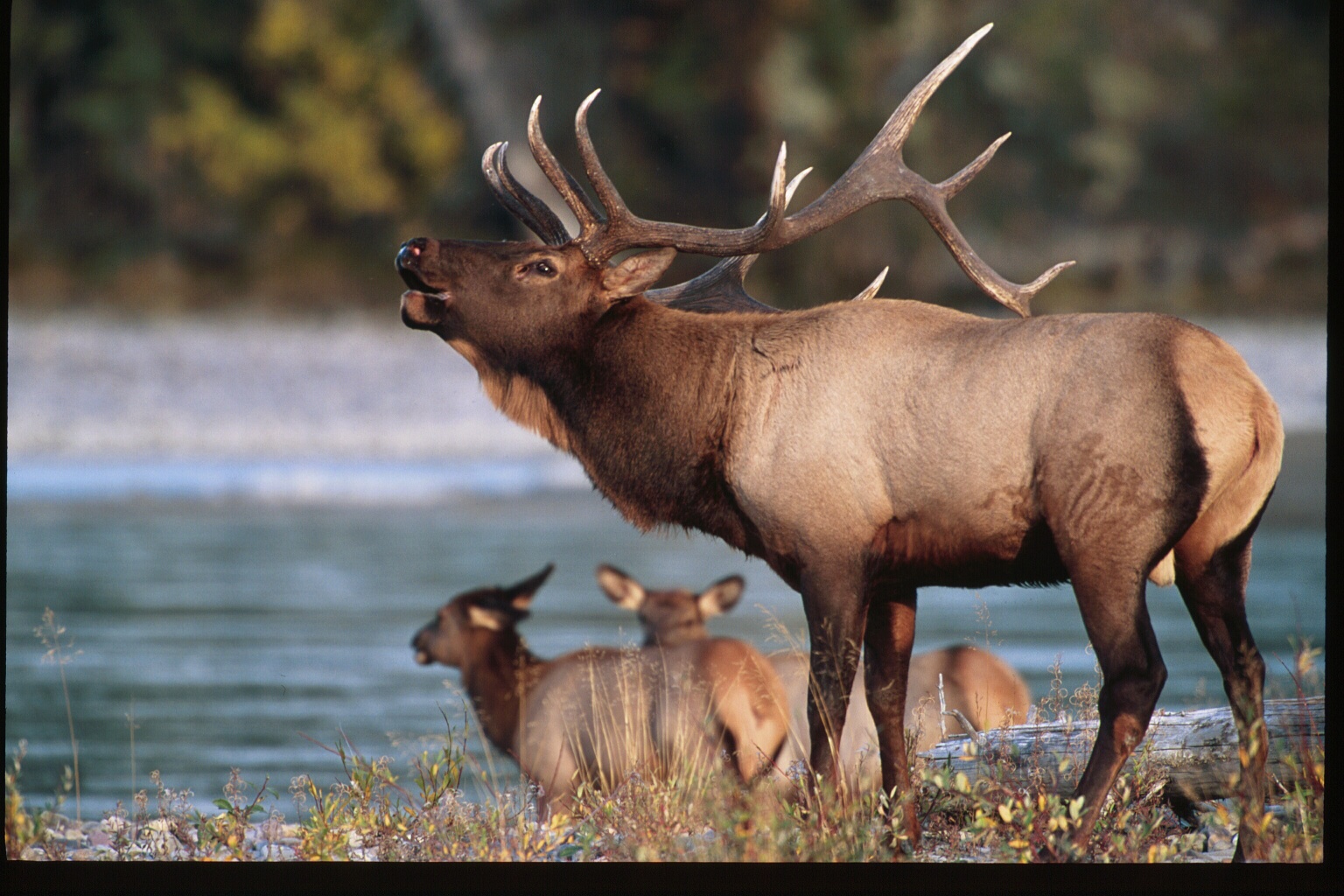
But it was always a special treat to wake up to the sight of the local elk herd bedded down in the upper corner of the field, less than 50 yards from the house.

People often panic at the thought of 20 or 30 large animals competing with their cows for pasture grass, but elk are anything but sedentary grazers—they’re always on the move. Sticking together as a group, they make a circuit around their range through forests and across rivers to find themselves in a new place every day for a week or two, before starting the circuit anew. It was always sad to see them move on from the protection of our posted private property, yet you could almost predict to the day when they’d show up again.

But there was one lone elk cow who seemed to shadow the herd, always a few days behind. We saw her far more often than the herd, and we soon figured out that she was staying nearby in the surrounding forest rather than migrating over the miles-long circuit like the rest of her kind. The reason became obvious—she had a pronounced limp as though barely able to use her right front leg.

When we got a good look through binoculars we saw that her foot was in fact missing! What the hell could have happened to cause that? My first thought was that she caught her leg in some overgrown barbed wire, a familiar threat since “livestock growers” almost never remove unnecessary fencing when they finally quit the business.

Asking around to the locals, their standard reaction was a snicker and a half-assed guess that someone must have shot it off during hunting season. Either scenario seemed remotely possible, but not necessarily all that probable, considering the horse-like size of the animal in question. One bullet or a strand of barbed wire shouldn’t do that much damage.

Twice over the years I’ve found dogs caught in steel-jawed foot-hold traps in other parts of the state (one of them had to have his lower leg amputated) and I started to wonder if the elk might have stepped into a trap set for coyotes (whom the locals hate with extreme prejudice).

I knew that smaller mammals, as well as hawks and eagles, were often unintended victims of trapping; but the thought of an animal as large as a deer or elk being caught in a trap was just too hard to get my mind around. It wasn’t until I read the following lines in “Montana, Idaho trappers catching more than just wolves,” and then saw a photo of a hunter-killed cougar who had earlier lost his toes in a trap, that I suddenly knew for sure—that’s how she lost her foot!: “Trappers reported capturing 45 deer. Twelve of those died. They also captured 18 elk and four moose. One of the elk died.”

The article goes on to quote the Idaho Department of Fish and Game’s state “game” manager, looking out for his cronies while objectifying the animals, “No one wants to catch a deer. It costs them a lot of time.” I don’t even want to try to imagine what an ungulate like that goes through to try to escape a trap—even before seeing an approaching trapper.

Traps are often compared to landmines set for any passing animal. But the difference is that while a landmine blows an appendage off instantly, a steel-jawed trap works its evil slowly—the more its victim struggles to escape, the more damage is done.

In the case of the elk, escape meant not only catching up with the rest of the herd, but also getting away from anyone who might happen by. If determined enough, an animal as powerful as that could eventually pull herself free of a trap’s steel jaws, but freedom would likely come at the expense of a foot.

Text and Wildlife Photography ©Jim Robertson, 2013. All Rights Reserved

Text and Wildlife Photography ©Jim Robertson, 2013. All Rights Reserved

Bill to stop wolf hunts in MN introduced today

From Howling For Wolves

Today, legislation was introduced into the Minnesota House of Representatives to reinstate a five-year moratorium on recreational wolf hunting and trapping. Chief house author, Rep. Jason Isaacson (DFL – Shoreview) introduced H.F. 1163, the companion bill for S.F. 666 introduced by Sen. Chris Eaton. The bill calls for a five-year wait before another wolf hunting season can be proposed, and only for population management purposes after other options are explored. Read the press release here.

Mark your calendars! A Senate hearing of the bill has been scheduled on Tuesday, March 12 at noon before the Environment and Energy committee. Let’s fill the hearing room and the halls for the wolf. It was your efforts making calls and sending emails to committee members that pushed us forward.

Now we need your help to secure a hearing in the House Environment and Natural Resources Policy committee. A bill must be heard and passed out of one committee before March 15, 2013 to stay alive. Please call the committee members listed below to voice your support for H.F. 1163 and request the bill be heard and passed through committee.

House Environment and Natural Resources Policy Committee
Rep. David Dill (Chair) 651-296-2190
Rep. Peter Fischer (Vice Chair) 651-296-5363
Rep. Tom Hackbarth 651-296-2439
Rep. John Benson 651-296-9934
Rep. Tony Cornish 651-296-4240
Rep. Dan Fabian 651-296-9635
Rep. Andrew Falk 651-296-4228
Rep. Steve Green 651-296-9918
Rep. Rick Hansen 651-296-6828
Rep. Clark Johnson 651-296-8634
Rep. Denny McNamara 651-296-3135
Rep. John Persell 651-296-5516
Rep. Mark Uglem 651-296-5513
Rep. Jean Wagenius 651-296-4200
Rep. JoAnn Ward 651-296-7807
Rep. Barb Yarusso 651-296-0141

Please know that to work a bill into law requires many repeated actions to push it through. We will have several urgent requests for actions over the next few weeks to keep each bill moving forward to a final floor vote. In the meantime, mark your calendars for the Senate hearing on Tuesday, March 12 at 12 pm. Please email us atrespond@howlingforwolves.org if you are able to attend. We want a strong showing of support at this hearing.

Text and Wildlife Photography ©Jim Robertson, 2013. All Rights Reserved

Text and Wildlife Photography ©Jim Robertson, 2013. All Rights Reserved

Stop the Spread of Psychopathy—End Hunting and Trapping

In light of the rise in violent crime, many have pondered the question: “How do I know if my neighbor is a psychopathic serial killer?” Well, unfortunately, it’s not easy. Unless of course you happen to live in any number of rural areas across the country where hunters are required to wear blaze orange—then the psychopathic serial killers stand out like a bunch of sore thumbs.

Okay, so maybe it’s a bit hyperbolic to compare hunters to serial killers. Yes, they both obsess on and stalk their victims, whom they objectify and depersonalize in their single-minded quest to boost their self-esteem, and the kills made by both hunters and serial killers are followed by a cooling off period, but serial killing usually has a sexual component to it.

Let’s hope hunters aren’t literally getting off on their exploits.

Maybe a better comparison for a hunter would be to a mass murderer: the inadequate type who snipes with a hunting rifle at innocent passers-by from a clock tower, or fires an AR-15 at cars from an embankment over a freeway.

Either way, the plain fact is cruelty to animals often leads to the killing of people. The perpetrators of the Columbine mass school shooting in Colorado honed their slaying skills by practicing on woodpeckers with their hunting rifles. David Berkowitz, the self-proclaimed “Son of Sam” serial killer, who habitually took sport in shooting lovers in parked cars along the streets of New York City, began his criminal career by shooting his neighbor’s dog.

Why does the public put up with these people in their midst?

The mainstream media downplays the behavior of serial animal killers as though hunting was just another “sport” to report on; like they were covering some Boy Scout Jamboree. They repeat by rote hunter/”game” department jargon like the animals were inanimate objects, using emotionally void terms such as “crop” for deer or “wolf harvest” for the unnecessary torture and murder of sentient beings vastly more admirable than their pursuers.

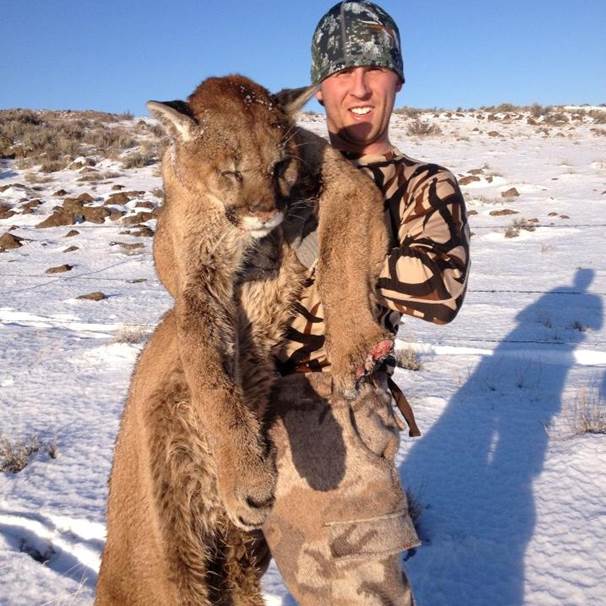
Worse yet are the noxious spread of anything-goes anti-wolf/anti-wildlife websites and chat rooms now widespread in social media. Consider the following comments made in response to a hunter showing off the cougar he killed (photo below)…

February 11 at 8:34am – “Nice cat bud.”

February 11 at 8:34am via mobile – “Colter! I had no idea you were into cougars.”

February 11 at 8:39am via mobile – “Hahahaha only old hairy ones like this one!!”

February 11 at 8:51am via mobile – “Good cat man congrats.”

February 11 at 9:15am via mobile – “That’s a nice cat bud!”

February 11 at 10:25am via mobile – “Thanks! Damn fun hunt.”

February 11 at 4:39pm – “what did you do, shoot its paw off!”

February 11 at 5:25pm via mobile – “It had been stuck in a trap at some point. Either chewed it off or pulled it off.”

In other words the poor cougar suffered, possibly for days, in a trap, before being shot by a trophy hunter. “Non-target” species like cougars often end up in traps set for other undeserving animals.

The Ravalli Republic reports (in typical mainstream media passionless fashion) in their article, Montana, Idaho trappers catching more than just wolves

In the first year that wolf trapping was allowed in Idaho, trappers captured a total of 123 wolves.

But according to a survey by the Idaho Fish and Wildlife Department, those same trappers in 2011-2012 also inadvertently captured 147 other animals, including white-tailed deer, elk, moose, mountain lions, skunks and ravens.

Trappers reported that 69 of those animals died as a result.

Trappers reported capturing 45 deer. Twelve of those died. They also captured 18 elk and four moose. One of the elk died.

The same number of coyotes ended up in traps as deer. Trappers reported that 38 were killed. Mountain lions also took a hit. Nine were captured and six died.

“There are a heck of a lot of people out there trapping furbearers,” said the Montana Fish, Wildlife and Parks wildlife management chief. “And there also are a lot of people trapping coyotes, which aren’t even regulated.”

Meanwhile, Idaho allows trappers to use wire snares that collapse around an animal’s neck as it struggles to free itself.

The Idaho Department of Fish and Game’s state wildlife game manager vacuously adds, “No one wants to catch a deer. It costs them a lot of time.”

Any society that looks the other way when people murder animals for fun does so at its peril. Marine biologist, Rachel Carson, author of Silent Spring, had this to say about the growing problem:

“Until we have the courage to recognize cruelty for what it is—whether its victim is human or animal—we cannot expect things to be much better in this world. We cannot have peace among men whose hearts delight in killing any living creature. By every act that glorifies or even tolerates such moronic delight in killing we set back the progress of humanity.”

It doesn’t get much more cruel or moronic than this…
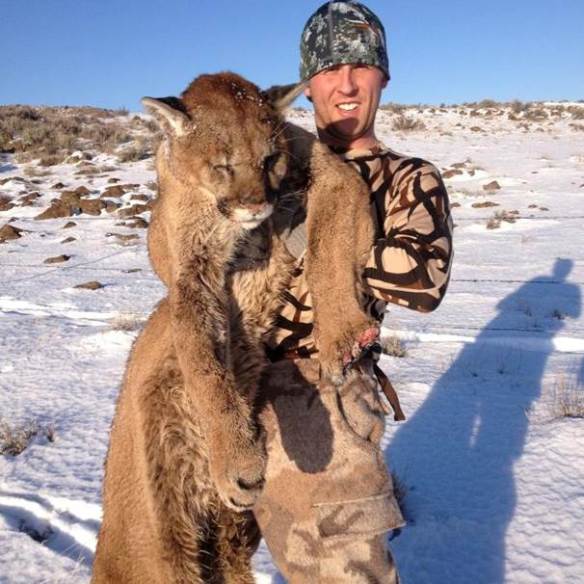
cougar kill