Goodbye, Gurney’s pitta

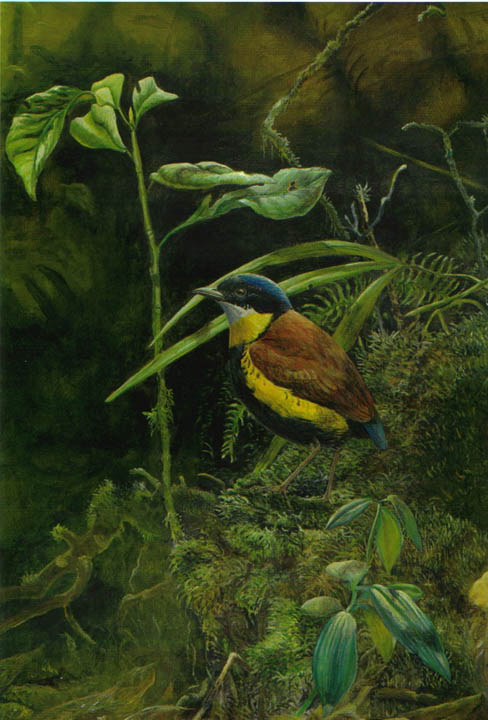
In keeping with the theme of yesterday’s post, “Where Will We Be in Y3K?” (the loss of biodiversity/mass extinction), here’s an article about another species faced with extinction which I received from fellow naturalist and wildlife advocate/animal activist, Barry Kent MacKay. Barry is also a great painter of birds, including this one of the critically endangered Gurney’s pitta…

Painting copyright Barry Kent MacKay

Painting copyright Barry Kent MacKay

Published: 22 May 2013 Post Publishing:

Southern Thailand is home to one of the world’s rarest bird species, but authorities must act now to save it from extinction

From May to October every year, the Gurney’s pitta (Pitta gurneyi), one of
Thailand’s protected wild animals, have their breeding season. Their last
remaining habitat in the Kingdom is a small fragment.

The site is an Important Bird Area (IBA) and arguably the most important
one on the peninsula, supporting the richest lowland forest birdlife in
Thailand. …

The Royal Forest Department (RFD), the Department of National Parks (DNP)
and Krabi provincial administration have been able to halt the destruction and a
little of the lowland forest remains. It is estimated that there may be as few as 13 individuals (perhaps only four to five breeding pairs) now surviving…

Continued…Full story here:

http://www.bangkokpost.com/lifestyle/family/351259/goodbye-gurney-pitta.

Where Will We Be in Y3K?

With several important issues on deck to blog about, the spring winds blew a tree over our power lines and we spent the afternoon back in the relative Stone Age, huddled next to an outside window, straining to read printed pages by what natural light the stormy day had to offer. I decided to do some spring cleaning and throw out anything I hadn’t read or in some other way utilized in the last decade or so. Just as the power came back on I came upon the following letter I wrote after reading Richard Leakey’s book, The Sixth Extinction. This letter, which is as relevant today as when I wrote it (except that there are now 7 billion people instead of 6), was published on January 10, 2000 in the Seattle Post Intelligencer:

Ina fit of arrogant optimism bolstered by surviving the Y2K non-crisis, many are asking, “Where will we be in Y3K?” Perhaps a more pressing question is,” Which species would be able to survive another 1,000 years of mankind’s reign of terror?”

Forget computer malfunctions, power outages or other inconveniences. The new millennium finds us in the midst of a mass extinction unrivaled since a giant asteroid struck Earth 65 million years ago. Unfortunately, Bruce Willis can’t bail us out of the impending Armageddon by simply blasting a menacing death-rock to smithereens.

Our species, one in 1,413,000, is out to prove that it doesn’t take an asteroid strike to unravel life’s intricate diversity. In doing so, humans are on a collision course with destiny. We are eradicating 30,000 species per year—120,000 times the natural extinction rate of one every four years.

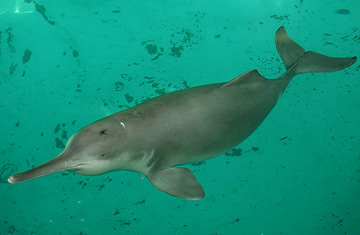
A recent annual survey by the Chinese government found so few of their nationally celebrated, freshwater white dolphins remaining in the Yangtze River that on Dec. 29 they were written off as living relics of an extinct species. China and India now boast more than 1 billion each of a human population that is 6 billion strong and growing. Comparing those figures with the billion inhabitants on the entire planet in 1600, any game manager would clearly see a species out of balance.

As Richard Leakey, the renowned paleoanthropologist warns, “Dominant as no other species has been in the history of life on Earth, Homo sapiens is in the throes of causing a major biological crisis, a mass extinction…And we may also be among the living dead.”

Where will we be in another millennium? Will a future Bruce Willis save us from ourselves? Or will we have gone the way of the dinosaur and the Yangtze white dolphin?

360_yangtze_dolphin_0810

Anti-Wolf Fanatics Scramble to Counter Pro-Wolf Message

First, here’s a message from PredatorDefense.org:

Introducing Our Wolf Billboards

wolves_billboard_Yellowstone

This is an image of one of the five billboards we’re having installed on highways approaching the entrances to Yellowstone National Park, starting in June. They will greet tourists visiting the park via Montana, Wyoming and Idaho and are designed to get them to wake up to the desperate plight of wolves in America.

We really need your help to sustain this billboard campaign throughout the summer and to expand it to even more locations. PLEASE DONATE TODAY!

Timing is critical. We’ve already lost 1,700 gray wolves to hunters and trappers in Montana, Idaho, Wyoming, Minnesota, and Wisconsin since wolves were removed from federal endangered species protection in 2011 and management was handed over to individual states. This slaughter has been largely unpublicized and has therefore been unnoticed by the greater public. The situation is dire, as the U.S. Fish and Wildlife Service intends to remove protections for wolves across nearly the entire country. This would be disastrous for gray wolf recovery

No sooner did Predator Defense erect their billboards for the wolves than did the bogus pseudo “conservation”/anti-wolf group “Big Game Forever” begin fundraising for a Yellowstone area billboard campaign of their own. Theirs would of course carry their standard anti-wolf rhetoric, while feigning concern for trophy target species like moose and elk. Here’s part of an intercepted “BGF” email alert meant to tug at the heart strings of self-serving trophy hunters across the west:

Folks, 

Once again, America’s moose, elk and other wildlife need your help. There is a major highway billboard campaign aimed at stopping wolf management in the Northern Rockies. Big Game Forever needs your help to educate the public and the 3.4 million annual visitors to Yellowstone National Park of the importance of restoring balance through responsible wolf, moose and elk management.
 
Here is what is happening. Over Memorial Day weekend, a new series of billboards popped up on several major highways leading to Yellowstone Park. It appears that these billboards are aimed at influencing national sentiment against responsible wolf management.

Big Game Forever has been working over the past several weeks to respond to this misplaced advertising attack.

 
We have reserved a number of billboards around Idaho and Montana to educate the public about the very real moose crisis emerging in wolf states of Montana, Idaho, Wyoming and Minnesota. We are also working with a coalition of conservation-minded sportsmen to place billboards in Cody Wyoming.
 
Please go to http://biggameforever.org and click on the “Donate” button. A number of generous private donors have already stepped up to match your donation. Your $25 dollar donation becomes $50. Your $100 donation becomes $200. Please go to http://biggameforever.org and click on the “Donate” button.  100% of the donations received during this campaign will go to this important educational campaign.  Your generous donation makes all the difference.
Keep in mind that whenever “Big Game Forever” mentions “conservation” or “responsible wolf management” they are really talking about wolf eradication–by any means possible. Donations to that group come from wealthy trophy hunters.
Now more than ever pro-wolf groups like http://www.predatordefense.org/ need your donations to spread the word for wolves, through billboard campaigns and other selfless efforts. Already, pro-wolf proponents have stepped up with the offer to match donations made in support of their support. Don’t let the pseudo conservationists dupe the public with their “it’s all here for us” attitude.

No Life of Pie

Film Review and commentary by Jim Robertson

Life-of-Pi-Richard-Parker

Spoiler Alert:

If you haven’t seen the movie, Life of Pi, and you plan to, don’t read this post yet. In discussing what I feel is the story’s theme I will end up revealing some of its major plot points, and I don’t want to spoil the experience just to make a point about ethical veganism…

Still here? Ok, assuming you’ve seen the film (or read the book on which it’s based), you’ll recall that there are essentially three parts to the story, ending with what many critics felt was a disappointing and even unnecessary “alternate” account of events to explain how Pi survived such a long ordeal at sea. Personally, I didn’t find the ending a disappointment, perhaps because I may have been one of the few people who got the message the movie was trying to make. After reading dozens of reviews fawning over the special effects (the computer generated middle act was indeed amazing) and decrying the ending, I found only one review that saw it the way I did: the “alternate” story (told by Pi to a pair of Japanese Ministry of Transport officials) was really what happened.

Now, you might be thinking, why does it matter; why ruin a fun thing (especially when it looked so astounding through 3-D glasses, so I hear)? To answer that, I’m going to try to make a long story short and hit its key points (many of which were completely missed by most mainstream film critics, and movie-goers).

The film starts off with an introductory act in which we learn about the early life of the main character, Pi, through a series of flashbacks as told to a visiting writer who wants to write his biography. We are told that Pi spent his childhood trying many of the world’s religions on for size, hoping to get to know God (his atheist father tells him, “You only need to convert to three more religions, Pi, and you’ll spend your life on holiday.”) At one point he jokes that as a Catholic Hindu, “We get to feel guilty before hundreds of gods, instead of just one.”

Of note is the fact that Pi is an ethical vegetarian. He’s also fascinated by a tiger (named Richard Parker, after its captor) stuck in a zoo owned by his father. When Pi is caught trying to befriend the captive tiger, his father decides to teach him a lesson by making him watch Richard Parker kill a goat, thus instilling a morbid fear of tigers in the curious boy.

The movie’s second act begins after it’s revealed that the zoo must close and the father decides to move the animals, and his family, by ocean-going freighter across the Pacific from India to Canada. En-route, the ship is swallowed up in a massive typhoon and Pi—according to the version of the story he is telling the writer, as we witness it—is the only human to make it onto a life raft. Somehow some of the zoo animals  must have escaped their pens in the ship’s hold, and he finds himself adrift with only an injured zebra, an orangutan, a hyena and Richard Parker—the 500 pound Bengal tiger—for company.

It’s during this portion of the movie that viewers are drawn in by its startling special effects; and it’s also when the main character learns that sometimes the world is no life of pie (my interpretation of the title, as a play on the expression “easy as Pie”).

Driven  by hunger, the hyena soon feeds on the zebra and, as it turns on the orangutan, Richard Parker rushes out from under the lifeboat’s only cover (where he has stayed out of sight until now) and quickly dispatches the hyena. This chain of events is essential to the plot since, skipping ahead to the third act, it mirrors Pi’s “alternate” story: substitute the zebra for a deckhand, the orangutan for his mother, the hyena for the cook and Richard Parker for Pi’s alter-ego.

The symbolism here is that after witnessing the cook kill his mother, Pi summons his tiger-inner-self to kill the cook. And eat him. That’s right, to survive his 227 days at sea, Pi had to turn to cannibalism. Incredibly, though it’s critical to the story’s theme, nearly none of the film reviews I read even mentioned cannibalism, since most critics didn’t realize that the second “alternative” version of Pi’s plight was what must have actually happened. I thought it was pretty obvious when an adult Pi asked the writer, “So which story do you prefer?” to which the writer answered: “The one with the tiger. That’s the better story.”And so it goes with God” was Pi’s reply, meaning that, people believe what they want to believe. In order to cope with the sometimes harsh realities of life and death, in this case, resorting to cannibalism for sustenance—and still retain one’s sanity—people often cling to a fantasy world and make up stories which are easier to stomach.

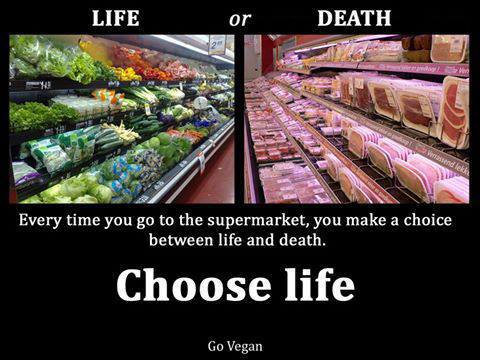
Life of Pi is more than just a happy little special-effects film about a vegetarian boy and a computer-generated, 3-D tiger surviving on computer-generated, 3-D tuna and flying fish. It’s about the kind of anguish any sane person would go through when forced to eat the flesh of another human being. Perhaps the reason I could more easily relate to the story’s deeper meaning (that so many carnivorous critics failed to see) is because, having eaten only plant-based food for the past decade and a half, I feel that same sick revulsion every time I pass the meat isle in the neighborhood grocery store and imagine people actually consuming the flesh so brazenly displayed there.
264431_455824994498980_1177070538_n

Wyoming Proposes Halving its Wolf Quota

Proposed Wyoming wolf quotas attract little public comment;  The Billings Gazette

MAY 25, 2013 12:00 AM • BY CHRISTINE PETERSON CASPER STAR-TRIBUNE

SHERIDAN, Wyo. — A proposed plan to cut the Wyoming wolf-hunting quota in half has generated little public comment during the first several statewide meetings.

Two people went to a wolf meeting held by the Wyoming Game and Fish Department on Wednesday night in Sheridan. Dozens of people went to the Sheridan meeting last year to discuss the first wolf-hunting season, said Mark Bruscino, large-carnivore section supervisor for Game and Fish.

The Pinedale meeting in early May had two attendees. Eleven people went to Dubois and four to Laramie. The upcoming meetings in Cody and Jackson may see larger crowds, said Dan Thompson, large-carnivore biologist with Game and Fish.

“Maybe people think (Game and Fish) has it under control,” said Ron Crispin, one of the two Sheridan meeting attendees.

Game and Fish officials are proposing cutting the wolf quota in northwest Wyoming from 52 to 26 this year. Wyoming’s first hunting season since wolves were delisted ended in December. Hunters killed 42 wolves, filling the quota in six of the 12 hunt areas.

The new quota will reduce Wyoming’s wolf population slightly, but also keep it above 100 wolves and 10 breeding pairs outside of Yellowstone National Park and the Wind River Indian Reservation, a requirement when they were removed from the endangered-species list.

Crispin thinks the new number is conservative. But he also thinks Game and Fish should probably be conservative to avoid wolves going back on the list for protection, he said.

The Jackson Hole Outfitters and Guides Association publicly supported the new quotas in early May, citing the same concern that wolves not return to the list, according to The Associated Press.

Thompson said lower public participation compared to last year may also be because the first hunting season went smoothly and with little controversy.

“People didn’t lose interest, but there was more of a normalization of it,” he said.

Public participation, whether high or low, won’t change how wolves are managed in Wyoming, he added.

At the end of 2012, wildlife officials estimated there were at least 169 wolves, 25 packs and 15 breeding pairs in the trophy game and seasonal trophy game management area, which is most of the northwest corner of Wyoming outside of federal lands. In all of Wyoming, including federal lands, wildlife officials estimated there were 277 wolves, 43 packs and 21 breeding pairs.

That’s about 16 percent fewer wolves in Wyoming than the end of 2011, Bruscino said.

Wildlife officials need to keep about 140 wolves in Wyoming outside of the Yellowstone and the Wind River Reservation to be sure it also has at least 10 breeding pairs. If the number of individual wolves drops closer to 100, breeding pairs could fall below 10, which could eventually trigger relisting, Bruscino said.

The hunting quota is decided by taking the number of wolves at the end of a hunting season, adding an estimate of the number of pups that are born and survive, and removing an estimate of the number of human-caused deaths such as removal for livestock depredation and car wrecks.

Slightly more wolves were killed last year because of livestock issues than biologists planned, and a slightly lower number of pups were brought into the population, Bruscino said. As a result, this year’s hunting-season quota was lower than anticipated.

Wyoming should probably expect a future hunting quota to stabilize between 15 and 25 wolves.

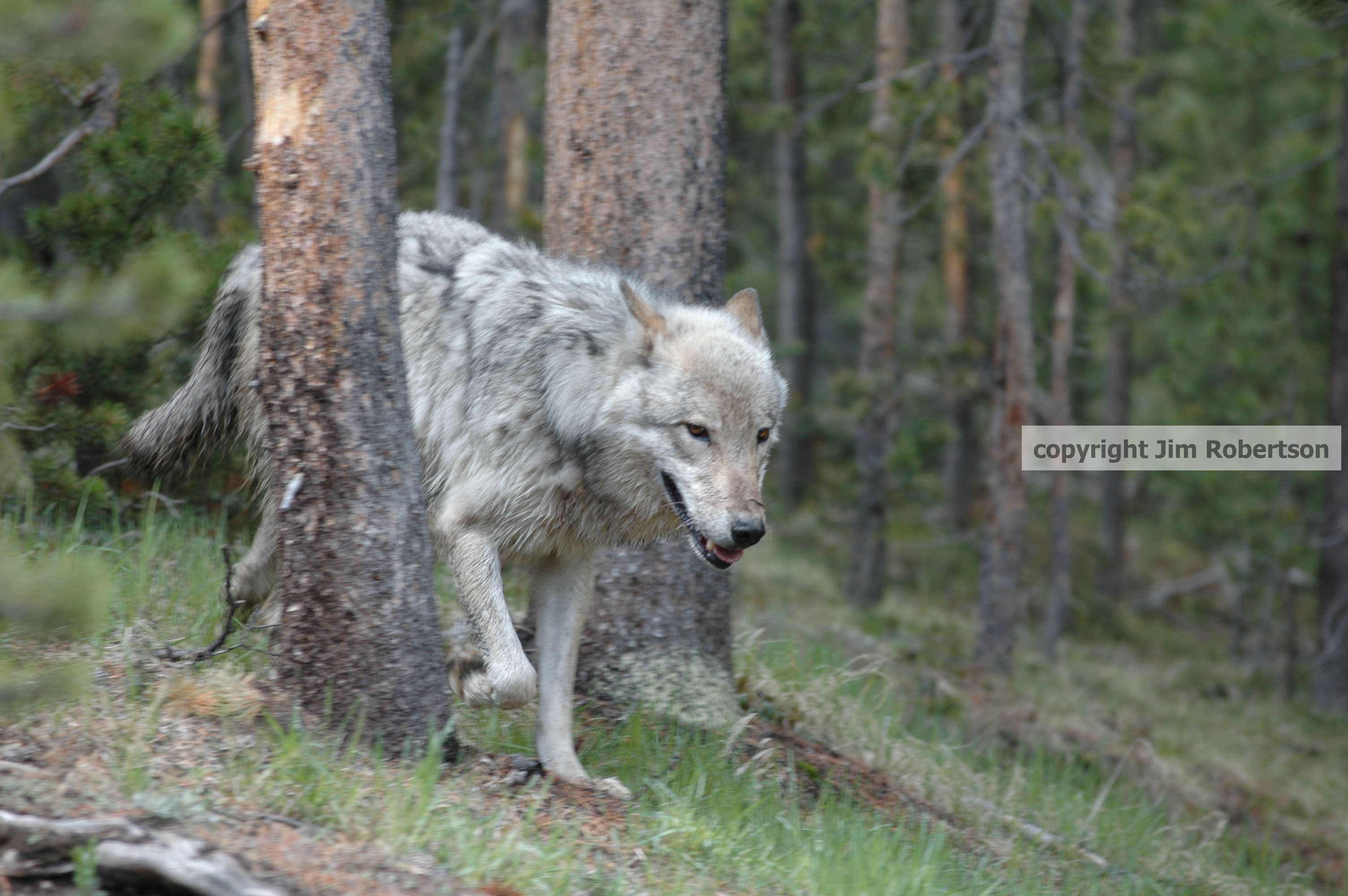
copyrighted Hayden wolf in lodgepoles

“It Puts The Lotion In The Basket”….

This must be a case of great minds thinking alike;) In July of 2012 I wrote a post called “The Serial Killers Named Buffalo Bill” https://exposingthebiggame.wordpress.com/2012/07/08/the-serial-killers-named-buffalo-bill/ which begins with the quote, “It puts the lotion in the basket…” and includes the lines: The fictitious “Bill” was modeled in part after the real-life serial killer, Ed Gein, who, like most sport hunters, made trophies and souvenirs from his victims’ bones and skin.

It seems whether their victims are human or non-human animals, objectification and depersonalization play major roles in the psyches of hunters and/or serial killers.

Nabeki's avatarHowling For Justice

buffalo bill tumblrBuffalo Bill/Silence of the Lambs

May 27, 2013

Yes, that’s the famous line uttered by the infamous serial killer, Buffalo Bill (Jame Gumm) in Silence of the Lambs.  What does he mean when he makes that statement? If you remember the movie, Gumm captures a woman he plans to kill for her skin and places her in a deep well in his house. He wants her to rub lotion on her body to make her skin softer,  so he lowers a basket containing skin lotion into the well and repeats the famous line, “It puts the lotion in the basket.” He uses the word IT when addressing her because he doesn’t see her as human, he sees her as an object, one he plans to exploit for his own sick pleasure.

He reminds me of trophy hunters who objectify their prey and see them as nothing more than targets…

View original post 1,670 more words

Graphic Video Shows True Nature of Hounders

dvoight09's avatarWisconsin Wildlife Ethic-Vote Our Wildlife

**UPDATE** May 31. 2013. The video is back up thanks to some wildlife advocates in other states. Please share this far and wide.

**UPDATE** May 28, 2013. The video has been pulled from YouTube. Apparently once these cowards take some heat over their sadism they remove their videos. I was able to obtain screenshots from the video, and have them on file. I also posted two more videos showing again what kind of monsters these hounder scum really are.

**WARNING** The following video is EXTREMELY graphic and depraved. 

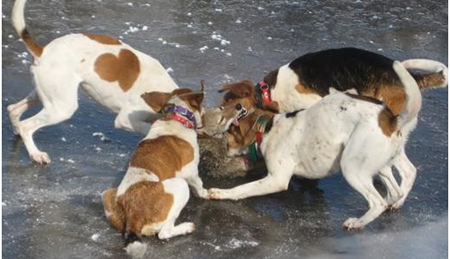
This video was forwarded to me today and I am sickened beyond belief. If you have the stomach for it this video illustrates what hounders are all about and what occurs throughout the year in Wisconsin and across the country. The disgusting cretins in this video not only allow their dogs to rip this coyote to shreds, but one of the sadists…

View original post 396 more words

Speak Out Against Coyote and Fox Penning in VA

Coyote photo copyright Jim Robertson

Coyote photo copyright Jim Robertson

From Project Coyote:

Penning, the practice of confining coyotes and foxes in fenced enclosures and allowing packs of dogs to chase and often maul them for “sport” and “entertainment”— with little opportunity for protection or escape— is a cruel and vicious practice that is prevalent in Virginia and several other states. Every year, thousands of wild canids are traded and sold to penning operations, both legally and illegally— after being trapped in the wild.

Aside from the suffering and inhumane treatment, penning also leads to the spread of diseases within and between domestic and wild canids. Tests reveal evidence of canine distemper and a variety of viral diseases, including canine parvovirus, canine coronavirus, canine herpesvirus, and canine parainfluenza virus, as well as over 20 species of parasites.

In 2012, the Virginia state legislature considered bills from the Senate and House of Delegates proposing to ban penning, but unfortunately the bills died in committee. Now the Virginia Department of Game and Inland Fisheries (VDGIF) is proposing to amend state regulations on penning.

However, the proposed regulations would not ban the practice outright, but merely establish standards that will allow much of the cruelty to continue. They can also be waived at the discretion of the VDGIF director, should they be deemed too “onerous” for a penning facility operator. Although the regulations would prohibit the use of coyotes in penning facilities, they do not offer the same protection to foxes, which can still be chased and torn apart by the dogs. Moreover, they do not mandate that operators obtain rabies vaccinations for dogs used in penning trials, thereby promoting the spread of disease.

What You Can Do:

Please contact VDGIF today and request that it ban penning outright. Note: Letters from outside of Virginia will be considered in the official record; however you MUST include personal contact information in your emails/letters or the VDGIF may discount your comments. Please submit your comments no later than May 31, 2013 by 5 p.m. EDT.

The channels for submitting written comments during the proposed regulation public comment period are:
• Online at http://www.dgif.virginia.gov
• Email regcomments@dgif.virginia.gov Be sure to include full personal identifying information
• Postal mail:
Virginia Department of Game and Inland Fisheries
Attn: Policy Analyst and Regulatory Coordinator
4010 West Broad Street
P.O. Box 11104, Richmond, VA 23230-1104
• Comment forms available at public input meetings
If you live in Virginia please consider attending and testifying at the next public meeting on the topic (individuals will have 3 min. to testify):

When: Thursday, June 13, at 9:00 a.m.
Where: 4000 West Broad Street in Richmond, VA
More info.: http://www.dgif.virginia.gov/meetings/

Suggested talking points:
• Capturing, transporting, marketing, and penning wild animals for dog training is inherently cruel, and should be banned for this reason alone. Pitting domestic canines against their wild cousins is ethically indefensible and parallels dog fighting- a practice now banned in the U.S. At least 3,600 foxes have died in pens in Virginia in the last three years alone. In many cases, the wild canids are mauled to death by the dogs.
• Penning facilities transmit diseases between wild canids and domestic animals, including rabies and parasites. Wild animals sold into these facilities are often transported from out of state without regulation or inspection.
• Virginia lacks the resources to enforce the proposed regulations. There are too few conservation officers to properly oversee that penning facilities follow the regulations.
• By allowing penning operators to waive out of minimal requirements, such as providing food and water to the foxes, the proposed regulation (4VAC15-290-160) effectively leaves penning operations unregulated.
• The Florida Fish and Game Commission banned coyote and fox banning statewide in 2010 because of ecological, ethical, and economic concerns; Virginia should do the same.
Thank you for taking action for our canine friends. Please share this action alert far and wide!

See Also: Coyote and Fox Penning: A Blood “Sport” That Must End, by Project Coyote’s Camilla Fox.

2010-06-22-coyotes