Federal agency investigates shootings of endangered Hawaiian hawks in Kailua-Kona
Reply

This article includes a good overview of the kind of anthropogenic threats that the wildlife face outside of Yellowstone National Park…
Worry over dead bison found north of Yellowstone Park
By Ralph Maughan On May 19, 2013
Montana is said to be investigating-
Gardiner, MT. Given the frequent stories of wildlife killing and hate that emanate from the Gardiner, Montana area, the latest find of 2 to 4 bison carcasses north of Yellowstone Park is raising worry about more illegal and legal wildlife killing in the area and/or the spread of domestic or wildlife disease.
The bison were found in areas frequented by people, not in any remote backcountry.
The area recently had an unpleasant incident of wolf killing following the placement of domestic sheep almost next to the Park that wildlife supporters said was deliberately done to cause controversy or provoke a wolf attack. Non-park wolves were soon credited with attacking the sheep.
For years the area has been scene of Yellowstone Park wildlife poaching, bison slaughters, heated controversy over elk numbers (too high or too low), Yellowstone Park wildlife migration routes, and what some see as excessive wolf hunting so as to decimate the population of Park wolves.
The winter just past also saw the first evidence of controversy over a growing Native American bison hunt that left a large number of bison entrails (8000 pounds) that would attract grizzly bears. They were cleaned up by Montana Fish, Wildlife and Parks.
The complete story on the recent find of bison carcasses is by Eve Byron of the Independent Record (here reproduced in the Missoulian).
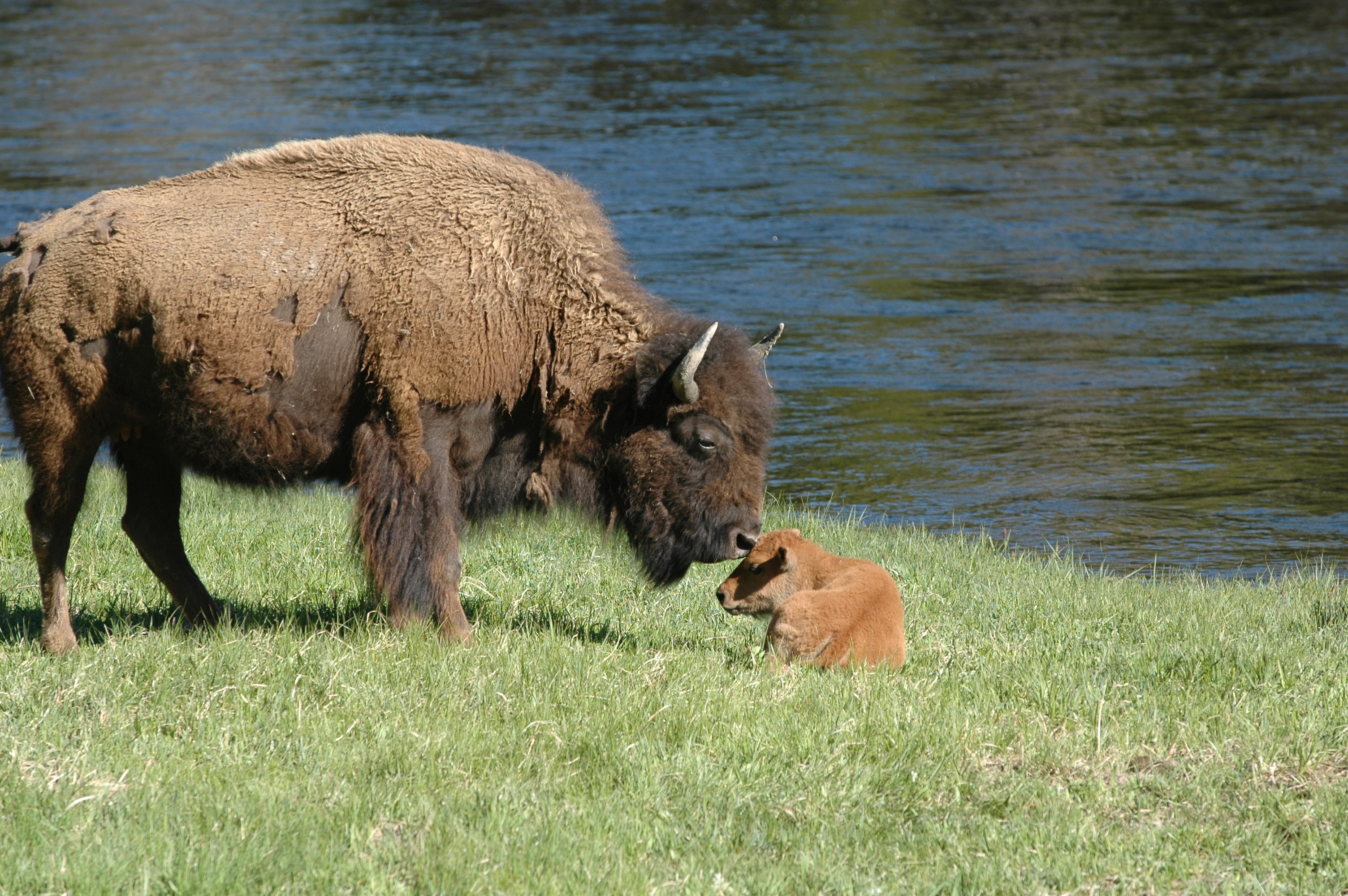
Wildlife Photography ©Jim Robertson, 2013. All Rights Reserved
The researchers conclude that the seals were probably exposed to H1N1 from ships dumping human waste in the seals natural range.
By now you’ve probably read, or heard on the news, something to the effect of “Texas teen ‘bags’ an 800-pound record alligator.” The Texas Parks and Wildlife Department say the alligator was between 30 and 50 years old. [That’s right, the animal was older and wiser than the young human who hooked and shot him.]
Typical of the media’s coverage of the atrocity is the following article from the Seattle Times:
A Houston-area high school senior has bagged a 14-foot, 800 pound alligator – the heaviest ever certified in Texas – on his first alligator hunt. [Great, he’s a trophy hunter for life now, no doubt.]
Texas Parks and Wildlife Department officials say 18-year-old Braxton Bielski bagged [“BAGGED”? Here the press are being about as disrespectful of the animal as the murderous kid] the record gator last week at Choke Canyon State Park, about 90 miles south of San Antonio.
The agency says in a statement that Braxton shot the giant reptile after hooking it on a line using raw chicken as bait. [They call it a “hunt” but the poor animal was hooked in the water like a fish, only later to be shot by the mighty human “hunter.”]
Bielski’s father, Troy Bielski, won a Parks and Wildlife drawing for a five-day permit to hunt in the Daughtry Wildlife Management Area. The Houston police officer says his son had been dreaming of hunting alligators for years. [Serial killers fantasize for years before murdering their victims too.]
I posted this article to my Facebook page yesterday; it received these fitting comments:
“For absolutely no significant purpose whatsoever. Sickening. This is what young people are taught through so many societal avenues – that no other living creature matters, except them and those like them. Not even other human beings. Humans are raising a whole bunch of Sociopaths and Psychopaths. Very Frightening.”
“Sick–go into its habitat–bait a hook–then shoot it from a boat when it comes up…”
“Wow, this is something to be proud of? There will probably never be an 800 lb alligator on this planet again, so good for this little asshole, he got the last one. I’m sure the killer of the last wolf, bear, cougar….will be just as proud of himself.”
Need I say more?
It’s not so surprising to hear about Syrian rebel leaders eating human hearts when this kind of treatment of other living things is taught to today’s youth.

Chickens burned alive in China because of the bird flu ”outburst”… Absolutely outrageous! Please, do something!
These horrors happen because of greedy humans breeding and using these animals for ”profit” and because of those who buy animal products. If everyone ate an animal-products-free diet, and didn’t use animals for any other purpose, none of these horrors would happen. Signing petitions can sometimes make a difference, yes. But if you really want this to stop, you must change your eating habits and your way of living — you must stop using animals for any purpose — and also help us raise awareness. Please, go vegan!
View original post 19 more words

Today, I had intended to write a post about the exploitative “reality” television shows that are all over television, but someone beat me to it. Yesterday, while at my health club, one of the channels showed the former “History” channel broadcasting a show called “Swamp People.” I couldn’t hear the dialog of the program but for a solid hour the show showed a collection of cretins impaling alligators with massive hooks and executing them with rifle shots. The killings were followed by showing camo hat types with dubious forms of dental hygiene acting like they were badasses for shooting these hooked animals execution style. This occurred over and over throughout the hour and I was astounded that people would consider these wildlife snuff films to be “entertainment.” Somehow television programs showing cretins executing alligators and other wildlife life have become popular entertainment in the United States. What does this say…
View original post 115 more words
From Wolfwatcher.org:
NWC Official Statement: Montana Wolf Hunt Proposal, 2013-14
May 13th, 2013
Montana officials estimated that at least 625 wolves, in 147 verified packs, and 37 breeding pairs inhabited the state at the end of 2012. During Montana’s 2012/2013 wolf season, hunters and trappers killed 128 wolves and trappers took 97 wolves for a total of 225. The actual numbers of wolves killed in the state, however, estimates more than 300 when factoring in wolves that were killed by depredation control (USDA’s Wildlife Services killed 108 wolves), vehicular accidents, disease and other natural causes.
Montana FWP Commission proposed its 2013-14 wolf hunting and trapping season. Comment period begins on Mon., May 13th and ends on June 24th at 5PM. Final decision will be made at a Commission meeting on July 10th in Helena.
•Submit via online submission – or – email: fwpcomm@mt.gov
•Submit via USPS mail at FWP – Wildlife Bureau, Attn: Public Comment, P.O. Box200701, Helena, MT 59620-0701
PROBLEMS:
1.Archery-only hunting would run from Sept. 7 through Sept. 14.
2.The hunting season is extended – the general hunting season (Sept. 15 and ending March 31, 2014); trapping season (Dec. 15 through Feb. 28, 2014)
3.The overall bag limit is 5 wolves per person in any combination of wolves taken by hunting or trapping, – an increase from 1 per person last year.
4.Wolf quotas would be maintained in areas near Montana’s two national parks, with a quota of 7 wolves in an expanded Wolf Management Unit 316 near Yellowstone National Park and a quota of 2 wolves in WMU 110 near Glacier National Park.
5.A new regulation would allow hunters to take a wolf over bait placed for trapping
BACKGROUND:
• As of Jan. 2013, Montana has 2.6 million head of cattle and 225,000 sheep. FWP Director Jeff Hagener said in a press release, “Confirmed livestock depredations due to wolves included 67 cattle, 37 sheep, one dog, two horses and one llama in 2012. Cattle losses in 2012 were the lowest recorded in the past six years.”
•In April 2012, MtFWP’s former Commissioner Ream stated, “The arrival of wolves in the West Fork added to the predatory pressure on the elk herds, but does not come close to the impact that mountain lions have. Statistics show that the elk population statewide is doing well with numbers at an all-time high of 112,000. He said the state management objective calls for 90,000 which means the state is about 22,000 elk over objective.” Ream suggests, considering a number of factors, that it was “a perfect storm“ that led to elk population reductions in Hunting district 250. Those factors include hunting, predation and weather and have all have tipped the balance in that area against the elk. He said the drop in the calf/cow ratio had hit a critical low, but did show some sign of recent recovery.
•In a May 1st article in the Independent Record, FWP Recommends Expanded Wolf Hunt Season and Bad Limit , George Pauley, FWP Wildlife Management Chief, said the reasons for the proposed changes in Montana’s 2013-14 wolf hunting season are twofold. “We’re just looking for opportunities to hunt wolves … and it’s an attempt to reduce the population,” Pauley said. “We’ve always had a philosophy of incrementally increasing harvest rates and opportunities.”
The National Wolfwatcher Coalition submitted its
NWC Official Public Comment re: Montana’s wolf hunting proposal for 2013-14.
We have already reached out to the Commission so that we can ensure the voices of all stakeholders are represented in its policy objectives. You are invited to review our statement and use it as a resource to guide the drafting of your own public comment via the directions above.
Questions or Comments? Contact us via email at : info@wolfwatcher.org
The first half of this post was excerpted from the chapter “Bears Show More Restraint than Ursiphobic Elmers” in my book, Exposing the Big Game: Living Targets of a Dying Sport…
An irrational fear of bears dates back to the earliest days of American history and is customarily accompanied by obtuse thinking and quirky spelling. The most famous inscription (carved into a tree, naturally) attributable to Daniel Boone (that guy who went around with a dead raccoon on his head) bragged how he “…cilled a bar…in the year 1760.” The bears Boone killed (and there were many) in North Carolina and Tennessee were black bears, a uniquely American species that, like coyotes, evolved on the Western Hemisphere.
Greatly fearing the grizzly bears they discovered on their voyage up the Missouri River to the Pacific, Lewis and Clark were among the first frontiersmen responsible for leading them down the path to near-extinction. In a May 5, 1805, entry in their journals, Lewis quilled of the “turrible” grizzly, “It was a most tremendous looking anamal and extreemly hard to kill.” Clark and another member of their party pumped the unarmed bear with ten shots of lead before he finally succumbed.
Between 50,000 and 100,000 grizzlies once inhabited the western continental US before incoming settlers shot, poisoned and trapped them out, quickly snatching up prime valley bottoms (the preferred habitat of grizzly bears) for themselves and their livestock. Thus driven into desolate high country, the rare grizzlies who hold on in the lower 48 are allowed only two percent of their historic domain. The current population of 500 is essentially marooned on islands of insufficient wilderness, cut off from one another by freeways, urban sprawl and a network of barbed wire fences that spell “keep out” to any grizzly who knows what’s good for ’em.
In the vein of fables handed down for generations, bear tales have been told, embellished upon, amplified and retold by sportsmen wanting to justify hounding, baiting and just plain killing. As Charlie Russell, author of Grizzly Heart: Living without Fear among the Brown Bears of Kamchatka, tells it:
“Hunting guides describe bears as ferocious, unpredictable and savage predators. They tell one horrifying story after another about people being torn apart. The victims are always those who approached the encounter poorly armed. Then the guides move on to recount countless acts of sportsman bravery: tales of real men stopping huge angry bears just short of the barrel of their guns. They keep it up until their clients are shaking in their boots, barely able to muster the courage to face the dreadful foe.”
Slowly but surely, hyperbolic bear tales are being replaced by the honest truth about bears and folks are waking up to the reality that bears aren’t really out to get them, as evidenced in this recent article from the Calgary Herald:
Overcoming fear of grizzlies key to survival of species, says author
Albertans need to stop being afraid of grizzly bears and learn to live with the animals to protect the threatened species in the province, says the former superintendent of Banff National Park.
Kevin Van Tighem, a fourth-generation Calgarian who worked with Parks Canada for three decades, said it’s time to reconsider how bears are managed in the province.
“If we really want bears to have a future, we need to manage them without fear,” he said in an interview with the Herald about his new book, Bears Without Fear. “We are primarily managing around a risk averse, keep-bears-scared-of-people paradigm.
“I don’t support bear hazing, I don’t support the Karelian bear dog program or the long-distance relocations.”
The strategies are all part of Alberta’s Grizzly Bear Recovery Plan 2008-2013, which was implemented after studies found there were fewer than 700 grizzly bears in the province — a number that led to their status as a threatened species.
All but one of the 15 grizzly bear deaths on provincial land (another two bears were hit and killed by a train in Banff National Park) in 2012 were caused by humans.
In addition, a total of 31 grizzly bears have been relocated by the province after threatening public safety, attacking livestock or damaging property — up from last year’s 24 “problem” bears.
Research shows relocation can triple the mortality of grizzly bears, which has raised concerns among conservationists.
Van Tighem said moving bears out of their habitat is part of the problem, pointing to the relocation of a mother grizzly bear and her three cubs out of Canmore last spring as an example.
“These were totally harmless bears,” he said. “They weren’t scared of people and because they weren’t scared of people, whenever they were surprised by a bicyclist or a dog walker, nothing bad happened. The mother would basically look and say, ‘Well, that’s people. They aren’t scary, so I don’t have to react in a scary way.’
As a result, he said the province took the best possible bears to live around and relocated them because they were worried about what could go wrong.
“We just can’t do that anymore,” said Van Tighem.

Text and Wildlife Photography ©Jim Robertson, 2013. All Rights Reserved

 Exposing the Big Game