
http://minnesota.publicradio.org/display/web/2013/08/22/environment/campaign-against-feeding-wolves?
by Dan Kraker, Minnesota Public Radio
BRIMSON, Minn. — “Don’t feed the wildlife!” is a message frequently trumpeted at campgrounds around Minnesota. It’s usually meant to warn people not to feed deer or bears.
But this summer wildlife managers are expanding that message to wolves.
In at least two locations in northeast Minnesota, people are feeding wolf pups — easy meals that could have very negative consequences.
At Hugo’s, the bar and general store that Gary Hepola runs with his wife in the tiny town of Brimson, about 40 miles north of Duluth, it doesn’t take long to see a wolf pup.
“You’ll notice they have no fear here,” said Hepola as he pulled his pickup out of the parking lot. “They’ll come right up to that window.”
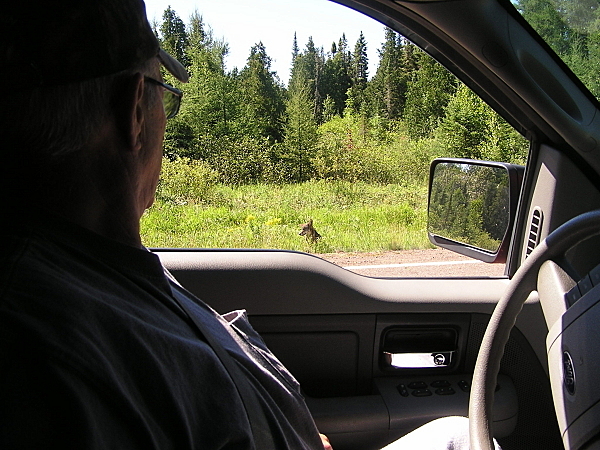
Sure enough, the young wolf, with pointy ears and splotches of gray, white and tan fur, ambles right up to Hepola’s open window. “What are you doing? Get off the road!”
Hepola said the wolves have grown steadily bolder over the past six weeks or so. He has seen people place piles of food on the side of the road to lure the wolves in close to snap pictures.
“I’ve chewed a few people out [and] said, ‘Don’t be feeding the wolves,'” he said. “People don’t realize they’re going to become adults. They’re cute now — not so cute when they’re big.”
Hepola fears that some of the pups might not even make it to adulthood. One of eight was killed by a car last week.
That number could grow, said Nancy Hansen, assistant area wildlife manager in Two Harbors for the Department of Natural Resources.
“They are at a very busy intersection,” Hansen said. “It’s going to get busier, with hunting season coming up, so I’m concerned.”
Hansen said the wolf pups are using a stretch of forest near the intersection of two county highways as a rendezvous site. The adults in the pack leave the pups to hunt and return with food.
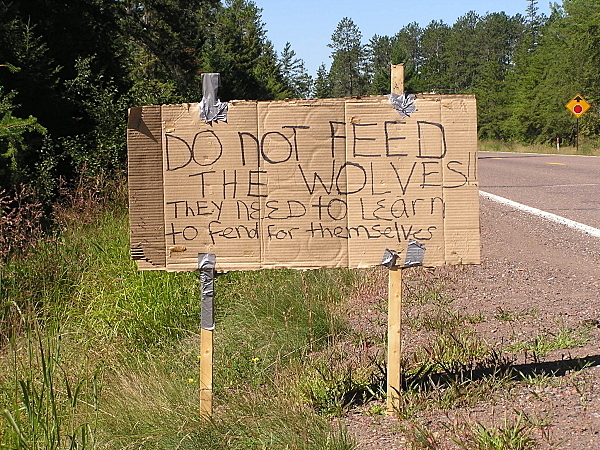
Wildlife experts say people sometimes see wolf pups alone, perhaps think they look thin, and assume they have been abandoned and need food. Hansen said the DNR is trying to educate the public otherwise.
“Basically, we really need people to police themselves,” she said. “As neat as it is to see these animals, this is not a normal situation, and anything they’re doing to get their picture taken with a wolf pup or feed a wolf pup, it’s not good for the pups.”
Hansen said officials cannot relocate the pups, because they would either die away from the pack or just return to the rendezvous point.
“If we can’t turn it around, we’ll probably have to capture the pups, they’ll either have to be moved to a facility, or destroyed,” she said.
Hansen said she has never seen a situation like the “Hugo’s wolves” as she refers to them. She said news of the wolves has spread like wildfire on Facebook, and more and more people are flocking to see them.
Jess Edberg, the information services director at the International Wolf Center in Ely, is dealing with a similar situation on the Echo Trail near the Boundary Waters Canoe Area.
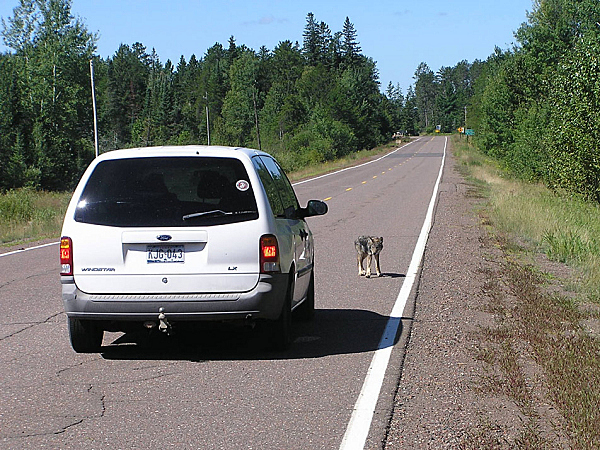
“The wolf pups were walking across the road, sitting on the road, watching vehicles go by, and somebody did see there was fresh food put out there the other day,” she said.
Edberg said every year or two she hears of emboldened wolves not fleeing from passing cars. In those situations, she said, it’s not enough to simply not feed them. She said even a passive observer can encourage wolves to frequent an area.
“We want to make sure that wildlife have a healthy fear avoidance of humans, so honking your horn or yelling, not encouraging the animal to be there is going to be helpful for the survival of that animal,” Edberg said.
At Hugo’s Bar in Brimson, owner Jody Hepola said the wolves have become something of a tourist attraction.
“The store’s been busy,” she said. “Lots of people come in to comment and get a snack while they’re out looking for the wolves, and lots of phone calls, asking, ‘Are they’re really wolves up there? What time of day, where can we see them?”
But Hepola said she would gladly give up the increased business. She wants the wolves to learn to fend for themselves.
 Exposing the Big Game
I hope they get the message to the public about the hazards of feeding wildlife (for the wildlife), and that the Department of Natural Resources is taking note about how many people want to see wolves ALIVE!
Right, that’s the message they should be taking from this–people like seeing LIVE wolves!
Although I agree that people should not be feeding them, I think it is ABSURD that some would be ‘destroyed’. There is most certainly a reserve of some sort that they can live their lives out in, happily as an alternative if they become too used to humans. Not only is the term ‘destroy’ a belittling term (you’re taking a LIFE away, you ARE killing someone) but there are just options around it. If we, humans, cause the problem where they become dependent on us… Then we, humans, should fix the problem we started. And NOT by killing them, but by sending them to a wolf reserve where they will be happily taken care of.
Here’s the message that should be getting to people; this was put out by the Wolf Army on Facebook. The Minnesota DNR has neglected to discuss the real truth about these cubs and it’s happening all over Northern Minnesota. It’s a travesty.
________________________________
Minnesota. Northern Minnesota.
Campaign against feeding of wildlife and in particular wolves.
There is nothing wrong with the idea of NOT feeding wildlife. In fact it is a good policy.
What’s wrong with this picture is that the wolf pups that have become a perceived problem near Brimson and at many other camp sites around Minnesota and for that matter Montana and Idaho, may well be hungry.
It is a direct result of the management policies of these states.
Many pups are starving simply because the elders in the packs are dead as a result of the ‘ungulate inspired management methods’ of the wildlife departments of the wolf states. Elders are simply taken out of packs, resulting in abandoned adolescents and pups. These pups will venture to roads, picnic spots and garbage dumps in search of food. Many will starve and some will take easy prey like sheep and pets.
Wolves are simply not ungulates and should not be managed by the culling of numbers as it has a grave impact on their social structure. Wolves are not natural hunters per se although they are born with the physical ability to hunt they have to be taught by older experienced wolves how to hunt effectively. Wolves also manage their own numbers as they had been doing in Minnesota for years. With that state’s new management policies that may well now be something of the past. It will take many generations for these packs to stabilize into normal social behavior. That is only possible if the ad hoc killing management is stopped immediately.
Good, point, Chris! But these pups have already imprinted on humans, they may possibly have some dog genes, too? People should take note that it only takes about three generations for wolves to become house pets IF they have docile genes. If you start to see coat variations unlike wolves, more like dogs, it can be either wolfdog genes or a mutation has taken place due to several generations of docile genes wolves breeding? Generally, this doesn’t happen in the wild, as usually only the alpha pair breeds. But since hunting wolves started, I know for fact that hunters most prize the breeding alpha pair because they wrongly think less wolves, more deer. By taking the alphas out, the more docile betas are only left to mate. Add to that, the family has lost it’s knowledgable leadership so the young, inexperienced wolves, without proper survival skills, are left begging for food from people, just as theywould from alphas. That is learned behavior, just as Jim pointed out, which generationally compounds.
Clearly, these fearless of humans pups will die in the wild and probably their parents, too? The pups need to be captured and will survive well in a wolf sanctuary. Their parents, with them, if possible?
People are going to feed them, it can’t be stopped. If someone is of the mind to do that, please do not just throw food out the car window! That cute pup you feed today could be tomorrow’s road kill! Go deep in the woods, near water, and throw the dog food bag out there. Leave a game camera and you will get your wolf puppie shots… or raccoons, skunks, etc! 🙂 without actually exposing the wolves directly to humans.
I am guilty of feeding critters. I’ve had unintentual bear encounters…so don’t drop your guard, or your drawers around any bear food! I only feed the wildlife when I clean out my fridge and it goes way in the woods, scattered all around. Wolves like fresh berries, eggs and most things dogs like. Please don’t feed animals along the roadside, they will die.
Pingback: Sleeping teen is bitten by wolf near Lake Winnibigoshish | Exposing the Big Game