
In an earlier post entitled, “Nothing to Be Proud Of,” I hinted at the regrettable fact that I used to fish. I promised that details would be forthcoming, but I realize now that this subject is worthy of a series of posts, starting with…
I’ve always been an “animal” person. The household dog, Jake—a German shepherd malamute mix—was my best friend and constant companion. He was my canine connection with the wolf, which I considered my “totem” animal.
But I wasn’t a one note wildlife advocate; I cared about all the animals of the land, sky and sea. Yet I subscribed to the all too common misconception that human beings had to eat meat. The food pyramid of the era in which I grew up (the 1960s and ‘70s) was as old as the mummified pharos and as outdated as the antiquated Egyptian practices of slavery and human sacrifice.
I was a self-taught naturalist and bird watcher, but I never aspired to be a nutritionist. I thought vegetarianism was a practice followed mostly by Eastern mystics, yogis, Hari Krishnas and the occasional hippie. And I was similarly ignorant about the intelligence of fish. Accepted “science” of the time held fish well below the surface of air-breathing, and therefore “aware,” animals. (Even today, grocery stores advertise “meat and fish,” as if fish flesh is somehow different from the flesh of we mammals.)
At the risk of sounding like an editor from Field and Stream, some of my fondest memories of my father centered around fishing at our family cabin. I was put off by power boating, but instead enjoyed taking the row boat out at first light while the lake was calm as glass and fish were jumping at the surface. As the morning fog lifted, motor boats would invariably break the calm, dragging water skiers around and around, while the fish would dive for cover.
Of course I could have left my fishing gear behind and just enjoyed rowing the boat across the lake, but at the time I went along with accepted thought and considered fish as “food,” perhaps even a more natural and environmentally sound choice than farm animals (I hadn’t even heard the term “factory farmed” yet).
I know now, after witnessing fish swim off trailing hook, line and sinker or flapping in piles on the decks of commercial gill net boats, that fishing is in no way a sound practice. Contrary to archaic, and perhaps wishful thinking on the part of fishermen, fish are part of the animal kingdom and share the same basic responses to pain as birds and mammals.
According to an article in Veganism and Nonviolence, by Gentle World: From salmon making the long journey from river to ocean and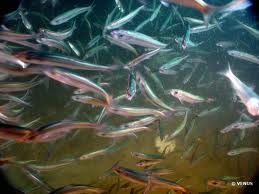 back, to goldfish swimming circles around a small pond, the inner lives of fishes are a mystery that scientists are only beginning to unravel. One of the key elements they are searching for is the extent to which each fish is sentient or, more specifically, how they process what we would call a “painful” sensation (such as a hook cutting into their lip.)
On this journey, scientists have discovered that fish have nerve structures that are anatomically very similar to those of humans and many other species of animals. Among these common structures are receptor cells called nociceptors, which are found throughout animals’ bodies and are activated by stimuli expected to cause damage to bodily tissues. Tellingly, some species of fish have upwards of 58 different nociceptors located in their lips alone*.
As in human anatomy, these nociceptors are wired by nerve fibers to the central nervous system (the spinal cord and brain.) When the pain centers in the brain are activated by signals from the nociceptors, they trigger the body to respond to the potentially harmful or life threatening events that may be happening.
Fish anatomy is so complex that they have even evolved the same “pain-blocking” substances (endorphins) as humans.** It is theorized that endorphins help animals to tolerate pain from severe injuries in order to help them escape from a predator. This leaves us with the question: Why would fish have endorphins in their bodies if they couldn’t feel pain? And why is there still a debate over their sentience?
 Exposing the Big Game
glad you’ve chosen to make it a series of posts. gentle world is a great resource.
I just stumbled on to them by accident which searching fish; glad I did!
So true, thanks! And, as our oceans are increasingly poisoned by radiation, plastics, sewage and other discarded waste & trash from Homo sapiens, these wonderful non-humans will suffer and die, too, as our species goes down the tubes. Those humans who continue to eat them, will ingest these toxins, so there is some justice to this insanity.
It certainly isn’t instant Karma though