
Missoula Independent
News/Opinion November 14, 2013
Pack Pride by Marybeth Holleman
The U.S. Fish and Wildlife Service’s decision to delist gray wolves nationwide is flawed because it’s based on the total number of wolves, a statistical approach that, according to wolf biologist Gordon Haber, is “ecological nonsense.”
Haber spent over 43 years observing Alaska’s wild wolves, mostly in Denali National Park, before dying in a plane crash while tracking wolves. To locate wolves, he snowshoed, skied and flew in winter; he backpacked and hiked in summer. He endured temperatures 50 below zero, blizzards, thunderstorms, mosquitoes, and the risk of grizzly and moose attacks. Few modern biologists have such unassailable experiential authority.
Haber’s take-home message was this: You can’t manage wolves by the numbers. You can’t count the number of wolves in an area and decide whether it’s a “healthy” population, because what really counts is the family group, or pack, as some still call it.
“Wolves are perhaps the most social of all nonhuman vertebrates,” wrote Haber. “A ‘pack’ of wolves is not a snarling aggregation of fighting beasts, each bent on 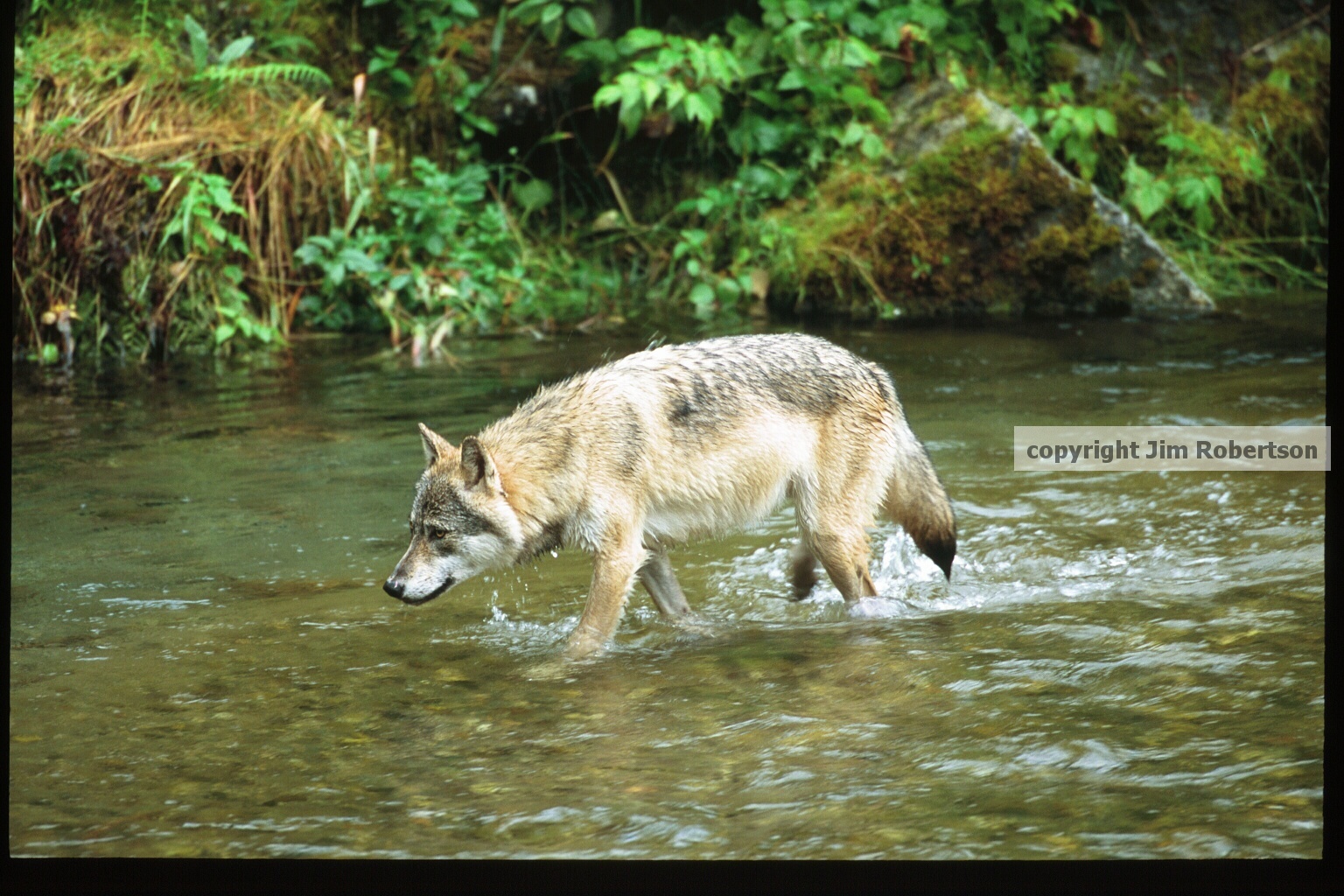 fending only for itself, but a highly organized, well-disciplined group of related individuals or family units, all working together in a remarkably amiable, efficient manner.”
Haber devoted his career to studying intact family groups, especially the Toklat wolves of Alaska. First made famous by Adolph Murie’s 1944 The Wolves of Mount McKinley, the Toklats rank with Jane Goodall’s chimpanzees as the two longest-studied mammal social groups in the wild.
Wolves go to great lengths to stay with family; when important members are lost, families can disintegrate and remaining individuals often die. Haber knew this firsthand after an alpha female wolf, who, after her mate was killed in a botched government darting study, died of starvation, alone. Relocated wolves travel hundreds of miles to return home. And the first wolf seen in California in 90 years, OR7, has never stopped moving: He’s searching for a mate, for family.
Left unexploited (that is, not killed) by humans, wolves develop societies that are astonishingly complex and beautifully tuned to their precise environment. Once, Haber observed the Toklat wolves moving their den because heavy winter snow had decimated the moose population; a week before pupping, the wolves shifted to another den closer to caribou. He also recorded unique hunting methods, among them moose hunting by the Savage River family that he called “storm-and-circle.”
Family groups develop unique and highly cooperative pup-rearing and hunting techniques that amount to cultural traditions, though these take generations to mature and can be lost forever if the family disintegrates. After the entire Savage River family was shot illegally in the winter of 1982-’83, Haber never saw the storm-and-circle technique again.
A healthy wolf population is more than x number of wolves inhabiting y square miles of territory. The notion that we can “harvest” a fixed percentage of a wolf population corresponding to natural mortality rates and still maintain a viable population misses the point. According to Haber, it’s not how many wolves you kill, it’s which wolves you kill.
Natural losses typically take younger wolves, whereas hunting and trapping take the older and more experienced wolves. These older wolves are essential because they know the territory, prey movements, hunting techniques, denning sites, pup rearing—and because they are the breeders. Haber observed this many times: Whenever an alpha wolf was shot or trapped, it set off a cascade of events that left most of the family dead and the rest scattered, rag-tag orphans.
It happened again in April 2012. A trapper dumped his horse’s carcass along the Denali National Park boundary, surrounded it with snares, and killed the pregnant alpha female of the most-viewed wolf group in Denali. With her death, the family group had no pups, and it disintegrated, shrinking from 15 to three wolves. That summer, for hundreds of thousands of park visitors, wolf-viewing success dropped by 70 percent.
This is not unique to Alaska. In 2009, Yellowstone National Park’s Cottonwood group disappeared after losing four wolves to hunting, including both alphas. In 2013, the park’s Lamar Canyon family group splintered when the alpha female—nicknamed “rock star”was shot.
So it’s never about numbers. It’s about family. A wolf is a wolf when it’s part of an intact, unexploited family group. Wolves are no longer endangered when these groups have permanent protection, and when we manage according to this essential functional unit. If we leave wolves alone, we’ll be the ones to benefit.
The government has extended the comment period for delisting gray wolves from Endangered Species Act protection to Dec. 17, 2013. Go to regulations.gov and click on Gray wolf: Docket N. (FWS-HQ-ES-2013-0073).
________________________________________
Marybeth Holleman is a contributor to Writers on the Range, a service of High Country News (hcn.org). With Gordon Haber, she is the author of Among Wolves: Gordon Haber’s Insights into Alaska’s Most Misunderstood Animal. She also runs the blog Art and Nature (artandnatureand.blogspot.com) and lives in Anchorage, Alaska.
 Exposing the Big Game
Looks like a pretty good article, in that wolves know what to do, without human interference. The recent capture of an Arizona Mexican Wolf (Alpha Male) to New Mexico, because of “failed non-lethal control methods” is another example of FWS’s total disregard for this species. And again, it points to the presence of the destructive livestock industry and its general hatred for this species.
It makes a good point that killing a wolf is really killing an entire family.
Wolf Myths: The wolf numbers have to be driven down
Wolf slaughter is very American and very Canadian and very European. We, Americans, brought with us from the old worlds hysteria about wolves and posted the first bounty around 1630. Wolf massacre has continued since and is obviously still going on, especially in the wolf massacre states of Montana, Wyoming, Idaho and Wisconsin.
State and federal wildlife agencies from the beginning to the present have sided with hunters and ranchers and bought into the lies, myths and folklore reasons (stock predation and ungulate predation) for marginalizing or wiping out the wolf and other predator populations. It is like the concept of ecology is beyond them, that wolves and the other predators are good for wilderness ecology but not man, and that it would be better for all if we had a prevalent concept and practice of living with the predators instead of against them. But no, the wildlife agencies think they have to drive down the wolf numbers (not true, not proven) for the hunters and ranchers so that the hunters can engage in more sports killing (recreational opportunities), and the exaggerated lie of stock predation can be validated.
References:
https://exposingthebiggame.wordpress.com/2013/10/31/sorry-but-wolf-slaughter-is-not-american-by-james-william-gibson/
“The Hidden Lives of Wolves”
“The Wolf Almanac”
Wolf myths, lies folklore:
Anytime I bring up the subject of wolves to anti-wolf minds I run up against one or more of the following myths, lies, folklore:
-Wolves are killing herds of cattle. No wolves kill about 0.002 % of cattle in MT, 67 of 2.6 million in 2012. Many ranchers of cattle and sheep are encroaching on wolf and in general wilderness with 772 permits to graze in national forests in MT alone.
-Wolves have to be managed, killed in large numbers, their populations driven down to marginal existence or they will rampage over the landscape, and be everywhere. No, wolves will fill up wilderness niches in some of their old territory, across the states then regulate their own populations relative to game and wilderness availability.
-Wolves are dangerous. Wolves are scary. They attack people. No, there are only two documented cases in North America in history, in the last 100 years, weakly substantiated. One was in Alaska and one in Saskatchewan. The rest is old world folklore.
-Wolves are decimating or wiping out elk herds. Elk numbers are up in the states wherein there are wolves or not. Elk numbers in MT have gone from 89,000 before wolf reintroduction to 141,000 now.
-Wolves are wiping out the Yellowstone elk herds. No, there are not and never have been enough wolves in YNP to wipe out or significantly affect the herds. At most, they may have a 5% impact, which has been good for the herds and the ecological system, flora and fauna. Before wolves (1995) elk numbers in and around YNP were at an all time unsustainable high. Then there were two rough winters in a row (1995-1996, 1996-1997) followed by drought years. Even though elk numbers were declining, FWP MT allowed hunting, spring and fall, outside the Park for years. Man is the main culprit, plus maybe forage, weather, and a current generally rich predator environment of bear, lions, and wolves. Man (sportsmen), sports killing impact is additive. Predator-prey relationships are natural, millennium old, and healthy. Sports’ killing of animals is not healthy for man or the animals they kill. Wolves are healthy for the elk herds and else as they are apex animals who belong there, making the herds healthier and having a positive trophic cascading effect on flora and fauna (plant and animal). Wolves tend to kill the weak, diseased, vulnerable and to move the herds. Man, sportsmen, go for the trophy animals a lot weakening the bloodlines of the herds. It is man that needs to be managed, not wolves, bears on lions. Man is the disease on wildlife, flora and fauna.
These same minds do not accept that wolves belong in a healthy ecological wilderness and could care less. They also do not buy the argument that wolves bring in $35.5 million in added tourism to YNP making each wolf worth over $400,000.00 (based on population estimate of 80).
Wolf haters (ranchers, sportsmen, yokels) discount any argument they hear for wolves, pro-wolf facts and science, the logic of ecology, the boon to tourism, get angry, shut their minds, walk away. And/or they could care less about anything beyond their own noses.
Then there is the media. Is there any investigative reporting anymore? The media repeats the myth, lies, folklore of the anti-wolf minds giving them some credibility.
As a result of the myths, lies, folklore mindsets, repetitions, and general ignorance, the public also repeats the myths, lies and folklore. Conservationists are not going to have any or much impact on the rigid and reactive mindsets, so they must not only continue to counter the ignorance with valid information, but also appeal to a larger audience and find wolf friendly legislators at the state and federal levels. Also, the dollar appeal of wildlife viewing, by far more profitable than wildlife killing, needs to get out there. All of this must come out over and over.
Great article. It tears me up to think of the decimation of these family units so in tune to their environment. Not that I find this news or surprising. Glad it is getting out there in such an informative way. Thanks.