What Would Happen to All the Animals if Everyone Went Vegan?

Dr. Will Tuttle: Educator & Author
November 20, 2013

OneGreenPlanet

Those of us eating a plant-based diet often find our food choices causing more questions and consternation during the upcoming weeks than during the rest of the year. One of the perennial concerns I’ve found people have is that if everyone went vegan, what would happen to all the animals—chickens, turkeys, pigs, and cows? If we stopped eating them, wouldn’t they just take over the Earth, threatening our survival?

For years this question irked me because it seemed patently ridiculous, and worse, would be used to justify the cruelty of eating animal foods. Now, though, whenever I hear this question, I see it as an opportunity to deliver a brief meditation on how our world can be healed.

Imagining the world gradually going vegan is imagining the most positive possible future for our species, for the Earth, and for all living beings. First of all, as we reduce the number of animals we are eating, that will send a message to agribusiness to forcefully inseminate fewer female pigs, turkeys, cows, fishes, and other animals, so fewer animals will be imprisoned, and there will be less mutilation, killing, violence, terror, and suffering. It also means there will be lower demand for GMO corn, soy, alfalfa and other feed grains, and thus less deforestation, monocropping, and pollution. As this continues, there will be more food to feed starving people, and also monocropped land can be returned to being critically-needed habitat for wildlife, whose populations are being decimated by the habitat loss caused by grazing livestock and growing feed grains.

As the vegan trend continues, streams will come back and run cleaner. More birds, fish, and other animals will be able to thrive, there will be far less toxic pesticides and fertilizers needed, and the oceans, which we are devastating, will begin to heal. As studies continually demonstrate, livestock production is the main driving force behind global warming, and this also will decrease. In addition, by eating less animal-based foods, people will be healthier physically as they eliminate the toxic fat, cholesterol, and animal protein that drive obesity, diabetes, arthritis, cancer, kidney disease, heart disease, and drug use. People will become healthier emotionally and spiritually, also, as they cause and eat less misery, and our culture, as its level of violence decreases, will become healthier as well.

As forest, rainforest, and prairie communities come back to life, along with riparian and ocean communities, the devastating mass extinction of species that is going on right now will slow down. To raise and slaughter hundreds of millions animals daily for food on this planet, we are forcing hundreds of species of animals and plants into extinction every week. Because of our appetites for a few species of birds, mammals, and fish, we are destroying the Earth’s genetic diversity, and it seems absurd to be unconcerned about these tens of thousands of species, but to care only about the few that we’re eating. In any event, the animals we imprison today for food lived freely in nature for millions of years and could do so again. The animals that we most intensely enslave for food and products, such as turkeys, ducks, geese, chickens, and fish, are all doing just fine in the wild (aside from being hunted and having their habitat destroyed). They would continue to do so, and this is also true for pigs, sheep, and goats, which even today have substantial wild populations. There is no reason to think that the animals we are eating and using wouldn’t be able to return to their natural lives living freely in nature—they already are!

Cows are the only possible question—their progenitors, the aurochs, were forced into extinction in the 1600s, but it is certainly conceivable that cows could be reintroduced into central Asia and Africa where they lived for millions of years, and with time would return to the ecological niche they inhabited before cruel human enslavement tore them from their ancestral homelands.

So, it’s a refreshing question to ponder. It’s remarkably uplifting and heartening to reflect on “what will happen if we all stop eating meat, dairy products, and eggs?” Contemplating this, we see clearly that there’s nothing stopping us from creating a heaven on this beautiful and abundant Earth – nothing except the culturally mandated, deeply-ingrained, and deluded habits of routinely abusing animals for food. Each one of us can question this, and I hope the next time you hear this question, you’ll welcome it enthusiastically!

We can all discuss this question a few times during the holidays, and by doing so, pull back the curtain to reveal the positive future we can create together. There is no action more powerful anyone can take to subvert the dominant paradigm of exploitation and inequality than to shift to a plant-based diet for ethical reasons. By going vegan, and spreading the vegan message creatively, we take the most effective action to create a world where peace, abundance, sustainability, freedom, and universal joy are not just possible but natural.
524958_3325028303604_654533903_n

Understanding the Great Divide

http://boldvisions.businesscatalyst.com/opinion.html

Stephen Capra

Another week has passed and we have lost more wolves. Not really a surprise, but we also lost a beloved malamute while its owner was hiking. Shots were fired, screams persisted and a beautiful dog lay dead with seven bullets penetrating his body. This is becoming the mantra from Montana on a daily basis. When walking a family canine, a dog must always wear blaze orange and the master must say his prayer of protection when on a trail. The killing of wolves has become a sickness for the depraved and wicked.

This past week in Albuquerque we had a hearing on the Mexican wolf, with ideas the Fish and Wildlife Service has about expanding their range, what the count will be when they are deemed no longer endangered and perhaps easing the means of killing for ranchers. Perhaps 300-400 people showed up for the hearing in a large meeting room at the Comfort Inn. Clearly the pro wolf people held the majority, but there remained plenty of ranchers and county commissioners and other wolf haters who spoke out with rage about the wolf.

Several things struck my mind as they talked. First, why do ranchers not understand it’s rude to leave your hat on at such hearings? It is clearly designed to show their personal arrogance and sense of control. Yet, to me it just shows ignorance. Then there is this obsession with the constitution. Since when did the people that robbed, killed and destroyed our public lands have such a deep feeling about the constitution? The answer is only when it seems politically viable to their own good. Not for any other more altruistic goal.

Then it was time for the fear game rhetoric-Our children……Their safety……We are losing our entire herds…..We are being wiped out…….Poor me……….

It was the usual regurgitation of lies and their dream of an antiquarianism way of life, circa 1870.

What makes this issue so frustrating and demoralizing are the people- the killers, who seem to glee in the chance to steal life. This is the group I characterize as the “angry mob.” They are collectively the people that best define Obama haters, anti-tax loathers, people, who feel that issues like Gay marriage, Climate Change, Health Care are things that liberals like the President have brought to their doorstep and they must fight back, with pride and furry. They do this by collecting an arsenal of weapons, ammo, scopes, night vision equipment. They speak in chat rooms and share their rage against this new America.

They seek in their twisted way a chance to have power and control. The victim of this demented mind-set is wolves. Wolves represent freedom and the power of true spirit. Wildness is at their core, but also love and a sense of family. Yet, for those who feel they have lost control, this animal and its demise makes them feel a sense of power, a place of control, the means to settle their rage. To allow themselves a sense of freedom and spirit, they must kill and steal it from the very symbol of that, which they seek. It also allows them to show their disdain for conservation. Ignorance it seems is truly bliss.

However, there is another aspect to this fight which is often overlooked and it stems from the conservation side. First, as we have said many times, groups like Defenders of Wildlife, tried to find common ground with ranchers from the start. In fact, even when it was clear it was not working, they simply kept doubling down on a flawed strategy. But some of their rational for this stems from the reality of dealing with foundations.

Foundations in America today define how we work in Conservation. They are the funding, which is the lifeblood of any campaign and any organization. Foundations like much of America tend to be more conservative in how they give. By this I mean they do not tend to like direct conflict or issues that cannot fit into a nice collective ending. Therein lies the problem with wolves. This is a fight that is not likely to have a happy, feel good ending; one side will lose. Right now unless we as a community say, we refuse to lose and we will not compromise any longer, all will be lost. But the pressure on many conservation groups is to find a road to compromise. That in turn has led to hunting seasons and other such destructive outcomes.

The opposition has rallied under one voice, which is to say no to all wolf recovery; to push as hard as possible to fight expanded ranges, to create longer hunting seasons, and to say repeatedly that our children and the livestock industry are threatened! The conservation community by contrast seems to have twenty positions and no clear unified strategy. Instead, wolf recovery has turned into an endless fund-raising opportunity, with little success to speak of.

Bold Visions Conservation stands by its 10-point wolf recovery proposal. It is designed to rally support from urban areas to dwarf that which comes from the rural hot spots. It means changing our rhetoric and understanding we are truly in a war, not just to save wolves, but a war of culture which will define the future of the West.

During the hearing a rancher from eastern Washington got up to thank Fish and Wildlife for not creating a sub-species category for wolves in eastern Washington, meaning they can be killed. My first thought was why was he here in Albuquerque? The answer, I believe, is that the ranching community is sharing strategy, working in a unified manner to take what has worked in Montana and bring it to New Mexico, Colorado or any place that could harbor wolves. They are funded to fight and fight they will.

There comes a time in conservation, as David Brower clearly understood, when you fight for what you believe, and when you do so, people respect you. In order to protect and expand wolf recovery we cannot be cute, or speak in only scientific jargon, rather we must get in the trenches and fight, this is a battle we can surely win, it’s for the heart and soul  of the America we want to be a part of and the future of our western heritage.

Wolves define the freedom and spirit that is the West of my soul. Join us in the trenches. Victory is ours, when we cross that great divide, united.

“I am he and you are me, and we are all together.”

 -John Lennon and Paul McCartney

Ohio expands hours of youth deer-hunting season

[There are only around 8,000 wolves in the entire lower continental U.S., yet last year, young hunters checked nearly 9,200 white-tailed deer during the two-day season. How long, will it take a hunters and trappers to eliminate all the wolves?]
http://www.wkyc.com/story/sports/outdoors/2013/11/23/ohio-expands-hours-of-youth-deer-hunting-season/3685739/
The Associated Press

COLUMBUS — Ohio is slightly extending the hours during which young hunters

Wildlife Photography ©Jim Robertson

Wildlife Photography ©Jim Robertson

can take white-tailed deer during the two-day season this weekend.

The Ohio Department of Natural Resources says youngsters can hunt deer from 30 minutes before sunrise to 30 minutes after sunset on Saturday and Sunday. The hunters must have a hunting license and a deer permit. They’re required to wear hunter orange and be with an adult who isn’t hunting.

Last year, young hunters checked nearly 9,200 white-tailed deer during the two-day season.

Tea Party Bill Would Eviscerate Endangered Species Act

http://www.biologicaldiversity.org/news/press_releases/2013/endangered-species-act-11-22-2013.html

For Immediate Release, November 22, 2013

Contact: Brett  Hartl, (202) 817-8121

Tea Party Bill Would Eviscerate  Endangered Species Act

As America  Celebrates 40th Anniversary of Landmark Law, Right-wing Senators  Seek to Tear It Apart

              WASHINGTON— Tea Party senators introduced a  bill this week that would effectively end the protection of most endangered  species in the United States and gut some of the most important provisions of  the Endangered Species Act. Senate Bill 1731, introduced by Tea Party Sens.  Rand Paul, Mike Lee and Dean Heller, would end protections for most of the  species that are currently protected by the Act and make it virtually  impossible to protect new species under the law. It would also eliminate protection  for habitat that’s critical to the survival of rare and struggling animals and  plants around the country.

“Here we are celebrating the 40th  anniversary of the Endangered Species Act this year, and the Tea Party wants to  tear it limb from limb,” said Brett Hartl, endangered species policy director  at the Center for Biological Diversity. “It’s really a sad testament to how out  of touch the Tea Party has become with the American people, and how beholden  they are to industry special interests that are more interested in profits than  saving wildlife, wild places and a livable future for the next generation.”

In its 40-year history, the Endangered  Species Act has been more than 99 percent successful at preventing extinction  for wildlife under its protection and has put hundreds of plants and animals on  the path to recovery, including bald eagles, grizzly bears, whales and sea  turtles.

Despite this successful track record, the bill’s  most extreme provision would require that every five years all protected species be removed from the list of threatened and  endangered species, eliminating all legal protections. No matter how close to extinction they might be, every  listed species would then have to wait until Congress passed a joint resolution  renewing their protections under the Act for another five years. Five years  later, this process would start over again, eliminating all protections until  Congress passed another joint resolution.

“The strength of the Endangered Species Act  — in fact all of our nation’s environmental laws — comes from the requirement  that science, not politics, guide the protection of our wildlife, air and  water,” said Hartl. “This bill would allow extreme ideologues in Congress to  veto environmental protections for any protected species they wanted, just so  they could appease their special-interest benefactors.”

The bill would eliminate all protections for  the critical habitat of endangered species and allow state governments to  effectively veto any conservation measures designed to protect an imperiled  species within their respective state. Meanwhile federal wildlife agencies  would need to complete onerous accounting reports to estimate the costs of  protecting endangered species rather than completing tangible, on-the-ground  conservation activities to protect species and the places they live.

“This bill would devastate species  protections and open the door to log, mine and pave some of the last places on  Earth where these animals survive,” Hartl said. “It’s a boon for profiteers  like the Koch Brothers but will rob every American who values wildlife and wild  places.”

The Center for Biological Diversity is a  national, nonprofit conservation organization with more than 625,000  members and online activists dedicated to the protection of endangered species  and wild places.

It’s All the Same To the Victim

Lately we’ve been hearing from a lot of holier-than-thou types quick to make a distinction between sport and subsistence hunters. Truth is, there’s not all that much difference between the two. Sport hunters and pseudo-subsistence hunters are often such close kin they’re practically kissin’ cousins. I know a lot of hunters, but I’ve never met one who didn’t boast about “using the meat.” By the same token, I’ve never met anyone who openly admitted to being just a sport hunter.

There are a lot of needy poor folk out there these day, including myself, but I don’t know anyone who really needs to kill animals to survive. Like sport hunters, subsistence hunters do what they do because they want to, they enjoy the “lifestyle.” If one thing differentiates the two, it’s that meat hunters have an even stronger sense of entitlement.

But, everyone has a right to feed themselves and their family, don’t they? Well, does everyone—all 7 billion humans and counting—have the right to subsist off the backs of other animals when there are more humane and sustainable ways to feed ourselves? How many self-proclaimed “subsistence” hunters are willing to give up all their modern conveniences—their warm house, their car, their cable TV or their ever-present and attendant “reality” film crew—and live completely off the land like a Neanderthal? Not many I’m sure—at least not indefinitely.

It’s unclear what makes some folks believe they have the right to exploit wildlife as an easy source of protein, but animal flesh is by no means the safest or healthiest way for humans to get it. While a steady diet of decaying meat slowly rots your system, millions of vibrant people have found a satisfying and healthy way to eat that doesn’t involve preying on others.

Text and Wildlife Photography ©Jim Robertson, 2013. All Rights Reserved

Text and Wildlife Photography ©Jim Robertson, 2013. All Rights Reserved

The Week that Was in the Bloodsport Capital of the United States

dvoight09's avatarWisconsin Wildlife Ethic-Vote Our Wildlife

As of this morning 213 wolves have been killed in the first five weeks of Wisconsin’s annual wolf slaughter. In little more than 10 days packs of vicious four legged weapons will be unleashed upon the surviving wolves in Wisconsin’s “Zone 3,” the only remaining open wolf kill area in the state. The killing cartel puppets at the Wisconsin DNR have to be hoping that the 251 kill quota is reached during the upcoming gun deer killing season that commences this weekend. They have already been taking massive heat over their reckless and politically motivated wolf slaughter/witch hunt and the last thing they want the public to see are the inevitable photos and videos of dogs attacking wolves in what amounts to government sanctioned dog fighting. If anyone comes across photos and videos exhibiting this activity please do not hesitate to forward it to us.

Yesterday I was informed by…

View original post 1,335 more words

Some Thoughts on Melissa Bachman and the Lion

http://www.abolitionistapproach.com/thoughts-melissa-bachman/#.Uo–277Tly0

by Gary  Francione

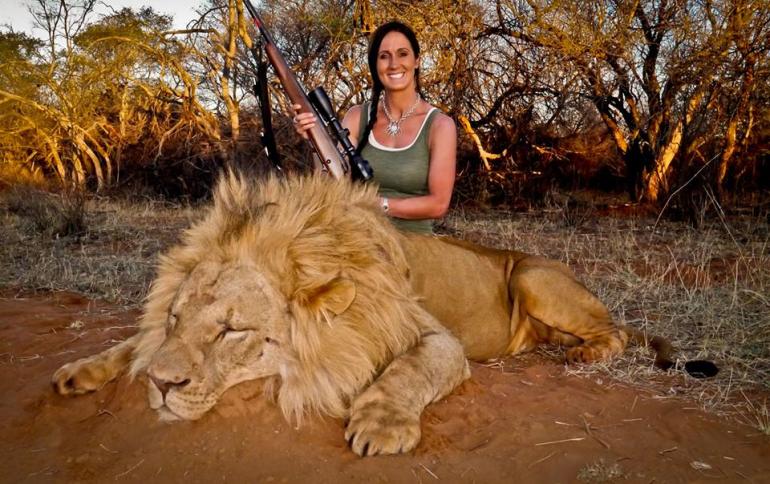
Melissa Bachman, who is the host of a hunting show called Deadly Passion, announced on her Facebook page on November 1 that she had killed a lion in South Africa and she posted this picture:

melissalion

The response was remarkable. According to one story, “Bachman found herself the target of vicious death wishes and obscenity-laced insults on Monday as critics on Twitter, YouTube and other social networks blasted the Minnesotan for her boastful hunting escapades.” According to another story, “More than 250,000 people have signed an online petition demanding that South Africa deny future entry to Melissa Bachman, a big game hunter whose smiling photo with a dead lion has sparked considerable outrage.”

And, to no one’s surprise, the large animal welfare charities are rushing to create a fundraising campaign with a petition to have lions listed as endangered under the Endangered Species Act (U.S.)

I posted something about this on my Facebook page, and I had to delete the comments and close the thread because of the horribly misogynist and violent comments that were being made.

People are angry that Bachman killed the lion unnecessarily. There was no need, no compulsion for her to do so. She did not kill the lion in self defense. She killed the lion because she enjoys killing animals.

And most of us think that that’s terrible; we don’t think that we should make animals suffer and die just because we derive some pleasure from it.

Or do we?

We kill and eat about 56 billion land animals not counting fish. There is no necessity; no compulsion. We do not need to eat animals to be optimally healthy and animal agriculture is an ecological disaster.

The best justification we have for imposing suffering and death on those billions of animals, many of whom have had lives far more hideous than the lion Bachman slaughtered, is that they taste good.

So how exactly does this distinguish those of us who consume animals from Bachman?

That’s a rhetorical question: there is no coherent moral distinction between her and most of us. The fact that Bachman kills “charismatic species” and the rest of us just kill chickens, pigs, cows, and fish is completely irrelevant.

The Bachman matter is no different from the moral schizophrenia that we saw in the matters of Michael Vick, Mitt Romney, and Kisha Curtis.

On the positive side, every time one of these cases erupts, we reaffirm our belief in the widely shared moral intuition that it’s morally wrong to impose suffering on or kill animals without a good reason. Ironically, we already believe everything we need to believe to reject animal exploitation altogether. It’s just a matter of coming to see there is no morally relevant difference between shooting a lion for fun or eating a steak because you enjoy it. In both cases, we have taken a life for no good reason.

Let us hope that these episodes of moral schizophrenia cause the light to go on at least for some who make the decision to put their morals where their mouth is and go vegan.

Gary L. Francione Professor, Rutgers University

©2013 Gary L. Francione

Movies About Hunting Humans For Sport

Friday November 22, 2013

8 (great?) hunting-humans-for-sport movies
By Dave Croy / World-Herald staff writer

Share on facebookShare on twitter
In 1924, Colliers Weekly published a short story by Richard Connell called “The Most Dangerous Game.”

It involved a big-game hunter who fell from a yacht and washed up on an island. A wealthy former Russian aristocrat named Zaroff owned the island. And Zaroff had grown bored of big-game hunting and developed a more ruthless pastime, one that involved causing shipwrecks with misleading navigation lights and hunting the surviving crew members after they swam ashore. Ultimately, of course, the hunter and the Russian had to square off mano a mano.

The story was, among other things, a commentary on the “sport” of big-game hunting, very popular at the time among the wealthy. But the notion of hunting humans for sport apparently captured the fevered imaginations of many a writer and filmmaker.

It spawned the 1932 film, “The Most Dangerous Game,” starring Joel McCrea and Fay Wray. (Filmed on many “King Kong” sets with much of the same cast and crew during a break in the making of that film.) The movie was remade in 1945 with the title “A Game of Death.” Since then, numerous films and television shows have made use of the premise, often attributing the original short story as inspiration.

With “The Hunger Games: Catching Fire” opening in theaters this weekend, it seems like the perfect time to revisit some of the better examples of this sub-genre of film.

8. “Surviving the Game” (1994)

Okay, this is not really a great film, but it has some wonderful actors playing really nasty bad guys, chewing the hell out of the scenery and generally spouting plenty of awful dialogue. Homeless Ice-T gets a job as a “hunting guide” for some rich guys, including Rutger Hauer, Gary Busey and F. Murray Abraham, (all scary enough in real life!) only to discover that he is their quarry! But Ice-T, as you might guess, won’t go down without a fight.

This is generally just a foul-mouthed knock-off of the original story, entirely propped-up by the performances of Hauer and Busey.

7. “Death Race 2000” (1975)

A schlockmeister Roger Corman production, this film put the fun back in funeral. David Carradine as Frankenstein and a pre-Rocky Sylvester Stallone as Machine-Gun Joe Viterbo are among the drivers in a high-speed cross-country race. In the futuristic world of the year 2000, U.S. democracy has given way to dictatorship, with the three-day race serving as a way to keep the populace pacified. Not only do the drivers score points for speed but for running down pedestrians, as well. The older and more infirm the pedestrian, the greater the point count.

This movie is a cartoonishly ultra-violent mess, with ridiculous “revolutionary” politics oozing through the mix, but, hey, Frankenstein’s car is a Corvette made to look like a giant alligator, and almost every minute of this “cult-classic” is good for a laugh.

6. “Battle Royale” (2000)

This financially successful critical darling from Japan is often cited as having served as a “template” for “The Hunger Games.” I submit that minimal research into this topic makes it obvious that themes like people hunting people, blood sports as “opiates for the masses” and the morality of child soldiers are recurrent throughout both history and fiction.

In this case, a class of 15-year-old schoolchildren is taken to an island, fitted with explosive tracking collars, given basic provisions and various “weapons” and told they each have three days to become the last student standing.

The ensuing violence is frequent, brutal and oddly matter-of-fact. The students’ motivations range from the comic to the melodramatic. The number of students with antisocial personality disorder seems statistically improbable for a group of 40-or-so kids.

More sophisticated critics were able to discern a greater level of depth to the proceedings than I was. I found the government’s motivations for holding the annual contest murky, the characters laughable and the action filmed with all of the grace of security-camera video.

It is never made clear in the film if the “Battle Royale” has a viewing audience outside those running the game. What I’m still trying to figure out is why this film had such a large one.

5. “Hard Target” (1993)

Based on the 1932 film “The Most Dangerous Game,” this was revered Chinese action director John Woo’s first American movie.

Sporting a mullet that appears to have been used to clean up after an oil change, Belgium’s own martial-arts hero Jean-Claude Van Damme stars as Chance Bordreaux, homeless Cajun merchant seaman in New Orleans. When Yancy Butler shows up looking for her homeless, missing father, Van Damme saves her from local hoods and agrees to serve as her bodyguard and guide. Turns out that pops was a victim of a ruthless group of human-hunters, led by creepy Lance Henriksen.

Soon, one of Jean-Claude’s homeless pals falls prey to the hunters, too. As Van Damme and Butler begin to gather evidence that the homeless men are being murdered, Henriksen and his goons decide to eliminate any threats to their operation. Will the hunters become the hunted? Will Henriksen get his due? Does the phrase “grenade in pants” ring any bells?

Solid Woo action scenes, but the cheesy script and Van Damme’s spectacular lack of acting talent keep this from being a truly awesome film.

4. “The Running Man” (1987)

With “The Running Man,” director Paul Michael Glaser (Starsky of TVs “Starsky and Hutch”) took a stab at the “over-the-top, thinly-veiled R-rated science-fiction satire,” as mastered by fellow director Paul Verhoven, and he acquitted himself pretty well, considering that he was brought in a week into the production to replace fired director Andrew Davis.

Arnold Schwarzenegger stars as Ben Richards, a former police helicopter pilot in the future wrongly convicted of killing civilians and forced to participate in a reality TV game show, “The Running Man,” where convicts are hunted by superstar “stalkers.” Richards begins killing off the hunters, one-by-one, and ultimately helps an anti-network resistance movement expose the fact that supposed “winning” contestants in the past have all been murdered.

While Ahnuld approaches the material with his usual gusto, the real standout is “Running Man” host and show-runner Richard Dawson (former “Family Feud” emcee) as the glad-handing, lady-kissing and utterly ruthless Damon Killian. Subtlety was the last thing on the minds of anyone involved in this very loose adaptation of the Stephen King novel.

More: http://www.omaha.com/article/20131122/GO/131129638/1181

574922_10150775941916188_960382052_n

Hunter Shoots, Wounds Montana Grizzly Bear

Grizzly survives after charging hunter, getting shot near Condon

CONDON — A female grizzly with two cubs who was shot Wednesday when she charged a hunter in the Kraft Creek drainage near here has apparently survived.

The hunter immediately contacted Montana Fish, Wildlife and Parks, which tracked the bear on the ground and in the air as she moved west toward the Mission Mountains.

“The determination was made that the bear was not mortally wounded,” FWP spokesman John Fraley reported.

The hunter fired a shot after the grizzly charged to within 50 feet of him. Fraley said wardens discovered a deer carcass about 75 yards away that the grizzly and her two cubs had been feeding on.

The Flathead County Sheriff’s Department, Two-Bear Aviation and pilot Jim Bob Pierce helped FWP track the wounded bear.

The investigation continues, and Fraley reminded people to carry bear pepper spray when hunting in grizzly country, adding that experts say it is more effective than a firearm in stopping a bear.

[Great, so now there’s a wounded mother bear out there trying to avoid hunters and raise her two cubs in peace].

Photo Copyright Jim Robertson

Photo Copyright Jim Robertson

Another Red Wolf Found Shot!

Red wolf found shot Nov 18 2013

An FYI to red wolf advocates, friends and family. We are in a crisis with the ongoing illegal killing of wild red wolves. Please be aware that the photo is wrenching. Do not view it unless you are prepared to see what a bullet can do to a red wolf. Check out our Facebook page for updates and also our web site at http://www.redwolves.com.

Neil

Red Wolf Coaltion – Board of Directors, Chair

USFWS NEWS RELEASE

U.S. Fish and Wildlife Service
Red Wolf Recovery Program
P. O. Box 1969
Manteo, North Carolina 27954

Contact: David Rabon, 252-473-1132 , david_rabon@fws.gov

November 20, 2013

Photo available at http://www.flickr.com/photos/usfwssoutheast/10961117113/

Red wolf found shot in Washington County, N.C. on Nov. 18, 2013. This is
the fifth red wolf killed or missing in less than a month. Photo by USFWS.

*Federal Officials Request Assistance Regarding Latest Red Wolf Killing*

*Reward for Information now up to $26,000*

The U.S. Fish and Wildlife Service is requesting assistance with an
investigation involving the suspected illegal take of a fifth red wolf in
the last month. In the latest death, the federally protected wolf’s body
was recovered from private property north of the town of Creswell, in
Washington County, North Carolina, on Monday, November 18, 2013. The red
wolf’s body had an apparent gunshot wound.

Anyone with information that directly leads to an arrest, a criminal
conviction, a civil penalty assessment, or forfeiture of property on the
subject or subjects responsible for the suspected unlawful take of a red
wolf may be eligible for a reward.

Pledged contributions from the North Carolina Wildlife Federation, Red Wolf
Coalition, Humane Society of the United States, and the Center for
Biological Diversity have increased the reward amount for information on the
suspected illegal take of the five radio-collared red wolves that were found
dead in the last month in Washington and Tyrrell counties, North Carolina.
A person providing essential information that directly leads to an arrest, a
criminal conviction, on the subject or subjects responsible for the
suspected unlawful take of one of these red wolves may be eligible for a
combined reward of up to $26,000. Individual organizations pledging
contributions will determine eligibility for payment of any reward.

Red Wolf