
http://www.salon.com/2014/01/11/15_ways_atheists_can_stand_up_for_rationality/
Atheists need to assert ourselves! Here’s how
by Jeffrey Tayler
I’ve often wondered how the term “New Atheism” gained such currency. It is a misnomer. There is nothing new about nonbelief. All of us, without exception, are born knowing nothing of God or gods, and acquire notions of religion solely through interaction with others – or, most often, indoctrination by others, an indoctrination usually commencing well before we can reason. Our primal state is, thus, one of nonbelief. The New Atheists (most prominently Richard Dawkins, Sam Harris and the late Christopher Hitchens) have, in essence, done nothing more than try to bring us back to our senses, to return us to a pure and innate mental clarity. Yet their efforts have generated all manner of controversy. Far outnumbered, and facing a popular mindset according kneejerk respect to men (yes, mostly they are men) of faith — reverends, priests, pastors, rabbis, imams and so on – the New Atheists have by necessity explained their views with zeal, which has often irked the religious, who are accustomed to unconditional deference. Even some nonbelievers who, again thanks to custom, consider religion too touchy a subject to discuss openly have been riled.
We atheists, however, need to buck up, assert our rationality, and change the way we deal with the religious, with everyday affronts delivered (at times unknowingly) by believers, with the casual presumptions that historically have tended to favor the faithful and grant them unmerited respect. A lot is at stake. Religion is a serious matter, reaching far beyond the pale of individual conscience and sometimes translating into violence, sexism, sexual harassment and assault, and sundry legal attempts to restrict a woman’s right to abortion or outlaw it altogether, to say nothing of terrorism and war. Now is the time to act. Polls – see here and here – show the zeitgeist in the United States is turning increasingly godless, that there are more atheists now than ever before (surely thanks in part to the efforts of the New Atheists). Most of Europe entered the post-faith era decades ago. Americans need to catch up.
I propose here a credo for atheists – concrete responses to faith-based affronts, to religious presumption, to what Hitchens called “clerical bullying.” (I’ll deal below with the three monotheistic, Abrahamic religions, but what I say applies to other confessions as well.) The faithful are entitled to their beliefs, of course, but have no inherent right to air them without expecting criticism. Religion should be subject to commonsense appraisal and rational review, as openly discussible as, say, politics, art and the weather. The First Amendment, we should recall, forbids Congress both from establishing laws designating a state religion and from abridging freedom of speech. There is no reason why we should shy away from speaking freely about religion, no reason why it should be thought impolite to debate it, especially when, as so often happens, religious folk bring it up on their own and try to impose it on others.
Herewith, some common religious pronouncements and how atheists can respond to them.
1. “Let’s say grace!”
No, let’s not. When you’re seated at the family dinner table and a relative suggests clasping hands, lowering heads and thanking the Lord, say “No thanks. I’m an atheist. So I’ll opt out.” Nonbelievers have every right to object when being asked to take part in superstitious rituals; in fact, if children are present, they are morally obliged to do so. Courteously refusing to pray will set an example of rational behavior for the young, and contribute to furthering the atheist zeitgeist.
2. “Religion is a personal matter. It’s not polite to bring it up.”
No, religion is fundamentally collective, and since time immemorial has served societies in fostering union, but also in inciting xenophobia and violence (especially against “unchaste” women and “impure” minorities), often on a mass scale. Nonbelievers need to further advance the cause of rationality by discussing it openly; doing so, as uncomfortable as it may be at times, will help puncture the aura of sanctity surrounding faith and expose it for what it is.
3. “You’re an atheist? I feel sorry for you.”
No, please rejoice for me. I fear no hell, just as I expect no heaven. Nabokov summed up a nonbeliever’s view of the cosmos, and our place in it, thus: “The cradle rocks above an abyss, and common sense tells us that our existence is but a brief crack of light between two eternities of darkness.” The 19th-century Scottish historian Thomas Carlyle put it slightly differently: “One life. A little gleam of Time between two Eternities.” Though I have many memories to cherish, I value the present, my time on earth, those around me now. I miss those who have departed, and recognize, painful as it is, that I will never be reunited with them. There is the here and now – no more. But certainly no less. Being an adult means, as Orwell put it, having the “power of facing unpleasant facts.” True adulthood begins with doing just that, with renouncing comforting fables. There is something liberating in recognizing ourselves as mammals with some fourscore years (if we’re lucky) to make the most of on this earth.
There is also something intrinsically courageous about being an atheist. Atheists confront death without mythology or sugarcoating. That takes courage.
4. “If you’re an atheist, life has no purpose.”
A purpose derived from a false premise – that a deity has ordained submission to his will – cannot merit respect. The pursuit of Enlightenment-era goals — solving our world’s problems through rational discourse, rather than though religion and tradition – provide ample grounds for a purposive existence. It is not for nothing that the Enlightenment, when atheism truly began to take hold, was also known as the Age of Reason.
5. “If you abolish religion, nothing will stop people from killing, raping and looting.”
No, killing, raping and looting have been common practices in religious societies, and often carried out with clerical sanction. The catalogue of notorious barbarities – wars and massacres, acts of terrorism, the Inquisition, the Crusades, the chopping off of thieves’ hands, the slicing off of clitorises and labia majora, the use of gang rape as punishment, and manifold other savageries committed in the name of one faith or another — attests to religion’s longstanding propensity to induce barbarity, or at the very least to give it free rein. The Bible and the Quran have served to justify these atrocities and more, with women and gay people suffering disproportionately. There is a reason the Middle Ages in Europe were long referred to as the Dark Ages; the millennium of theocratic rule that ended only with the Renaissance (that is, with Europe’s turn away from God toward humankind) was a violent time.
Morality arises out of our innate desire for safety, stability and order, without which no society can function; basic moral precepts (that murder and theft are wrong, for example) antedated religion. Those who abstain from crime solely because they fear divine wrath, and not because they recognize the difference between right and wrong, are not to be lauded, much less trusted. Just which practices are moral at a given time must be a matter of rational debate. The “master-slave” ethos – obligatory obeisance to a deity — pervading the revealed religions is inimical to such debate. We need to chart our moral course as equals, or there can be no justice.
6. “Nothing can equal the majesty of God and His creation.”
No need to inject God into this. “Creation” is majestic enough on its own, as anyone who has gazed into the Grand Canyon or the night sky already knows. While paddling a pirogue down the Congo, at night I often marveled to the point of ecstasy at the brilliance of the stars, the salience of the planets against the Milky Way – just one of the many quasi-transcendental experiences I have had as an atheist globetrotter. The world is a thing of wonder that requires no faith, but only alert senses, to appreciate.
7. “It is irrational to believe that the world came about without a creator.”
No, it is irrational to infer an invisible omnipotent being from what we see around us. The burden of proof lies on the one making supernatural claims, as the New Atheists have tirelessly pointed out. But here again the New Atheists are really doing nothing novel. Almost 200 years ago, the British poet Shelley, in his essay “The Necessity of Atheism,” noted that “God is an hypothesis, and, as such, stands in need of proof: the onus probandi rests on the theist.” This was clear to him even before we had mapped the human genome, discovered the Higgs boson, or even invented the telegraph.
8. “I will pray for you to see the light.”
Not necessary, but do as you like. Abraham Lincoln noted that, “What is to be, will be, and no prayers of ours can arrest the decree.”
9. “If you’re wrong about God, you go to hell. It’s safer to believe.”
Pascal’s wager survives even among people who have never heard the name of the 17th-century French philosopher and mathematician. Leaving aside whether blatant self-interest would please a god demanding to be loved unconditionally, which god will save us from hell? The god of Catholicism? Judaism? Islam? Doctrines of all three Abrahamic faiths prohibit entry into paradise for adherents of rival confessions.
10. “Religion is of great comfort to me, especially in times of loss. Too bad it isn’t for you.”
George Bernard Shaw noted that, “The fact that a believer is happier than a skeptic is no more to the point than the fact that a drunken man is happier than a sober one. The happiness of credulity is a cheap and dangerous quality.” A few shots of vodka will do for me, and are more to the point.
After the passing away of his son, Lincoln, in dire need of solace, nevertheless remarked that, “My earlier views of the unsoundness of the Christian scheme of salvation and the human origin of the scriptures, have become clearer and stronger with advancing years and I see no reason for thinking I shall ever change them.”
10. “As you age and face death, you will come to need religion.”
Perhaps in dotage anything is possible, but this turn of events is unlikely. Aging and the prospect of dying by no means enhance the attractiveness of fictitious comforts to come in paradise, or the veracity of malicious myths about hellfire and damnation. Fear and feeblemindedness cannot be credibly pressed into service to support fantastic claims about the cosmos and our ultimate destiny.
Whether one would even consider turning to religion in advanced years has much to do with upbringing, which makes all the more important standing up to the presumptions of the religious in front of children. One would regard the Biblical events – a spontaneously igniting bush, a sea’s parting, human parthenogenesis, a resurrected prophet and so on – that supposedly heralded God’s intervention in our affairs as the stuff of fairy tales were it not for the credibility we unwittingly lend them by keeping quiet out of mistaken notions of propriety.
11. “You have no right to criticize my religious beliefs.”
Wrong. Such a declaration aims to suppress free speech and dialogue about a matter influential in almost every aspect of our societies. No one has a right to make unsubstantiated assertions, or vouch for the truthfulness of unsubstantiated assertions on the basis of “sacred” texts, without expecting objections from thinking folk.
12. “Jesus was merciful.”
If he existed – and there is still, after centuries of searching, no proof that he did – he was at times a heartless prophet of doom for the sinners he supposedly loved, commanding those who failed to give comfort to the poor to “depart . . . ye cursed, into everlasting fire, prepared for the devil and his angels.”
13. ”You can’t prove there’s no God.”
Correct, at least epistemologically speaking. Reasonable atheists, “New” and old, would not argue with this. Richard Dawkins, for example, has told audiences that he is nominally an agnostic, since proving that something does not exist is impossible. He claims to be an atheist “only” in the sense that he is an “a-leprechaunist, an a-fairiest, and an a-pink-unicornist.” The evidence for God, fairies and leprechauns, he remarked, “is equally poor.”
14. “My religion is true for me.”
A soppy, solipsistic and juvenile declaration and cop-out bordering on the delusional and contradicting Christianity and Islam, neither of which recognize the other, and both of which espouse universalist pretensions. You will not find a scientist who will say, “quantum physics is true for me.” No one would have trusted Jonas Salk if he had promoted the efficacy of his polio vaccine as “true for him.”
15. “Don’t take everything in the Bible literally.”
Not taking the Bible (or other texts based on “revealed truths”) literally leaves it up to the reader to cherry-pick elements for belief. There exists no guide for such cherry-picking, and zero religious sanction for it.
I’m not counseling incivility — but arm yourself with the courage of your rationalist convictions and go forth. We will all be better off for it.
Jeffrey Tayler
Jeffrey Tayler is a contributing editor at The Atlantic.
 Exposing the Big Game
Why such a strange essay on an anti-hunting blog?
More than just an anti-hunting blog, this is my personal blog. As an author, I have other interests I write about or share articles on. It may be climate change, veganism, corporate greed or anthropocentricism, but it is usually tied to how humans treat other animals.
What an absolute insult. Cold blooded.
I see nothing cold blooded about it; sorry if the cold hard facts are insulting to you. Please don’t take it personally.
That’s alright. I feel better this morning. I just can’t bear the idea of dying and being nothing. I go to the Catholic church but have never been confirmed. I would say that I am not religious but I love the beauty of it. I love the feel of the rosary beads in my hands and the mantra of the rosary prayers. And I have always believed in an afterlife. I can’t fathom how people could live otherwise. But that’s just me.
There may be nothing, but at least there’s no more pain or awareness of suffering. It may not be as comforting as the thought of eternal heaven, but at least there’s no need to fear a horrible afterlife in hell. Humans are the only animals who believe in an afterlife, and the only ones who don’t just live for today. Some people dwell on it to the point of ruining the time they have now.
By God I’m atheist!
Reblogged this on "OUR WORLD".
You have a full right to stand up for what you believe in but not to be rude to people who believe in god. I’m religious and I believe everyone should be able to talk about what they believe politely but this is not polite…….
This piece was written by an atheists for other atheists, to encourage them to speak more freely. The author could have worded it more delicately, but I’m guessing he didn’t think theists would want to read something entitled, “15 ways atheists can stand up for rationality.” Sorry if you found it offensive.
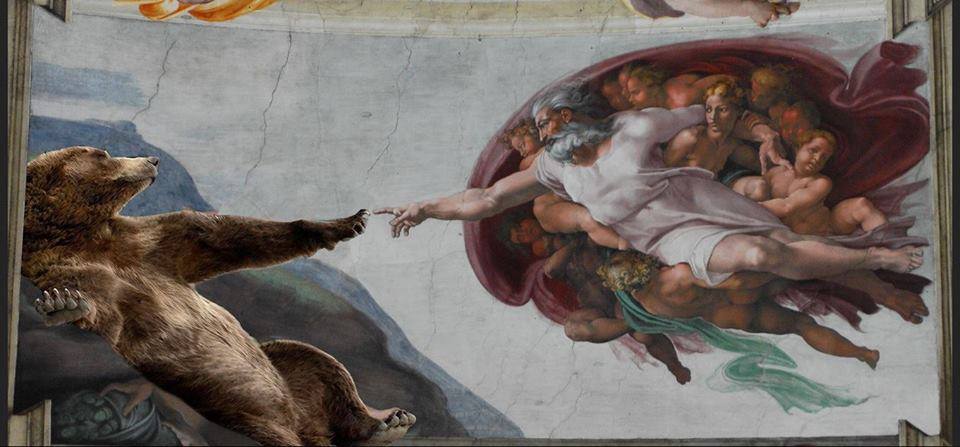
My point for posting the article is that I feel religion tends to foster speciesism by teaching that humans were created in the image of an all-powerful deity who prefers our species of animal over all others. Human arrogance has resulted in countless atrocities toward non-humans. The only way to counter that is through discourse. The problem is, anytime you talk about faithfully-held beliefs, you’re likely to offend someone. This piece originally appeared on Salon.com (my brother sent me the link and I added the bear painting to underscore add an anti-speciesist slant); if you think the author was overly rude, you can leave a comment on their site which he may answer to.
I see the point of religion fostering speciesism. The all powerful God and his indifference toward the brutalities of the animal kingdom. I have a hard time in church being the only vegan. But I was simply put out by your comment about the cold hard facts. I do not know if there is a god. And atheists do not have cold hard facts either. Oh well Jim-a very sensitive subject and gets people all riled up.
Thank you Brittany glad someone else saw this essay for the bigoted and very rude post it is. Not to mention incredibly arrogant.
Nice piece Jim, well thought out and helpful to those of us who are not religious. I sent this to some friends and they too loved it.
I thought this article would be helpful to some people; I’m glad you friends got something out of it.
He loved it! He’s a fan of Christopher Hitchens.
If there is nothing than for me life would be a cold blooded intellectual prison. I think spirits are everywhere and that animals have souls.
Thank you, Jim ☺ Wonderful, insightful piece. So comforting to know others feel as I do. Will share.
..and major kudos to the writer, Jeffrey Tayler..am always amazed at how so many “religious” types actually feel you are taking something away from THEM is you are a non-believer. If your belief is so strong, how could I deter from it? *shakes head*
I don’t believe atheists are taking anything away from me. I was sadly shocked at the rudness of it.
Thank you and thanks for sharing.
I see nothing rude about an atheist stating his/her position and it is Jim’s blog site so he has the right to post what he finds important or interesting. If one’s faith in religion and an all-powerful god is strong, why would one feel so insecure, so offended and challenged by a single article?
What’s more significant and relevant to this website is for the God Squad to please explain for us non-believers why their exists such a notable and disturbing correlation between hunting/animal abuse and fundamentalist Christianity in this country. Virtually every animal-abusing yahoo out there of any prominence, from Sarah Palin to Phil Robertson to Mike Huckabee to Antonin Scalia to Rick Perry to Ted Nugent … is a self-proclaimed Jesus-freak. Virtually every organized meeting of animal abusing psychopaths opens or closes with a benediction asking for, without a hint of irony, divine mercy and guidance; and these same organizations frequently sponsor “prayer breakfasts” before their members bound-off to murder or maim elk, deer, coyotes or other assorted “varmints.” If there is any truth to “by their works ye shall know them” then an ARA has compelling reasons to be deeply suspicious of any self-proclaimed Jesus-freak.
On the other side, I’ve yet to hear of a single contemporary bishop, priest, or minister, from Pope Francis to Billy Graham, unequivocally condemn before their congregation recreational hunting as a sin. As John Vyvyan put it with regard to another animal-abusing enterprise (vivisection) that organized Christian churches have also somehow overlooked in their fevered quest to rid the world of sinful behavior: “… the Church claims to be an authority in the sphere of faith and morals; but cruelty is a matter of morals, and if the Church permits it, then it is fair to ask, ‘If these are its morals, what has happened to its faith?’ (“The Dark Face of Science”)
Thanks Geoff for pointing out why an article like this is important to the cause for non-human animals
Reblogged this on Exposing the Big Game.