
Four more cases of deadly bird flu were reported in China on Wednesday, bringing the season’s total in that country to 221. Fifty-seven people have died.
The surge in cases has health officials worldwide watching closely as hundreds of millions of Chinese begin to travel for Chinese New Year.
The H7N9 strain of influenza jumped from birds to humans only last year. It is extremely dangerous, causing severe illness in more than three quarters of people infected and death in more than one quarter, according to Chinese researchers.
It is called bird flu because the virus originated in birds and so far is transmitted to humans only by live poultry. Cooked meat is no risk.
All of this year’s cases have been in China.
The surge in cases comes as China gets ready for what is called Spring Festival in Chinese. Known as Chinese New Year in the West, it begins Jan 31. People customarily travel to spend the holiday with family.
China estimates that 3.6 billion trips will be taken during the two-week holiday — and many of those traveling will be taking or buying live chickens and ducks as gifts.
Humans can be infected by being in close contact with “infected live poultry, mostly in live bird markets or when slaughtering birds at home,” the United Nations Food and Agriculture Organization said in a warning issued Tuesday.
So far, no sustained human-to-human transmission has occurred, according to the World Health Organization.
“Nothing can be predicted with certainty, but on present evidence, none of these viruses shows a potential to spread widely or cause an explosive outbreak,” Margaret Chen, director-general of the World Health Organization, said Tuesday in Geneva.
Flu viruses are notorious for quickly mutating into new forms, but so far genetic analysis by the FAO shows that the H7N9 virus has not changed significantly since its emergence last year.
“We are watching closely the increasing number of confirmed cases that are being reported from China during the past few weeks,” said Joseph Breese, an influenza expert with the Centers for Disease Control and Prevention in Atlanta. “Fortunately, Chinese health officials have not reported changes in the epidemiology of the virus that would lead us to believe it can easily spread between humans.”
The fear is that it could all too easily do so, said Mike Osterholm, director of the Centers of Excellence for Influenza Research and Surveillance at the University of Minnesota in St. Paul. “The clock is ticking but we just don’t know what time it is.”
Several things about H7N9 worry health officials. A major concern is that unlike other flu strains, it doesn’t make infected birds sick, so farmers don’t know their flocks are infected.
Humans are the proverbial canary in the coal mine in this outbreak. “The way we know that we have H7N9 in poultry is that humans start to get sick,” Osterholm said.
When testing shows a flock is ill, farmers have been reluctant to cull their birds because the animals seem healthy.
The birds breathe out the virus. That’s different from other flu strains, which are excreted in feces.
“We don’t know yet if there’s an infectious cloud that comes off the bird markets that can infect nearby humans,” Osterholm said. There have been cases in which people who lived close to a live bird market but didn’t go in still got infected, he said.
The concern is that with so many cases appearing in eastern and southern China, and hundreds of millions of people traveling long distances to get home for the holidays, the virus could find a way to mutate into something that can easily pass between humans.
“We’re in a ‘stay tuned’ moment right now,” Osterholm said. “If that happens, then bets are off. It’s potential pandemic time.”
 Exposing the Big Game
Unfortunately, it is Poetic Justice, is it now? The planet is smaller now, as everything is global. It is just a matter of time, until the right bacterial/viral infections become world-wide epidemics, with antibiotics ineffectual. Maybe this will be Homo sapiens’ demise, and some of the other life on this planet will survive–maybe.
Fortunately the birds don’t get sick from this strain of “bird flu.”
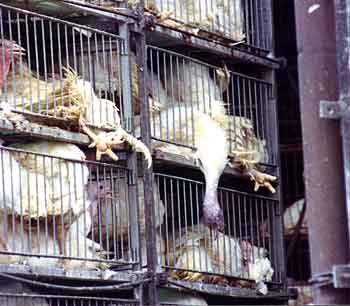
However, if there’s reason to believe a flock carries the virus, the farmers are supposed to kill them all. Judging by the picture, that’d put them out of their misery sooner, since they’ll get killed anyway (and their poor, short lives are sheer hell).
True
Not something to like but certainly worthwhile to share. It all stems from mono-production and crowded spaces. Let’s go back to the way we used to get eggs: from free roaming chickens which are treated humanely. They only cost a bit more but if you add that this results in healthier humans it really is less expensive.
Eventually, something is going to wipe us out and I blame the meat eaters. Granted I wasn’t born a vegan, but I was a vegetarian from a very early age (after witnessing my Nonna kill a live chicken when I was a small child). Farming practices today,even so-called “free-range/organic”, are egregious – animals suffer so stupid humans can eat their flesh and we vegans will have to live with the fall-out.
I liked your other post. I wish I could live on a planet where animals are cherished and valued, not devalued and murdered for profit.
We are a different species from those who can watch a live chicken be slaughtered for a few bites of flesh and not want to learn how we can live without causing suffering.
I remember bawling my eyes out when I learned the chicken my nonna roasted was once the live chicken running around her back yard. I developed such phobias around flesh after that and wouldn’t eat it. However, I still ate eggs and dairy. It wasn’t until educated myself on the plight of all animals raised for food (mostly through Mercy for Animals) that I became an vegan.
I find the vegan lifestyle very easy to live. I don’t understand people who say it’s too difficult. If I can do it, while working in Corporate America, anyone can!
Reblogged this on Time for Action.