
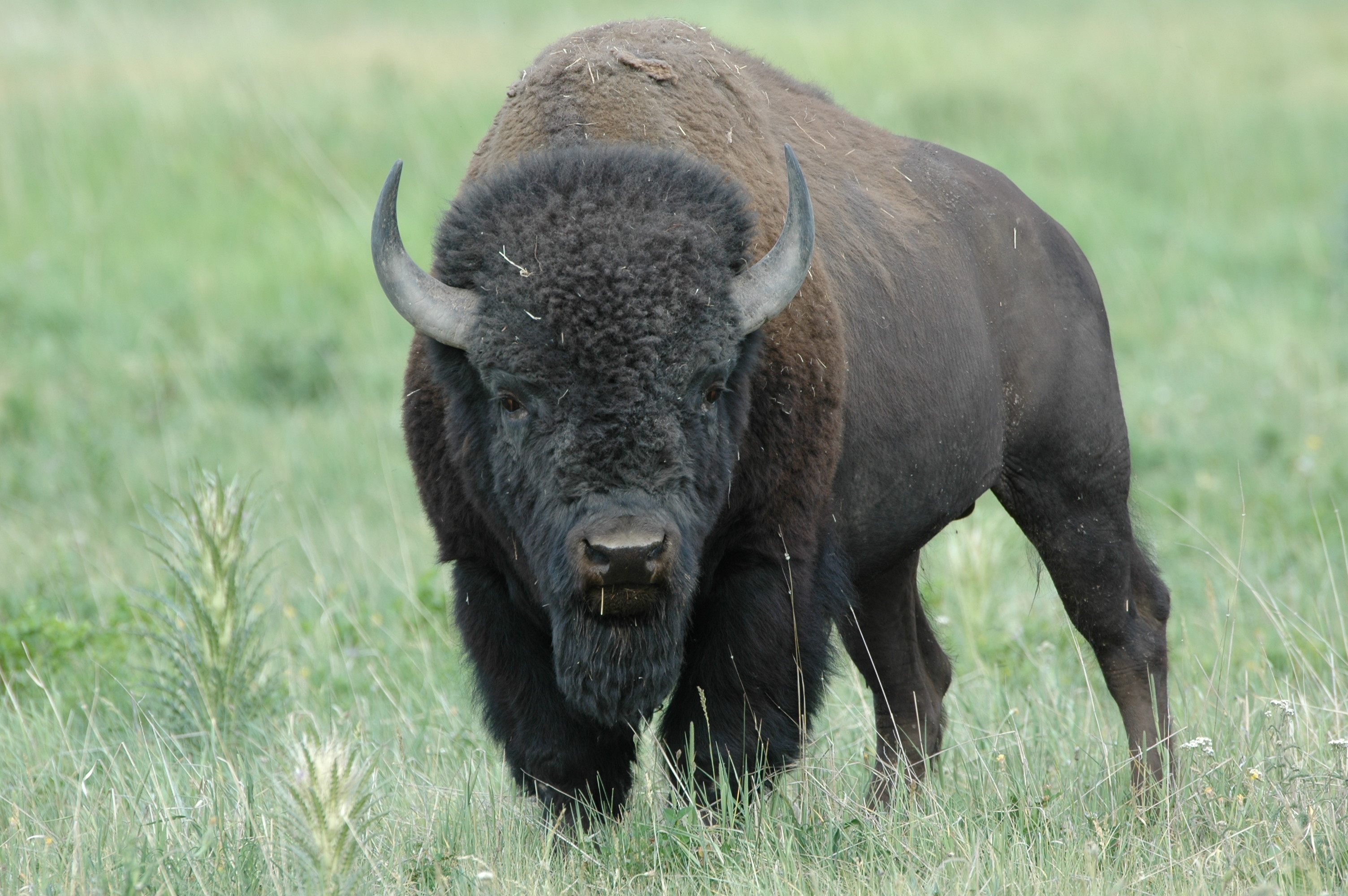
Wildlife Photography ©Jim Robertson, All Rights Reserved
Article by Brett French The Billings Gazette
As large numbers of bison begin moving toward Yellowstone National Park’s northern border, park officials are making plans to truck 300 to 600 of the animals to slaughterhouses, with the processed meat, hides and heads being distributed to American Indian tribes.
“We do have some agreements with tribal entities to take those animals this year,” said Al Nash, Yellowstone’s chief of public affairs. “But everything is very dependent on the bison migrating in significant numbers.”
The last count by Montana Fish, Wildlife and Parks put the number of bison outside the park’s northern boundary near Gardiner at 60 to 70, with most staying close to private property and away from hunters on nearby public land. Hunting is not allowed inside Yellowstone.
Growing herd
This summer, Yellowstone’s bison population was estimated at 4,600, close to the park’s peak bison population of 5,000 that was recorded in 2005. The bison are divided into two herds, with about 3,200 in the northern herd and 1,400 in the central herd, which migrates out of the park near West Yellowstone along the Madison River.
By agreement with the state of Montana, the park is required to keep the bison population at 3,000 to 3,500 animals.
“Our biologists are saying that if we were to look at a removal of about 600 bison each winter for several winters, then we would have a chance to move that population figure down to 3,000 or 3,300,” Nash said. “If we had no other management action, we could see 6,000 bison by the end of the winter 2016.”
The last and largest removal of bison was in 2008, when more than 1,600 bison were killed. Since 1985, more than 7,200 Yellowstone bison have been killed, according to the bison advocacy group Buffalo Field Campaign.
The park’s winter carrying capacity for bison has been estimated at 5,500 to 7,500. The cost of shipping bison to slaughter and having the meat processed was estimated at $50,000 to $100,000 a year.
Bison slaughter
Jim Stone, chairman of the Inter Tribal Buffalo Council, based in Rapid City, S.D., said his group is preparing to line up trailers, drivers and nearby slaughterhouses to process any Yellowstone bison that are captured and held at the park’s Stephens Creek corrals. The council is composed of 58 tribes in 19 states, 50 of which have their own tribal bison herds.
Although they’ll benefit from the park’s removal of bison with possibly thousands of pounds of meat being distributed, “the tribes have been opposed to a lot of what the park has done,” Stone said.
He said the group would prefer to see disease-free young bison quarantined —adding that he didn’t like that term — and then shipped to tribes with existing bison herds.
Such a shipment of 60 quarantined bison to the Fort Peck Tribe two years ago caused an uproar among surrounding ranchers and their legislators, despite the animals’ disease-free status.
Ranchers in Eastern Montana are nervous that conservation groups may succeed in their push to restore bison to public lands on the prairie. Stone said tribes should not be lumped in with such groups.
“A couple of things you’ll never hear from us is ‘free-ranging bison,’” he said. “That’s a state issue, not a tribal issue. We’re realists when it comes to managing buffalo.”
Stone said his group supports giving Yellowstone bison more room to roam on public land outside the park where they could be killed by hunters, in keeping with tradition. He said only older bulls and cows should be selected for slaughter.
The current ship-to-slaughter process may be necessary and the meat will be appreciated by tribal members, but Stone said the procedure is not respectful to the animals.
“The problem isn’t with killing buffalo, it’s with indiscriminate killing of buffalo,” he said.
______________________
Here’s a couple of appropriate comments from the people who sent me this article:
“Can’t someone stop this senseless killing. Who says the NPS has to agree to Montana’s absurd requirements. This is all driven by the ranchers and livestock department. Doesn’t anyone in Montana have the courage to stand up to these bullies. I think the tribes are enablers. They give the state livestock department cover by accepting these dead bison and prevent the bison from reoccupying its native habitat outside of the park. If they were really respectful of the bison, these tribes would be protesting the slaughter and lining up to keep the Dept of Livestock from killing the animals. They would refuse to cooperate with the state’s slaughter. This is a disgrace.”
“What a freak show… YNP has to be stopped from slaughtering bison! … what will stop these bastards?”
Please call and complain about this nonsense and imminent tragedy:
1. Governor Steve Bullock – (406) 444 –3111
2. Policy Advisor for Natural Resources, Tim Baker – (406) 444 – 7857
 Exposing the Big Game
Reblogged this on Wolf Is My Soul.
Or here’s a thought: let’s quit slaughtering the wolves and let them take care of the bison “problem.”
That would make too much sense.
I’m in full agreement
Let’s rescue all the wolves and put them in with the bison !
No need for these slaughters
Yellowstone,always seems spineless when it come to issues that “cross the borders”.They never oppose, out loud, when wolves are shot when they cross the border,and the same for bison.These animals are treated like escaping convicts,when in reality they have done nothing wrong,unless they become a TRUE threat to residents,outside the park.
Bison and wolves and bears and wild horses and ranchers and hunters:
Surely we can find a place for the bison to roam, and manage them outside Yellowstone and elsewhere maybe even without hunting, like shooting a cow in a field, call it harvesting at least, no just call it killing, not hunting. This is one of the last best places, right? Tourists don’t come here to see cattle and fences. Both people living in Montana and visitors think of it as somewhat wild. A real heritage would be to preserve and restore the wildness of Montana. How much bad PR can Montana create for itself with regard to bison and wolves and other wild critters? Montana is giving itself terrible PR with regard to bison, wolves, wild horses, and soon maybe grizzlies. I am glad to see FWP pushing the idea that there are other places in Montana for bison other than Yellowstone thereby ensuring their survival and biodiversity. Speaking of YNP, why cannot bison wonder outside the Park to traditional winter grazing grounds on public land instead of leasing that land to ranchers? Retire some leases. Manage the ranchers I say. Why cannot we find other public land in the state also? Ranchers and farmers are granted 772 permits on national forest lands in Montana, 3776 permits on BLM land in Montana, 26,000 permits in 16 western states. Who is encroaching? Man on wildlife? Let’s start retiring some of those permits and a lot of them and create permanent conservancy easements for wildlife on any leased land, and a buffer zone around Yellowstone and Glacier protecting wildlife.
Why are we so ruled by the oppositional opinions of ranchers and farmers and hunters (“sportsmen”}and misinformed pubic and rancher politicians and rancher legislators? You cannot confuse them with the facts. Per Lewis Carroll, “I have said it thrice, what I say three times is true.” It has been suggested and even planned that bison be designated for placement (by FWP Montana) in other parts of the state. They are brucellosis free, tested, repeatedly so. Yet public meetings about the issue are attended almost unanimously by rancher-farmer crowds yelling, “No way!” Bison wander out of Yellowstone into traditional winter grazing ground, and ranchers protest and stockmen corral them, haze them and slaughter them. Instead of managing the cattle and ranchers around Yellowstone, ranchers want to manage the bison and keep them from going into a traditional outlet for grazing near Gardiner. The reports on any brucellosis of the past 50 years passing from bison to cattle are anecdotal, unproven, and none documented, only once in a Texas A&M lab setting closely confined with cattle. Brucellosis is more likely by elk who are more numerous and routinely come and go by the thousands, but even that does not seem to be much the case, but then elk are protected by sportsmen and FWP, farmed really, and ranchers probably do not want to step on that sacred set (sportsmen) of toes. Montana FWP, US Dept. of Agriculture Wildlife Services, and USFWS are agencies that serve ranchers, farmers and sportsmen more than wildlife. For a change, on a larger species, other than elk or deer, FWP is the advocate for conservation and preservation of an American icon.
The wolves do not significantly impact stock. Many ranchers are ranching on public land displacing wildlife (772 National Forest permits, 3776 BLM permits in MT 2012) at a pittance in fees and complaining about bison or bison relocations or wolves or other predators or wild horses. Rancher mentalities in our western senators and representatives and governors and Interior Department subverted the intent and the law of the Endangered Species Act to politically manage wolves, in states particularly hostile to predators, versus scientifically, instituting an aggressive “management” (hunting and trapping) plan, really a vendetta driven by anti-wolf hysteria. Hunters repeat their anecdotal opinion (myth) that wolves are harming ungulate populations against evidence to the contrary. The number of elk in Montana is up 37% since wolf return. WY has had 10 years in a row of record elk kills. Hunters are the main pressure on elk and other wildlife. Predators are better and more natural managers of ecological systems, not FWP and other wildlife agencies, and not hunters or trappers. Ranchers repeat their anecdotal opinion (myth) that wolves are significantly impacting wildlife, really depredation is about .0026 percent. Elk populations in Montana have soared from about 89,000 in 1989 to 140,000+ in 2012, and have soared in other states the past decade. Wolves were reintroduced in 1995 in Yellowstone and ID, but had already started reintroducing themselves via Glacier. There were two terrible winters, 1995-1996 and 1996-1997 in Yellowstone that decimated those elk herds and over-hunting since, but those herds have re-bounded and are at more historic levels. Wild horse management by BLM (Bureau of Land Management) or Bureau of Land Mafia if you will is too influenced by their opinion. BLM is largely manned/loaded by them. To protect wildlife, wildlife habitat, national forests and monuments, what some of the last best places have to offer, we had better stop deferring to ranchers and hunters and rancher politicians. They are purely serving themselves and are in a hysterical state of mind. They are traditional encroachers on wildlife and habitat. We need to manage ranchers, sportsmen and other encroachers, and development which is right up to wilderness edges.
Thank you for this discourse
I never fail to believe how astoundingly let down I am by the Yellowstone Park Mgt. I worked in Yellowstone for 3+ months in 1966 at Old Faithful Inn. They have profoundly sold out. There was no portion of the Park I wasn’t familiar with. Shame on them, fire them, overturn the corrupt system that now exists. I weep for the loss of this Park.
Yellowstone has turned into “Disneystone”…it’s exists as a federal zoo.
What’s with the “Tribes” who basically sit back and watch the slaughter of both bison and wolves?
The least they could do is ship them up to the American Prairie Reserve to live out their lives in the wild.
and what kind of message does it send to feature a spearhead as the logo of the National Park Service?
In my frustration over our own species behavior, and lack of wisdom, I often wonder if nature is controlling us too. The only way to get rid of this destructive species, natures biggest mistake, is to make us incapable of understanding our part IN nature, ie make us think bigger and better than anything else in the Universe. This belief about ourselves is a sure recipe to our own demise. It sure is the most costly mistake ever made by nature, costing Earth the largest scar on itself it’s ever seen, costing Earth even the most successful species it’s ever created. It will take Earth a while to heal once we are gone but I’m sure nature won’t make the same mistake again.
I’m so sad to see all these beautiful species, amazing adaptations to the most incredible environments, disappear.
Two quotes come to mind:
“It has yet to be proven that intelligence has any survival value.” by A.C. Clarke
But then what IS intelligence?
AND
“Seriously, I dont know when exactly that UFO landed and dumped all these stupid people, but they apparently aren’t coming back for them.” by Daffy Duck 😉
Any other “intelligent” species in the Universe able to travel across the stars would most probably be a much better species than us in every way otherwise they would have not have come as far as they have.
Anyway, leave nature to itself and all will get balanced. Let the predators grow to the numbers natures deems right to keep a balance with herbivores. It’s not rocket science. We need to stop human greed to be able to do this though.
“Ranchers in Eastern Montana are nervous that conservation groups may succeed in their push to restore bison to public lands on the prairie.”
This is the reason for the bison slaughter, the wild mustang round-ups, the wolf, coyote,prairie dog, mountain lion and other native wild animal slaughter going on in The West. The livestock industry grazes on public lands, while agencies continue to genuflect to this environmentally-destructive enterprise, which rapes not only The West, but the whole planet. Reports indicate that wild species around the world have already declined by 50%–and that is probably a conservative estimate.And, think about how many places up around Yellowstone serve “bison burgers.” Forget this nonsense about anything being “sacred.” We have turned this planet & her non-humans into one Big Commodity.
http://www.foranimals.org