
http://www.psychologytoday.com/blog/complete-without-kids/201403/would-you-help-save-the-earth-being-childfree
Would You Help Save the Earth by Being Childfree?
Most people consider whether or not to have kids based on lifestyle factors such as career goals, finances, and leisure time, but there’s another group of folks who are doing so primarily for environmental reasons.
This past summer, Time Magazine published a cover story about the childfree life that discussed why people decide to not have kids. Author Lauren Sandler wrote that the birthrate in the US is the lowest in recorded history and that the fertility rate actually dropped by 9 percent between 2007 and 2011. She cites cost ($234,900 to raise a child born in 2011 for a family earning less than $100,000 per year) as a major factor in this decline. Careers are also impacted, especially for women, who may lose out on as much as a million dollars because of lost promotions and other missed opportunities in the workplace that result from taking time off to raise kids.
Sandler also points to the sense of freedom that comes from being childfree. Childfree adults have an abundance of time to spend with friends and family, at their jobs, and on their own leisure activities and self-care.
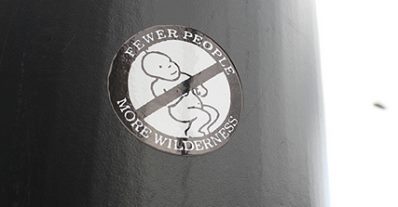
But there’s a third factor that Sandler neglected to discuss in her popular article—the green angle. Lisa Hymas, writer for Grist.org, wrote about this in a follow-up to the Time story. Hymas points out that the global population is now at 7.1 billion and is projected to reach 9.6 billion by 2050. That’s a lot of people stressing an already exhausted earth. She cites a Global Environmental Change study that boldly discusses the impact of each child on the earth.
The bottom line from this research is that all of the environmentally conscious deeds a person may do — recycling, riding the bus, etc. — pale in comparison to not having a child. As Hymas states, “The climate impact of having one fewer child in America is almost 20 times greater than the impact of adopting a series of eco-friendly practices for your entire lifetime.”
Hymas is in the lead in her willingness to boldly address this controversial issue and to encourage potential parents to consider the future of the earth when contemplating their own future. Bringing these issues to the forefront may lead them to forego having a child or to adopt instead.
Would you choose to not have kids primarily for the good of the environment? And if you wanted to be a parent, would you choose adoption for this same reason?
 Exposing the Big Game
Reblogged this on U.S. Constitutional Free Press.
It is difficult to ask people to be childless – but we sure could crack down on the systems that allow people to have multiple kids in order to sit on their backsides and collect benefit from the government which happens all the time. Also the world organizations who help feed the hungry, need to make sure that these poor babies aren’t being born into a life without food. Why are these women having children when they cannot feed them ?! To answer the question …… if I were starting out, I would not have a child now. Only because I have seen too much suffering, heart ache and unrepairable damage to our planet done over the years.
I can see that less people in the world would have ‘some’ impact on everything. China implemented a one child policy up until recently when they changed it to 2 children because many babies, mostly girls were left abandoned on the roadsides. There is how ever one particular section of the Middle East who are deliberately having up to 6-8 children per family and who obviously have a different outlook on all things. Perhaps not even a thought to important things about the environment, food supplies, well being etc. So likely others not having children is not going to change anything except the minority of these people in the world. But would being childless really save the amount of coal used? I don’t think so, its still going to happen. Would it stop buildings being built? No, its still going to happen. Food will still be required and more farmlands will still be used. These things aren’t going to stop happening because there are less people in the world. There maybe a smaller number of less buildings, fewer farmers trying to feed people and less polution but all the industries are still going to be operational. Its how we use these resources that are the key to slowing down earth impacts. The climate change has been happening since forever. Yoou only have to look at rock formations to see that. Mankind is pushing it along yeas, but its still going to happen. Really, the only way to save the planet would be some kind of disaster where 50-60% of the population perished, and fewer babies were born after that. Perhaps a return to the old days of not using modern conveniences like washing machines, cars, bbq’s, etc is the only way. Bicycles only. No electricity, no gas, perhaps being more cave man like is the answer? You will still need to light a fire to cook. The problem with some peoples is that they aren’t educated against issues that concern each country differently. Places like Ethiopia where many are born and just die is one example. They don’t understand about these issues. One would think they wouldn’t have children during their long period of drought and wars but their way of life includes children to support the family, that’s how they live. Adoption is a good way to help if you don’t want children of your own. Life still goes on. Proper management of industries would help considerably too.
It’s nice when as a woman you come to the conclusion that you don’t have to reproduce! I always thought I would have children because that’s what everyone did, but I never had a burning desire to have a child like some other women I know, who went into depressions because they were infertile, etc. Have I missed something? I don’t know, and I don’t care, because I am happy and I value my freedom. I don’t feel I owe the future any obligation. Adoption is always a good option too. Reproducing is a powerful instinct, as we can see by the amount of people in the world today – once you are past it, you can see that it is all biology.
Quote from above article: “Most people consider whether or not to have kids based on lifestyle….” Frankly, I do not think “most people” ever do much thinking about whether to breed or not, –especially to not. It just happens, and has been happening far too long. The idea that we must have offspring is really not so much “biological” but sociological–it has been drummed into most societies that “growth is good” and the pro natal ideology is ubiquitous.
Think for a moment about the few countries where there is “Zero Population Growth:” Just the term implies something is not right, and it isn’t good for that country. Even in Japan, a crowded island nation, the government is concerned that young couples are not having children, or enough of them, and that it will “hurt the economic growth,” and the country will “age,” causing a burden. Since Growth for Growth’s sake is the norm, governments and societal institutions invest energy, & money bombarding the public with pro natal ideology, sometimes subtle and sometimes more covert. Think of the tons of ads and endless “reality shows” depicting “happy families” with couples doing everything in their power to “conceive,” as the only goal in life. Even car ads depict smiling families with 2,3,4 kids popping out of that new, shiny car. Little, if anything, is ever discussed in public about the divorces, the money problems, the physical and mental stresses of having children. It is almost taboo to discuss , on any media, those humans who make a conscious decision not to breed. Even our tax system encourages breeding. If you do not breed, try adding your cat or dog as a dependent! Everything in society is weighted toward human breeding. We humans are choking the Earth to death.
I was reading that more than half of all pregnancies are unplanned! And anyone who keeps us with the news can see that not all birth parents are the loving, selfless nurturers that society holds up as the ideal.
So right! I personally think that non-human mothers do a much better job. I am watching a flycatcher build her nest, with her partner. Last year, they had 3 lovely chicks, and both were so absolutely dedicated and watchful to the young. What a joy & privilege it was and is for me to see them in action.